Story at a glance:
- Autex Acoustics, an acoustic manufacturer with verified carbon neutral products and operations, has introduced a new mounting system called SpinFix, made from recycled PET.
- When used with this clip-on, clip-off mounting system instead of adhesive, Autex Acoustic panels can be affixed to walls without getting contaminated.
- While the company has a closed-loop system for manufacturing waste, using SpinFix removes a meaningful technical barrier to recycling, bringing Autex a step closer to full circularity.
For manufacturers with circular ambitions, drawing a neat little loop is so much harder than it looks.
You’ve heard of the “circular economy.” It’s been more than a decade since the climate-friendly manufacturing model rose to fame (albeit, niche fame) as an aspirational gold standard. In contrast to a linear manufacturing model (make-use-discard), a circular model creates products and waste that can be reused and recycled, rather than tossed in a landfill. It’s a tidy thought, but a wildly thorny reality to create. Countless hurdles arise on a company’s quest for circularity: financial disincentives, tech limitations, and international policy mismatches, for starters.
But one crucial roadblock begins at the design stage. A lot of products simply aren’t designed for reuse. They’re not modular, thus hard to disassemble, thus difficult-to-impossible to actually recycle. To achieve circularity, product design can’t just be about looking good; it has to be about doing good at end of life, too.
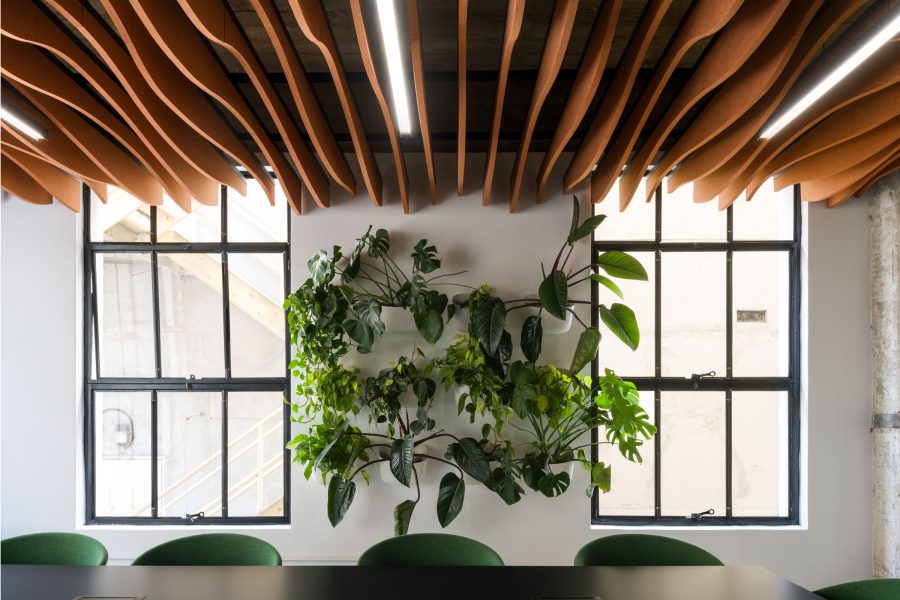
In 2024 interior designer Nicole Villamin was tasked with designing Autex Acoustics North America’s flagship showroom in downtown Los Angeles. Photo by Ed Mumford
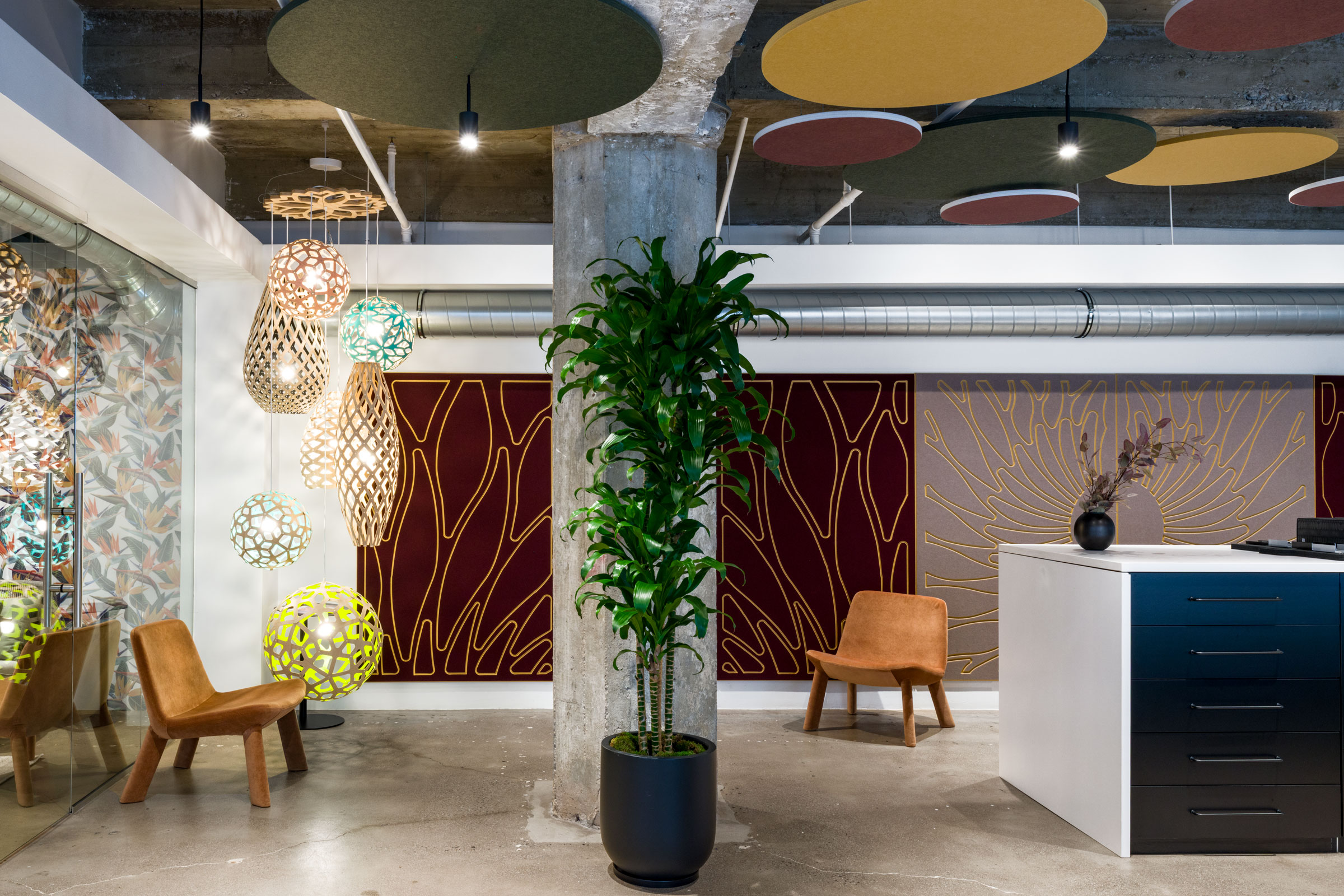
As an interior designer, of course Nicole Villamin thinks about design, but, candidly, is more focused on the “experience” part. In 2024 Villamin was tasked with designing Autex Acoustics North America’s flagship showroom in downtown Los Angeles. The collaborative workspace was intended to showcase the company’s sustainable acoustic products—to show off not just their ability to absorb reverberation and enhance sound clarity, but to look good while doing it. That means it’s covered, floor-to-ceiling in many parts, in acoustic enhancing panels.
While she was on a tight deadline, Villamin was hit with a familiar feeling. Anyone who’s decorated so much as a studio apartment knows it: You’ve thrifted that perfect coffee table, you’ve found the rug that ties the room together, you’ve laid out the gallery wall to a T. You click “purchase” and start hammering when your gut betrays you with a nagging little question: What if there’s something else we’d like to showcase down the line?
Reducing, reusing, and recycling has to begin with design.
“I was only aware at the time of the self-adhesive, where you just pop it off and stick it on the wall,” Villamin says. The showroom needed to be flexible, with the ability to swap displays to accommodate different office, work, and event uses. Phil Goodin, managing director of Autex Acoustics North America, had news that instantly quelled her anxiety: They wouldn’t install the acoustic panels to the wall with adhesive. If she changed her mind she could just pop the panels out and swap in new colors. Villamin has worked as an interior designer for 10 years, and she’d never heard of such a thing. That’s because it’s a new device created by Autex Acoustics. It’s called SpinFix.
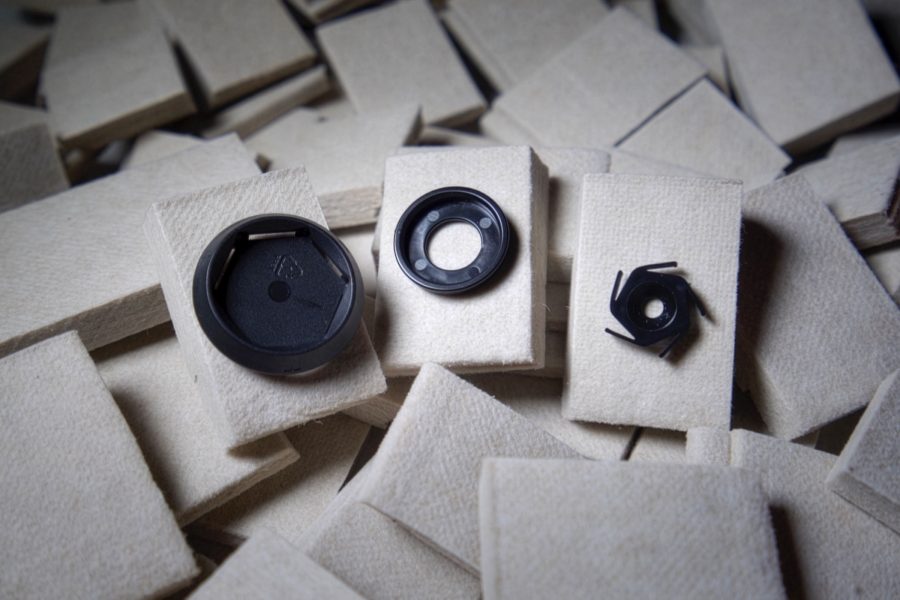
Autex Acoustics introduced SpinFix, made from recycled PET. It’s part of a clip-on, clip-off mounting system that can be used instead of adhesive, so panels can be affixed to walls without getting contaminated. Photo courtesy of Autex Acoustics
SpinFix uses friction welding technology to attach the PET mounting clip to the panel. The wall-side clip is drilled in; the panel-side clip is friction-welded. Friction welding means no adhesive at any stage. This also creates a slight gap between the panel and the wall, which enhances the acoustic performance of the panel by a small percentage.
This clip-on, clip-off method means it’d be no big deal if Villamin did change her mind—and she didn’t, for the record. But it offers a substantial environmental benefit as well. Though Autex panels themselves are recyclable (using Autex’s patented RePet process), applying adhesive makes them significantly harder—and in practice, unlikely to recycle. The glue typically used to affix an acoustic panel to a wall is so strong that, when you eventually remove them, bits of drywall come along with it. This contaminates the panel.
-

- “When we’re designing a product we think about the end of life,” says Phil Goodin, managing director of Autex Acoustics North America. “What do we want to do with it at the end of life? We want it to be fully recyclable. And so from there we work backward to design the product. We’re designing for disassembly.” Photo by Ed Mumford
-
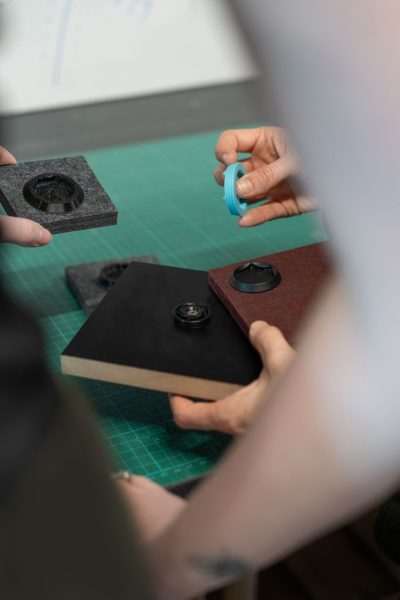
- SpinFix uses friction welding technology to attach the PET mounting clip to the panel. Photo courtesy of Autex Acoustics
“When panels are contaminated you can still figure out a way to recycle it,” Goodin says. “But transparently, it’s a lot harder to recycle, meaning they end up in landfill.” By using SpinFix instead of adhesive, the panel remains recyclable. It’s the next step in Autex Acoustics’ enduring pursuit of a more perfect circular manufacturing model. In other words: reducing, reusing, and recycling has to begin with design.
When we’re designing a product we think about the end of life. What do we want to do with it at the end of life? We want it to be fully recyclable.
Goodin thinks about this in slightly different terms. “When we’re designing a product we think about the end of life,” he says. “What do we want to do with it at the end of life? We want it to be fully recyclable. And so from there we work backward to design the product. We’re designing for disassembly.”
Autex’s commitment to sustainability isn’t a recent pivot; it’s a decades-long pursuit that has only deepened over time. The company was the first in interior acoustics to include embodied carbon on Declare labels in the UK and USA. When the World Green Building Council (GBC) announced a 40% reduction in embodied carbon by 2030 and net-zero by 2050 goal in 2018, Autex aligned its emissions targets and got to work.
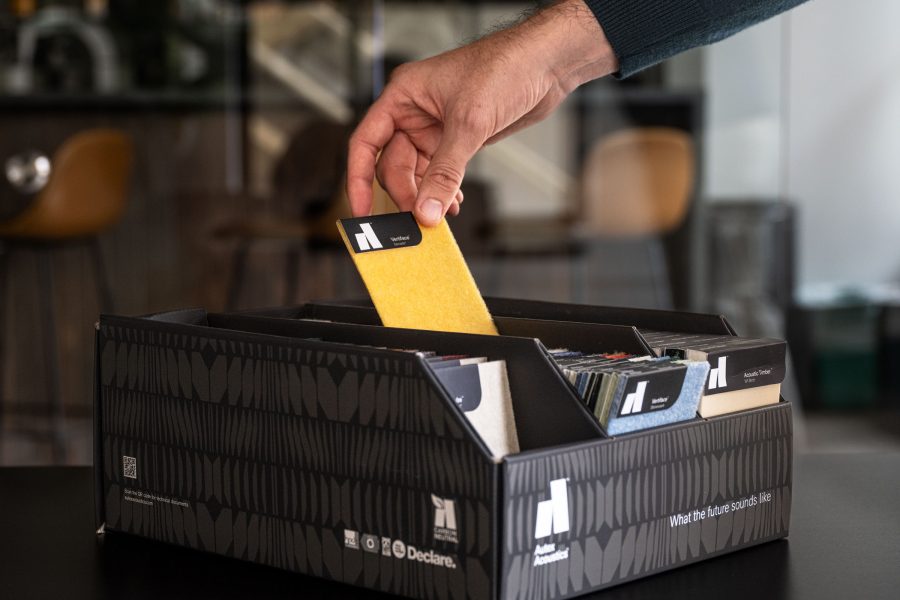
Autex Acoustics was the first in interior acoustics to include embodied carbon on Declare labels in the UK and USA. Photo by Ed Mumford
The company published its first Environmental Product Declarations in 2017 and balanced emissions from their acoustic products to zero in 2021—with its entire global operations now carbon neutral. In New Zealand they’ve even achieved a NaturePositive+ certification for their wool product Luma wool, meaning the process of creating their products has improved the environment. Luma wool is also carbon negative (-8.6 kg CO2e). Now they’re designing backward, beginning at end of life. Goodin has been considering this design mind-shift in such terms for the past two to three years, but one Autex has been building toward since the beginning.
But closing that loop can be a pesky task. One significant milestone on the way was their development of the Pelletizer, a proprietary device essential to reusing their own manufacturing waste.
Here’s how it works: Autex produces its fiber panels, which include recycled fiber already, at its primary manufacturing facility in Auckland, New Zealand. They’re then shipped to various Autex fabrication centers across the globe, including a North American outpost in Riverside, California. It’s a large, brightly lit and airy fabrication facility, lined with stacks of large, long, half-inch thick sheets of fiber paneling waiting to be shaped. On the wall two flags hang vertically side-by-side: that of the US and New Zealand.
Here—specifically, on large, flat beds reminiscent of gigantic CNC-cutters—the panels are precision-sliced for specific design needs. Designers like Villamin work with in-house acoustic design consultants to figure out the specs. That cutting process inevitably produces excess fiber scraps. “You can’t really make a product without having some kind of manufacturing waste, or scrap,” Goodin says. “But we try not to use the word ‘waste’ too much because it sounds like it’s going in the landfill.”
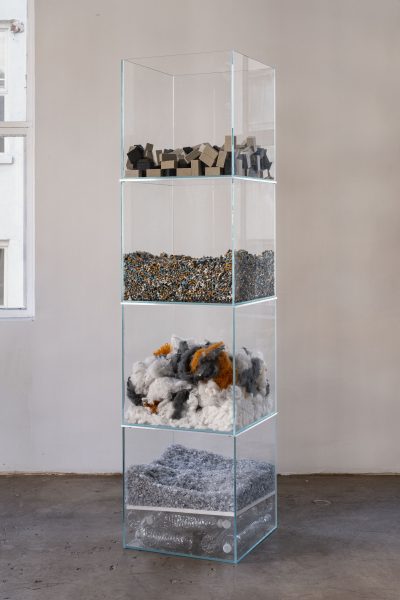
Autex Acoustics’ material life cycle is seen on display here, from raw recycled PET fiber to cube off-cuts, transformed into SpinFix clips. Photo by Ed Mumford
It’s certainly not going into the landfill. The off-cuts are fed to the Pelletizer, the first PET fiber pelletizer designed specifically for acoustic textiles, which, as Goodin puts it, “slices and dices it and turns it back into pellets.” Those pellets are sent to a local outside vendor, who uses molds to create Autex hardware: SpinFix clips, Frontier™ End Caps, and Vicinity™ Workstation Clamps—used to assemble and affix acoustic panels. (Autex also uses some aluminum hardware, which is also recyclable via a separate process.) With the pelletizer all Autex “waste” gets to live another life as a new Autex product. As of October 2025 Autex Acoustics reported it had transformed 250 tons of recycled PET waste into its own accessories and industrial applications.
Among those pieces of hardware made from excess fiber scraps? SpinFix. This practical gadget is Goodin’s ethos of “designing for disassembly” brought to life. And this applies not only to the hardware’s end of life, but that of the elements of the product it interacts with. Mounted using SpinFix instead of adhesive means Autex panels, too, can be recycled. This broadens the closed loop to encompass not just manufacturing waste but the totality of the products themselves, too. “The system can be closed the moment you stop contamination,” Goodin says.
Oh, and when you’re done with the panel and the hardware? You can—in theory—just chuck the whole thing into the Pelletizer and restart the life cycle. The barrier is getting the panels back at end of life. “Now we’re working toward every product moving forward, to be fully aligned with this: Put it up, enjoy it, take it down, recycle it, next.”
This part, though, presents a logistical issue: Once the consumer reaches end-of-life with their Autex products, how do they go about getting them recycled properly? While Autex products are totally recyclable, you can’t just toss them in your blue bin; they require specific machinery for repurposing. The company has launched takeback recycling initiatives in New Zealand and Australia, wherein the company collects and repurposes installation waste—no panels themselves, though. “The dream is to eventually take back panels that reach their end of life in buildings,” according to a 2024 press release. Goodin says Autex plans to launch a pilot takeback program in California soon.
This isn’t an insignificant hurdle. Autex panels tend to live a long life; they have a 20-year warranty. But still, end of life comes for us all. And what if someone wants to switch up their look, as SpinFix allows for? Including used consumer products in the circular economy, for Autex and for many recyclable products across the industry, requires proper collection. What’s the point of creating all these recyclable goods if there’s no easy way to get them to the proper recycling facility? If we’re designing for end of life, one would think that should include a solution for getting the panels to the Pelletizer. But this would require industry-wide change and collaboration to find a solution.
But if their climate-forward action tells us anything, Autex Acoustics doesn’t back out of a challenge. In fact, the company doesn’t position themselves against competitors; they position themselves against the problem. Inherent to that position, Goodin says, is the task of addressing every step in the product life cycle. “If we’re going to align with the GBC and truly try to lead, we have to challenge ourselves to make really cool things that we can use at end of life and make sure it’s recyclable,” he says. “As I like to say: It’s plastic, done better.”