Story at a glance:
- On most large buildings, labor, access, surface preparation, and disruption cost more than the coating material, so how often a facade needs repainting shapes what a coating really costs.
- An AGC life cycle analysis based on Japanese steel bridge specifications found a FEVE fluoropolymer system cost about 10% more to apply than polyurethane—but as little as $1.56 per square meter per year over its service life, compared with $4.76 for polyurethane.
- After roughly 30 years of outdoor exposure in Japan, a FEVE-coated section remained in service with 97.3% gloss retention while a competing coating had already been repainted.
The coating is one of the smallest line items on the cost of a facade. It is also one of the few specification decisions an owner keeps paying for, or keeps saving on, for decades. “While in the grand scheme of things, a coating cost is typically very small in the overall cost of an asset, it can have a huge impact on the long-term life and maintenance of the asset,” says Connie Przeslawski, product development chemist at AGC Chemicals Americas.
That gap between upfront price and long-term maintenance is why Przeslawski wants coatings included in the early discussion. She says the ideal time to decide is during design development, when facade material, appearance, exposure, and performance criteria are still being set. Architects, specifiers, facade consultants, fabricators, and coating manufacturers or applicators all have a role. “As soon as the idea crosses your mind, it should be considered,” she says.
Defining “Lasts”
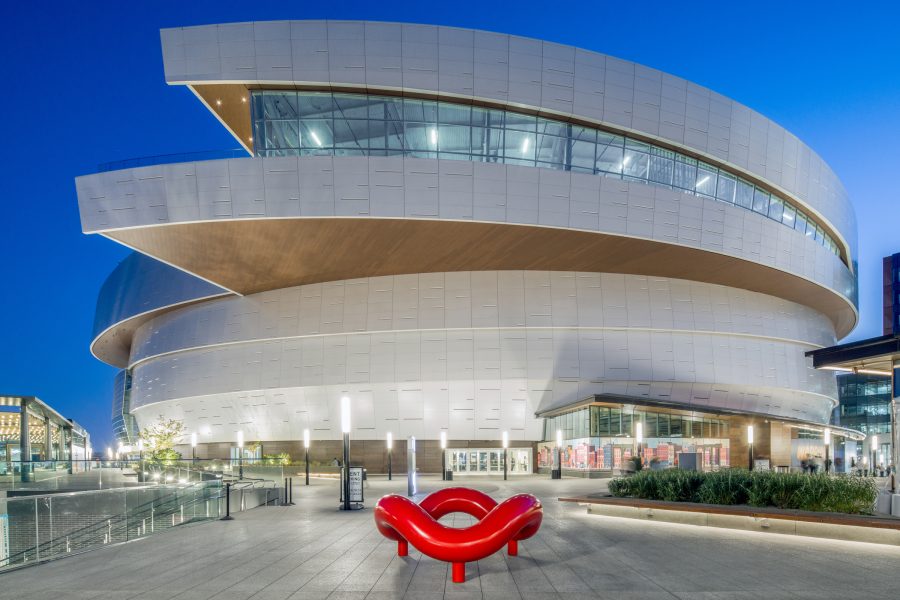
Photo by Jason O’Rear, courtesy of AGC Chemicals Americas
Manufacturers routinely describe coatings that last 50 years. Przeslawski says the key word in that claim is also the least defined. “I think the word ’lasts’ should be a defining factor, because I feel like that varies depending on who you’re talking to,” she says.
An owner may repaint because a facade has lost its color or shine, even while the coating is still protecting the building. The reverse is harder to catch. “The coating may look really good, but it’s losing performance mechanisms, and it could be a result of internal corrosion that may not be visible,” she says.
Where that line is varies by project. “Depending on your priority of whether the aesthetic is the most important thing or the performance is the most important thing, that, I think, is that threshold of what ‘lasts 50 years’ can be,” she says.
AGC publishes a 30- to 60-year performance range for coatings made with its LUMIFLON FEVE (fluoroethylene vinyl ether) resins. Przeslawski says that range traces back to AGC’s parent company in Japan. The company supports those accelerated testing method projections with long-term natural exposure programs and decades of field experience in Japan.
The Real Cost of a Repaint
“A lot of people think you just buy the paint, and you repaint it,” Przeslawski says. “It really is a lot more logistics and costs that go into a repaint cycle.”
Repaint means assessing damage, cleaning, surface preparation, scaffolding and lifts, rerouting traffic, keeping workers safe, labor, and collecting and handling waste—along with the hazards those processes can carry. “The true cost of a coating system is rarely the coating itself,” she says. “On most large buildings, labor, access equipment, surface preparation, containment, staging, waste management, and operational disruption often exceed the cost of the coating material.”
AGC’s technical bulletin on life cycle cost shows how that plays out. Priced by topcoat alone, a LUMIFLON-based fluorourethane runs $12.01 per square meter. That is almost four times a polyurethane at $4.08 and eight times an alkyd at $1.47. Przeslawski says most of that premium lies in the resin. “The main premium or the value added is really in the chemistry of the fluoropolymer topcoat,” she says.
The gap narrows sharply once primer, middle coat, topcoat, labor, surface preparation, and staging are added in. The full fluorourethane system came to $93.87 per square meter, about 10% more than the $85.65 polyurethane system. Both used zinc-rich primers and epoxy middle coats.
The analysis draws on coating specifications from the Japan Road Association’s handbook for steel bridges, along with construction cost data from 2006 and 2007. It then divides applied cost by expected service life: about seven years for alkyd, 18 for polyurethane, and 30 to 60 for FEVE.
Measured that way, the order flips. Alkyd comes in at $9.93 per square meter per year and polyurethane at $4.76. A 30-year FEVE system falls to $3.13, which the bulletin notes is a third the cost of the alkyd and two-thirds that of polyurethane. The 60-year system falls further, to $1.56.
Four Decades in the Field
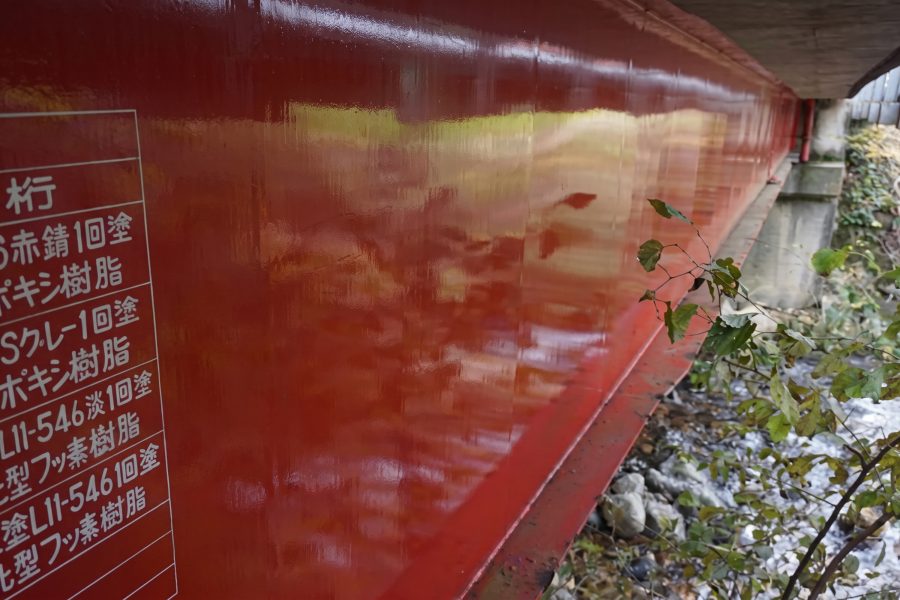
AGC’s oldest documented LUMIFLON project, the Tokiwa Bridge in Hiroshima, has a coating that is now 40 years old. Photo courtesy of AGC Chemicals Americas
Cost models depend on their service life assumptions. To provide real-world data on those assumptions, AGC points to its oldest documented LUMIFLON project, the Tokiwa Bridge in Hiroshima, Japan. In 1986 the bridge’s surface was prepared to SSPC SP2/SP3 and repainted with two coats of epoxy primer and two coats of FEVE fluoropolymer. That coating is now 40 years old.
AGC has tracked it along the way. The topcoat started at a gloss reading of 75.2. By 2008, 22 years in, gloss had dipped to 66.2 before cleaning. After wiping, it measured 77.6, slightly above its original reading, with a ΔE color change of 2.3, compared with 3.5 before wiping. In 2016 at the 30-year mark, the uncleaned surface held 70.1% of its initial gloss. A simple wipe-down brought that back to 97.3%.
For owners that kind of interval is what the life cycle math depends on. “On a high-rise facade every avoided repaint can eliminate significant costs associated with access, labor, traffic control, waste handling, and disruption to building operations,” Przeslawski says.
The Case for the Short-Term Owner
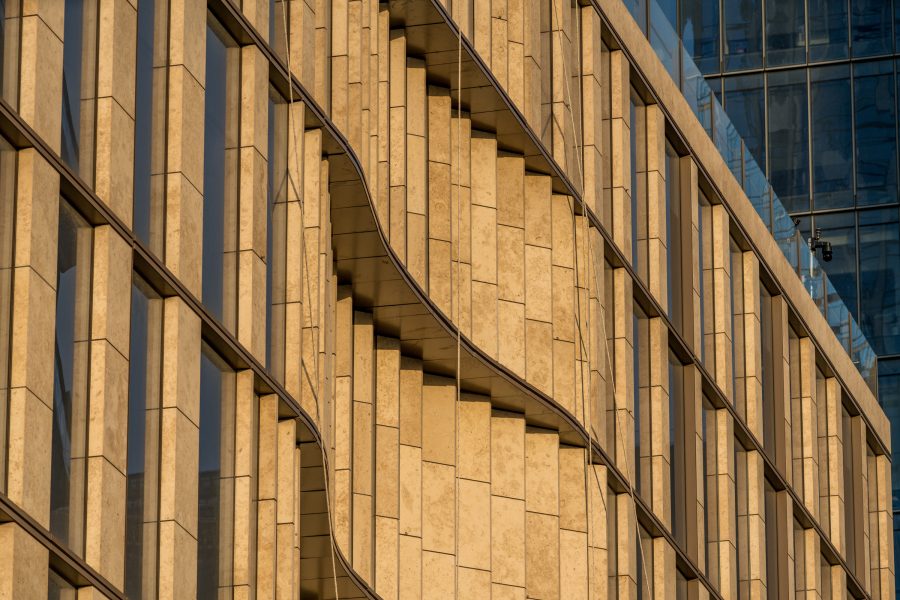
Photo by Max Touhey, courtesy of AGC Chemicals Americas
Not every decisionmaker will hold a building long enough to see that first avoided repaint. A developer who plans to sell within five years has little obvious stake in year 30. Przeslawski says the liability doesn’t disappear with the sale. “While the asset may change hands regularly, it shouldn’t eliminate the future maintenance liabilities,” she says.
Coatings can also shape how a property sells by giving buyers a read on its future financial needs. “Nobody wants to really buy a house if it looks like it’s going to need a full recoat of paint,” she says. “The same goes with structures in the long run.”
Three Questions Before You Specify
One of the most common mistakes, Przeslawski says, is focusing on a single variable—usually the number of years. She encourages teams to look past a warranty’s term to its limits on color change, gloss retention, film integrity, corrosion, and eligible substrates. The exposure the building will actually face matters just as much.
If a design team has only three questions to ask before specifying a coating, she says they should be these. The first is: How long should the building be in operation before major maintenance is required? “Service life should come before coating cost. A coating that lasts decades before major maintenance is needed often delivers a lower total cost of ownership than one with a lower initial price,” Przeslawski says.
Next, what will maintenance require? “Repainting costs far more than paint,” she says. “Access systems, labor, surface preparation, containment, waste management, and operational disruption all contribute to life cycle cost. The best coating specification is often the one that reduces how often those interventions are needed.”
Finally: What sustainability outcomes is the project trying to achieve? “Environmental performance is increasingly tied to durability,” Przeslawski says. “The longest-lasting coating system may also have the lowest life cycle resource consumption because fewer maintenance cycles mean less material, less labor, less waste, and lower embodied carbon over time.”
Przeslawski would like to see specifications do more of that connecting work. She wants them to tie together substrate, pretreatment, primer, topcoat, wet and dry film coverage for liquid applications, and even maintenance strategy. “I would love to see more discussion on how specifications connect all of these moving components,” she says. That means “thinking big picture, here are all the moving parts that come together to make a successful project.”