

Story at a glance:
- The speed and scale of the data center boom pose challenges but also represent an opportunity to implement cutting-edge solutions for both sustainability and security in real time.
- Since data centers are extremely resource-intensive, it’s especially important to mitigate negative effects on the environment and improve these facilities’ overall sustainability.
- High-performance doors with radio frequency shielding are a vital part of both overall security and everyday functioning in data centers.
The global AI race has skyrocketed demand for data centers, which continue to grow rapidly in scale, complexity, and strategic importance. In fact, four of the biggest tech companies (Alphabet, Microsoft, Meta, and Amazon) expect to spend almost $700 billion combined this year to further expand their AI infrastructure, according to CNBC.
“The whole world right now is grappling with this boom,” says Rachel Barr, director of engineering and R&D at AMBICO Limited, a leader in high-performance door and frame solutions. “Both major tech companies and governments around the world need to be able to safely house this huge amount of data as technology is moving at such a rapid pace.”
As of November 2025 the US had more than 4,100 data centers—nearly 10 times more than any other country in the world, followed by the UK (499), Germany (487), and China (381). According to a December 2025 report by the American Edge Project, 2,788 new data centers have been announced or are under construction in the US.
Today’s intensified demand for new data centers is driving the need to build quickly and at great scale. At the same time, it’s more critical than ever to design durably both for physical security and the environment. While the speed and scale required can pose challenges, the data center boom can also represent an opportunity for architects, engineers, and facility planners to innovate, implementing cutting-edge solutions for both sustainability and security in real time.
Specifying Security
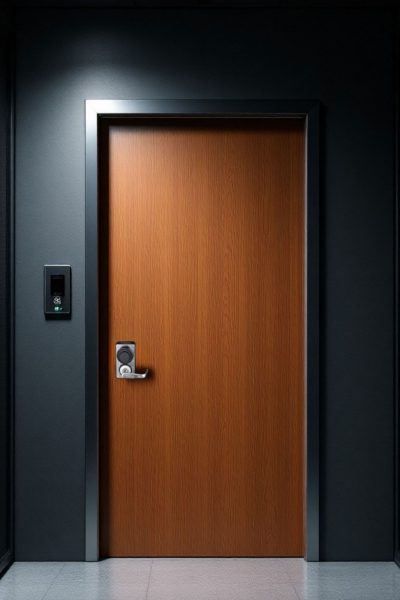
Specifying door assemblies that can achieve both RF shielding and acoustic performance is essential. Photo courtesy of AMBICO Limited
Physical security is inextricable from cybersecurity, particularly in data centers. The physical building, including doors, must be designed to protect the digital information stored inside and prevent data espionage, according to AMBICO Owner Jack Shinder. “The ability to penetrate digital information has become so much simpler,” he says. “Everybody who holds a phone these days has a very powerful computer literally in their hands.”
To make data centers more secure, Barr says architects should consider the role of doors as soon as possible. “Thinking about doors early is the best way to ensure your building meets the requirements you need,” she says. “They are such an important part of the overall security solution.”
As of November 2025 the US had more than 4,100 data centers—nearly 10 times more than any other country in the world.
Unlike wall, floor, or ceiling components, doors need to be able to move. That’s why Barr says doors can represent a huge weak spot in the security of a space. “We are not only working with a movable component, but we also have limited real estate, and we’re always trying to make these high-performance doors look like regular doors,” Barr says. In other words door components in a space of less than two or three inches can be required to perform just as well as a 12-inch fixed element right beside it.
Many architects spend very little time working on doors, with the majority of their time focused on other building systems and elements, Barr says. “Consulting with a manufacturer that has experience in these high-performance solutions is the best way to bridge the gap between design intent and available products, ensuring they work seamlessly together.”
Radio Frequency Shielding Doors
Radio frequency (RF) shielding doors and frames protect against electromagnetic interference in places that store sensitive equipment or confidential information. “If you don’t have protection that is achieved through this RF shielding, you’re putting your data at risk,” Barr says.
AMBICO RF door and frame assemblies have been tested in accordance with IEEE 299 testing procedures to ensure effectiveness. The performance of these doors and frames can be specified as a particular attenuation at a certain frequency (e.g. 40 dB at 1GHz), as a consistent attenuation across a band of frequencies (e.g. 25dB from 400Mhz through 10GHz), or as varying attenuation across a band of frequencies (e.g. 25dB at 200Mhz, 35dB at 800MHz, 40db at 1.2GHz). “We’ve had a longstanding interest in radio frequency door products and increased our footprint in that space dramatically over the last three to five years, largely driven by the requirements of the military for cybersecurity,” Shinder says.
RF shielding doors and frames protect against electromagnetic interference in places that store sensitive equipment or confidential information.
He says that when the data center market opened up in the last three years, it demanded a level of cybersecurity not previously seen in the non-military context. He says AMBICO’s experience working on military projects helped prepare the company for the data center boom because the performance requirements are very similar.
RF shielding is not only crucial for data centers’ security; it also helps these facilities function. For example, many server rooms are situated closely together, generating large amounts of electromagnetic emissions. Controlling electromagnetic interference, including radio frequency interference, supports reliable system performance and data integrity, Barr says. In other words, preventing electromagnetic interference, including radio frequency interference, is vital for everyday operations.
Sound performance for data centers’ doors is also key. Server rooms are notoriously noisy due to high-speed cooling fans and HVAC systems constantly working to prevent servers from overheating. Considering that people often work in office spaces adjacent to server rooms, another concern in data centers is noise pollution, which can lead to negative health effects like hypertension, heart disease, and sleep disturbances. Typical requirements for acoustic attenuation in data centers to create a healthy working environment in adjacent spaces is STC50, but special applications may require even higher ratings. Specifying door assemblies that can achieve both RF shielding and acoustic performance is essential.
Challenges & Opportunities for Sustainability
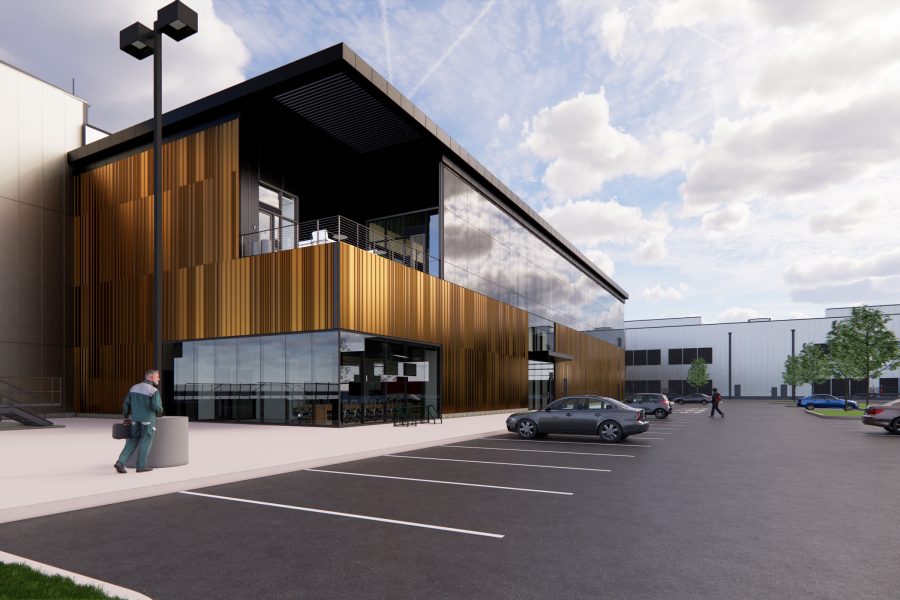
Gensler worked on two hybrid mass timber data centers for Microsoft. Rendering courtesy of Gensler
After a plateau between the mid-2000s and early 2020s, electricity consumption in the US hit a record high in 2024 and again in 2025, according to the US Energy Information Administration. The commercial sector, and data centers in particular, is driving the uptick in electricity demand. Just one AI data center can consume as much electricity as 100,000 households, according to the Pew Research Center.
Besides power, data centers often use extensive amounts of water for the cooling systems needed to keep servers working. Meanwhile, areas that are already water-stressed like southern Arizona, the Colorado River Basin, and Texas house two-thirds of the data centers built or in development since 2022, Bloomberg found. Since data centers are extremely resource-intensive, it’s especially important that architects do all they can to mitigate negative effects on the environment and improve these facilities’ overall sustainability.
While the speed and scale of data center construction create plenty of challenges, it also creates opportunities, according to Rob LoBuono, technical director and global leader of Gensler’s Critical Facilities practice. In other words, speed and scale doesn’t have to be at odds with sustainability goals.
LoBuono says he’s seeing a lot of interest from clients in prefabrication solutions, like a repeatable module for a roof panel that uses sustainable materials like straw and organics. “If we’re looking at a wall, for example, can you consider that wall almost like Lego blocks? If we have, say, a 400-foot wall, can we take 20-foot sections and think about the building from those different perspectives? And in that 20-foot section, can we have a prefabricated module with everything baked into it? Then all they have to do is bring it onsite and just connect those pieces together.”
Reducing construction time cuts emissions, and data centers clients have a vested interest in optimizing the timetable whenever possible. Prefabrication methods have the potential to reduce waste, cut transportation emissions, and improve reuse of materials in the end-of-life stage. In a California-focused case study published in Building and Environment in 2023, researchers found that modular construction specifically could reduce emissions for housing units by 2 to 22%, depending on materials used and the factory location.
LoBuono says Gensler is having “a lot of these opportunistic conversations, more than in any other practice,” since data centers are driving an immense amount of investment and speed in the market. He points out that the “hyperscalers” are the same big companies with already set 2030 and 2040 sustainability goals. For example, Microsoft has promised to become carbon-negative by 2030. “Hyperscalers need to build fast, but they also have commitments,” he says. “So they’re trying to meet those commitments while also doing these large campus projects at a speed that’s been pretty unprecedented.”
LoBuono worked on two hybrid mass timber data centers for Microsoft, incorporating cross-laminated timber (CLT) to reduce the buildings’ embodied carbon by 35% compared to conventional steel and by 65% compared to typical precast concrete. “It’s a pretty compelling argument to the industry that timber and organic materials can meet the metrics of speed, quality, durability, and also be an embodied carbon reduction,” he says.
Another option to help improve data centers’ sustainability is to consider swapping in FSC-certified wood for high-performance doors. Shinder says AMBICO developed RF-shielding and acoustic doors made with wood that’s FSC-compliant, establishing a chain of custody to sustainably managed forests.
Data Centers Demand Product Innovation
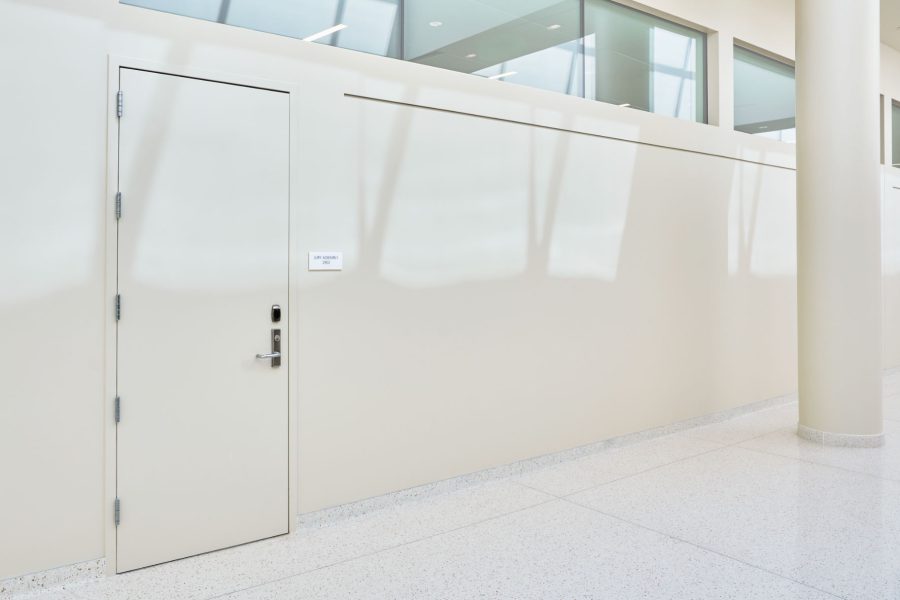
Physical security is inextricable from cybersecurity in data centers. The physical building, including doors, must be designed to protect the digital information stored inside and prevent data espionage. High-performance doors with radio frequency (RF) shielding play a vital role. Photo courtesy of AMBICO Limited
When LoBuono first started working on data centers 12 years ago, he says it was common to build specific to a kind of technology and simply expect that technology to stick around. “In this day and age that’s not the case,” he says, adding that buildings must be designed to be flexible, which also makes them more sustainable. “The more flexible your building is, the longer it’s going to last and be a practical building. Finding opportunities to make that building more flexible has quite a bit to do with doors.”
In order to change out equipment in server rooms, large openings are essential. However, any gap needs to be carefully planned to avoid heightening security risks. “Trying to balance the fact that we need a lot of security barriers [and] these fairly large, open paths becomes a big challenge,” he says, adding that “a lot of what we do in the early design phases” grapples with this balance between security and functionality.
Barr says AMBICO has received a lot of requests from clients over the past few years for a pair of high-performance double doors that would allow large equipment to move in and out. Unlike other applications for RF shielding doors, it became clear that data centers often required wider space.
In response, AMBICO worked with a third-party lab to find a solution that allowed architects to achieve the functionality they needed in data centers without compromising performance. AMBICO’s paired doors, which completed testing just a few months ago, use an astragal instead of a mullion. This means the seal (required on all gaps in an RF shielded opening) is attached to one of the doors. As a result Barr says both doors can be opened easily at the same time to move hefty equipment through.
Previous products available in the market included a center post that could be removed, but that process would take hours and impact the seals, according to AMBICO. While the need for RF shielding doors that provide a larger clear opening width has existed for some time, the new product is an example of how data centers created more demand and helped spark innovation. “That’s the way these products come into the market,” Shinder says.
Over the past 40 years Shinder says he’s seen how performance standards can progress quickly—from bullet and blast resistance to acoustics. “They start at a certain level and then over a period of time, and it might be only two or three years, the industry wants to achieve a higher level of performance,” he says. “We are not standing on what we’ve done in the past; we’re always continuing to innovate.”

