Story at a glance:
- Lighting is increasingly being integrated into the design process from the beginning rather than treated as a finishing touch.
- Advances in LED technology have shifted the industry conversation from energy efficiency toward human health and well-being.
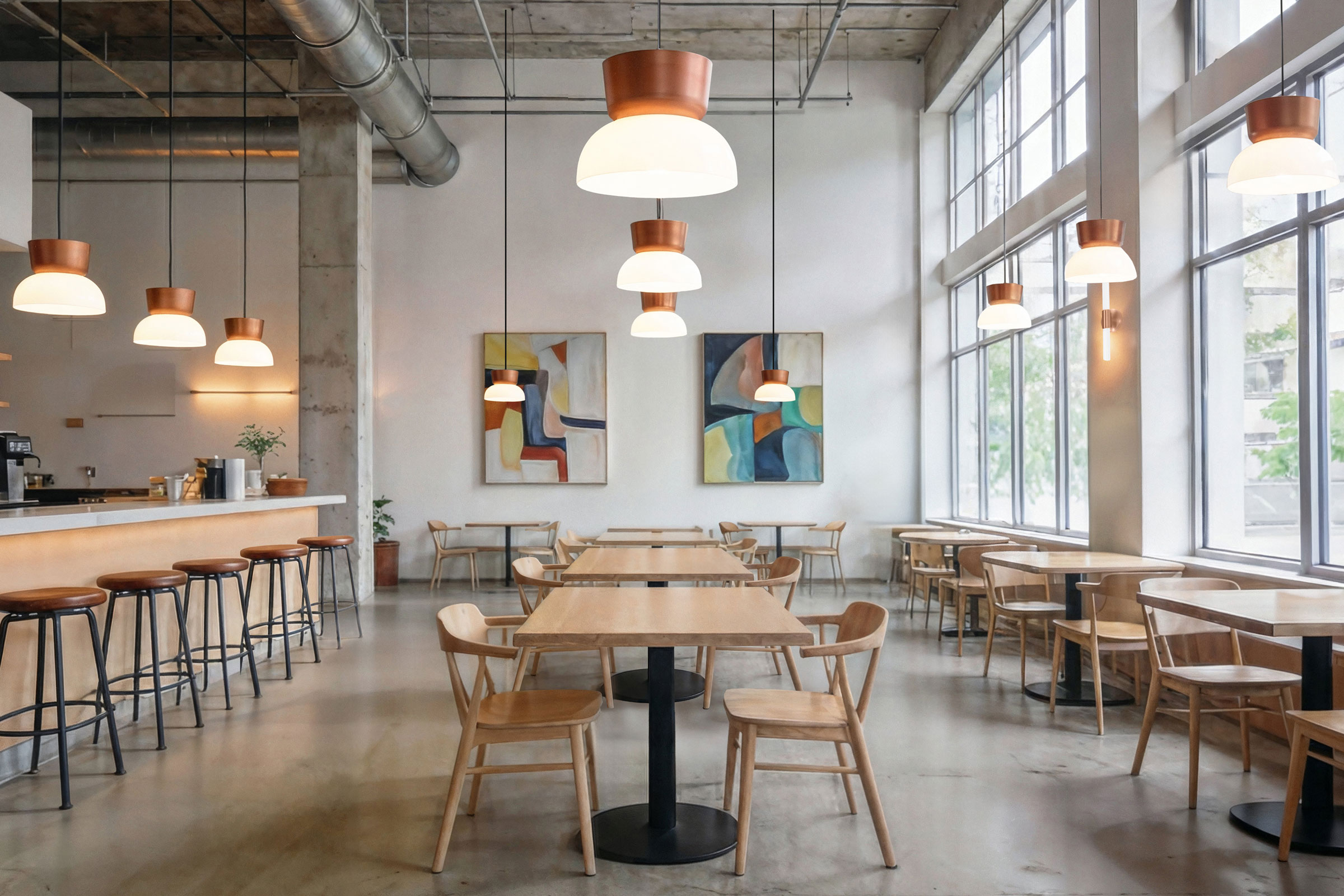
- Milwaukee-based Visa Lighting’s recently launched Anna Collection reflects the broader trend toward softer, more adaptable architectural lighting.
Lighting is often one of the last decisions made in a building project, but experts say that approach is increasingly at odds with what good design requires. When lighting is treated as an afterthought—specified late in the process by a contractor optimizing for cost—the result is frequently a space that fails to match the designer’s original vision.
“If there isn’t a strong spec, contractors can light a space with very inexpensive flat panel fixtures or downlights,” says Hans Nielsen, senior designer and product strategist at Visa Lighting, a Milwaukee-based manufacturer of architectural luminaires. “The result is a space that feels flat and lacks personality.”
Fortunately that dynamic is starting to change. Advances in LED technology, a growing body of research on the relationship between light and human well-being, and shifting aesthetics across commercial and health care design are all pushing lighting further up the priority list for architects and interior designers.
A Shift in the Industry Conversation
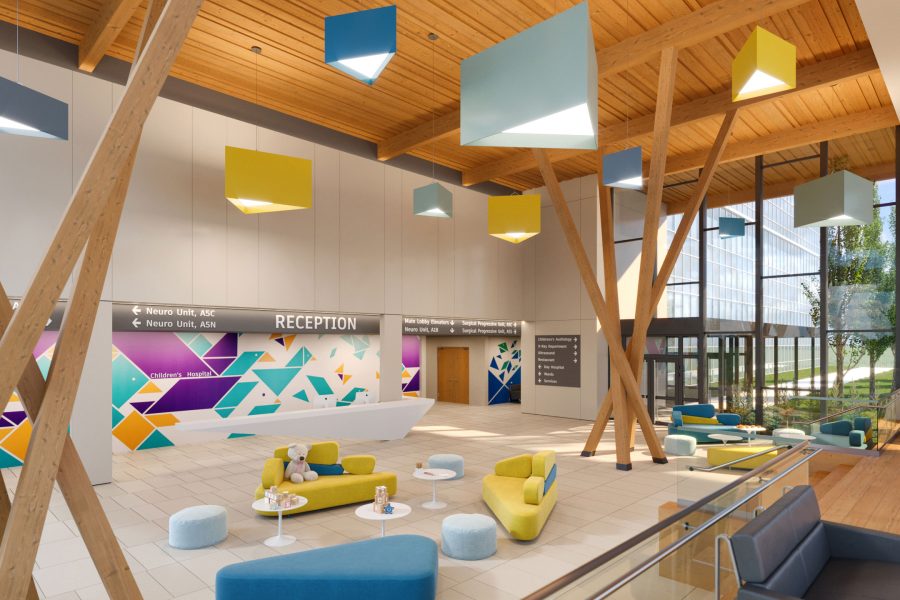
Celest TR lights are seen here in a children’s hospital. The pleasing triangular shape can be used to create a bold geometric statement and add whimsy to large venues or big open spaces. Bright colors and acoustical felts make a special focal point that serves two purposes—ambient light and sound damping. Photo courtesy of Visa Lighting
For much of the past decade the conversation on LED lighting in sustainable design has been primarily about energy efficiency—lumens per watt, compliance with energy codes, and reductions in operating costs. Yet that conversation is maturing.
“The technology has advanced to the point where we’re seeing diminishing returns on efficiency with each new iteration,” Nielsen says. “You can only push physics so far. Thankfully this has made room to shift the conversation toward how lighting impacts our health and well-being.”
Topics like glare control, color rendering index, spectral distribution, and circadian rhythm support are now becoming central to how lighting designers and architects approach a project. For example, a 2019 review by researchers at the University of Basel and University of Oxford, published in Somnologie, found that rhythmic variations in ambient light directly regulate the brain’s circadian pacemaker, and that poorly designed artificial lighting environments can increase the risk of sleep-wake disorders, mood disruption, and related health consequences.
That technical evolution has been accompanied by a broader aesthetic shift. Nielsen points to a move away from the stark, minimalist luminaire—thin, rectilinear, and efficient—toward softer, more organic forms. He traces part of that shift to the pandemic, when people spent far more time in interior spaces and began re-evaluating what those spaces needed to offer. “Things started to shift to a softer, more comfortable look and feel,” he says. “I can’t help but notice that shift spilling out into other industries as well as health care.”
The practical implication is that designers are increasingly moving toward larger luminous surfaces and layered indirect lighting. “Designers are embracing this to reduce visual harshness and evoke a sense of calm,” Nielsen says. He also points to a growing interest in biophilic lighting—an approach informed by the natural variability of outdoor light. “Lighting conditions outdoors are constantly changing hour by hour, day by day. We evolved to thrive in this variability and our bodies expect it.”
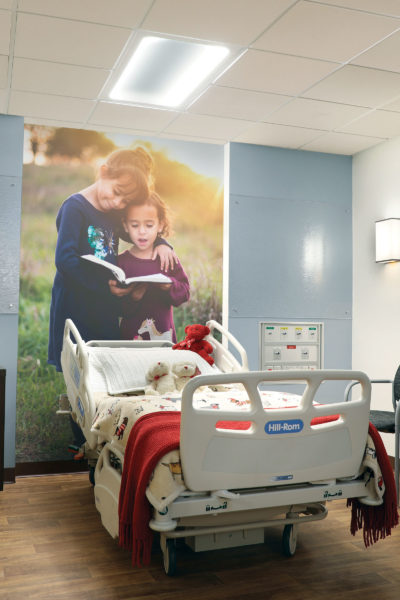
The Harmony 2×4 overbed light features a unique cove-like curved lens design. The fixture is one example of how modern LED technology can balance clinical performance with a softer, more restorative aesthetic. Photo courtesy of Visa Lighting
Health care spaces offer a useful lens for understanding the tension between function and human-centered design. For decades clinical environments have been defined by harsh fluorescent lighting optimized purely for visibility, and the consequences for patients and staff have been real. “There are so many health care facilities that haven’t been renovated in many years,” Nielsen says. “You have patients and caregivers still going through their day-to-day with dated lighting that’s honestly not very high-quality light.”
The challenge for designers working in those environments is balancing clinical performance with a softer, more restorative aesthetic—a problem Nielsen says is more solvable than it may appear. He points to Visa’s Harmony patient room overbed fixture as an example of how LED technology has made that balance achievable: The fixture packages ambient, reading, exam, and night light modes into a single unassuming form factor while delivering the cove-like indirect light quality designers have long wanted in patient rooms but couldn’t achieve within the constraints of a health care environment.
The Anna Collection
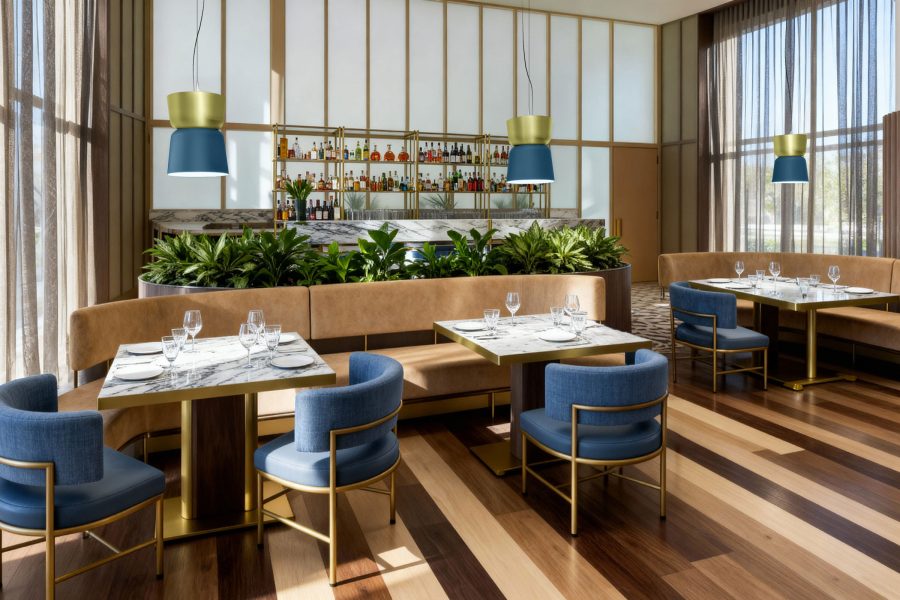
Advances in LED technology have shifted the industry conversation from energy efficiency toward human health and well-being. The Anna Collection is seen here. Photo courtesy of Visa Lighting
Visa Lighting’s recently launched Anna Collection is a direct response to the market trends Nielsen describes. “The concept for Anna kept rising to the top,” Nielsen says. “We finally started showing the idea to lighting designers, architects, and interior designers and received overwhelmingly positive feedback.”
The mission, as it took shape, was to combine a soft, organic aesthetic with the technical performance and configurability that would make the collection genuinely useful across a wide range of environments. Anna is available in four standard silhouette configurations, with both the upper and lower shade independently specifiable as either spun aluminum or luminous acrylic. The translucent, matte white acrylic option produces a soft, diffused glow; the aluminum shades, spun in-house by Visa’s own craftspeople in Milwaukee, come in 20 standard powder coat colors and eight alternative metal finishes designed to evoke brass, bronze, copper, and other premium metals.
Those alternative metal finishes are a point of particular emphasis for Nielsen. Standard metal plating—a common alternative—relies on toxic chemicals that pose environmental and human health risks. “We’re able to emulate that look and feel in a much more sustainable way,” he says, through a specialized coating applied to recyclable brushed aluminum.
Each pendant also incorporates dual LED modules, one upward and one downward, delivering both task illumination and the softer indirect light that counteracts the cave-like effect of purely downward-facing pendants. The collection delivers 90+ CRI for strong color accuracy across retail, hospitality, workplace, and public space applications.
What Architects & Designers Should Consider
The timing of lighting decisions within the design process matters. Nielsen advocates for incorporating lighting into the earliest stages of a project, not as an add-on at the end. “The final execution of a design can look totally off compared to the initial vision if the lighting isn’t right,” he says. “Some of the best designs integrate the lighting from the beginning.”
That means asking early questions about how a space is intended to feel and how it will be used—questions that directly shape the lighting strategy. Will the space need to serve multiple functions? Does it need to accommodate different moods at different times of day? “By using layers of light with separate controls, a room can transform from a bright, productive space to a comfortable gathering place,” Nielsen says. “The designer and client can have fun exploring different personalities a space can have through different lighting scenes.”
Lighting also plays a structural role in the visual organization of a space that is often underappreciated. “It can be used to create or reinforce visual hierarchy,” Nielsen says. “Knowing where you’re going to place fixtures and how that light is going to fall across surfaces in a space can help achieve the design intent much better than waiting until everything else is designed before dropping in the lighting.”
Design-Driven Solutions in Practice
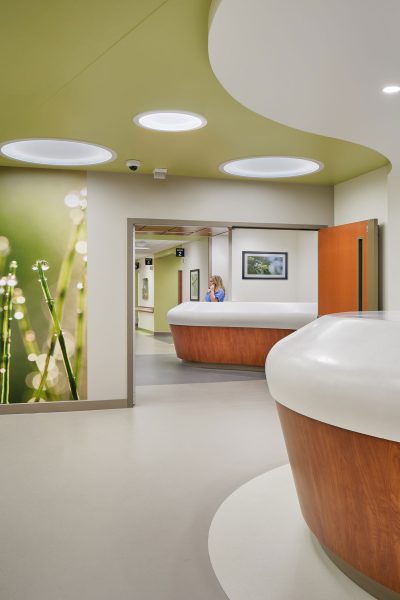
CannonDesign created calming, supportive environments using Visa Lighting at Froedtert and the Medical College of Wisconsin’s campus. photo by Patsy McEnroe Photography, courtesy of Cisa Lighting
Two recent projects illustrate what it looks like when lighting is integrated into the design vision from the start—one in behavioral health and another in the performing arts.
At Froedtert and the Medical College of Wisconsin’s campus transformation in Milwaukee—a project encompassing more than 1.3 million square feet of specialized care facilities designed by CannonDesign—the design team worked to create environments that felt calming and supportive without sacrificing clinical performance.
In the behavioral health wing that intention extended to the lighting specification. The team’s decision to soften the environment architecturally—including a rounded intake desk designed to reduce the clinical tension of an admissions space—required fixtures that matched the same sensibility. Visa Lighting’s Symmetry fixtures were selected to complement those organic details. “To fit that aesthetic you’d have to have a round, soft-looking light fixture in the space,” Nielsen says. “I can’t imagine that space being executed as well as it was without the Symmetry product.”
At the Fireside Dinner Theatre in Fort Atkinson, Wisconsin—a regional institution that has been entertaining audiences since 1964—the design vision called for large globe pendants that would evoke celestial bodies suspended from the center of the dining and performance space.
Visa Lighting fabricated the globes through its Zume In globe pendant line, then worked with a local hand-painting artist who has partnered with the company for more than a decade to execute the imagery on each fixture. “Being able to achieve the designer’s vision of that space through our capability and localized manufacturing and localized partnerships, I think that was a real success story,” Nielsen says.
Sustainability Through Durability
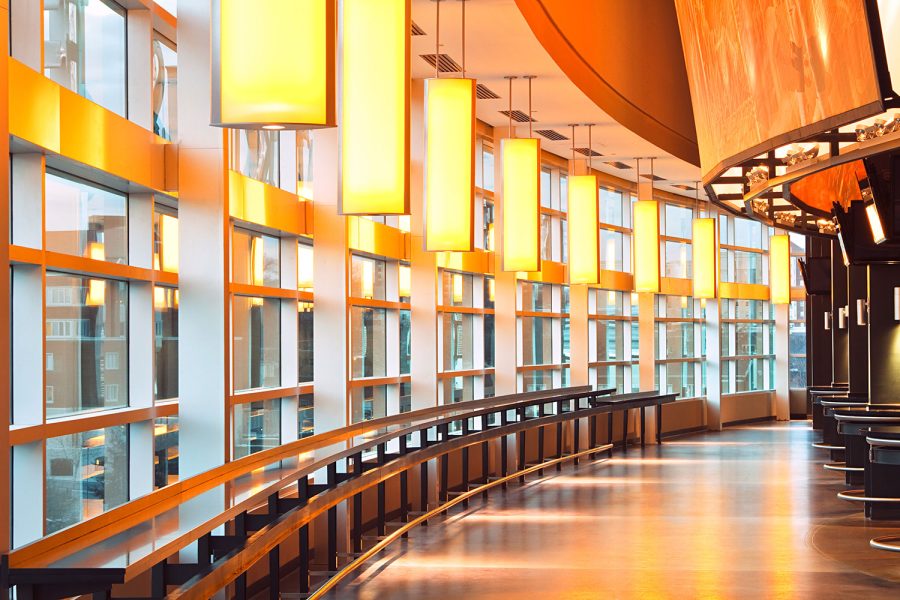
Visa Lighting’s Air Foil pendants’ elliptical shape creates a luminous plane of light that enhances exterior elevations, stairwells, lobbies, and entryways. Photo courtesy of Visa Lighting
Visa Lighting’s approach to sustainability is rooted as much in supply chain and product longevity as it is in materials. The company manufactures the majority of its products in-house at its Milwaukee facility, sourcing what it cannot produce internally from within approximately a one-state radius whenever possible. “I could see how a manufacturer might save a few bucks shipping something from overseas,” Nielsen says. “But in the process there’s all of this unmeasured carbon that’s produced, and that doesn’t come through in the cost of the fixture.” All Visa lighting luminaires meet Buy American Act and Build America, Buy America compliance standards.
The more central sustainability argument for Nielsen, though, is durability. “The thing we’re most proud of is our ethos of sustainability through durability,” he says. “We engineer our products to outlive the building in a lot of cases. Our goal is to keep light fixtures out of the waste stream by making them last as long as possible.”
The predominantly aluminum construction of the Anna Collection supports recyclability at end of life, and its classically proportioned design is intended to remain relevant across design cycles.
Looking Ahead
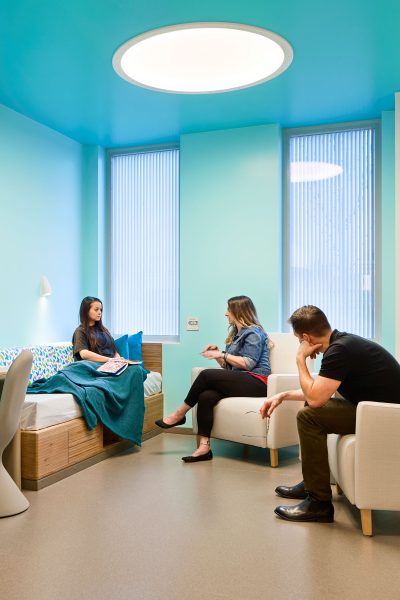
The Symmetry family offers 4″, 23” and 45” diameter models designed specifically for patient overbed, general use, tunability, and behavioral health/high abuse. Photo courtesy of Visa Lighting
The industry conversation around lighting is broadening, and Nielsen sees significant opportunity ahead—particularly around health and well-being applications. “Whether it’s focusing on circadian rhythm or just trying to make the lighting more biophilic in both its aesthetic appearance as well as how our bodies react to it, that’s the new frontier,” he says.
The challenges are real. Many health care facilities are overdue for renovation and still rely on outdated fluorescent systems, smart controls adoption remains inconsistent, and lighting budgets continue to get compressed when project teams face cost pressure. But the design tools and product options available today are considerably more capable than they were even a few years ago, and the conversation among architects, lighting designers, and product manufacturers is increasingly sophisticated. “Any design-driven lighting solution should not be a compromise, but a piece of the puzzle where all of these details have been considered,” Nielsen says.