Story at a glance:
- As patient-centered care continues to shape the future of health care environments, a greater emphasis is being placed on spaces that promote wellness for both patients and caregivers.
- Pallas Textiles collections reflect this shift—designed to give architects and designers the flexibility to create calm, restorative spaces that respond to the evolving demands of modern care settings.
When Shay Nothstine read In Between Two Kingdoms: A Memoir of a Life Interrupted, she was struck by writer Suleika Jaouad’s description of the white, sterile walls. “You may have a great team who’s taking good care of you, you may be getting the clinical treatments you need, but what if you’re stuck in a room like that for six weeks straight?” says Nothstine, a longtime designer and now director of sales and distribution for Pallas Textiles. “That really stood out to me as someone speaking firsthand about how the environment around them impacts them because she talked about her mental struggles.”
Nothstine is happy to report that the industry has changed a lot in the last decade, and spaces today are designed to be more welcoming and hopeful than in years past. More designers are using color, texture, and even nature to design inspiring spaces. She’s optimistic about the understanding of how a space makes people feel versus simply how it looks or performs. “There’s science backing that up,” she says. “Some practices are trendy, but I don’t think biophilic design is a trend. I think we’re just scratching the surface.”
Looking back over the history of health care, she says it was institutional and sterile. “Sterile meant clean, sterile meant safe, but it didn’t necessarily make you feel good in the space.”
Recent studies show how much the look of a space can impact the healing process, including a call to create calming public and private spaces. People are realizing, Nothstine says, that these spaces actually affect their moods, their well-being, and how their bodies and minds heal.
The best healing spaces have layers, says Lauren Andrysiak, principal and senior design leader at CannonDesign. She’s been doing this work for more than 20 years. “This is something a hospitality designer taught me; when you layer things, something in the environment speaks to someone,” she says. “It’s not about taking everything out because you’re worried about offending someone. It’s more about presenting sensory-rich environments that support everyone on a human level.”
In recent years she’s seen a lot more attention paid to health care design, and that’s exciting, Andrysiak says. “Manufacturer reps and teams are pouring research and evidence-based opportunities into the work we’re doing to not only substantiate our claims that something we’re doing is helping to calm someone or support them, but also to support us in presenting products that are appropriate for the work we’re doing. Now we can actually create the environments we’ve always been envisioning.”
Nothstine says Pallas is always listening to the demands of health care and what designers are looking for, and that goes beyond color trends. “Designers are taking a little bit more of a risk today, thinking about how to layer colors that complement each other. Maybe you start with the foundations of nature, but then you add an element that’s a bit unexpected.”
Andrysiak says layering color and texture makes a space feel more human, reducing that clinical feeling people have come to expect over the years. “I also think we shouldn’t have one rule for all of health care that we follow forever. There are guidelines to keep people safe, but you should look for ways to do that while also creating an environment that is remarkable and memorable and special and intriguing; that shouldn’t be left out of health care.”
What Makes a Space Calming?
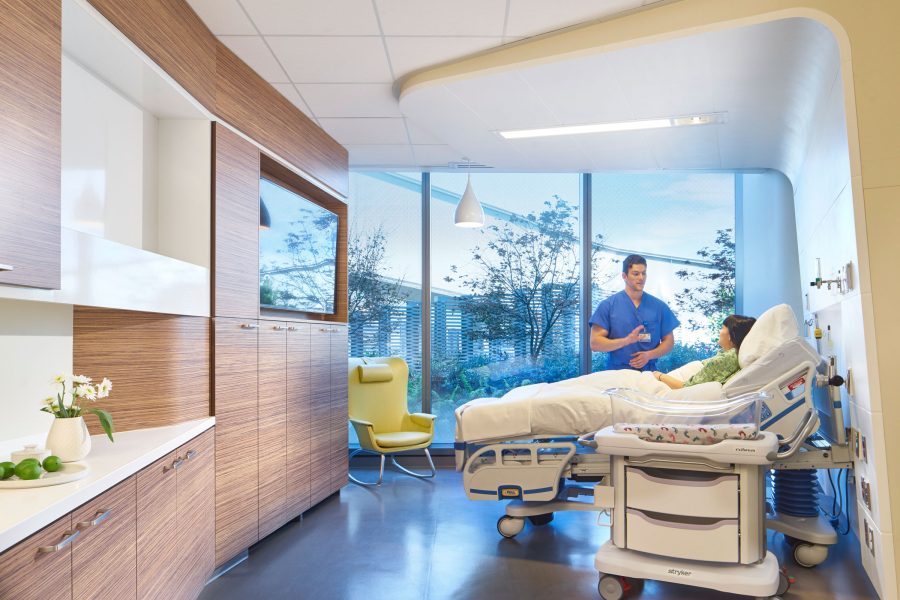
Photo by Christopher Barrett Photography, courtesy of CannonDesign
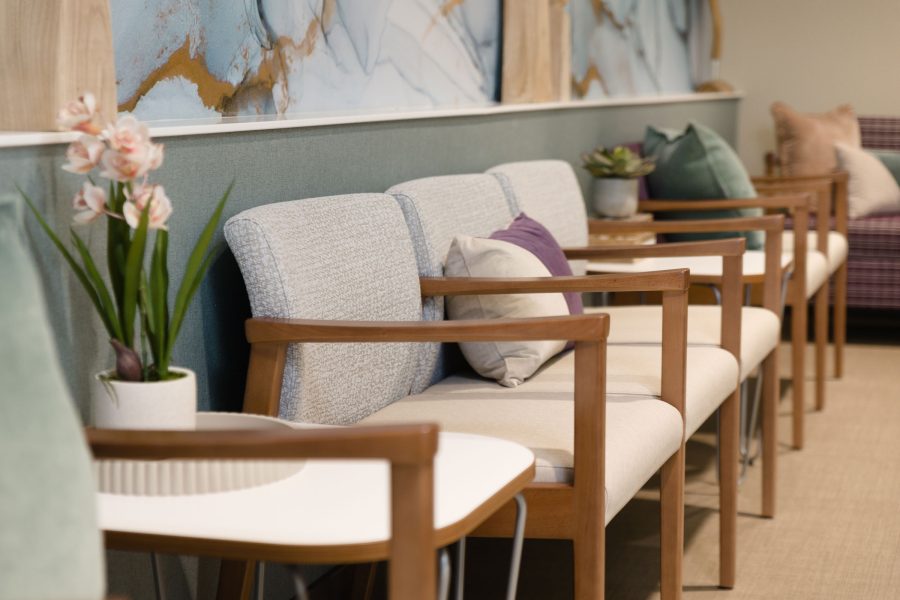
Affina Multiple Seating is designed for ease of ingress and egress and available with open, wood arms or closed, upholstered arms. Photo courtesy of Pallas Textiles
It’s no longer about designing neutral spaces with low lighting, Nothstine says. Providers of design-rich performance solutions like Pallas are thinking about health care design more holistically, considering the spectrum of needs of anyone who might be there. “We’re really thinking about things in a much deeper way, being more sensitive to people and having a more deepened awareness for the complexity of our audiences.” To some, low lighting is calming, for example, but that might feel scary to others, she says, hence the shift toward more layered designs that offer autonomy.
Nothstine says a calm, modern space uses the principles of biophilic design without being too literal. Successful designers lean on natural patterns and materials, she says, like using a natural wood versus a metal, introducing colors that evoke nature, and providing access to natural light. “It should not be a flat approach, like, ‘Oh, let’s find a pattern that has leaves on it.’ Yes, you could do that, but you don’t necessarily have to have a tree in the space, right? It’s more so taking from those elements of nature.”
Innovation at Pallas comes in part from listening to their reps all over the country, Nothstine says, as they talk to designers about what they need. The Giverny Collection is one example of how those needs show up in new textiles. “It’s very relevant for health care,” she says of Giverny. “We’ve heard designers say the colors are right on. That reinforces that we’re on the right path.”
Nothstine says Pallas continues to listen to what they’re doing right while paying attention to gaps or needs in the market. “Then we can forecast and develop patterns and construction that are relevant to the needs of health care.”
The Giverny collection was inspired by the gardens at Giverny, which Claude Monet used for inspiration in his paintings. The individual designs in the collection each pay homage to and reinterpret the impressionistic color, style, and brush stroke techniques that were heavily influenced by nature. These elements all come together in a single style within the collection named Monet. Another design, Toile, combines woven and nonwoven, inspired by canvas. “Because it’s inspired by Claude Monet there’s a beauty to it,” Nothstine says, pointing to how different looks recall a lily pond or the sky, in keeping with the known benefits of biophilic design. “It leans more toward organic elements; it’s not geometric.”
The colors, too, are more calming and quieter, rather than bright and bold, she says.
Performance
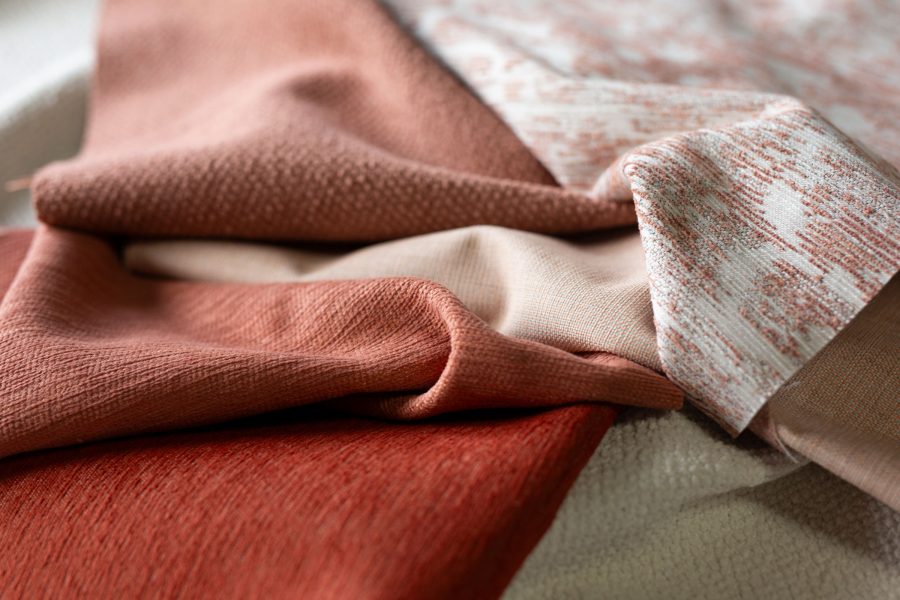
Pallas Textiles’ In Good Company collection features six styles woven with SEAQUAL YARN containing upcycled marine plastic. Photo courtesy of Pallas Textiles
Nothstine says conversations around performance are changing, too, and that also shows up in Giverny, as the collection incorporates sustainable innovations like HYPHYN biodegradable vinyl, SEAQUAL YARN, and USDA-approved bio-attributed materials, supporting designers’ growing demand for products that combine artistry, performance, and environmental responsibility. SEAQUAL yarn is made from ocean plastic waste that is reclaimed and repurposed.
“Vinyls are still sought after because vinyl is a high-performance material, and it’s more budget-friendly, but we’re more mindful now of the impact of vinyl on our environment and what’s happening to it at the end of its life,” Nothstine says, pointing to Pallas’ recent introduction of HYPHYN—a biodegradable performance vinyl that breaks down by more than 90% within 24 months in landfill conditions—in its collections. “I’m excited about technology that’s been introduced in just the past year or two, where a biodegradable vinyl is now available with the HYPHYN technology. We’re excited that we were one of the first to bring both to market,” Nothstine says.
Nothstine says non-wovens will continue to be a foundation in health care design because they’re easy to clean, but introducing more high-performance wovens is a win. “Especially when I’m going to sit in a chair for six hours to get some type of therapy. But I also know it needs to last, right?”
Andrysiak says designers are trying to find more enduring materials, and CannonDesign looks for partners who are also working to reduce and remove chemicals of concern wherever possible. “We’re at this great point in time where our manufacturer partners are doing research and really developing some great opportunities. Our clients are great partners because they will test things,” she says. “It’s a great community of people who are trying to solve things together.”
A Textile Revolution
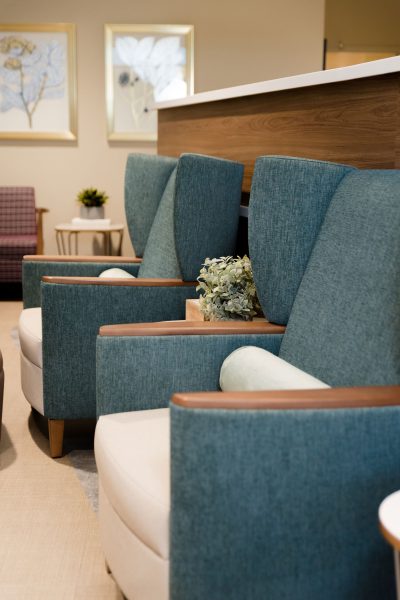
The Affina Lounge Chair has a contemporary design, available in low-back, high-back, and wingback using materials from Pallas Textiles, KI ingrade, or COM upholstery options. It can be specified to have matching or contrasting fabric. Photo courtesy of Pallas Textiles
Nothstine recalls the feeling of the cryptons of that past. “If you’ve been around long enough, they weren’t comfortable, but they were necessary. Now the days of uncomfortable cryptons are behind us. You can have a fabric that’s woven, has a great hand, and a beautiful aesthetic. Designers are shocked because it’s a nubby bouclé, and that was unheard of 20 to 30 years ago. That’s a really positive aspect—that a fabric can perform well and still have a good hand and feel good to sit on. We want to create an emotional response with fabric.”
Andrysiak also remembers the lesser options. Ten to 15 years ago there weren’t many choices for interiors in health care, at least not compared to when she worked in commercial hospitality, where she had many beautiful textiles with a soft hand to choose from, she says. Easy-to-clean vinyl was convenient because it could withstand harsh chemicals “but you slid right off the chair.”
Over the years the industry stepped up to fill a need, Andrysiak says. She says today’s options are a lot more fun, with new, high-performing knitted and woven materials that can also stand up to the cleaning required in a health care environment. “It allows us to be much more playful in the environment.”
That feeling against your skin matters so much more when you’re in a health care environment, too, she says, considering sensitivity during and after something like cancer treatment. “You’re sitting in a chair all day, and you’re in an environment you have very little control over. Understanding that level of detail becomes really important,” Andrysiak says.
She says the industry has stepped up to deliver tough materials that are lovely to touch, with patterns and textures people feel comforted by. “The construction of the materials has been very fascinating,” she says. “I love learning about it.”
That attentiveness—the research, the reclaimed ocean yarn, the fabric that finally feels good against skin—still traces back to something simple: the person sitting in the chair. For Nothstine it’s the image from that memoir that stays with her, the six weeks spent facing sterile white walls. She and Andrysiak agree the industry is only beginning to understand what a space can do for someone’s healing. As more designers embrace that layered, human-centered approach, health care environments may start to feel less like something to endure—and more like something that helps carry people through.