Story at a glance:
- Patient-centered design can give patients back a sense of control by reducing stress points throughout the care journey and within the room itself.
- Furniture plays a critical role in recovery by supporting mobility, independence, family presence, staff safety, cleanability, and long-term flexibility.
- La-Z-Boy Healthcare | Knú Comfort designs recliners, sleep products, and multipurpose patient room furniture to help health care spaces feel less clinical and more human.
Imagine your worst hospital experience. The lights are too bright. The room is too cold. And the only view is a beige wall, a strangely translucent curtain, and the hard gleam of equipment. Family members hover awkwardly over plastic chairs and burnt coffee. You fear moving from bed to chair, fear the humiliation and pain because the furniture feels intimidating, too much like another machine.
Here, the room is not just a setting. It is part of a potentially powerful bodily experience. Diana C. Anderson, a Boston University geriatrician and architect, has argued that the built environment should be considered a medical intervention, noting that design can alter behavior, shape patient-clinician interactions, and influence treatment outcomes.
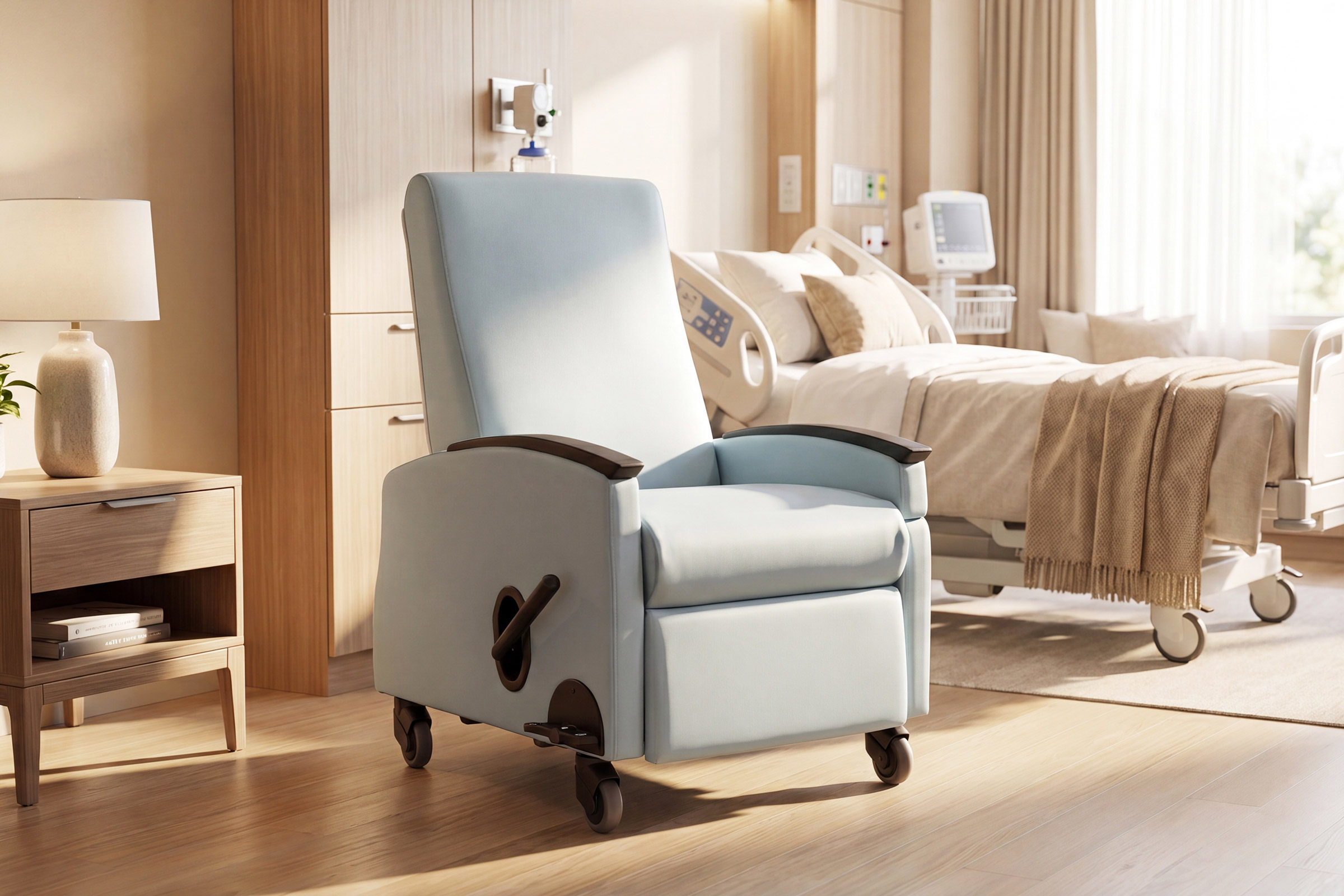
The best patient rooms today feel different. Imagine a room for healing awash in gentle daylight, a view of sky, room for family to gather and support. A space that can shift from rest to treatment in seconds, with intuitive controls and furniture built for safety and dignity. The space is still highly functional and clinical, but it also supports the breathing, breakable humans inside it.
Design for the Journey
For Neil Abrams, medical planner with SmithGroup, patient-centered design starts before the patient ever reaches the room. “What we really want to be doing is identifying the points along the journey where there might be stress or challenges,” he says. “What we want to do from a planning perspective and even a design perspective is create physical environment interventions where we can help mitigate stress, smooth out operational efficiency, wayfinding, and so on.”
Inside the patient room that often means agency. “A more recent trend is that patients want to have control over their environment,” Abrams says. “Because it allows them to feel like the room is more personalized and customized to them.”
Caterina Hutchinson, interior design principal with SmithGroup, says furniture has a direct role in patient comfort and recovery. “If we give patients a sense of control, even with little things, it can really lower their anxiety.”
Furniture as a Recovery Tool
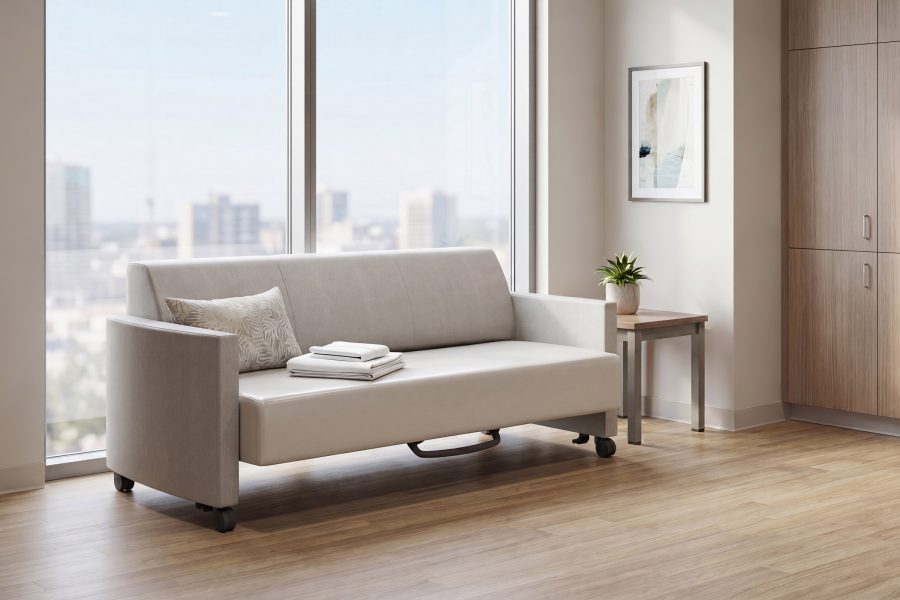
Photo courtesy of La-Z-Boy Healthcare | Knú Comfort
For La-Z-Boy Healthcare | Knú Comfort, comfort is the foundation of the company’s work, according to President Adam Stemle. But in health care, comfort is not just softness. “Comfort is everything. Comfort is our ethos,” Stemle says. “We wanted to make sure that comfort is woven into every product we design. And not just the physical comfort for the patient, but comfort for staff and the organization in knowing that the investment in the product is going to last, comfort in knowing that the product is going to perform as it should.”
Furniture in a patient room has to do more than look welcoming. It has to support recovery, cleanability, maintenance, mobility, infection control, patient transfers, caregiver operations, and long-term use. It has to be—almost—a piece of medical equipment itself. But it cannot feel like it.
La-Z-Boy Healthcare | Knú Comfort recliners, in particular, are designed to support a range of patients and uses. Stemle says product development begins with the physical experience of recovery. The end goal is not only to support the body but also to make that support feel less mechanical. “There are a lot of products in the marketplace that look like a piece of equipment and, frankly, I think that’s where you get a little bit of the anxiety,” Stemle says.
Recovery is not passive. Healing does not happen only while prone and immobile. Getting patients out of bed and into a chair can support mental and physical health, reduce the risks associated with long stretches of immobility, and help patients regain a sense of control. “Furniture can support mobility, safety, and independence,” Hutchinson says. “It’s important to provide patients with more than just the bed. That’s why you see a move toward providing a recliner.”
A recliner gives a patient somewhere else to be—a familiar place. It creates an option between lying down and walking the hall. It can support eating, reading, resting, conversation, and a return to movement. For staff, features like casters, adjustable seat heights, patient lift access, and drop-down or removable arms can help make transfers safer and reduce daily strain.
La-Z-Boy Healthcare | Knú Comfort also offers furniture designed to serve multiple needs in the same footprint, including Elevate (vertical lift) recliners that can function as recliners, clinical surfaces, and sleep spaces.
Control can also be built into the furniture itself. “If it’s a really palliative situation, somebody’s very ill, the hand wand gives them all the control and all the power to adjust the foot rest up, or adjust the seat angle, and tip it back to take pressure off of the low spine,” Stemle says. “There are little nuggets that are built into all of these different products that try to offer the flexibility and the control to allow the patient to heal with dignity.”
Room for Connection
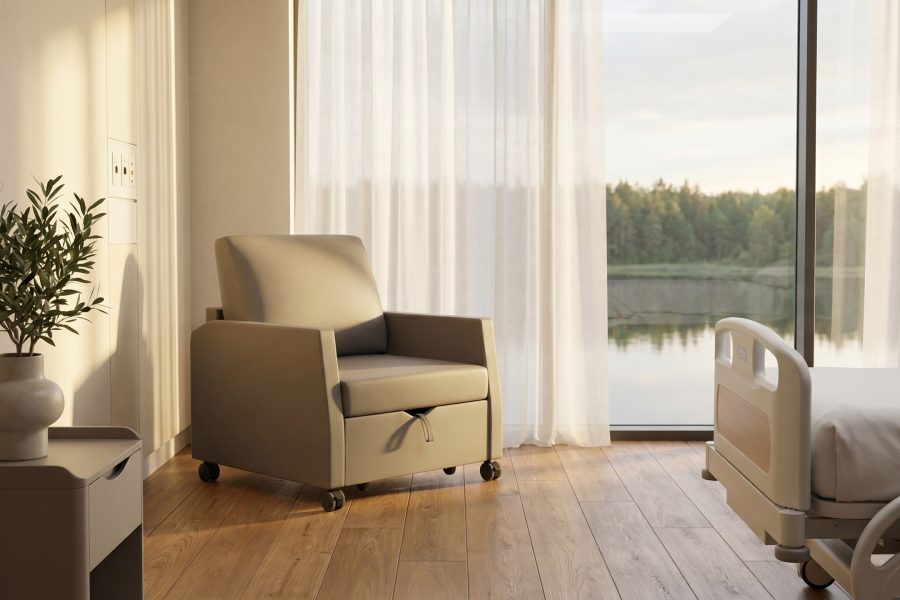
Photo courtesy of La-Z-Boy Healthcare | Knú Comfort
Abrams says families are integral to healing, which means patient rooms need family zones that are appropriately sized, comfortable, and equipped for longer stays.
That is where sleep products and multipurpose furniture become part of the recovery environment. La-Z-Boy Healthcare | Knú Comfort’s sleep sofas, sleep chairs, and sleep benches are designed to work as seating or sleepers, helping family members rest overnight, sit, work, share a meal, chat, or simply remain present.
The best patient rooms also help health care teams move comfortably through the space. Hutchinson says layout affects acoustics, views, light, visual clutter, and the overall sensory experience. A clear patient zone, provider zone, and family zone can reduce disruption and allow staff to work efficiently while preserving a patient’s sense of calm. “When the space works well like that, a patient feels supported rather than overwhelmed,” Hutchinson says.
Modern patient rooms are increasingly expected to bend around the patient as needs change, and furniture can do the same—reclining, sleeping, supporting treatment, welcoming family, and adapting for future use. The room is still clinical, but when designed well it becomes something more personal: a place where comfort, control, and dignity are built in.
“At the end of the day it’s really for the patients and the community and the staff that are going to be providing care,” Abrams says. “As long as that’s the North Star I think we’re doing a good job.”