Story at a glance:
- The 50L Home Coalition’s Los Angeles Pilot asked if people could achieve 50 liters, or roughly 13 gallons, of water per person per day while making that experience feel abundant.
- Better defaults, clearer prompts, and simpler interfaces reduce how often someone has to consciously decide to do the sustainable thing.
For decades our basic approach to residential water conservation has been pretty consistent: Use less. Install a lower-flow fixture. Take a shorter shower. Run full loads. Water the landscape less often.
Those strategies matter, but after several years working on water efficiency in California, I have come to believe we are still asking the wrong question. Instead of asking people to conserve more, what if we designed homes that simply worked better with less water?
That idea has now been tested in real homes through the 50L Home Coalition’s Los Angeles Pilot and explored by architects, engineers, landscape architects, and students through USGBC California’s Shaping the Future of Water Use at Home Architectural Design Challenge. Together they point toward a different future for residential water design. This future is more integrated, more circular, and better to live with.
Make Efficiency Feel Like an Upgrade
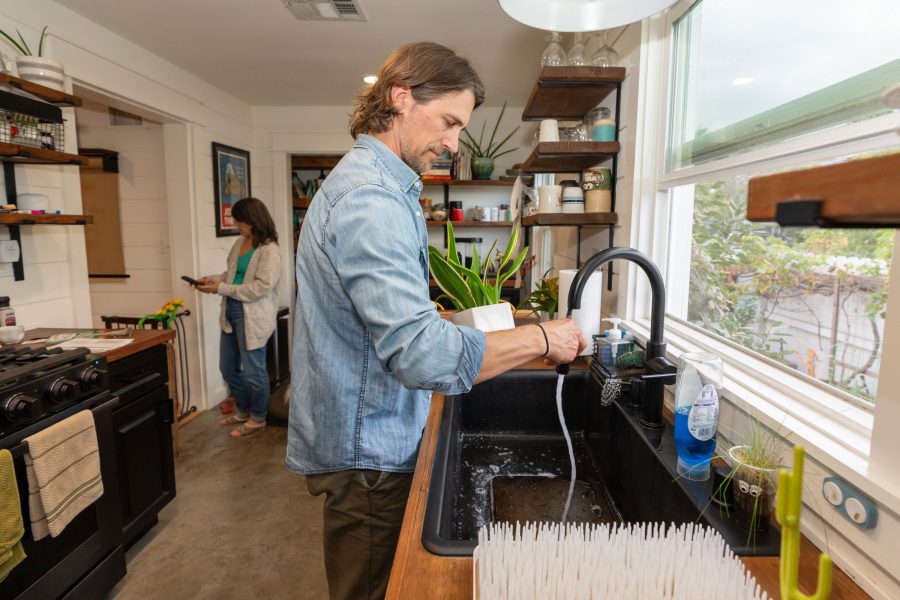
Photo by Ling Luo, courtesy of USGBC California
The premise behind the 50L Home Coalition is simple: Can we achieve 50 liters, roughly 13 gallons in American speak, of water per person per day while making that experience feel abundant?
In Los Angeles we had the opportunity to test that premise in real homes with actual families. The pilot began with residents who were already relatively efficient water users and paired high-efficiency fixtures and appliances with better-performing household products. Instead of testing a faucet here or a washing machine there, we focused on the activities that make up life at home: showering, cooking, washing dishes, doing laundry, and using the bathroom.
By the final phase participating homes averaged 79 liters, or about 21 gallons, of indoor water per person per day—26% below their already-efficient baseline and 56% below the official Los Angeles average. We demonstrated that 50 liters was in reach and will be achievable in the not too distant future. But what interested me most was not the savings numbers. People said their lives got easier.
Can we achieve 50 liters, roughly 13 gallons in American speak, of water per person per day while making that experience feel abundant?
High-efficiency washers paired with detergents designed for cold-water performance meant less sorting and less hot water. Better dishwashing products reduced soaking, scrubbing, and pre-rinsing. Efficient showerheads worked when they maintained the pressure and coverage people wanted. Nobody was being asked to suffer through efficiency. On the contrary, in many cases, they preferred it.
That is an important lesson for sustainable design more broadly. If the lower-impact choice consistently feels inferior, we will struggle to scale it. History tells us this is true: Efficiency does not sell, and it has not scaled. The sustainable option should be the better option.
Stop Designing One Fixture at a Time
The pilot also reinforced something we see across high-performing buildings: Individual technologies only work as well as the systems around them. In some homes, for example, lower-flow kitchen faucets interacted poorly with tankless water heaters. The reduced flow didn’t always trigger the heater properly, so residents ran the faucet longer, waiting for hot water. The faucet was efficient. The system was not.
We saw another version of this with dual-flush toilets. Giving someone more choices sounds like a good idea, but measured behavior showed people did not always select the lower-volume flush as intended.
These seem like small examples, but they point to a much larger opportunity for designers. Things like pipe length and water-heater location matter. Fixtures, controls, appliances, and products interact, and so do the habits of the people living in the home.
Hot water may be the biggest opportunity of all. In the 50L pilot, total hot-water use fell 44%, with particularly strong reductions in kitchens and laundry. Every gallon of hot water we avoid using also avoids the energy required to heat it.
A water decision becomes an energy decision. An energy decision becomes a carbon decision. That’s why the next generation of water-efficient design needs to move beyond specifying low-flow fixtures. We have to take a holistic approach and design the whole experience.
Build Circularity In
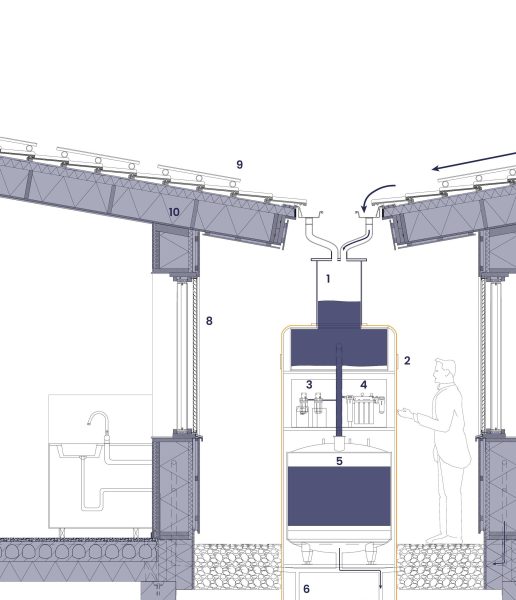
The Design Challenge winning student submission by Flow, titled “CoFlow,” treats domestic water as communal infrastructure. At the unit, all wet rooms cluster around a tight back-to-back layout to shorten pipe runs and reduce hot-water energy loss. Drawing courtesy of USGBC California
This systems-thinking was one of the strongest themes across the 112 submissions from nine countries that we received through the Architectural Design Challenge. One of my favorite ideas came from the Hydro-Circular Home, which received our professional Excellence Award. Its premise is almost surprisingly simple: Make homes greywater-ready from the beginning.
The design includes dual-drain washer boxes, labeled stub-outs, dual plumbing in multistory buildings, and dedicated non-potable water lines. Instead of treating greywater reuse as a specialty system someone might add years later, the plumbing anticipates circularity from day one.
We already do this elsewhere. Increasingly we build homes solar-ready and EV-ready because preparing the infrastructure while walls are open is much easier than tearing them apart later. Why not water-ready? That does not mean every home needs an elaborate onsite treatment system. It means we stop designing buildings that make future water reuse unnecessarily difficult.
The student-winning CoFlow project took this idea a step further. Developed for Atwater Village in LA, it clusters kitchens, bathrooms, and other wet spaces to shorten pipe runs and reduce hot-water loss. Adjacent homes share a “wet spine” that manages rainwater, greywater, filtration, and hot water. At the neighborhood scale, storage, bioswales, and retention areas reconnect those homes to the larger watershed. It’s a different way of thinking about infrastructure, not as something hidden behind a wall or ending at a property line but as part of the architecture itself.
Beyond the Building
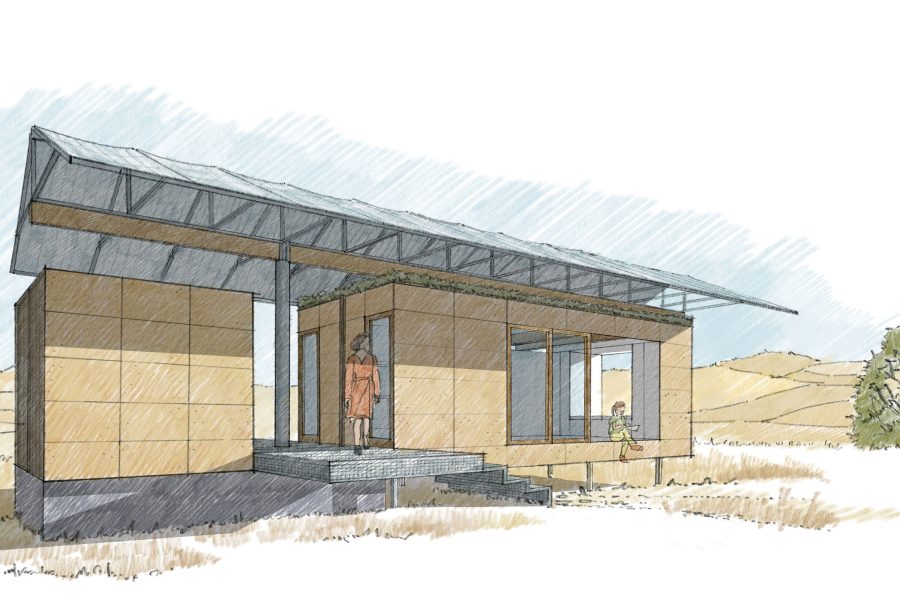
This photo shows the exterior of the Bio-Regional Shelter. Illustration by Henry Gao, courtesy of Red Dot Studio
That same idea showed up again and again in the challenge: The home does not end at the exterior wall. Red Dot Studio’s winning Nature is Home: Bio-Regional Shelter is a great example.
Designed for fog-rich coastal California, the project combines atmospheric water harvesting with onsite biological treatment and closed-loop greywater reuse. A solar roof supports a heat pump and battery system. Mass timber and straw structural insulated panels reduce embodied carbon, while a laundry filter captures microplastics before they enter the surrounding environment.
What I like most about the project is not any one technology. It’s the way everything works together. Water, energy, carbon, materials, resilience, wastewater, and landscape are not treated as separate sustainability categories; they are simply parts of one building system.
Other entries transformed conventional suburban yards into working watersheds through rain gardens, roof capture, greywater-fed fruit trees, permeable landscapes, and onsite infiltration. That’s another shift I think our industry needs to make. Rain falling on a property is not waste to move quickly into a storm drain. Greywater is not necessarily waste after one use. And a landscape is not just decoration around a building. All three can become infrastructure.
Design Behavior Into the Home
We also need to think differently about how people interact with water. Most of us have almost no intuitive sense of how much water we use. We can see the battery level on our phone instantly, but household water consumption largely disappears behind walls until a bill arrives weeks later. Several student projects explored how design could change that.
The Water Battery proposed a simple wall-mounted display that shows a household’s daily water budget like a phone battery icon. The team deliberately did not make it another app. The information becomes part of the shared environment, more like a thermostat.
Another project, Red Light, embedded a gentle behavioral cue directly into the showerhead, using light to signal shower duration. I like both concepts because neither depends on another lecture about conservation. They change the environment in which decisions happen.
That mirrors something we learned from the 50L pilot. Most residents settled into appliance settings quickly and rarely changed them. Eco modes often went unused. Better defaults, clearer prompts, and simpler interfaces may ultimately accomplish more than offering people another menu of choices. Good sustainable design should reduce how often someone has to consciously decide to do the sustainable thing.
Make the Sustainable Home the Better Home
The encouraging part is that much of this does not require us to wait for a technological breakthrough. We can shorten hot water runs today. We can specify fixtures based on performance and experience, not flow rate alone. We can make new homes greywater-ready. We can pair efficient appliances with the products and routines that allow them to perform as intended. We can capture rain where it falls and design landscapes to hold it. At the same time, technologies like atmospheric water generation, recirculating showers, smart controls, and onsite reuse can continue pushing the boundary.
When we launched the Design Challenge, we asked a simple question: What would a home look like if water scarcity had been a design constraint from the beginning? The most interesting answers were not homes defined by scarcity. They were homes that made better use of what they had. For too long sustainability has sometimes been framed as a negotiation over sacrifice: How much comfort, convenience, or beauty are we willing to give up to use fewer resources?
I think designers can ask a much more compelling question: How do we create homes people want because they are more comfortable, more resilient, easier to live in, and more beautiful, and they happen to use dramatically less water? When we get that right conservation stops feeling like conservation. It just becomes good design.