Story at a glance:
- DuctSox is a complete air-dispersion system that performs in ways metal simply cannot.
- Modern fabric ductwork is beautiful, functional, and high-performing, with greater control of air.
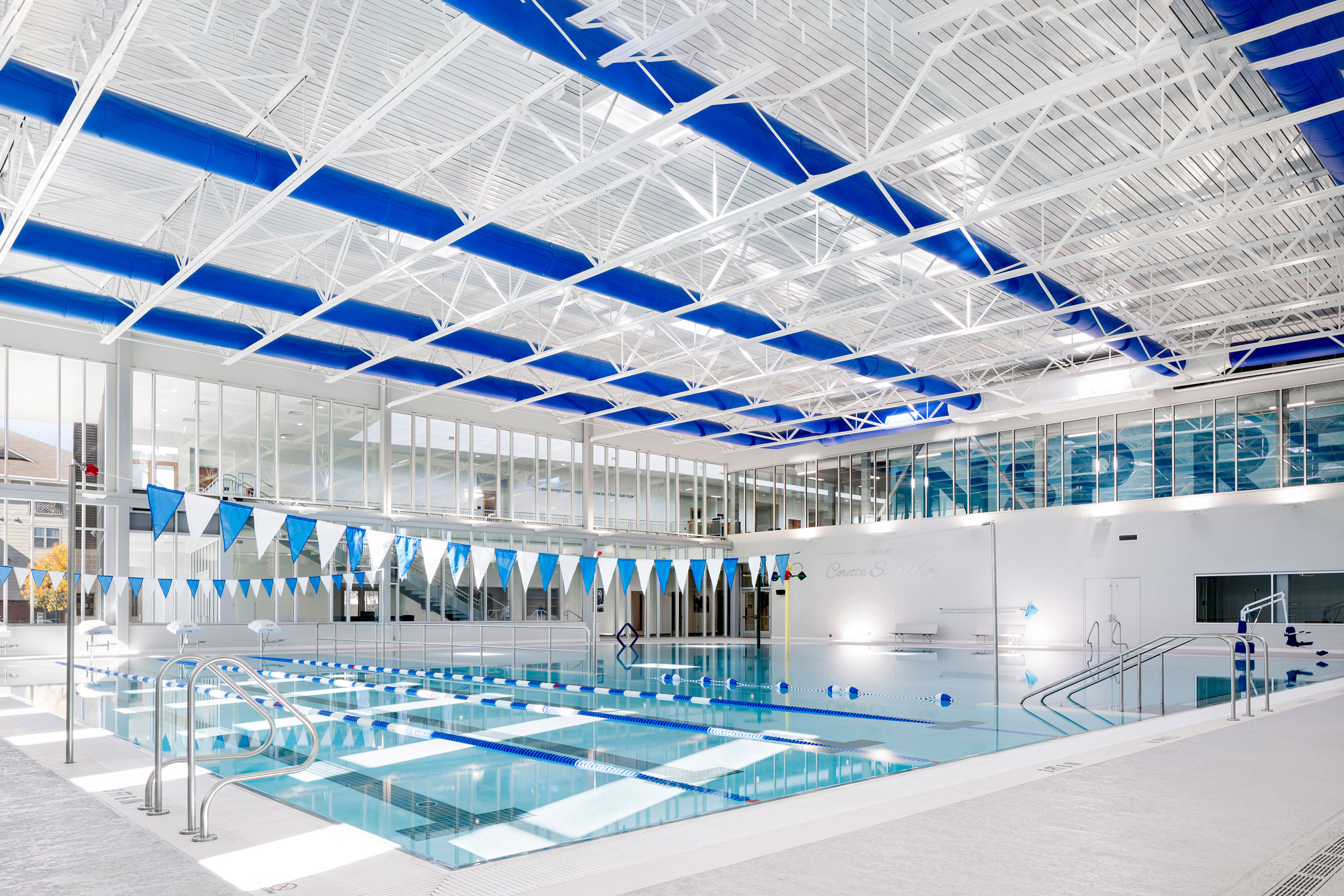
Allegiant Stadium, Harvard University, The Sphere—these are just some of the major players using fabric ductwork in their facilities. Fabric systems like DuctSox are lightweight, flexible, and breathable, allowing for uniform and precise air dispersion that makes spaces more comfortable, quiet, and efficient than metal ductwork.
“With a lot of metal ducts you have big diffusers hanging off. From the diffuser you get some localized drafting. It’s not a uniform spread of airflow. With this you get a very consistent, reliable delivery of airflow,” says Nick Paschke, business development manager at DuctSox. He joined the company in 1995 and has a background as a mechanical engineer.
With this you get a very consistent, reliable delivery of airflow.
Fabric ducting can deliver air through fabric surface and engineered outlets for precise airflow, reducing drafts, hot spots, and cold spots. “Our product really lets engineers build a system to get the air where it needs to go,” Paschke says. This even distribution often improves occupant comfort and can enhance overall HVAC performance compared to traditional metal duct systems. Customized DuctSox solutions also eliminate condensation risk, making spaces more hygienic.
The Evolution of Fabric Duct Systems
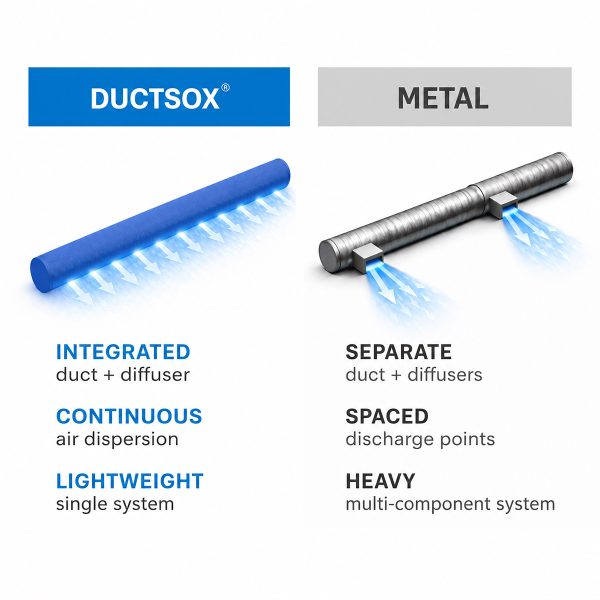
Image courtesy of DuctSox
For decades traditional metal units that moved air throughout a facility were commonly referred to as ductwork. Each system requires a variety of components to achieve proper airflow. When fabric was introduced more than two decades ago, it was referred to as “fabric ductwork” or “fabric ducting.” The reality is that fabric provides a complete air dispersion system that is customized to match the needs of specific applications, Paschke says.
Fabric ductwork got its start in the food industry, as processing facilities needed condensation-free solutions. “Because of the way the airflow passes through fabric, you wouldn’t get condensation,” Paschke says. “At times the USDA inspectors recommended our product to food processing facilities that were having problems with moisture or condensation, drafts or particles from refrigeration coils.”
While earlier DuctSox were used as a filter to create a cleaner environment, modern systems have precise openings cut into the fabric for controlled airflow patterns. “We started growing into new markets, expanding from industrial to distribution to sports facilities to plant growth to data centers to laboratories and critical environments and sound studios,” Paschke says.
You don’t have to go far to find an application of fabric ductwork today, he says. For example, DuctSox is the preferred vendor for the YMCA, as fabric doesn’t rust or corrode in pool environments. It’s also proved vital in sports and music arenas, with less heavy material amounting to less overhead risk of something falling, plus less strain on installers. DuctSox weighs 90% less than most of its metal counterparts. “If we can pull 90% of the weight out of something, that’s way better for the industry,” Paschke says.
He says contractors like DuctSox because it’s labor-friendly. “It takes some time and skill to be able to install sheet metal safely without hurting yourself, and fabric is more apprentice-friendly, requiring less lift equipment. There’s not a lot of risk, and there’s not a lot of weight. It’s also installed later, so the projects are cleaner and further developed.”
SkeleCore Gives Form
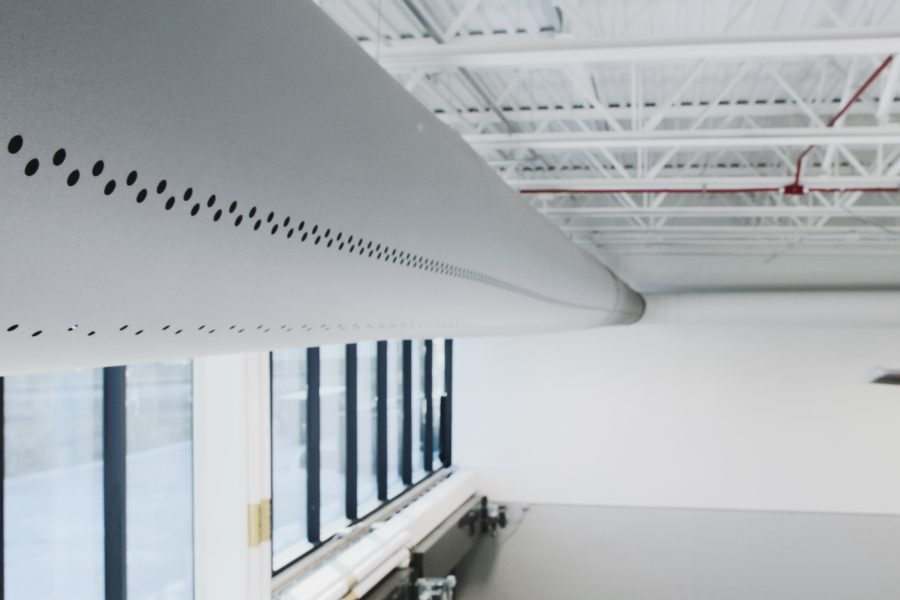
Photo courtesy of DuctSox
For years there was a misconception that fabric ductwork was the “cheap” or temporary option. That goes back to fabric’s origin as a product that deflated when the fan shut off, and from an aesthetic standpoint, many architects didn’t like that, Paschke says.
Today more appealing solutions keep the product in its inflated shape when the air shuts off. SkeleCore fabric duct tensioning systems (SkeleCore FTS) eliminate sagging and maintain duct shape without relying on airflow or system conditions. SkeleCore is the only fabric duct system that delivers full-length, full-circumference tensioning, Paschke says. “By doing that it increases the durability of the product, and it’s in a pristine frame. It’s not going to get tattered over years.”
Now experienced customers are turning to fabric because they realize it can be a permanent solution that looks good and delivers air more precisely than metal, Paschke says.
Fabric in Action
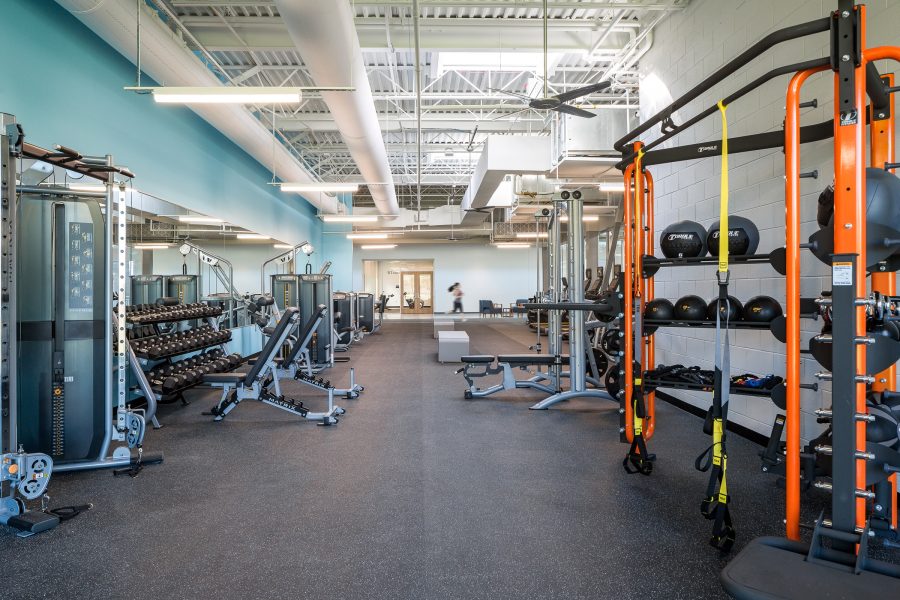
Photo courtesy of DuctSox
DuctSox has worked with impressive clients all over the country, from Allegiant Stadium in Las Vegas to recording studios at Harvard to music venues like Salt Shed in Chicago, plus countless churches, The Sphere, and more large arenas coming up soon.
You may not see it, but custom ETS SkeleCore is keeping the large screen and crowds comfortable at The Sphere. “Behind the screen everyone looks at and is amazed by there’s this 156-inch diameter DuctSox,” Paschke says.
Any open ceiling areas where you’re concerned about comfort and acoustics, fabric is a great solution, he says, as it eliminates the diffusers often required with metal, where each diffuser could be a noise source, plus additional expense.
The biggest point remains, though, that these fabric solutions allow you to control where air is delivered. “Does the project require a high velocity air movement with orifices overhead? Does it need a low draft of cool airflow from below a table? We even offer a flexible system to work within Underfloor Air Dispersion (UFAD) systems to make sure there’s uniform temperature,” Paschke says.
Today there’s a much better understanding of how to move air in specific, even sensitive environments, whether it’s airflow sensitivity for an ice arena or indoor swimming pool, lab, or data center. While fabric is often designed in new construction projects, it’s a great fit for the flexibility needed in retrofits, too, Paschke says. He recalls one Milwaukee project that had to learn a tough lesson, as they experienced metal ducts with linear diffusers that began to rust and become discolored due to condensation. “The university ended up tearing them out and putting fabric in. They now have our DuctSox in the facility,” he says. “It was a learning experience—an expensive one, but a learning experience all the same. The result actually has better airflow with more outlets, and the durability is going to be much greater now that it’s fabric.”

Photo courtesy of DuctSox
We’ll dig more into the world of fabric ductwork with an article on efficient airflow design and technical considerations in September on gbdmagazine.com.