Story at a glance:
- Flooring’s carbon impact extends beyond manufacturing to maintenance, replacement, and end-of-life considerations.
- Longer-lasting modular flooring can reduce both material consumption and costs over the life of a school.
- Environmental Product Declarations and total cost of ownership can help specifiers compare flooring options more effectively.
Schools looking to reduce their carbon footprint face thousands of material decisions, from structural systems and insulation to furniture and finishes. Flooring may seem like only one piece of that equation, but because it covers so much space—and may be replaced multiple times during the life of a building—its long-term impact can add up quickly.
For school districts already working within tight capital budgets, that creates a difficult challenge. A flooring product that appears inexpensive initially may ultimately require more maintenance or more frequent replacement, increasing both its financial and environmental cost. “All materials have a carbon footprint,” says Brandon Kersey, director of business development and segment manager for education at J+J Flooring. “Every aspect of it, from the material to transportation, installation, day-to-day use and maintenance, and then end-of-life disposition, has carbon associated with it.”
Understanding those impacts can help architects, specifiers, and facility managers make flooring decisions that support both sustainability and long-term value.
Understanding Embodied Carbon
For specifiers comparing flooring products, one important starting point is embodied carbon, or the emissions associated with producing a material before it begins its useful life in a building.
Kersey says the calculation typically considers what are known as the A1 through A3 phases of a product’s life cycle: raw material extraction, transportation to manufacturing, and manufacturing itself. “If you’re trying to lower the carbon footprint of a particular project, you can attack it by selecting products that have lower embodied carbon,” he says.
The Environmental Product Declaration, commonly known as an EPD, provides a useful tool for making those comparisons. “The first thing you look at, and the source of this data, is the Environmental Product Declaration,” Kersey says. “As you’re reviewing potential products, you want to look at those declarations in order to assess the impact of any given material.”
Those numbers, however, tell only part of the story. A product may begin with an attractive embodied carbon profile, but its environmental performance over decades can look very different depending on how often it requires maintenance and replacement.
Longevity Changes the Equation
One of the most overlooked factors in evaluating flooring is also one of the simplest: How long will it remain on the floor? “The single most overlooked thing is how long the product lasts,” Kersey says. “The product that stays on the floor the longest is going to be the most sustainable because every time you replace the flooring, you reset the embodied carbon.”
Consider a school building expected to remain in service for 75 years. If one flooring system needs to be replaced five times during that period while another needs replacement only twice, the carbon implications extend well beyond their original manufacturing impacts. “Every time you replace it you’re starting all over, back to material extraction,” Kersey says. “If a product only has to be replaced two times, you’re going to have a much more attractive overall footprint over the life of the building.”
The same principle applies financially. “A product that lasts longer means you’re not going to incur the cost of replacement as often,” he says. “Every time you replace that product, you’re going to take a monetary hit, and you’re going to take a carbon hit.”
Factoring in Maintenance
Replacement is not the only operational consideration. The way a floor is maintained throughout its service life also contributes to its overall carbon footprint.
Maintenance can involve electricity for cleaning equipment, cleaning chemicals, water, labor, and other resources. Different flooring systems require different maintenance schedules and processes, making those requirements important when comparing products. “Any activity that you do toward maintaining a product is going to have some amount of carbon associated with it,” Kersey says. “Anything you do related to maintenance will impact the overall life-cycle carbon footprint.”
That is also where upfront pricing can become misleading. “You can’t just look at the initial material plus installation cost,” Kersey says. “A floor that may look like a really good idea upfront for the project cost may have much higher maintenance costs associated with it, and it may have to be replaced more often.”
For budget-conscious school districts, evaluating those continuing expenses can provide a much clearer picture of what a flooring system will actually cost to own.
The Benefits of Modular Flooring
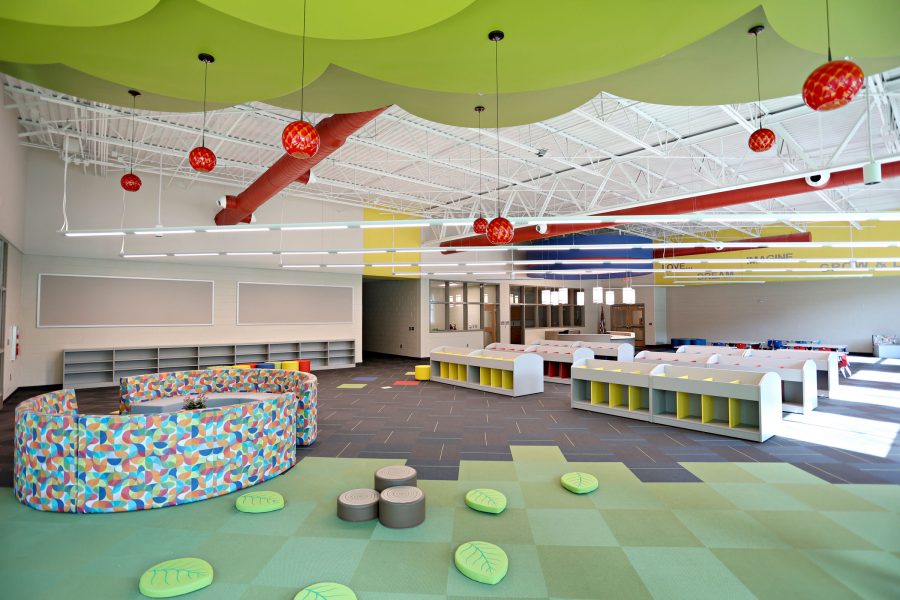
Modularity can further extend flooring life by allowing schools to address wear or damage without replacing an entire installation. “With modular flooring you are able to deal with issues due to damage without replacing all of it,” Kersey says.
That means if one section of a classroom or corridor becomes damaged, individual modules can be removed and replaced. A wall-to-wall system, by comparison, may require a significantly larger intervention.
Modularity can also reduce disruption during replacement. “You can do it in sections as opposed to having to clear out everything in an area to deal with a wall-to-wall roll good,” Kersey says.
That targeted approach can mean less material entering the waste stream, less new flooring required, and fewer disruptions to an occupied school.
Balancing Performance & Carbon
Kersey points to Kinetex textile composite flooring as an example of how J+J is addressing both embodied carbon and durability. “Kinetex has a very low embodied carbon number, and that comes from really two reasons,” he says. “First Kinetex is low mass. But at the same time it’s also extremely high performance.”
The combination matters because reducing the amount of material used provides only part of the benefit if a product wears out quickly. “The longer a product is on the floor, the more sustainable it is because you’re not hitting that reset button,” Kersey says.
He says Kinetex carries lifetime warranties and has been installed in high-traffic environments like airports, sports venues, and public spaces. In some cases he says the flooring replaced products that previously needed replacement every two years and has remained in service for a decade. “Now you’ve gone from replacing every two years to replacing every 10 years,” Kersey says. “Think of the savings, both monetarily and on embodied carbon.”
J+J also uses carbon and renewable energy offsets to address the remaining impact of Kinetex, which Kersey says allows the company to offer the product as carbon neutral.
Looking at the Whole Life Cycle
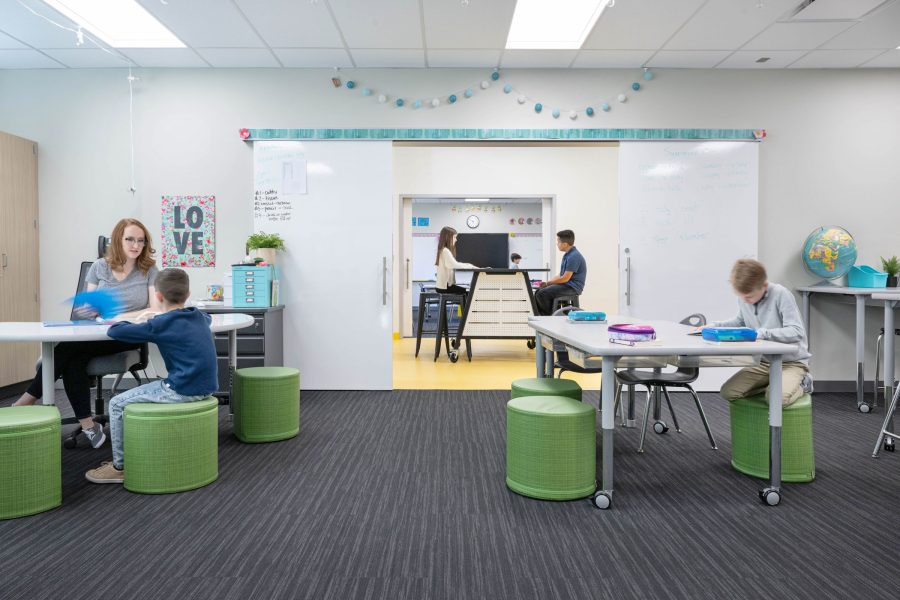
For architects and facility managers, the takeaway is to look beyond a flooring product’s purchase price or any single sustainability metric.
Kersey recommends considering total cost of ownership alongside EPD information and product warranties. J+J offers an online calculator designed to help evaluate initial and ongoing costs, while warranties can provide another indication of expected product longevity. “You should look at the overall cost of ownership,” he says. “What is it going to cost initially, and what is it going to cost over time? Then you combine that knowledge with the data in the Environmental Product Declaration.”
For schools, where every capital dollar matters, that broader view can align two goals that may initially seem to compete: reducing environmental impacts while controlling costs.
Choosing flooring that requires less maintenance, lasts longer, and can be replaced selectively when necessary means fewer resources consumed throughout the life of the building and potentially fewer dollars spent replacing them.
In low-carbon school design, sometimes the most sustainable material is simply the one that does its job longer.