Story at a glance:
- gb&d takes a field trip to go behind-the-scenes of manufacturing and design with major flooring company Tarkett in Dalton, Georgia.
- The global company is on a mission to make recycling effortless, from its takeback program to products that are just plain easy to recycle.
- Tarkett leaders share their insights on the environmental and financial benefits of making recycling easier.
Blue, orange, green, speckled, solid—all of them strong and sustainable—Arnaud Marquis is flipping through some of Tarkett’s latest flooring samples at Tarkett’s manufacturing and design facilities in Dalton, Georgia, when I visit in March.
-
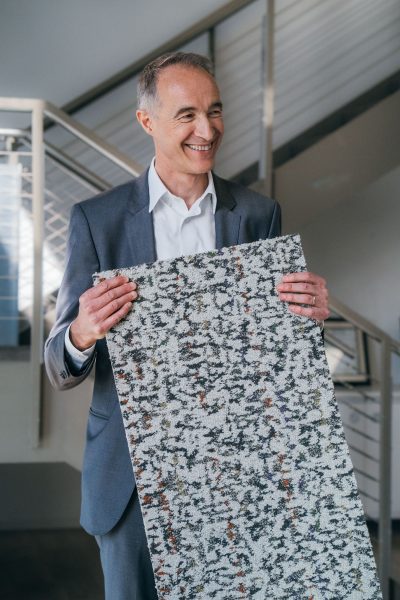
- Arnaud Marquis, chief sustainability officer for Tarkett Global, shares Hieroglyph from the new Transcribe collection, seen here in a color called Spontaneous. Photo by Julie Ellison
-

- Rachel Palopoli, director of circular economy for Tarkett North America, is committed to recycling. She grew up in the trash collection business and knows all too well how much people throw away. Photo by Julie Ellison
The chief sustainability officer for Tarkett Global, based in Paris, is on the ground talking to teams across departments about the company’s continued efforts in sustainability; he’s set for a day of collaboration with a bit of cheerleading. The company-wide meeting of the global flooring leader will focus largely on how to ensure everyone understands their role in improving and reaching the company’s sustainable objectives, furthering a commitment to people and planet as part of the company culture.
“We have to reduce waste. Not only waste in our factory—this is something we’ve been doing for decades—but also waste that happens when a product is installed and the waste at the end of life of our products,” Marquis says. Every year Americans throw out approximately two million tons of carpet, despite the fact that much of it is recyclable, according to the Product Stewardship Institute. The industry desperately needs to further develop the circular economy and recycle products back into the stream, Marquis says. “We know the linear economy is already impacting societies and our value chain. And we have to understand what needs to be done to manage all these impacts.”
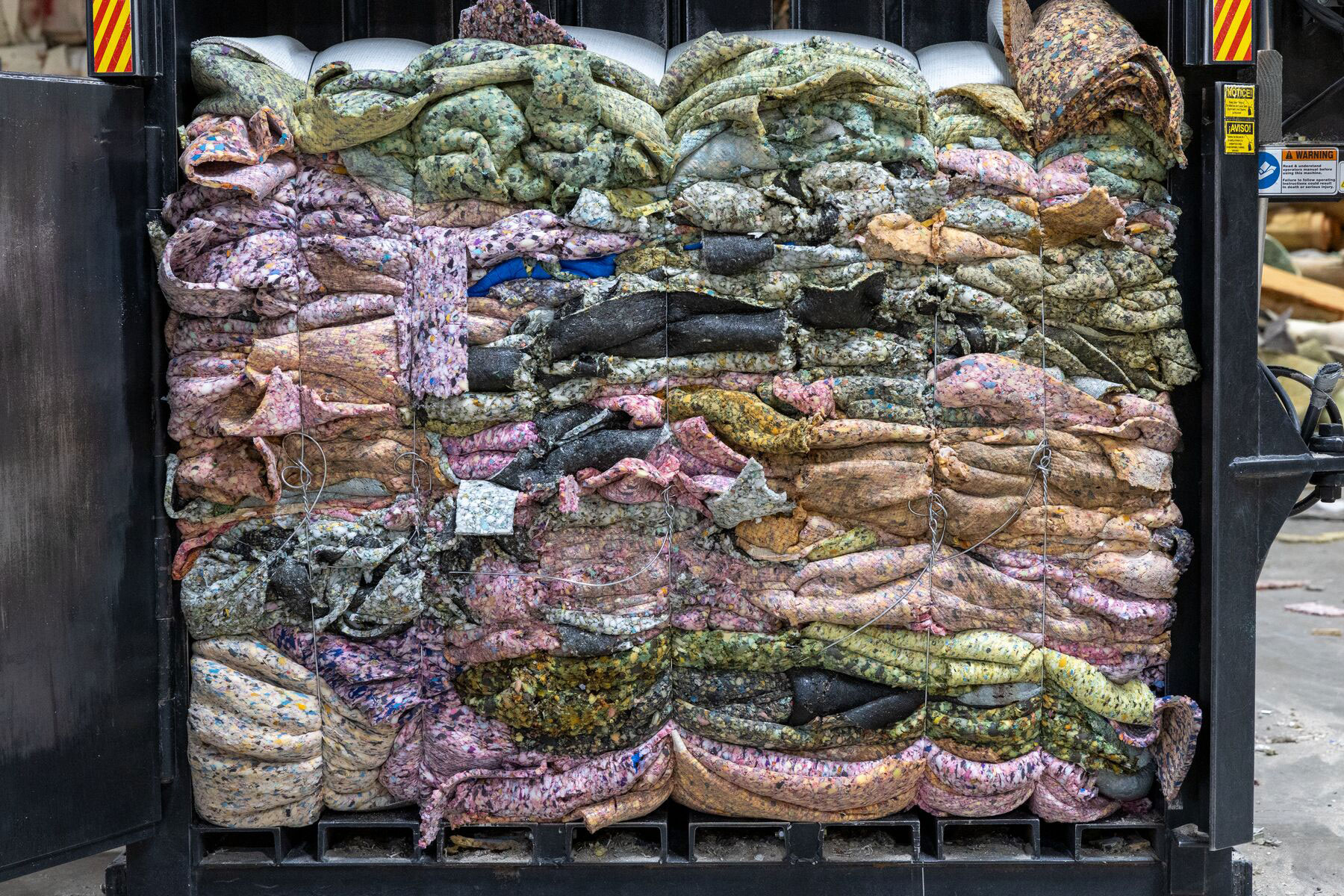
In the last few years Tarkett North America has essentially “restarted” its ReStart program, improving upon its take-back and recycling program in the US by offering to take back quite literally any flooring—even if it’s not manufactured by Tarkett. “It is making it easier for the customer, the contractor, whoever it may be, to get those reclaimed materials back,” says Rachel Palopoli, director of circular economy for Tarkett North America.
We are talking about a transformation that can only be achieved if everybody is working on it.
Originating in the 1950s when Tarkett began recycling flooring in Europe, the takeback program has grown exponentially over the last three-and-a-half years Palopoli has been with Tarkett. It’s all part of educating the industry about the benefits—including potential cost benefits—and making recycling as easy as possible, she says. “The second we make it too difficult, they will walk. They will not recycle. Time is money in the field, and we understand that.”
Palopoli knows a little something about landfills versus recycling. She grew up in a family of entrepreneurs running a trash collection business. “I got to witness what people were throwing away,” she says.
Today Palopoli is part of a team that educates contractors, architects, and other building professionals about how to easily recycle flooring, from how to separate product types to how to stack and organize pallets for pickup. It’s crucial to make recycling easy for customers and contractors, she says. “The second there’s a break in communication, education, timeliness, you can immediately go back to a linear economy. It’s important to engage with everyone.”
Most people know too well that just because something is recyclable doesn’t mean it will be recycled, Marquis says. “If you don’t convince people to send it back to us, if you don’t create the ReStart program we have created, that costs as well. It’s a decision taken at the highest level of the organization because it has an impact on the P&L. When you are not really committed to do the steps to make it happen, then it’s useless. At the same time we would like for our customers and our competitors to also take actions to support the development.”
Palopoli says Tarkett feels responsible for helping to change behaviors. “If an installer is used to throwing out that carpet, we feel responsible. We have to help them change that behavior.” Tarkett aims to show them how recycling can affect their bottom line, too. “Because if you have to get 40 dumpsters, how much do those cost? What if we showed you an easier way and it balanced out cost-wise or saved you money?”
Reducing Virgin Materials
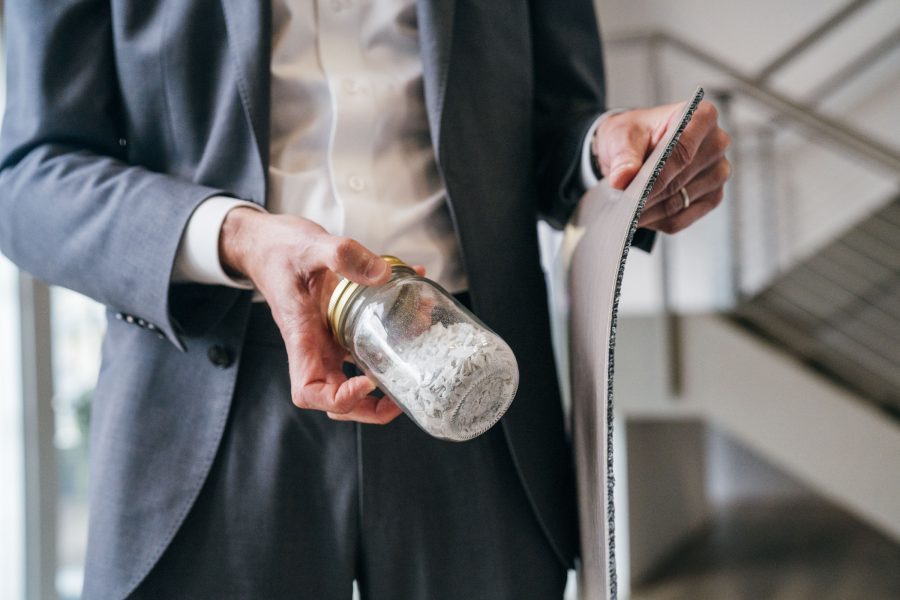
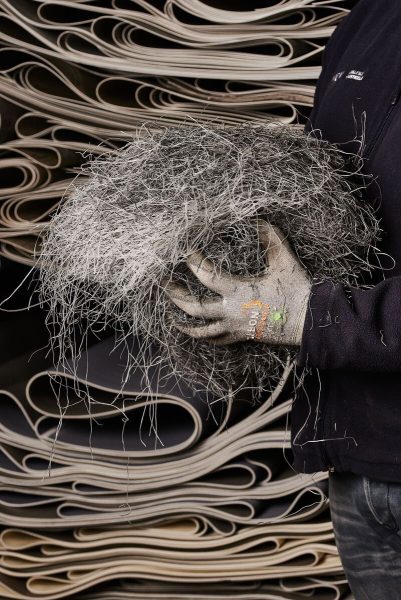
Until recently there was no solution to recover PVB when it reached end of life. Today it can be cleaned and recycled to become a high-quality raw material used across the flooring, automotive, construction, and plastics industries, including in Tarkett’s ethos® carpet tile. Photo by Julie Ellison
“Tarkett is committed to developing a circular economy by recycling old flooring, but we also seize every opportunity to reduce the use of virgin material, which sometimes includes waste from other industries,” Marquis says. “One example is the partnership we created in 2014 with a supplier of recycled PVB.”
Developed in the 1930s, PVB, or polyvinyl butyral, resin is a tough, clear, adhesive, and water-resistant plastic film. It’s widely used in laminated safety glass, primarily for automobiles, like laminated safety glass in car windscreens and buildings. Until recently there was no solution to recover PVB when it reached end of life. It simply became waste. But Tarkett’s supplier’s engineering and recycling experts developed a treatment process to clean and recycle post-use PVB, transforming a once unrecyclable material into a high-quality raw material that could be used by the flooring, automotive, construction, and plastics industries, including Tarkett’s ethos® carpet tile. In total the company has reused 51,800 tons of PVB films, equivalent to materials from more than 53 million windshields.
Plus, every time Tarkett uses a recycled material instead of a virgin material, they reduce oil extraction, Marquis says. “Manufacturing this type of polymer requires a lot of energy, while transforming this PVB waste into this backside does not require a lot of energy. The carbon footprint of the recycled raw material is usually two to three times lower than a virgin raw material.”
And, Palopoli says, it can be recycled infinitely, even after flooring may be down for decades. “It goes down for as long as it possibly can, and then we take it back. We have figured out how to recycle it—how to separate the ingredients so we can take that backing and put it into new backing. We’ve made the investment to do that.”
It’s part of Tarkett’s overall mission to waste nothing—not even the dust generated when making stair treads. The backing of the stair tread has to be ground down so it adheres well, and Tarkett captures that dust and puts it back into rubber tile as a filler. Over the last six years Tarkett reduced greenhouse gas emissions by 27% across the whole value chain, ahead of their target of 30% by 2030. As for the amount of recycled material on average in Tarkett-manufactured products, the company doubled to 20% in 2025, up from 2019. They are on track to reach their goal of 30% average recycled content by 2030.
“We do a lot of good things, but we also know that we have to do more. Humility is very important within Tarkett. We know that when we look at the percentage of carpet that is recycled in the industry, in the States or worldwide, it’s just a few percent. We need to do more,” Marquis says.
Getting Rid of Controversial Materials
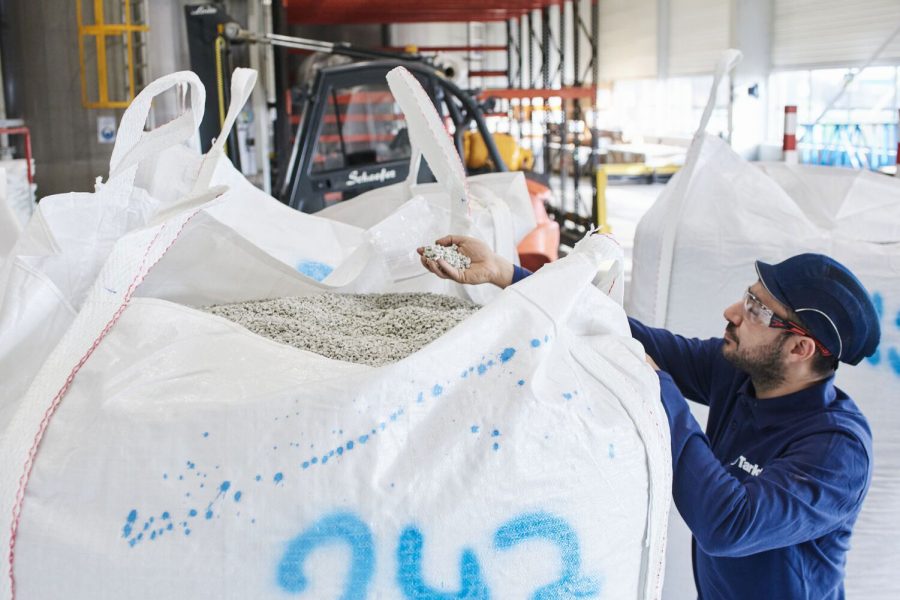
As part of the ReStart program, Tarkett will even take back and recycle flooring manufactured by competitors to keep more material out of landfills. Photo courtesy of Tarkett
As an international company with strong European roots, Tarkett is also leading the charge in the move away from controversial materials while reducing waste. One way they’ve accomplished that is by omitting ortho-phthalates.
All Tarkett flooring products are ortho-phthalate–free. While phthalates are generally still admissible in flooring products across the US, Tarkett points to the potential health harms associated as a reason to avoid using them. Some of the potential impacts of phthalates include fertility risks, early puberty, risk of low birth weight, obesity, diabetes, immune system impacts, cardiovascular and respiratory problems, and some cancers and neurological and behavioral problems, according to Environmental Working Group, a nonprofit focused on agricultural practices and industry loopholes that pose a risk to human and environmental health.
“We try to be scientific. We rely on science, and we work with internal and external experts to understand both what we need to do and how to keep improving,” Marquis says.
Strong Standards
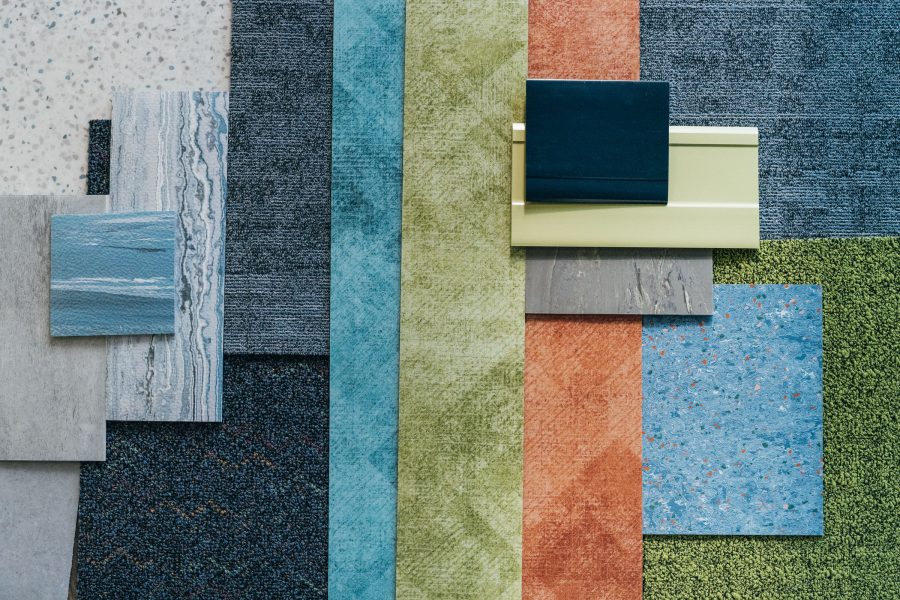
all Tarkett products are ortho-phthalate-free and guided by Cradle to Cradle principles. Photo by Julie Ellison
The state of California is currently the only US state with an active product stewardship or EPR program on carpet, Palopoli says. As such, California’s recycling rate is 38.5%, according to The California Carpet Stewardship Program’s 2024 Annual Report. “That’s because the state stepped in and there are subsidies tied to the recycling of that carpet,” Palopoli says. “You can see that, with regulation, it can increase the recycling rate on carpet.” The rest of the country recycles less than 5% of carpet annually.
Headquartered in France, Tarkett already complies with strict European regulation, Marquis says. “For Tarkett regulation is an opportunity. We tend to like regulation,” he says. “It’s a way to set up a level playing field with the rules of the game for everyone, and then it’s a way to accelerate action and align people so we can amplify the work and reach the target faster.”
Some flooring could stay down for 30 or 40 years, so it’s important to not only manufacture according to regulations but to design and manufacture for the future. “We have to make sure when we put something on the market today that it is future-proof and ready to be recycled in 20 or 30 years,” Marquis says.
-
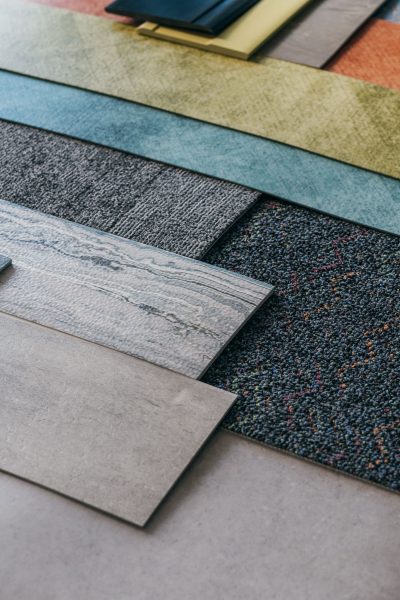
- Tarkett’s portfolio, coined the Tarkett Solution SPECtrum, offers the industry’s broadest variety of flooring solutions.Photo by Julie Ellison
-
- Since 2010 Tarkett has diverted more than 129,000 tons of flooring waste from landfills through its global ReStart takeback and recycling program. Photo courtesy of Tarkett
In some ways Tarkett is predicting the future by pushing beyond current regulations. While some ingredients may be “fine” by current standards, the Tarkett teams want to know the complete ecotoxicology, looking at what precisely is in a product. The company follows a strict methodology to track and understand the impact of each material, from what’s in each product to how much water is consumed in its production. In fact, more than 90% of their raw materials are third-party assessed against Cradle to Cradle principles.
When there are debates about potential impacts on the environment, we at Tarkett would recommend a substitute.
“Regulations may say, ‘You can use this product,’ but when there are debates about potential impacts on the environment, we at Tarkett would recommend a substitute,” Marquis says. “We have teams inside Tarkett who are working on identifying products that are not only green; they are validated as future-proof, so we can be confident that in 20 or 30 years, when it comes back, we will be able to recycle it.”

“This is our Powerbond RS. From an installation standpoint, all we need to do is peel this back and lay this down. As of today it’s the only carpet product that is CERTIFIED Asthma & Allergy Friendly®,” Palopoli says. Photo courtesy of Tarkett
Tarkett’s Powerbond hybrid carpet is one example of a carpet that endures. “This is Powerbond that came out of a school in Colorado, and it’s over 50 years old,” Palopoli says, holding a scrap of teal carpet to show its condition. “You wouldn’t think it was over 50 years old. From a sustainability perspective durability is one of the biggest levers, and I’m not sure how much better you can possibly do.”
Tarkett pulled the carpet out of the old building because it was going to be demolished. They tested the Powerbond to see how it was holding up; it held its integrity even against a dumped bucket of water. “Powerbond essentially is a waterproof, wall-to-wall moisture barrier, so moisture can’t come into this,” Palopoli says.
Tarkett is laser-focused on shifting from a linear to a circular economy and bringing in the right partners to help, communicating this goal to everyone from customers to suppliers to installers to other industries looking for recycled material. All vinyl flooring reclaimed by ReStart, for example, is sent to a manufacturer in the automotive industry. “It’s many stakeholders who have to be included in this strategy. Everybody has a role to play,” Marquis says. “We do that with the objective not only to transform Tarkett but with the objective to transform the industry. Because again, we are realistic. We are not talking about small challenges ahead of us as a society or as a company. We are talking about a transformation that can only be achieved if everybody is working on it.”
Where Ideas are Born
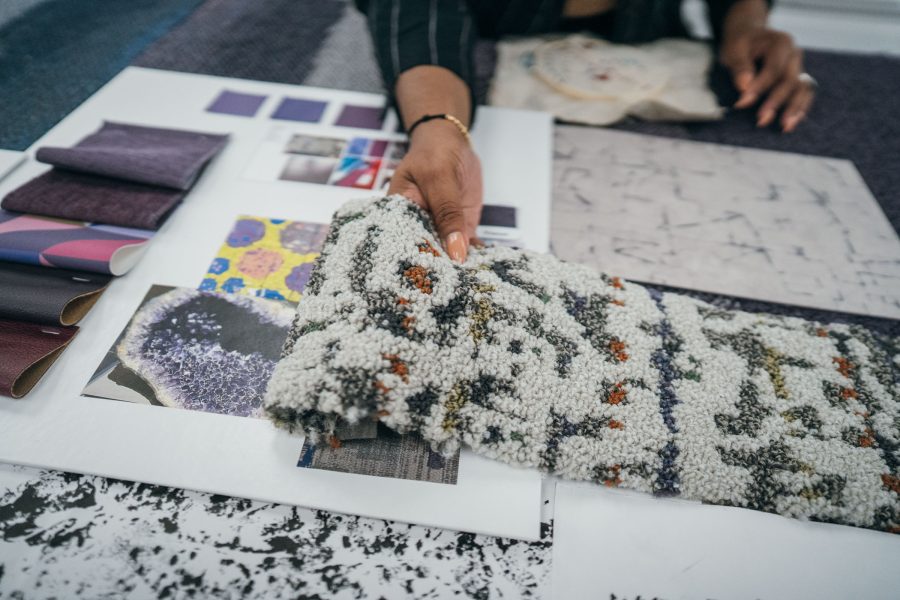
Tarkett’s Omoleye Simmons shares how styles like this one in the Transcribe collection were inspired by hieroglyphics. Photo by Julie Ellison
A short drive away from the Tarkett manufacturing facility, mood boards, drawings, paintings, and even a piece of embroidery spread across a large table inside Tarkett’s Design Center. Omoleye Simmons, vice president of commercial design, is going over the latest product to be launched at Fulton Market Design Days in June 2026.
The new collection, Transcribe, celebrates the process of making—from spontaneous idea to final creation. “This started out with some very loose, long brush strokes. It was an exploration of how art is the core form of expression,” she says. “How it really feeds all of our souls, whether we’re looking at it or we’re experiencing it, whether we can draw or paint or not. It’s still an outlet that helps to heal.”

Omoleye Simmons, vice president of commercial design at Tarkett, looks over the latest designs to be launched at Fulton Market Design Days in June 2026. Photo by Julie Ellison
Tarkett makes room for diverse methods of creative exploration—whether that’s getting out a paintbrush and sketchpad or taking the team to a museum or a glassblowing class. Simmons says it’s all in the name of getting ideas flowing. Beside the design center, employees test possible future designs on smaller machines before they’re greenlit for manufacturing.
The Transcribe collection explores how communication transcends over many eras, with looks like Narrative Thread. Hieroglyphics inspired another piece that almost looks like a blanket with pops of orange and purple. “It tells that story of being able to communicate at different times through different languages and different cultures,” Simmons says.