
Story at a glance:
- With in-house resources, global design firms like Perkins Eastman bear a responsibility to help advance sustainability across the industry.
- Setting clear project goals and integrating sustainable designs lead to measurable outcomes for environmental performance and human experience.
- Sustainable design has become less about why and more about how—how to operate at all scales, from urban planning to material composition.
Throughout her career architect Heather Jauregui has often had to explain: why sustainability? Why it’s important, why designers and clients needed to be thinking in that direction, why sustainability should be integrated into projects. Now, years into her efforts, Jauregui spends a lot less time convincing others why and finds her industry peers and clients are ready to take action toward how they can do better. “Sustainability is everything. It should be on every project, every budget, every schedule, everywhere,” Jauregui says.
Understanding passive design strategies and integrating sustainability into a project used to be more common, but a shift in the industry has isolated sustainability. “Sustainability has been siloed, making sustainable design seem like a daunting task, like rocket science. But sustainability is just good design, and architects need to take back the mantle of responsibility. Designers are already incredibly skilled at looking at a problem 40 million different ways; they just need to boil it down to fundamentals. Then sustainability becomes a lot more achievable and well-integrated,” she says.
Providing those actionable steps is exactly how Jauregui finds herself in a position—as director of sustainability at Perkins Eastman, a global leader in architecture and design—to lead by example. The firm’s designers are all in agreement that sustainable design is the direction they need to go, but there has been some uncertainty in how to achieve those goals. One way Perkins Eastman addressed this was by creating a materials action plan. It’s the firm’s response to the AIA Materials Pledge and Common Materials Framework, and it’s set to launch internally before the firm shares the plan externally.
“Our materials action plan very clearly says: Here are the steps we want you to take on every project. It’s of broader industry value because we all have the same goal. Climate change is not a competitive advantage issue. We all know we need to make significant strides, especially in materials, so none of this thinking should be proprietary. Perkins Eastman wants to share where we can because the industry needs to advance together and we need to help each other get there,” Jauregui says.
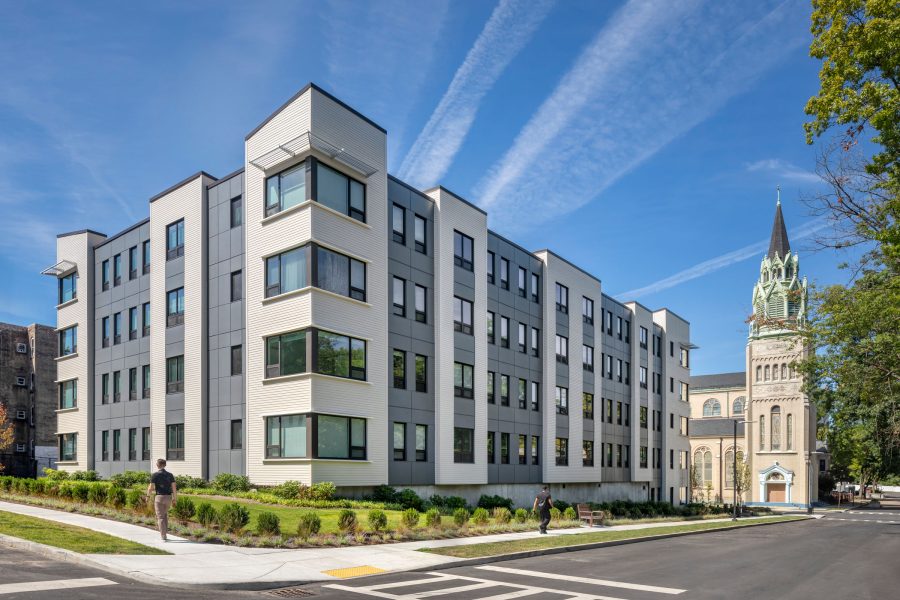
Sustainability is often framed as a technical challenge with technical solutions. But the La Mora Senior Apartments in Yonkers, NY—the first modular-built, passive house–certified senior living building in the US—proves sustainability is a cultural challenge and that integrating passive design principles creates energy-efficient buildings with comfortable living spaces. Photo by Andrew Rugge, courtesy of Perkins Eastman
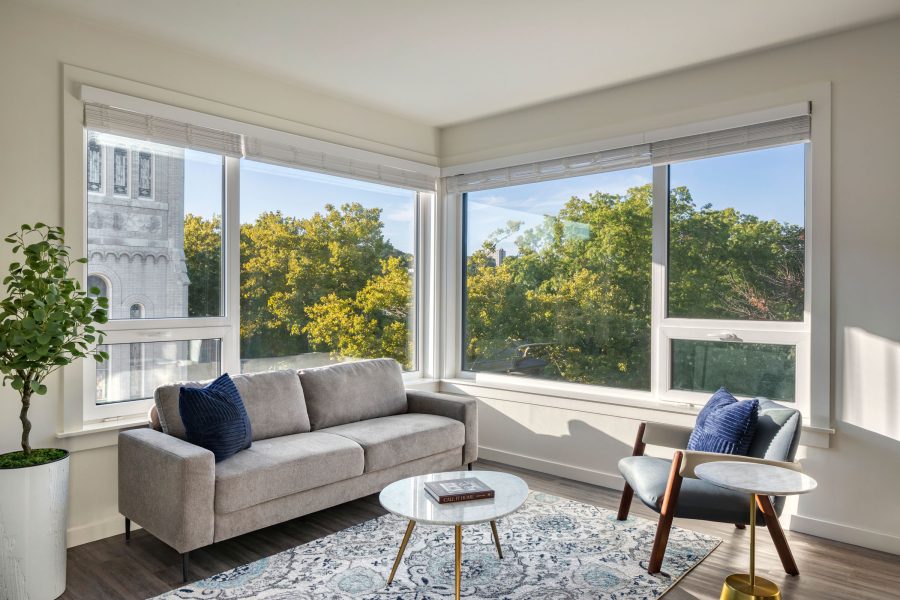
Efficient HVAC and a high-performance envelope contribute to La Mora being the first modular multifamily building in the US to be certified by Phius. Photo by Andrew Rugge, courtesy of Perkins Eastman
Projects like La Mora Senior Apartments in Yonkers, New York, show that while sustainability is often framed as a technical challenge with technical solutions, it’s really more of a cultural challenge. “We used to be more culturally connected with natural cycles, but since the mass production of HVAC, we’ve lost that connection,” Jauregui says. “We need to get back to passive design, make that foundational, where every architect understands how things like orientation, envelope choices, daylight, and ventilation are all important. Technology can support but can’t compensate for good design.”
Technology can support but can’t compensate for good design.
At La Mora, the first modular-built, passive house-certified senior living building in the US, Perkins Eastman started with passive principles. By improving the rigor of the building’s envelope to reduce heat gains and losses, they were able to save energy but, most importantly, especially for the senior population, to create more comfortable spaces.
“Sustainability is not just PV panels on the roof or heat pumps in closets. If you don’t start with good design and basic passive principles, you’re never going to get where you need to go,” Jauregui says. With good passive designs from the beginning, designers strengthen the long-term value of a building rather than inflating the project budget in the end.
Accountability and transparency are just as essential from the outset of a project. Jauregui’s team talks about accountability on a nearly daily basis. For each project they set measurable goals and make them public. Firm-wide Perkins Eastman created a sustainability resolution identifying very clear goals, and every year since the company publishes an annual progress report. Committing to external frameworks like the AIA 2030 Commitment and AIA Materials Pledge also helps keep people and firms accountable.
Setting clear goals, however, is often overlooked, particularly from a sustainability standpoint, even though integrating sustainability goals into the general project goals ultimately determines the outcomes that will be measured. “Perkins Eastman is very intentional about integrating and measuring environmental performance and human experience. At the end of the day, if we don’t capture the human outcomes alongside the building performance outcomes, then we’ve missed an opportunity to show the world how design impacts our lives. It’s not just carbon reduction; it’s also daylight and indoor air quality and cognitive health and social connection,” Jauregui says.
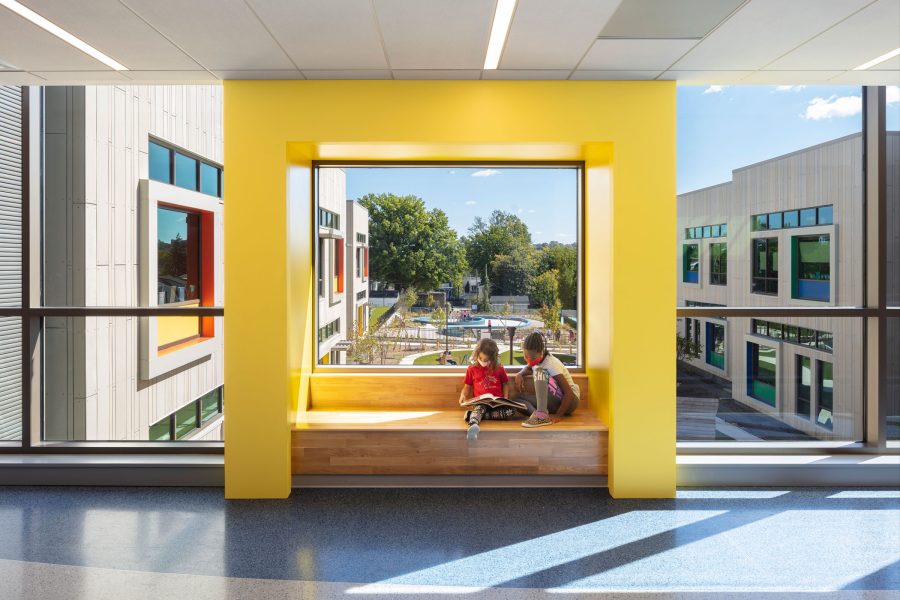
John Lewis Elementary School in Washington, DC, is an example of Perkins Eastman’s holistic approach that integrates wellness of people and planet into the design. The school is the first K-12 in the world to achieve Platinum certifications in both LEED for Schools and WELL. It’s also the first net zero energy school in DC. Photo by Joseph Romeo, courtesy of Perkins Eastman
John Lewis Elementary School in Washington, DC, is one of Perkins Eastman’s greatest examples of this philosophy to approaching a project holistically. The project achieved net zero energy, LEED Platinum, and WELL Platinum. “We always look comprehensively at the wellness of people and wellness of planet. At John Lewis Elementary we zoomed in on design strategies like daylight that have an impact on energy but also have an impact on human health and student performance in the spaces. That got us a better-quality educational environment that really influences what matters in school, which is educating students well.”
Part of Perkins Eastman’s continued success is that its architects like Jauregui embrace the opportunities and challenges of every project, and every architect in the practice takes ownership of sustainability. The firm also takes a broad approach to addressing climate change, operating at all scales, from urban system city planning all the way down to the chemical composition of materials. “As an industry we’ve made a lot of progress, but there’s still so much work to do, and as a large design firm, Perkins Eastman has a big responsibility to share our resources, tools, and frameworks to help continue to push the needle.”