Story at a glance:
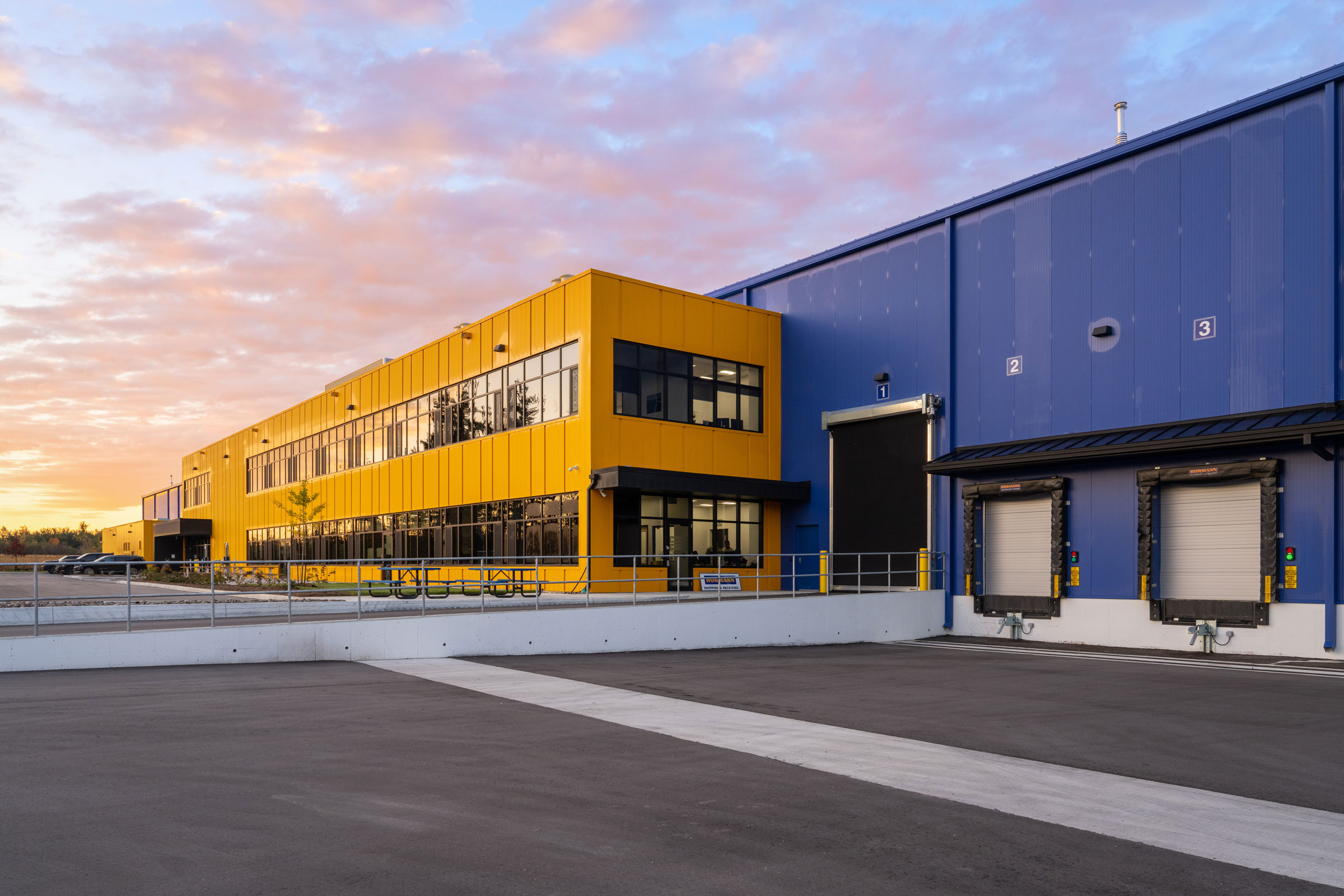
- The new 120,000-square-foot facility is home to Hörmann offices for administration services, sales and technical support, engineering, and state-of-the-art manufacturing for rubber doors.
- Hörmann North America is committed to improving processes for more sustainable manufacturing and less physical strain on employees.
Five large cranes move thousands of pounds of rubber and aluminum from station to station inside the new, streamlined Hörmann North America manufacturing facility in Oro-Medonte, an hour-and-a-half outside Toronto. The precision behind the assembly of finished goods is impressive, as materials like large sheets of rubber and long metal tubes combine with detailed parts beneath 30-foot ceilings. Opened in October 2025, the 120,000-square-foot building houses both Hörmann’s Canadian headquarters as well as the manufacturing of high-performance rubber doors that are in demand everywhere from condos and parking garages to cold storage and distribution.
The cranes are just one of the important new investments for Hörmann, a family-owned manufacturer known for its innovative rubber doors that date back to an urgent need in the mining industry. The crane guides the process, moving materials from welding to paint to assembly to finished goods before a finished door is put on an industrial dolly and rolled up. This makes the process safer, considering doors and parts could weigh as much as 6,000 pounds, says Nick Marando, vice president of operations at Hörmann. “Imagine there’s a 60-foot long metal tube that’s two feet in diameter. You have to weld it over here, and then you have to take it over to the paint booth and paint it, and then you have to bring it over to the assembly area to assemble it. Now we’ve got the crane so we can safely move it along.”
While the overall square footage of the new building is the same as the former plant in Barrie less than 10 miles away, the footprint is much more efficient, Marando says. “The main difference in how we’ve grown is in the height. That’s only become a discussion point maybe in the last 10 years,” he says. You could have a million square feet, but if the building is 10 feet tall, you’re much more limited, he says. “We went with 30 feet to the ceiling so we could put cranes in and have that integrate into our process.”
In Hörmann’s former location the crew used forklifts, and more employees were needed to move product around; some people did the heavy lifting and some supervised for safety. Today multiple cranes go up and down long production lines to move the process along efficiently. “Typically in manufacturing you want a U-shape facility, where you go down a lane, turn a corner, and come back up. In Barrie we were going up and down up and up and down three times. Our product can be up to 60 feet tall by 60 feet wide, so turning the corner becomes a bit of a problem,” Marando says. “In this plant we managed to have nice long lanes where we can basically run down one direction and come back without having to turn the corner. That allows us to use the crane in a safe manner. It reduces the number of people, and it allows us to be a lot more flexible.”
Wherever we could improve our people, our processes, and our product, we did.
It also means less physical strain on employees, Marando says, looking over an assembly that probably weighs 4,000 pounds. “Rather than lift it with a forklift, you can come with a spreader bar and a crane, pick it up, and it’s safe. We’re trying to keep everyone in a job that doesn’t tear down their body, a job they want to come back to. We bring in new equipment, and we train them where they weren’t trained before.” Hörmann gives them tasks that five years ago they may not have imagined, like having the ability to program a CNC machine and run an automated aluminum machining center. “Wherever we could improve our people, our processes, and our product, we did.”
Marando says many processes were reviewed using FMEA, or Failure Modes and Effects Analysis—a systematic process hazards analysis approach that identifies potential issues that could cause or contribute to an accident. Hörmann has noise, safety, and environmental evaluations scheduled for 2026.
Additional Improvements
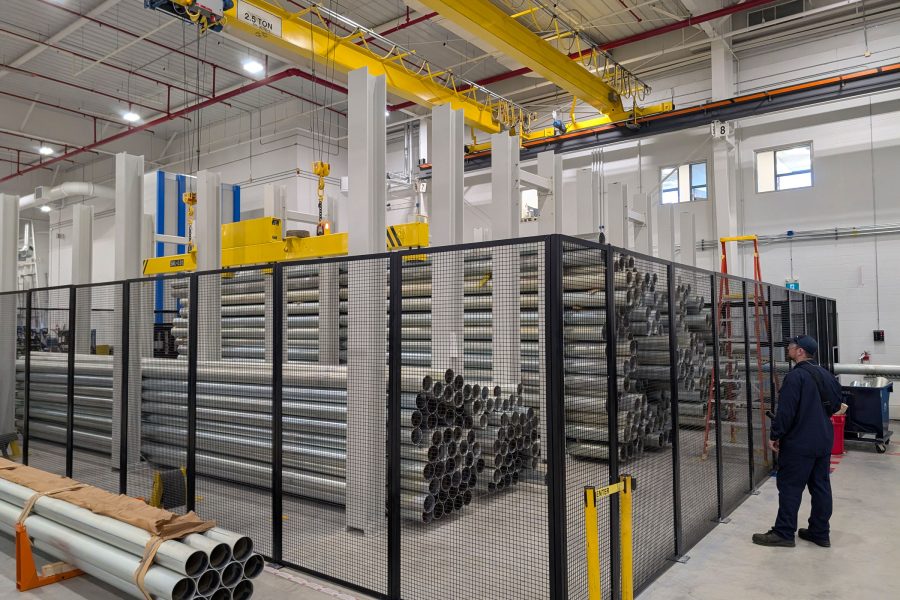
Cranes are seen here moving product inside the Hörmann North America manufacturing facility in Oro-Medonte, opened in 2025. Photo courtesy of Hörmann North America
The new plant is a marriage of manual and automation, with a new automated curtain machine, vertical lift, and welding machine as well as a team suited up in PPE to glue seams by hand.
The aluminum machining center is broken into sections so the operator goes into the warehouse, loads all of an extrusion on the machine, enters the program into the machine, and then works on something else for an hour while the automation does its magic. “It made sense to invest here because we can get a much better quality product. We can take the time and effort to educate and get higher skilled labor,” Marando says.
A dedicated team helped get the Hörmann crew up-to-speed on the new machining center in a couple of weeks. “They showed our team who were running the machine how to maintain it and run it and how to program it in some cases. Two years ago they were literally using a drill or a jigsaw to drill holes into the curtain; now they’re programming it. The way everyone took to the automation was refreshing.”
The floor is entirely paperless, and each station has a rolling computer cart. An employee logs on to see their job for the day, and everyone has the ability to see everyone else’s work. All of the order information is entered into SAP then flows down into engineering. “The automation within engineering and SAP creates all the documentation for the manufacturing drawings and any of the quality checklists. That all goes out electronically. Every station has the ability to, on a daily basis, open the computer and know what they need to do,” Marando says.
Not all improvements are computer-based, though. Hörmann’s skid system was optimized in the move by turning to preset modular skids—120 feet broken into four 30-foot sections. “Before we would build a custom skid, and it took a lot of measuring and a lot of customization. Now we have a standardized cross-section of what the skid looks like, and then depending on the length we either build it four feet longer or not,” Marando says. “Now they’re able to have pre-cut assemblies for the skid, that way they’re not having to build a skid from scratch. It’s not a carpentry project.”
This helps them keep up with the pace of the machine, too. “In Barrie it used to take us two days to build a curtain. We’ve timed out all of the stations so every 30 to 45 minutes, depending on the size of the door, we can have a curtain coming off of the line,” Marando says.
Marando says having more vertical space allows them to store more materials and have room for more finished goods. They can optimize truckloads, too, filling a truck with materials and storing what they don’t need, whereas before they might have had to accept a half-full truck because they didn’t have room to store material needed at a later date. “They’ll bring an entire truck and we can manage it. We store the material here, and they invoice us when we use it. They’re a long-time partner of ours, and it helps us to be able to keep our price down and not send a truck half-empty. It keeps everything as efficient as it can be.”
Who is Hörmann?
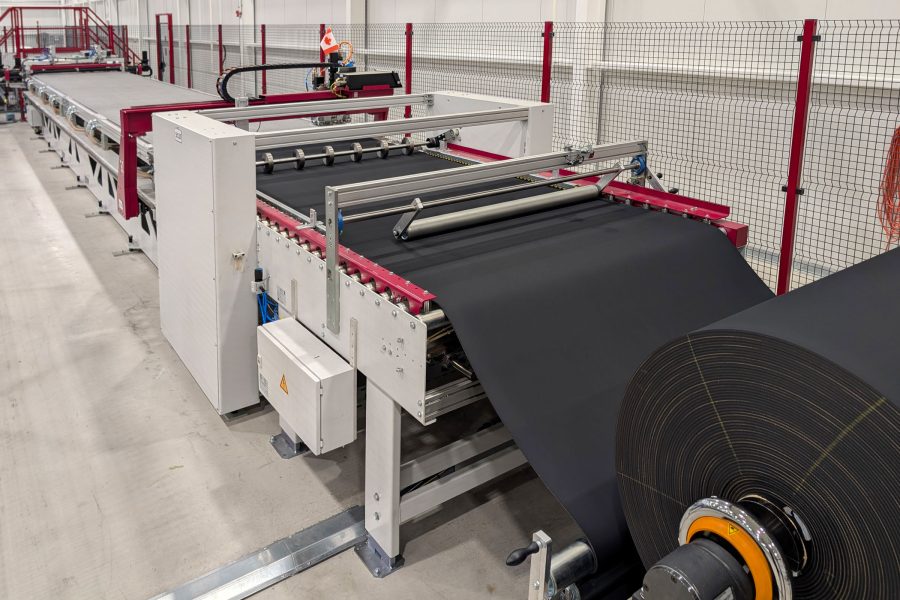
Increased efficiency has meant increased production for Hörmann. “Five years ago a really good year would be five HD-XL doors. Since we moved into this building we’ve been doing one HD-XL door every week,” says Nick Marando, vice president of operations at Hörmann. That was Hörmann’s 2032 goal, achieved years early. “By opening up the space and having the people to handle more product, we’ve been able to go to market and get the market that was out there.” Photo courtesy of Hörmann North America
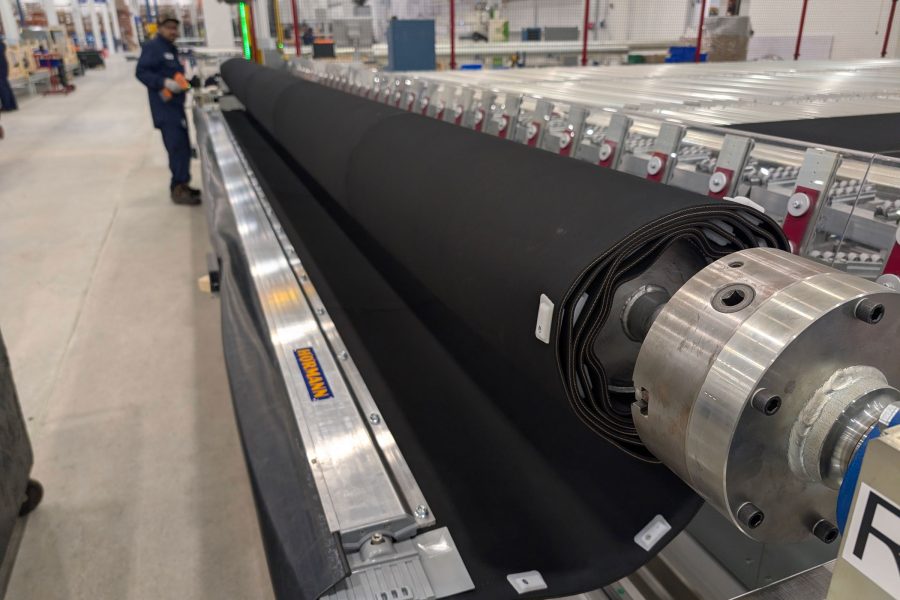
With new processes and equipment, Hörmann went from a four-day build process to a day-and-a-half. Photo courtesy of Hörmann North America
Thirty years ago the company (TNR Industrial doors at the time) was a small “mom-and-pop” shop with a handful of employees making five doors a year, Marando says. Word got out about their ability to custom-build doors to meet seemingly any need, and orders came in from all over the world.
“We pretty much don’t say no when it comes to unique rubber door solutions. We can do stainless steel doors for potash mining, extra-large vehicular doors, waste management doors; we can do special finishes and epoxy finishes. We can do all kinds of things others in the industry really can’t,” says Dan Hadcock, vice president of sales Canada for Hörmann.
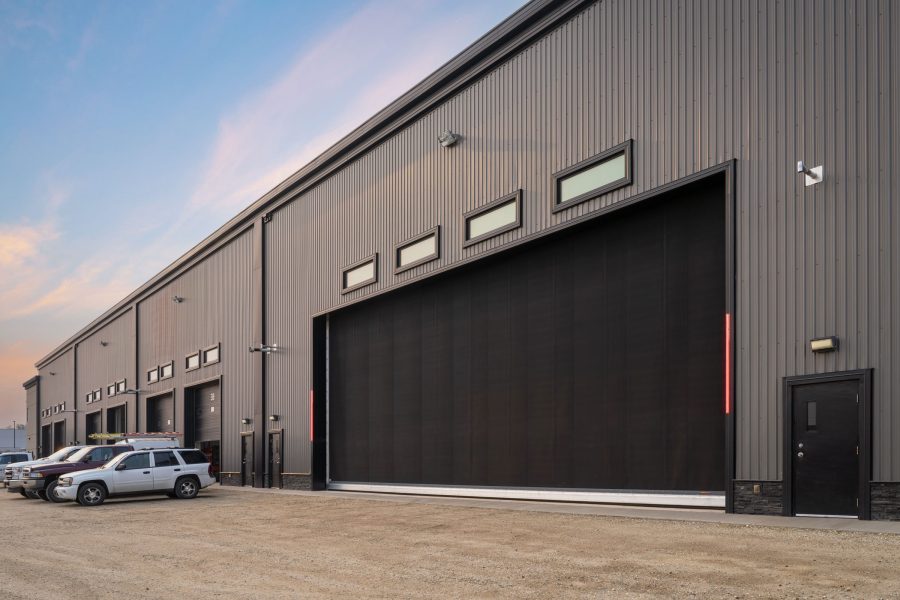
Hörmann is known for manufacturing large rubber garage doors for industrial needs and more. Photo courtesy of Hörmann North America
Every rubber door at Hörmann is custom-made, and all are manufactured to be high-performing and impactable. A car could drive into it, and it won’t take the building down for the day; they’ll quite literally bounce back into operation. Hörmann doors also require little maintenance—usually none up to 100,000 cycles, Hadcock says. The modern Hörmann garage door is in condo buildings all over North America, partly because it’s so quiet—a huge improvement over traditional steel or aluminum doors opening and closing at all hours and disturbing the peace, Hadcock says.
The Hörmann family purchased the then-named TNR company in 2017 with a commitment to invest in employee education and keep the plant in the region. “When you work for a family company like the Hörmann family, they don’t look for investments that are going to pay off in a quarter. They have a very long lens,” Hadcock says.
Marando says the new building was probably one of the largest investments the Hörmann family has made on a new building. He says it was part of a promise they made to the previous owner: “They said, ‘We’re not going to shut you down and move you away. We’re not going to change everything. We’re not going to change who TNR is. We’re going to make it better by reinvesting back into the people and back into the plant.’”
Today more than 80 employees work in the facility—roughly 40 of them in manufacturing and production. “We went from five to 10 doors a year to thousands of rubber doors last year,” Hadcock says.