Story at a glance:
- USG Corporation is an industry-leading manufacturer of building products and innovative solutions, from the world’s first gypsum panel to the first acoustical ceiling tile and beyond.
- A leader at USG shares how the 125-year-old company is building on a tradition of design and manufacturing through a sustainable lens.
“I tell people all the time—USG has really helped shape and develop all the transformational products where we live and work,” says Diane Earll, Ceilings Division president at USG, where she’s been overseeing exciting advances for more than 34 years. “It’s interesting to go through our 125-year history and know that we developed wallboard, we developed acoustical ceilings, we developed modern lightweight technology. We even developed a shaftwall system so big skyscrapers can go higher and use elevators.”
Since its founding USG has been leading a materials revolution, one that continues to push the industry forward, including with some solutions never thought possible, like the recent launch of Sheetrock® Brand UltraLight Tough Panels. “It’s even lighter weight than before, and it’s more durable, so you have less damage on the jobsite,” Earll says. That’s a big deal, given how much wallboard is handled from the time it leaves the manufacturing plant and travels from truck to distributor to jobsite. “This product is more durable so there is less damage and less waste. Installers and distributors are really loving it.”
Why Less is More
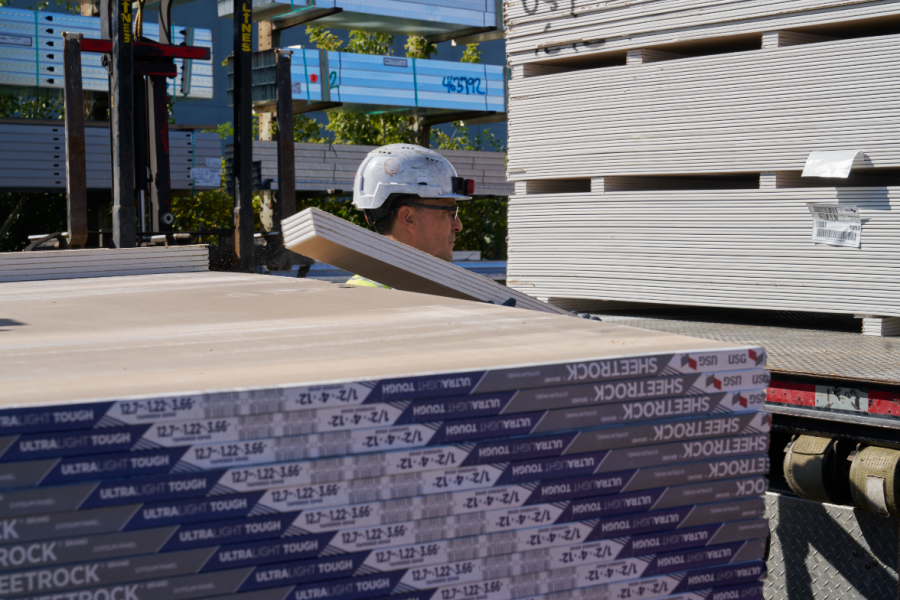
Photo courtesy of USG
Earll has spent her decades at USG in many roles, including in product development as well as focusing much of her time on sustainability and now leading USG’s ceilings business, the company’s second largest area. Today she and her team continue to build on a passion for innovation and material science, which includes creating lighter than ever before solutions, directly improving sustainability outcomes. “We’ve done a really good job of prioritizing our lightweight product portfolio. In 2010 we launched our first lightweight wallboard where we took almost 30% of the weight out of wallboard.”
Why does that matter, she asks? For one, it means using less resources, like water, to manufacture. Less water use means less energy is required to drive off water during manufacturing. “And then, because it’s lighter weight, you can get more products on a truck, so you’re using less embodied energy to manufacture and less fossil fuel to transport.”
Sixteen years after the first lightweight innovation, USG’s latest lightweight wallboard is even more durable than the heavier wallboard. “It’s not that easy to innovate and make it lightweight but still make it more durable and have all the other qualities people like about wallboard,” Earll says. “It’s all about the way you formulate it. We have more than 100 scientists at our Corporate Innovation Center (CIC) just outside of Chicago, and they look at what type of materials you need to create the best wallboard.”
The CIC puts all of its products under intensive testing to be sure they’re both lightweight but also strong enough to hold up over the lifespan of the space. Experts utilize unique fire, acoustical, structural, and environmental testing capabilities to evaluate all products and systems.
“We are taking this generational look at what is going to be needed in 10 and 20 years, too,” Earll says. “It’s thinking about how you solve the needs of contractors saying, ‘We want lighter weight products because we need to work faster on the schedule. And we need to ensure our skilled labor force can safely work longer into their careers.” Considering all of this and more from the beginning results in improved products that benefit everyone, and architects and building owners are demanding it, Earll says. “They want to be more sustainable in construction.”
Low Carbon, High Quality
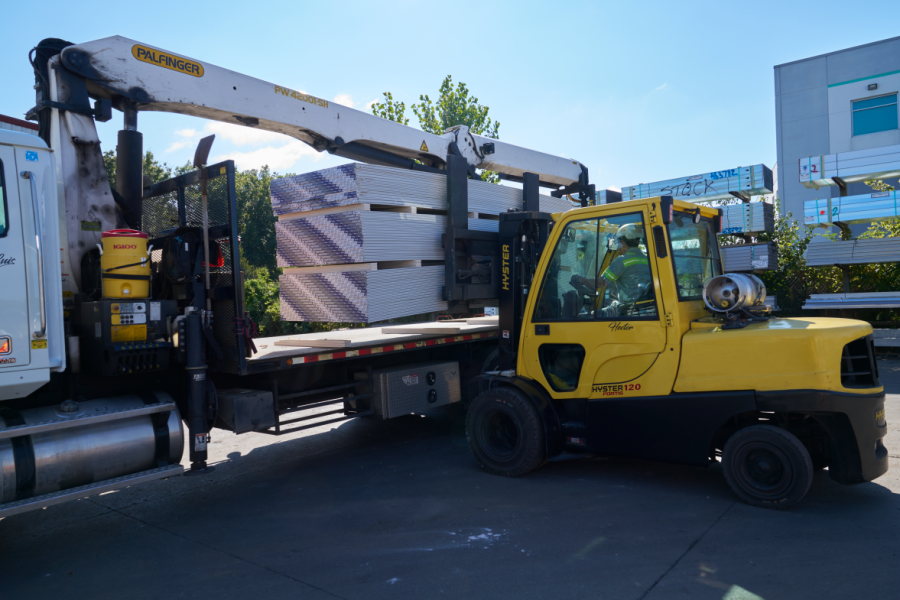
Photo courtesy of USG
USG currently has more than 50 manufacturing plants across North America, with a new, incredibly efficient plant set to open later in 2026 in Wheatland County, Alberta, Canada. “It’s our first wallboard manufacturing plant we have opened in decades,” Earll says.
The new plant will focus on producing wallboard with 20% less carbon emissions and 25% less water. The plant will have an onsite solar field for power operations and take a zero waste to landfill approach; 100% of production waste will be recycled. “This is really one of the first times we’ve done this as a manufacturing plant, but we went in with a vision,” Earll says.
USG also has the capability to bring waste from a jobsite back into its manufacturing operations and reuse that in future processes. “It’s really a circular vision.”
Many of USG’s other plants also have solar fields, Earll says, but the Alberta facility is unique in that every single element is built around sustainability and zero waste. The project comes from lessons learned and processes perfected at other USG plants, she says. “Wheatland has allowed us to design what we would say is best in class. We were able to ask: What could best in class look like? And then we can use that as a proving ground and replicate it in all of our operations.”
We were able to ask: What could best in class look like?
It’s also exciting for Western Canada, she says, as access to many building materials, especially wallboard in that area, is challenging.
Reducing carbon emissions is a win-win, too. “We believe this focus is good not only for the economy but for the future of the planet. We also know it makes really good business sense,” Earll says. “We have proven that when we focus on initiatives that work to reduce emissions, it also drives operational efficiency and reduces operational costs. You focus on reducing carbon, but at the end of the day we’re reducing costs across the business.”
But it doesn’t start and end with products; it’s also operational elements. USG uses LED lights across all of its plants and is always looking at alternative energy opportunities, including wind and hydropower in addition to solar, Earll says. “We will for sure reach 100% renewable power by 2030 in all of our 50-plus manufacturing plants.” On the ceilings side of the business, Earll is proud to say that has already been achieved across manufacturing.
Choosing the right vendors is another path toward a more low-carbon future. USG chooses its partners very carefully, Earll says, with particular focus on how raw materials are sourced. “We’re dependent on that, so how do we focus on partnering with vendors who are local and who have eco-friendly logistics? How do we get it to our customers? And then we encourage our suppliers to have the same vision as us and adopt lower carbon options.”
USG also has a number of recycling programs and partners with both architectural firms and influential building owners when possible in an effort to reduce waste to zero on the jobsite. “We partner with key owners—the Googles or the Amazons of the world, for example—to say, ‘If we are partners with you in this space, we will help remove the job waste from the jobsite.’ We’ll bring it back to our plants, and it’s all about reusing the products. We’re also thinking about doing that from the very beginning,” Earll says.
Forward-Thinking Strategies
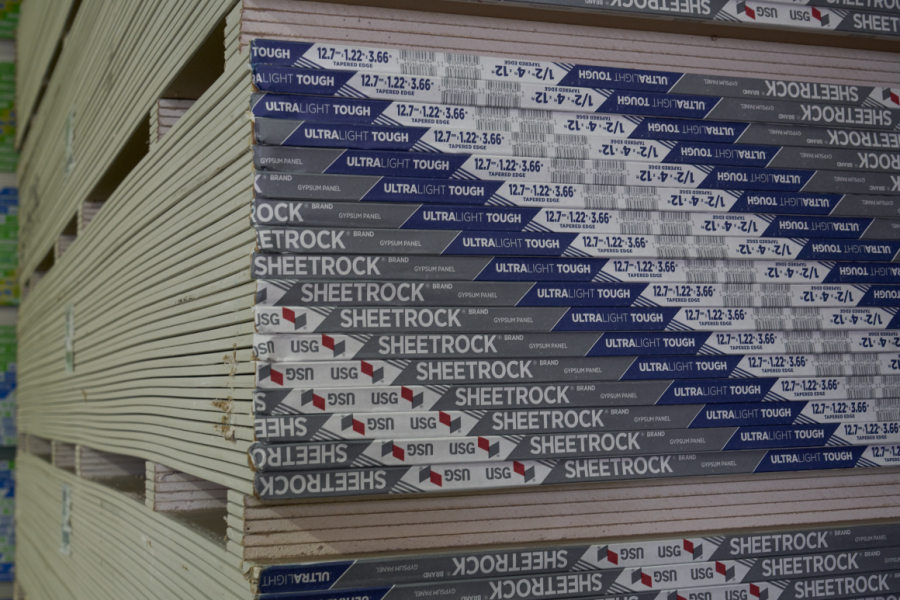
Photo courtesy of USG
Planning for the future is one of USG’s four key strategies. “We are really focused on putting in practices today to be able to plan for the future. Everything we do is with future generations in mind,” Earll says.
Since she started more than 30 years ago, she’s seen a profound shift in attitude around sustainability. Where some people used to talk the talk, not everyone put actions behind their words until more recently. “Did they really believe in it?” Earll asks. “We’ve seen a transformation, and our customers are asking for this. You can’t walk in a building today without seeing a LEED certification, and that wasn’t like that before. When I think about sustainability I’m thinking about efficiency, sustainability, innovation—all of that. We have to think about it from the time we are manufacturing a product because you’re manufacturing a product for the future. You’re anticipating needs in the marketplace.”
Earll says USG will continue to focus its innovations around meeting those needs, even as they evolve or differ depending on location, as what’s built in the US may differ from what’s built in South America, for instance. “You have to look at those trends, but sustainability considerations will continue to shape how we think about the entire life cycle of our product development, including this concept of waste reduction, whether it’s in our plants or on jobsites, and then understanding material efficiencies.”
They’ll also remain committed to extending the lifespan of products once installed. “We’d like to make sure the spaces we help create are easy to maintain, and that comes down to quality and durability. That will not change. How people install it may change, so how do we then take that into consideration?”
While the industry continues to face challenges like labor shortages, contributing to demands for lighter, faster, more durable products, USG will continue to meet those needs while investing in sustainability. “We will continue to ask our customers what they are looking for,” Earll says. “We have always been driven to solve the challenges of the owners and architects who are out there building new spaces, or even repurposing existing spaces to serve new needs for the community.”
She says the focus will forever be sustainability for future generations. “We will not lose sight of that,” she says. “We will achieve our sustainability goals. And then we will figure out what is next, and we will continue to innovate around the needs of the industry we have served for over a century.”