Story at a glance:
- Flooring is one of the most influential—and often overlooked—tools for improving acoustics in schools.
- Soft-surface solutions can significantly reduce reverberation, background noise, and sound transmission.
- Early collaboration between designers and manufacturers leads to better-performing learning environments.
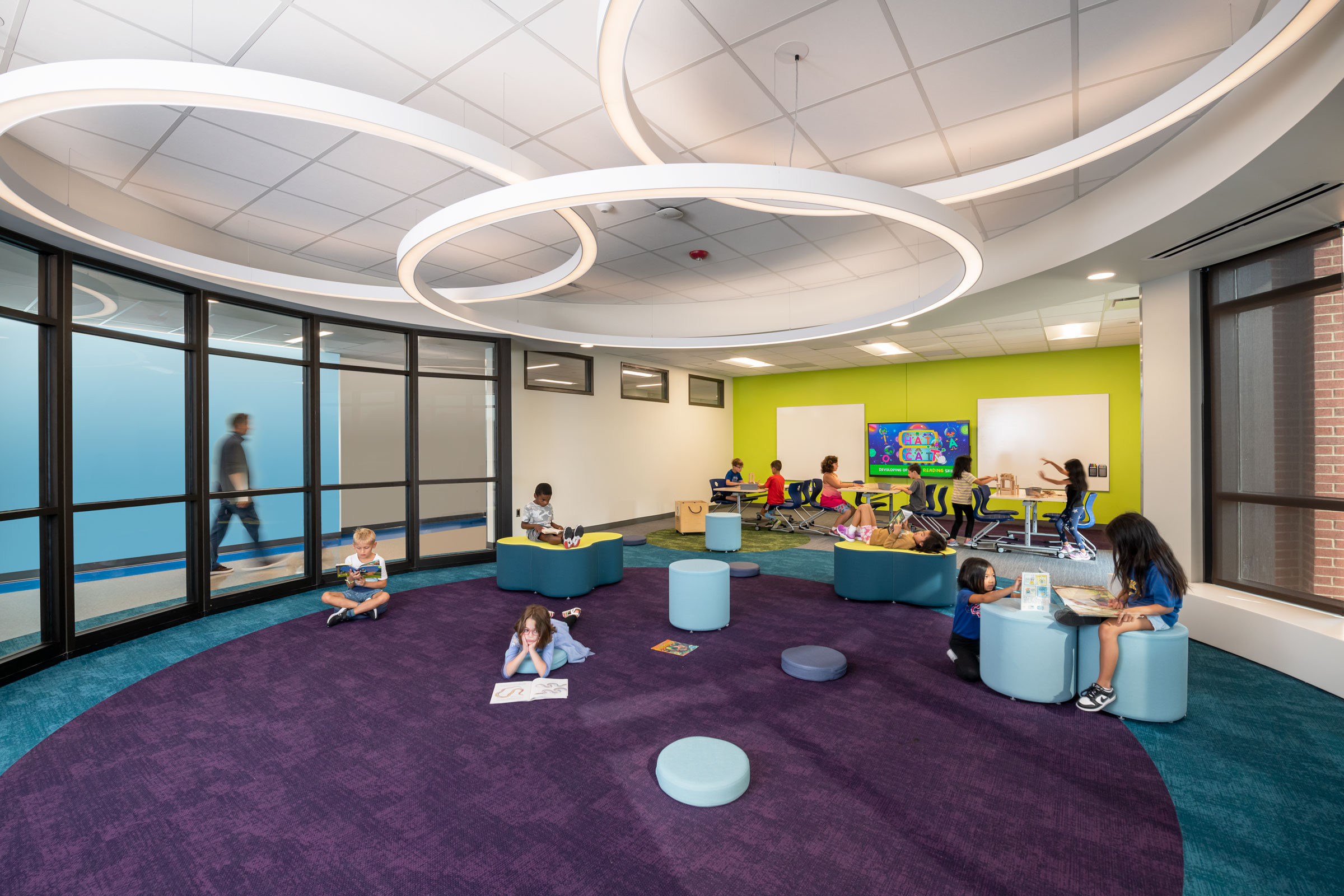
In classrooms across the country, sound is often an invisible barrier to learning. From hallway noise bleeding into lessons to reverberation that muddies speech, poor acoustics can disrupt communication between teachers and students in ways that are difficult to fix after the fact.
While ceilings and wall systems are commonly discussed in acoustic planning, flooring is increasingly emerging as one of the most impactful, though underutilized, tools in the design process. “Flooring is one of the most abundant surfaces in a building,” says Brandon Kersey, director of business development and segment manager for education at J+J Flooring. “Square footage-wise, it’s a whole lot of space that can really be used to work in your favor, not only aesthetically but also acoustically.”
Why Acoustics Matter
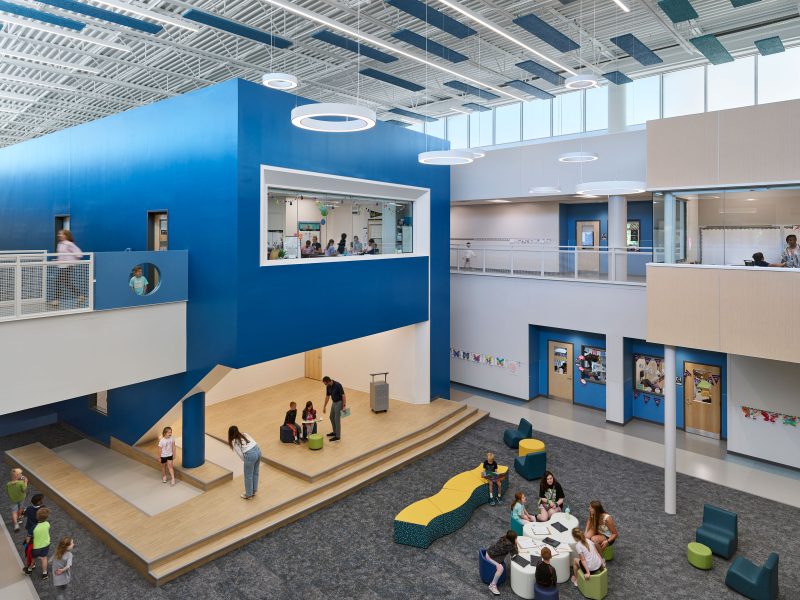
Photo courtesy of J+J Flooring
Communication is essential in any classroom. When sound bounces unchecked across hard surfaces it creates a noisy environment that makes it harder for students to hear and be heard, and that’s a challenge too many teachers are facing. “The main issue is effective communication between the teacher and the students,” Kersey says. “If you have acoustic issues you can start running into problems with reverberation and background noise that really inhibit effective learning.”
Those challenges extend beyond the classroom itself. For instance, corridors can become major sources of disruption, especially during class changes. “If you’ve ever been in a building with hard surfaces during a class change, it can sound like a war going on in the hallway,” Kersey says. “All of that reverberation and echo with no absorption can be incredibly disruptive to nearby classrooms.”
Designers working within existing school buildings often find these issues are magnified. “My work is primarily focused on renovating existing classrooms or designing additions onto older buildings,” says Heather Clark, an interior designer at Esser Design. “Acoustics are rarely something we can design from scratch. We have to improve what already exists.”
A Holistic Approach
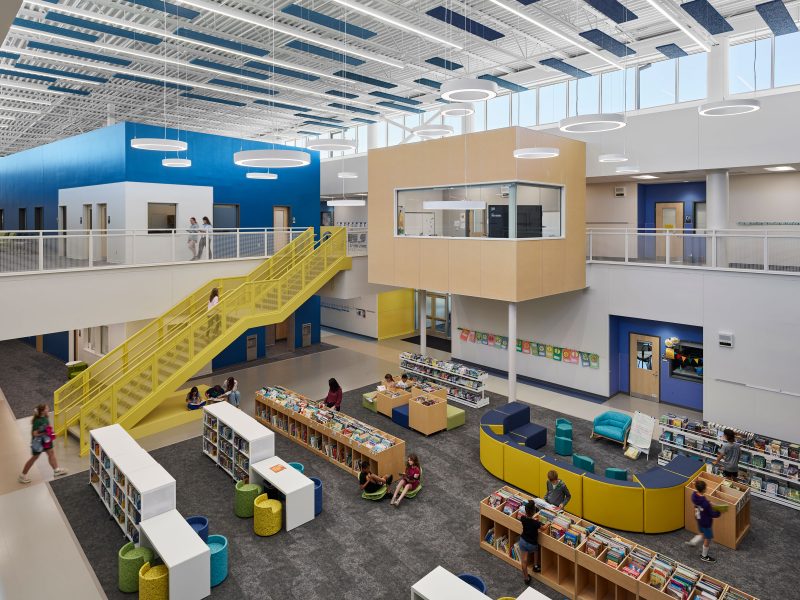
Photo courtesy of J+J Flooring
Rather than relying on a single solution, many of today’s best-performing classrooms take a holistic approach to acoustics—one that considers how sound moves through an entire space.
Clark begins by studying how classrooms function day to day. “I approach acoustics holistically by looking at how a space is used—how teachers move, how students collaborate, and how sound travels between classrooms and corridors,” she says.
In that broader system, flooring plays a central role. “In renovation settings especially, flooring is one of the most impactful tools we have,” she says. “It can significantly reduce reverberation and background noise while also improving comfort.”
Kersey says that while ceilings and wall systems can help manage sound, they are often interrupted by lighting, mechanical systems, and other design constraints. “The floor is really the most plentiful surface you have to work with,” he says. “It covers almost 100% of that horizontal space, so it’s a huge opportunity to absorb and control sound.”
Soft vs. Hard Surface
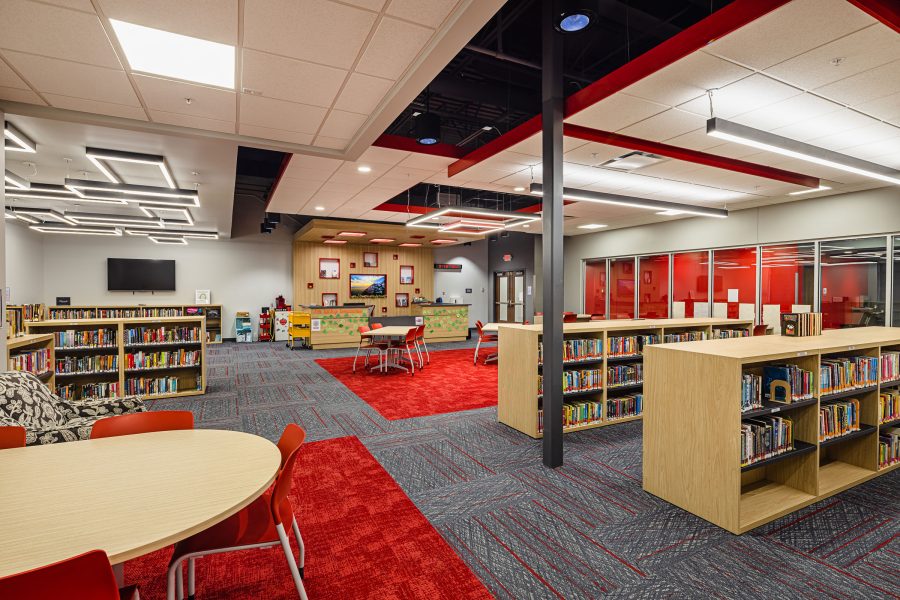
Photo courtesy of J+J Flooring
In recent years many schools experimented with hard-surface flooring like polished concrete or luxury vinyl tile. While those materials offer durability and ease of maintenance, they often come at the expense of acoustic performance. “A hard surface is going to have zero in-room noise reduction,” Kersey says. “It’s going to deflect sound rather than absorb it, which leads to more reverberation.”
That shift hasn’t gone unnoticed by designers. “A common challenge is that school committees often request polished concrete, assuming it will be a cost-saving option,” Clark says. “In reality it comes with significant trade-offs—higher noise levels, increased reverberation, and greater physical fatigue for teachers.”
As a result many schools are reconsidering soft-surface options, particularly newer materials that combine acoustic performance with durability. One example is Kinetex, a textile composite flooring that blends the benefits of carpet and resilient flooring. Unlike traditional carpet, which relies on vertical fibers to absorb sound, Kinetex uses a dense composite structure that maximizes acoustic performance across its entire thickness. “What that means is pretty much all of its thickness is sound-deadening material,” Kersey says. “That yields even better acoustics than commercial carpet.”
Designing for Flexibility
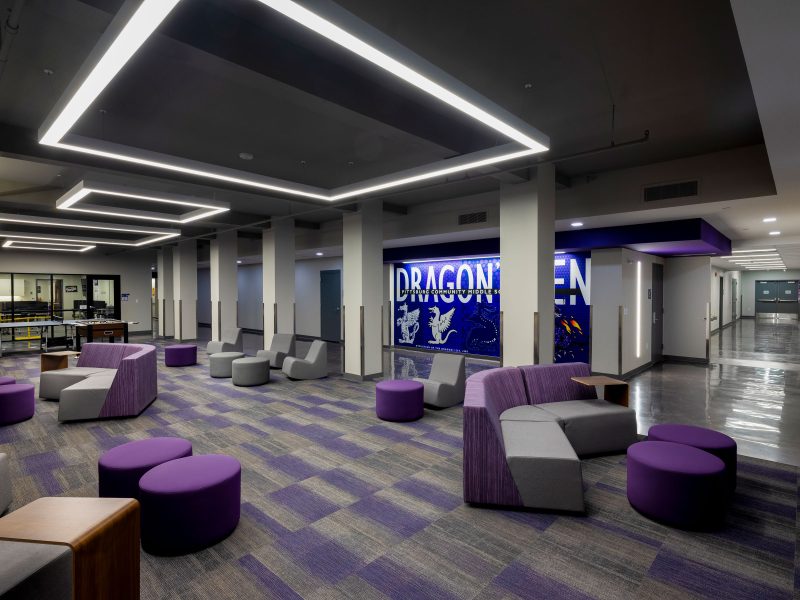
Photo courtesy of J+J Flooring
As classrooms evolve to support more collaborative and flexible learning styles, acoustic performance is becoming even more critical. Students are no longer confined to desks. They move between group work, independent study, and informal learning on the floor, making comfort and sound control essential design considerations. “I design spaces knowing that students don’t learn sitting at desks all day,” Clark says. “They collaborate on the floor, stretch out with laptops, and move between learning modes constantly.”
Flooring that supports those varied behaviors can fundamentally change how a space is used. “When flooring is comfortable and cleanable, it naturally encourages flexibility,” Clark says. “The space supports how students want to work, rather than forcing a single way of learning.”
Teachers benefit as well. In quieter environments they don’t have to project their voices as much, reducing fatigue over the course of the day.
Bringing Flooring in Earlier
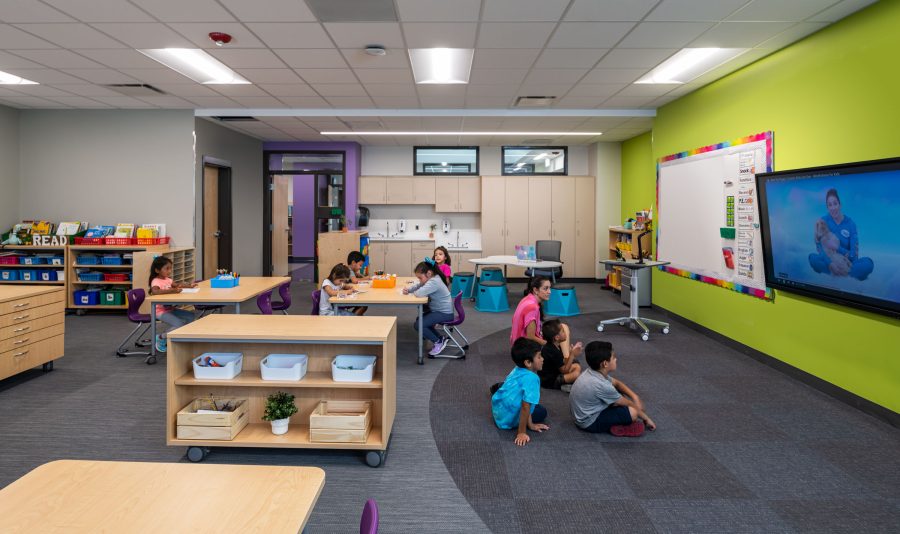
Photo courtesy of J+J Flooring
Despite its impact, flooring is still sometimes treated as a late-stage decision, selected after major design elements have already been finalized. “I think flooring should be considered as early in the process as possible,” Kersey says. “You really need to look at the space holistically.”
Early collaboration between designers and manufacturers can help shift the conversation beyond upfront cost to long-term performance. “Trusted partners play a critical role in educating both the design team and the client,” Clark says. “They help shift the focus to life cycle value, acoustics, comfort, and overall human impact.”
Those early conversations are especially important in renovation projects, where constraints limit the ability to make structural changes. “In many cases flooring is one of the most practical ways to make a meaningful improvement,” Clark says.
A Foundation for Better Learning
Ultimately acoustic performance isn’t just a technical consideration; it’s a human one. When classrooms are quieter, more comfortable, and better suited to communication, they support both teaching and learning in measurable ways.
“Acoustics are huge,” Kersey says. “And when you combine that with the other attributes of these types of flooring solutions, it really ends up being the right answer for education.”