
Story at a glance:
- Planning is fundamentally about shaping the future with intention, not simply reacting to the next proposal.
- A leader at Openlands shares how natural lands are often treated as vacant space awaiting development, when these places are vital to people’s well-being.
- These lands absorb stormwater, recharge aquifers, reduce flooding, improve air quality, support wildlife habitat, and provide important public health and economic benefits.
The Chicago region is undergoing one of the most significant landscape transformations in the country. Across Will County and the southwest suburbs, farmland and open space are rapidly being converted into warehouses, trucking facilities, and logistics infrastructure tied to the nation’s expanding supply chain economy. The recently published story from the New York Times, “20,000 Trucks a Day: Life Near a Booming Warehouse Hub,” captured the human consequences of that growth. But the issue extends beyond any single project or community. It is about whether growth is being guided by long-term planning or driven parcel by parcel through fragmented local decisions.
Local governments are under real fiscal pressure. Communities built largely around single-family housing often struggle to cover the long-term costs of roads, utilities, schools, public safety, and infrastructure maintenance through residential property taxes alone. In that context industrial development and expanded tax revenue can appear necessary. But decisions at this scale cannot be shaped only by short-term fiscal considerations. They should reflect adopted plans, infrastructure realities, environmental limits, and the long-term priorities residents have repeatedly expressed at the local and regional level.
Comprehensive plans exist for precisely this reason. They are intended to help communities manage growth before major land-use decisions are made. Yet increasingly, large industrial projects appear to be advancing ahead of, or in conflict with, the very planning frameworks meant to guide them. As the city of Joliet, Illinois, updates its comprehensive plan and Will County launches the “Guide Will County” process, local leaders should ensure major annexation and rezoning decisions align with adopted and ongoing public planning efforts rather than preempt them.
That concern is especially important in the southwest suburbs, where groundwater depletion risks have been extensively studied and documented. Several communities have approved costly infrastructure projects to import Lake Michigan water as local supplies become strained. At the same time, development patterns continue to intensify water demand. That contradiction points to a larger failure to connect infrastructure planning with land-use policy. Existing watershed plans and watershed protection ordinances should be enforced consistently, and future development decisions must account for the limits of finite natural resources.
Too often natural lands are treated as vacant space awaiting development. In reality they are essential infrastructure. This region contains some of the Midwest’s most significant natural landscapes, including globally rare prairie and wetland ecosystems that remain alongside one of North America’s largest logistics networks. These lands absorb stormwater, recharge aquifers, reduce flooding, improve air quality, support wildlife habitat, and provide important public health and economic benefits. Farmland also sustains the region’s agricultural economy while preserving open space that would otherwise be replaced by pavement and rooftops.

In 2015, through a partnership agreement with the National Forest Foundation and the USDA Forest, 27 bison were introduced as a restoration experiment at Midewin National Tallgrass Prairie. Photo courtesy of Preston Keres, USDA Forest Service
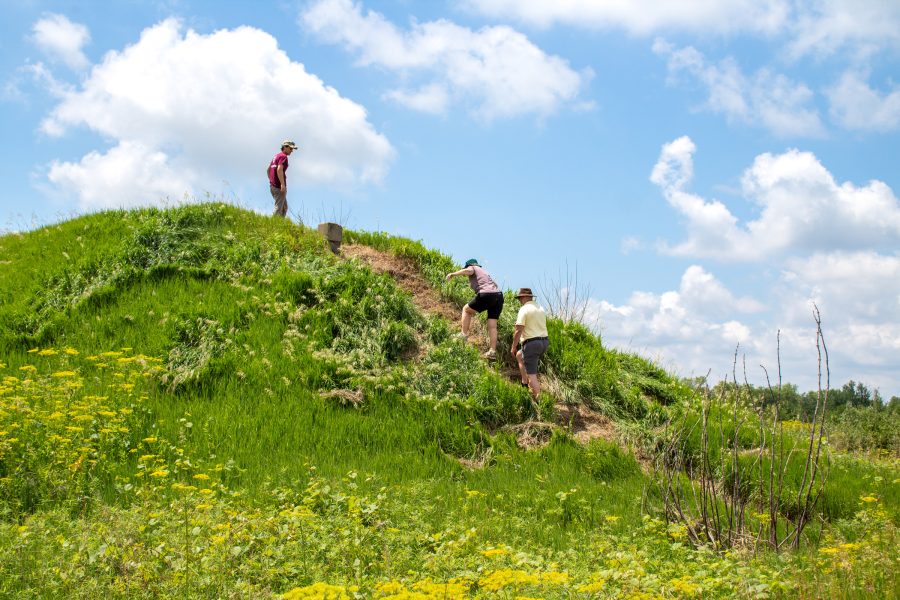
People walk up the back of a bunker for a better view of the landscape during the 30th Anniversary Open House of Midewin National Tallgrass Prairie in June 2026. Photo by Madison Smith, courtesy of Openlands
Openlands has long supported balanced regional growth through efforts like advocacy for the Midewin National Tallgrass Prairie, participation in the Jackson Creek Watershed Plan, and engagement in the “Moving Will County” planning process—planning that clearly states community priorities for natural resource protection in and around this industrial growth. Acknowledgement of this is reflected in Openlands’ involvement alongside local landowners like Delilah LeGrett in litigation related to the City of Joliet’s annexation and rezoning of farmland for large-scale logistics development. But the underlying challenge is broader than any single lawsuit or warehouse proposal.
Increasingly the problem is one of cumulative regional impacts that cannot be addressed through isolated municipal decision-making. Watersheds, truck traffic, air quality, and infrastructure systems do not stop at municipal boundaries. Yet in northeastern Illinois, planning and zoning authority remains highly fragmented across hundreds of local governments, with limited requirements for regional coordination or state-level planning support.
The Chicago Metropolitan Agency for Planning (CMAP) plays an important and valuable role in advancing regional planning and helping municipalities coordinate across jurisdictions, but it will require voluntary collaboration to achieve regional goals set forth by CMAP. In a state with more units of local government than any other in the country, it is striking that there is not more sustained planning guidance or support to help manage growth across such a complex landscape.
Planning is fundamentally about shaping the future with intention, not simply reacting to the next proposal. As growth pressures intensify around the nation’s largest inland port, the public has an opportunity to demand that land-use decisions reflect long-term stewardship alongside economic development. The choices being made now will determine whether this region grows in a coordinated and sustainable way or continues down a path where cumulative impacts outpace the systems meant to manage them.