

Story at a glance:
- Tenants now expect outdoor space to be integrated into buildings, including at home. Outdoor spaces ranked in the top five amenities most important to renters, according to a 2025 survey from Apartments.com.
- The demand for outdoor spaces aligns with a growing desire for more sustainable buildings, but it also reflects a growing recognition of nature’s benefits for physical and mental health.
After a meeting in an office building, you step out onto the terrace to take a call surrounded by greenery. Visit a friend’s new apartment complex and without ever leaving the building, you share drinks on the roof while preparing dinner on communal grills. Almost anywhere you go these days you can find evidence of the rise of outdoor amenity spaces.
What was once an afterthought is now a top priority for builders, designers, and tenants across all sectors, says Hanover’s National Sales Director Lee Fuhrman. “The demand really has never been stronger than what it currently is.”
Healing & Connectivity
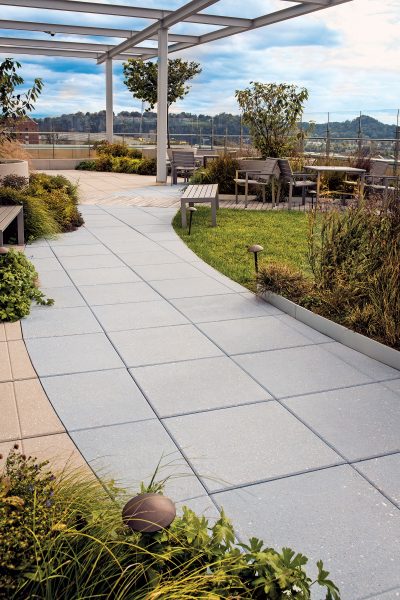
The new Daniel G and Carole L Kamin Tower at UPMC Presbyterian in Pittsburgh, for example, highlights green spaces as a key design element. The paver terrace features a walking path that allows patients, loved ones, and staff to wander around outside surrounded by plants.
Hanover Architectural Products collaborated with the design and construction teams at UPMC to depict acanthus leaves and stems using pavers winding through the pathways. To achieve the design Hanover and the team spent years working together to map out an elaborate arrangement of Hanover’s Prest Brick and Prest Paver square-shaped pavers, including different shades and textures. Most of the four-by-four squares were light in color. To illustrate sprawling leaves that emerge from the lighter tones, the pathway also incorporates the same Hanover Pavers in shades of green—all soothing calming colors, Fuhrman says.
After construction wraps up in late 2026, the Kamin Tower expects to open its doors to patients in January 2027. People will be able to experience the leaf pattern design when walking through the terrace as well as from patient rooms on the western side of the tower. “Pavers are a key component to create that transition from the indoor to the outdoor environment,” Fuhrman says, adding that the strategy keeps outdoor green spaces from feeling disconnected from the rest of the structure.
As part of the project artist, Stacy Levy also created glass pavers cast with medicinal plants the same size as the Hanover Pavers. These are incorporated in the ground around the terrace’s seating areas.
Whether it’s the presence of shady plants to make the space more comfortable during summer or the nature-inspired public art and walking path, the Kamin Tower project links the entire medical facility and the people within it to the natural environment. When you take a break outside and breathe fresh air, your mind relaxes, and it’s easier to be vulnerable with others, too, leading to conversations you might not otherwise have, Fuhrman says.
Indeed, green spaces offer a variety of documented health benefits, including encouraging physical activity and social interaction as well as psychological restoration, according to a paper published in Risk Management and Healthcare Policy. Specifically, nature lowers stress hormones like cortisol and helps slow the heart rate while boosting serotonin and dopamine levels, thereby improving mood, according to the Minnesota Department of Health.
For a medical facility, an outdoor space becomes a place to bond and share information that can help people get through exhausting and painful experiences while extending much-needed stress relief to patients, their family members, and staff.
Green Space in the Workplace
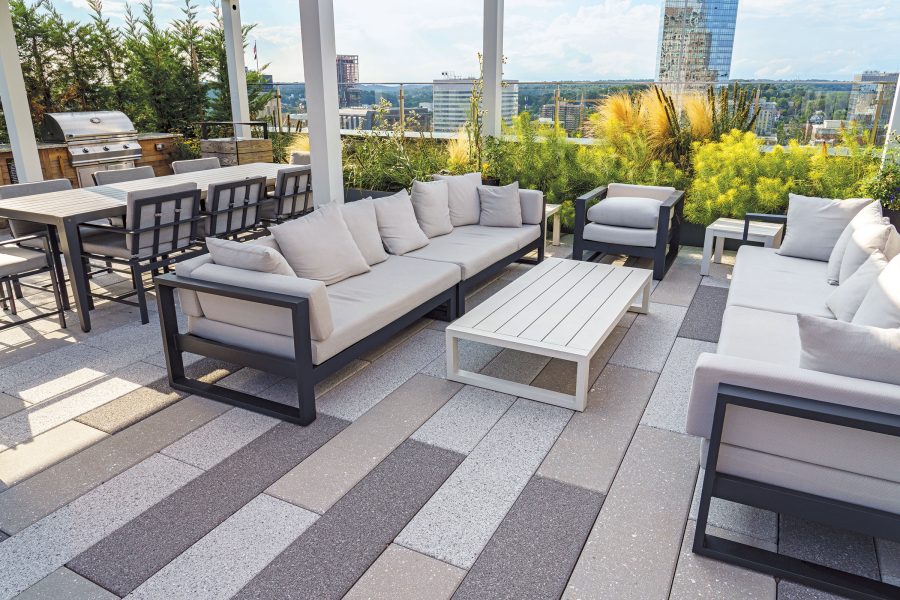
During the pandemic large swaths of office workers became accustomed to working from home, stepping outside for fresh air whenever they wanted or taking their laptops out to the patio to work outdoors. Fuhrman says tenants have come to expect outdoor space embedded in the work environment no matter where that is. “The outdoor amenity space has become essential rather than optional.”
When design teams work on corporate campuses and mixed-use properties, for example, they’re prioritizing outdoor spaces from the inception of these projects at a rate that was extremely uncommon a few decades ago. In the past these outdoor amenity spaces were often offered as mere accessories to the building, rather than a core part of the overall design. “A lot of times paved surfaces were value engineered out,” Fuhrman says.
That has changed drastically, and today mixed-use office buildings with amenities like green spaces significantly outperform peer assets for rental rates, according to JLL research. Modern offices are also seeing more life at all hours, as part of more popular mixed-use buildings that include conference centers, bars, and even hotels and entertainment centers, too.
In these mixed-use properties outdoor amenity spaces act as a bridge between a variety of tenants. Often tenants also use outdoor spaces as a centralized gathering area for large events that members of the broader community can attend. JLL found that for this new generation of “live-work-play” office buildings, enhanced outdoor rooftop terraces and courtyards serve as top revenue drivers.
Ultimately outdoor amenity spaces aid employee retention, tenant retention, and increase the building’s profitability, Fuhrman says. He adds that the demand for outdoor amenity spaces also continues to increase competitiveness in the marketplace from building to building. “Who has the better amenities could be where some people will land.”
For large companies with their own campuses, outdoor amenity spaces have become a crucial design feature. Hanover has provided pavers for outdoor areas on the corporate campuses of Apple, LinkedIn, Facebook, and Microsoft, to name a few.
While the demand for outdoor spaces aligns with the desire for more sustainable buildings, it also reflects a growing recognition of how green space can naturally improve work environments. For example, researchers found that integrating green space into the workplace improved relationships and cooperation with colleagues, reduced stress levels, and boosted creativity and concentration in a 2023 study published in the International Journal of Environmental Research and Public Health.
A Sense of Community
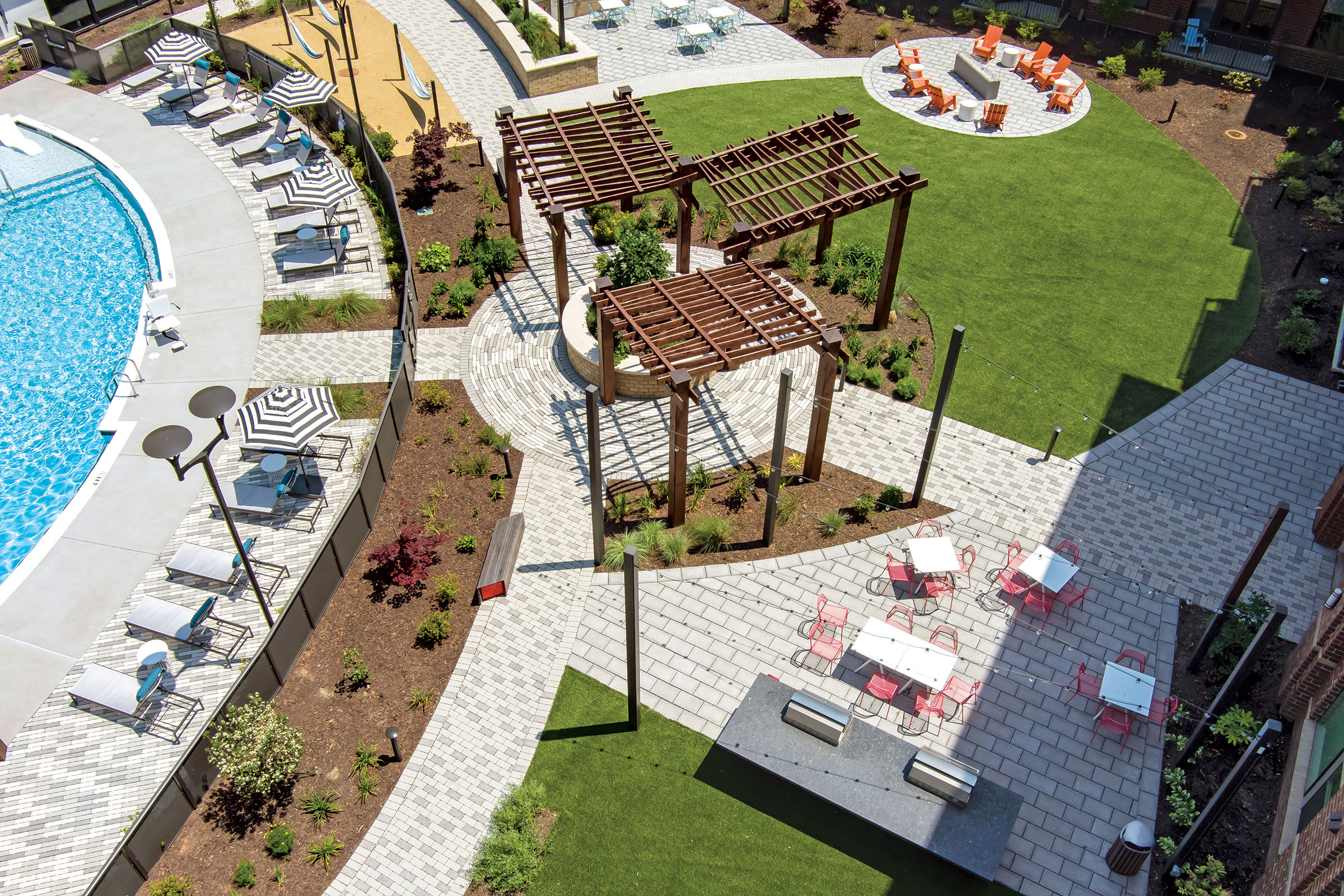
Outdoor amenity spaces are also becoming common in multifamily environments. Outdoor spaces ranked in the top five amenities most important to renters, according to apartments.com, with 37% of respondents calling them crucial.
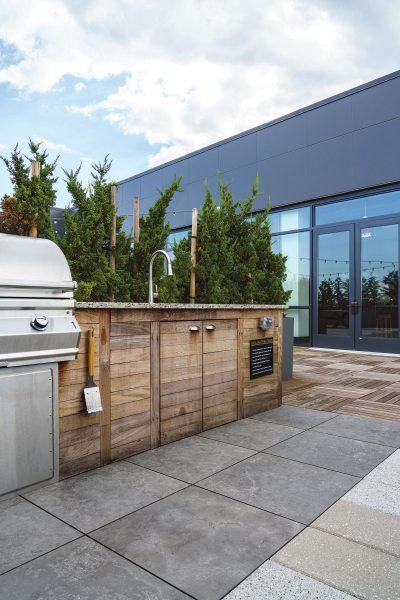
When Hanover works on multifamily complexes, pavers create natural pathways for people to move between kitchen areas, the pool, and indoor spaces. In several projects Hanover’s Porcelain Pavers also helped outdoor communal kitchen areas stay clean and maintain their value, Fuhrman says. “If any drippings fall to the ground they have a tendency to stain other materials, but porcelain pavers are able to be tidied up very quickly.” This also reduces the cost of maintenance for building owners while allowing tenants to continue to enjoy the area.
Communal outdoor spaces like rooftops on apartment buildings also help foster human connection. “The making of potential friendships starts with a simple look or conversation, where nowadays you see how many times people just pass one another because they’re looking at their phones,” Fuhrman says. After looking at screens all day, beautiful plants on a nice day in an inviting environment can encourage people to look up from their phones and actually see each other, he says.
Research consistently demonstrates that greenery in the built environment helps people form a sense of community, expand their social contacts, and decrease feelings of social isolation, according to the Harvard Chan NIEHS Center for Environmental Health. “People start acting and reacting differently when they’re in an environment that welcomes you to breathe,” Fuhrman says.
