Story at a glance:
- Resilience meets sustainability at Palisades Charter High School after the LA fires, designed by DLR Group.
- Strategies included maximizing daylighting and incorporating natural ventilation, and native landscaping.
On January 27, 2026, Palisades Charter High School students returned to their original campus for the first time since the devastating Palisades Fire destroyed approximately 30% of the classrooms and forced a one-year closure. Today classes are resuming in remediated surviving buildings and modular interim classrooms as students and teachers reconnect after an intensely challenging period of loss and instability.
As lead architect responsible for the rebuild of Pali High, as the school is colloquially known, we at DLR Group celebrate this important milestone and look forward to the reimagined campus fully opening in 2028. In its next chapter the school will offer an educational environment as inspiring, adaptable, and resilient as the community that it serves.
Future-Focused, Fire-Resilient Design
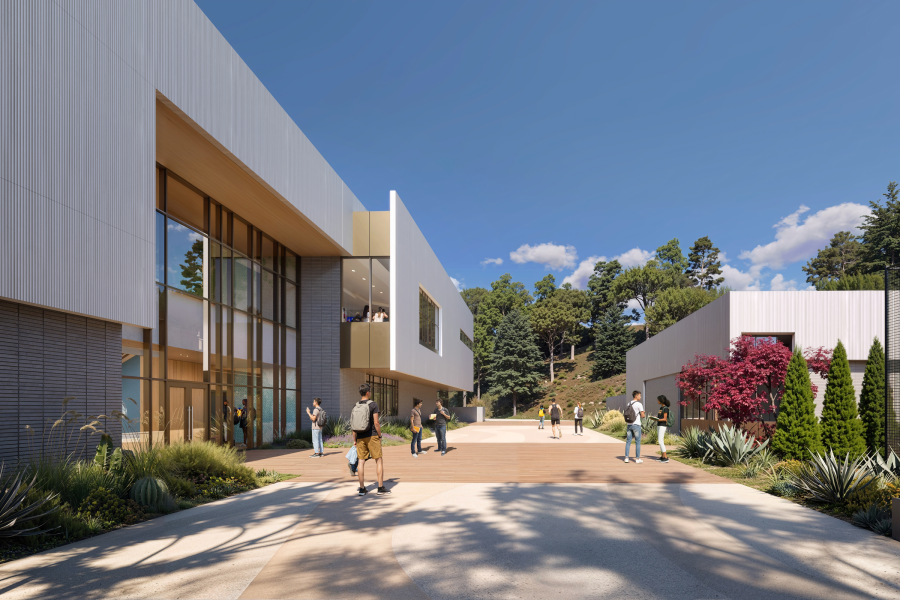
DLR Group specified Class-A roofing and non-combustible cladding, including metal panel systems and brick veneer, for the new Palisades Charter High School. Rendering courtesy of DLR Group
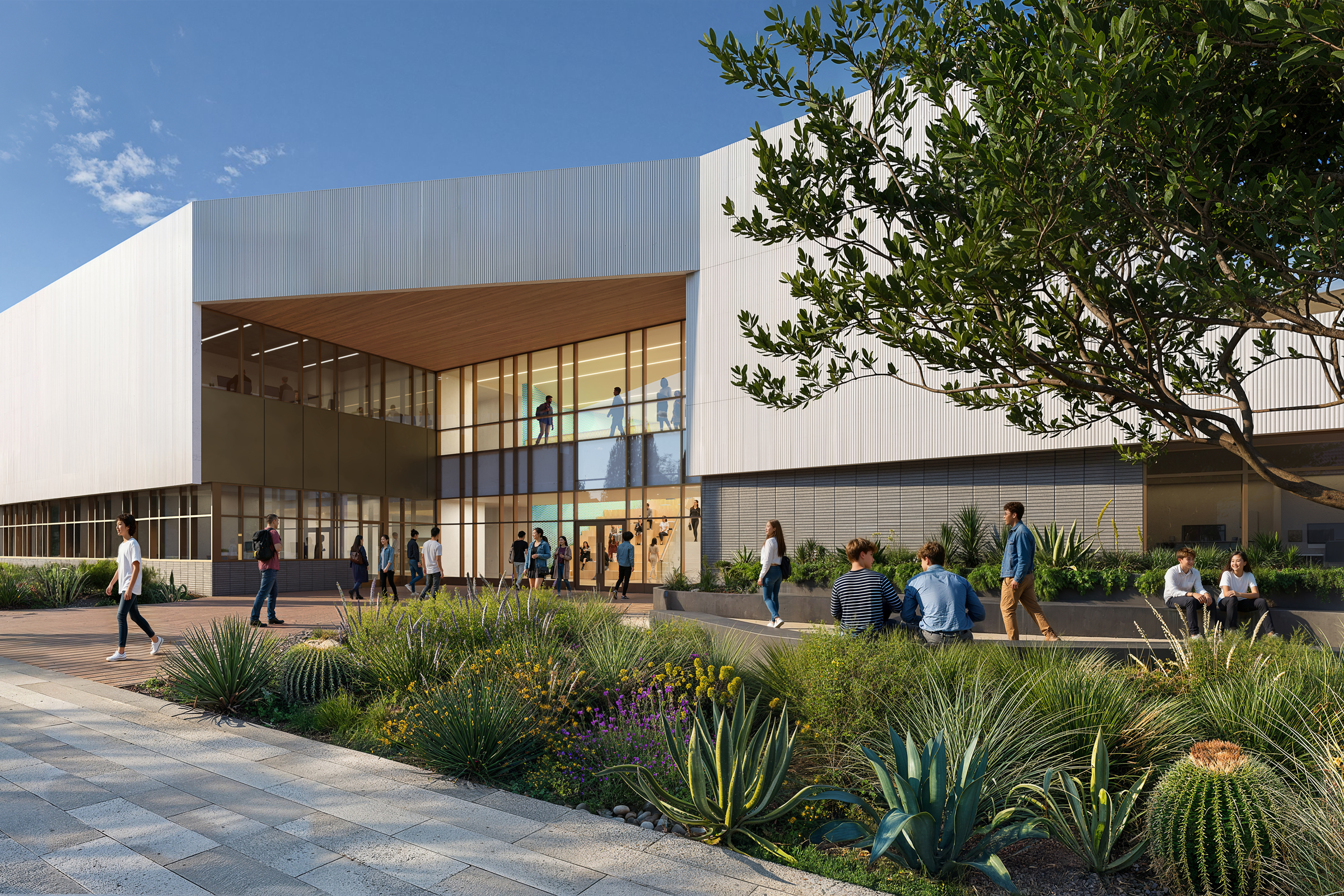
Strategic landscape design, materials and assemblies, and mechanical systems provide fire protection for the new campus, ensuring Pali High reemerges stronger and more secure. Our team designed defensible spaces through native, fire-adapted plantings, terraced slopes, and shaded fuel break areas. The design maintains a 30-foot defensible zone around the new buildings, with no woody plants, no bark mulch, and fire-resistant ground covers. Stormwater features serve fire break purposes and provide rainwater collection. We specified Class-A roofing and non-combustible cladding, including metal panel systems and brick veneer, the latter creating a connection to the architecture of the existing campus buildings.
To ensure indoor air quality, the buildings are designed to switch to a protective mode during wildfire conditions. The design includes sealed economizers, reduced roof penetrations, and rooftop mechanical strategies designed to limit smoke intrusion. Rooftop solar panels will energize the building in the event of an emergency.
Pali High will incorporate CALGreen and CHPS-aligned strategies that prioritize sustainability, student health, and long-term resilience. The design features a high-performance building envelope with continuous insulation, low-E glazing, and integrated exterior shading to reduce energy demand while maintaining thermal comfort.
The campus will operate with all-electric, high-efficiency HVAC systems supported by onsite photovoltaic generation and battery storage, advancing decarbonization and ensuring continuity during power outages. Daylighting strategies will maximize natural light with effective glare control to lower energy use and enhance learning outcomes.
Water efficiency will be achieved through drought-tolerant native landscaping, high-efficiency fixtures, rainwater capture, and gray water reuse in compliance with CALGreen requirements. In response to wildfire and seismic risks, the campus will employ fire-resistant materials, defensible space planning, and seismic-resilient structural systems to create a healthy, low-carbon, and durable learning environment designed for long-term resilience.
These integrated strategies will help the Pali High community thrive in a changing climate. This campus is poised to become a beacon, demonstrating the pivotal role schools can play in recovery by demonstrating environmental leadership.
A Vision to Rebuild and Reimagine
DLR Group has extensive experience building back better in the aftermath of crises and natural disasters. After a May 22, 2011, tornado destroyed 10 schools in Joplin, Missouri, our team collaborated with CGA Architects on the James D. MacConnell award-winning interim high school and designed a new permanent facility that transformed loss into an opportunity to evolve.
In partnering with Los Angeles Unified School District to rebuild Pali High, our focus was returning students and teachers to a permanent facility and bringing a sense of normalcy and stability to students and families whose communities were devastated by the fires. And rather than simply replace damaged structures, we saw an opportunity to transform the campus into a model of future-ready learning, climate resilience, and sustainable design.
Our design includes a new two-story classroom building, a single-story academy building, spaces to support on-campus programs during construction, a restored track and field area with new field building, and a renewed baseball field.
With the loss of CTE spaces in the fire, we are centralizing new film, media, engineering, and maker spaces in the two-story building, with acoustic infrastructure, advanced filming capabilities, and indoor/outdoor flexibility to elevate the experience for students exploring diverse career pathways. The design integrates outdoor learning opportunities, learning stairs, and interactive corridors that anchor circulation and student engagement. Newly added collaborative and gathering spaces serve as valuable resources for the entire campus, enhancing the educational experience for all students.
Designing for Emotional Resilience
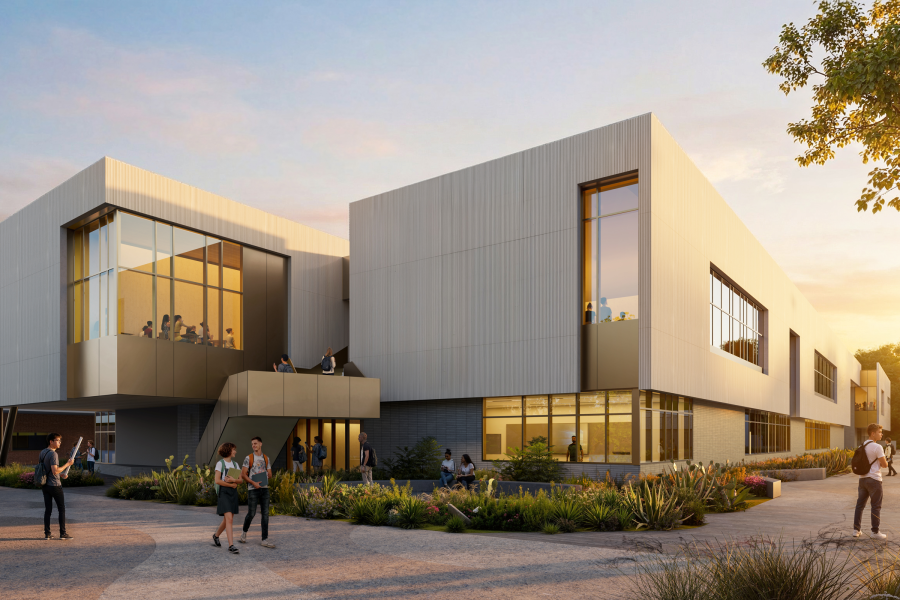
Students returned to Palisades Charter High School, designed by DLR Group, in January 2026. Rendering courtesy of DLR Group
In the process of mapping out a plan to rebuild Pali High, our vision was grounded in the reality that the fire did not just destroy buildings; it disrupted safety, security, and the interactions and routines that knit communities together. Drawing from 25 years of collaboration with Los Angeles Unified and consistent community engagement, we set out to create flexible learning spaces that foster collaboration and belonging.
Building a new identity as a campus of interwoven indoor-outdoor spaces, the new program extends learning beyond the classroom, ensuring that circulation, gathering, and specialized spaces serve a dual purpose of connection and enrichment.
Inspired by Pali High’s dramatic setting between the cliffs of the coastline and the canyon beyond, the design features learning stairs, ground-floor science, engineering, and maker spaces connecting to outdoor learning zones, and classrooms organized in stacked configurations with adjacent teacher collaboration areas that allow learning to extend into breakout zones. Outdoor plazas, rain gardens, and amphitheater-like spaces create layered moments of learning and reinforce a sense of togetherness on campus.
Incorporating biophilic design principles, our design aims to transform campus into a healthy, energy-efficient, and fire-resilient environment. Maximized daylighting, natural ventilation, and native landscaping don’t just reduce the new buildings’ environmental impact; they also enhance the overall student experience, enhance well-being, and prepare the campus for environmental challenges.
We can build a brighter, more resilient future in the aftermath of crisis. Pali High offers lessons in how to transform recovery into a period of refinement, reaching new heights of environmental, emotional, and educational readiness.