Story at a glance:
- Four Sherwin-Williams experts contributed to the development of a new PCR for resinous floor coatings, establishing a framework for EPDs.
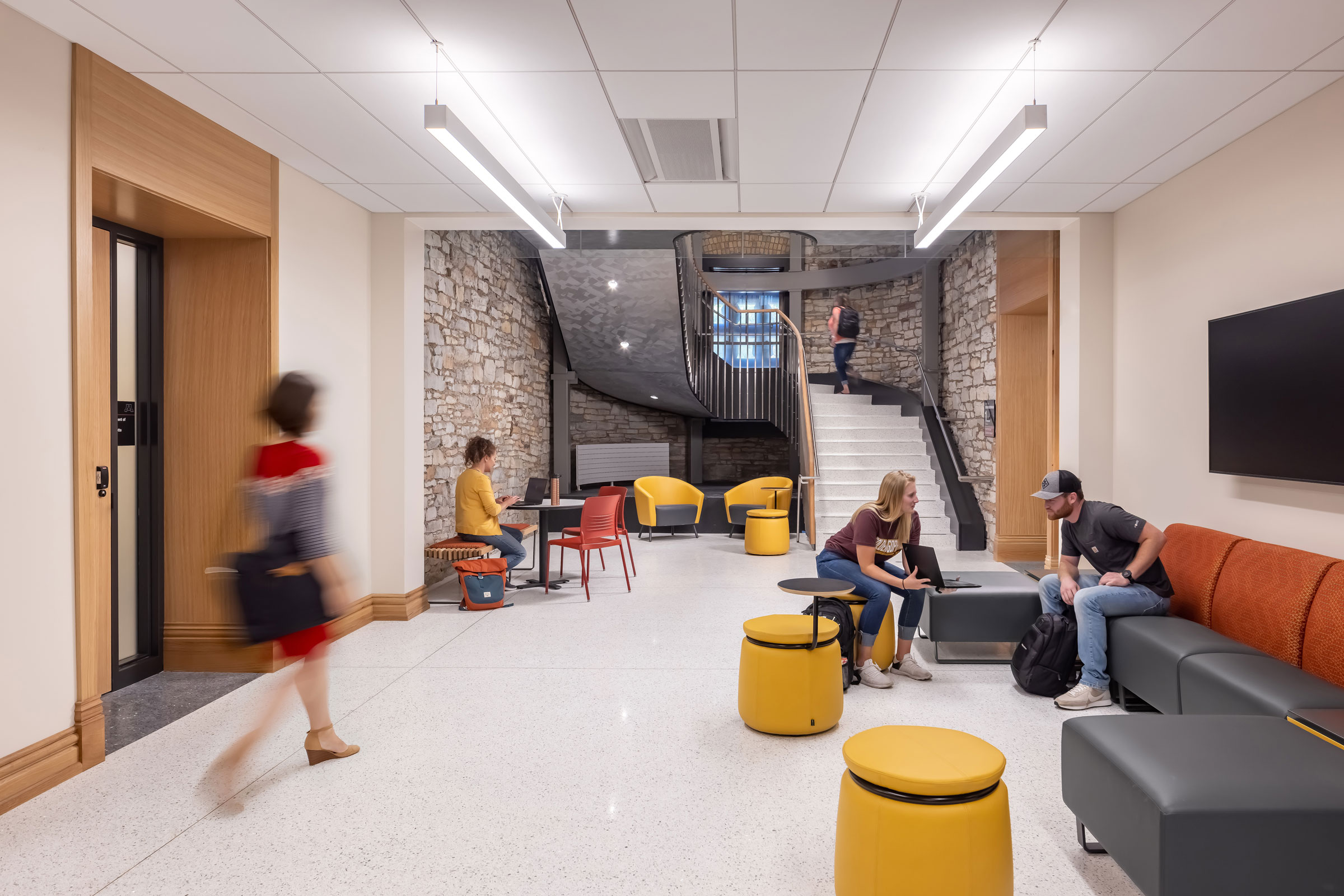
- Resinous flooring systems from Sherwin-Williams offer architects and builders an attractive, customizable way to satisfy LEED goals, no landfills required.
- Resinous flooring offers exceptional durability and longevity among flooring options, never needing to be replaced or contributing to landfills.
Millions of tons of carpeting, tile, laminate, and VCT wind up in landfills every year. Still, many architects and designers may not specify flooring products that can last a building’s lifetime, and environmental certification programs haven’t always rewarded such choices.
That’s changing fast, however. In February 2026 Sustainable Minds published a new Product Category Rule (PCR) for resinous flooring under LEED v5 that awards points for low-emitting materials, long-lasting products that reduce waste, and systems that reduce water and energy consumption.
That may push resinous flooring products—standout solutions for durability, longevity, and customization—to the top of architects’ wish lists. “You never need to tear it out and put it in a landfill,” says Jen Zepeda, marketing director for Sherwin-Williams High Performance Flooring. “The new PCR acknowledges that, and it’s a big selling point.”
The New Rule
Previously the PCR assessed flooring only by the environmental performance of the overall system. The new rule indicates that “resinous flooring systems are typically not completely replaced over the service life of the building, but instead are periodically resurfaced.” This allows users to customize systems to meet job requirements and earn points toward certification—sometimes more than what a standard flooring system might.
Four Sherwin-Williams experts contributed to the development of the new PCR for resinous floor coatings, establishing a framework for Environmental Product Declarations (EPDs). EPDs now distinguish between single-layer products and multilayer systems, permitting a more granular representation of complex installations’ sustainability.
Sherwin-Williams has published EPDs for nine resinous flooring products so far, making them eligible for four different LEED Materials & Resources credits. In addition, new LEED for Interior Design and Construction guidelines allow flooring solutions to contribute points toward LEED status on new and retrofitted projects.
A Lasting Solution
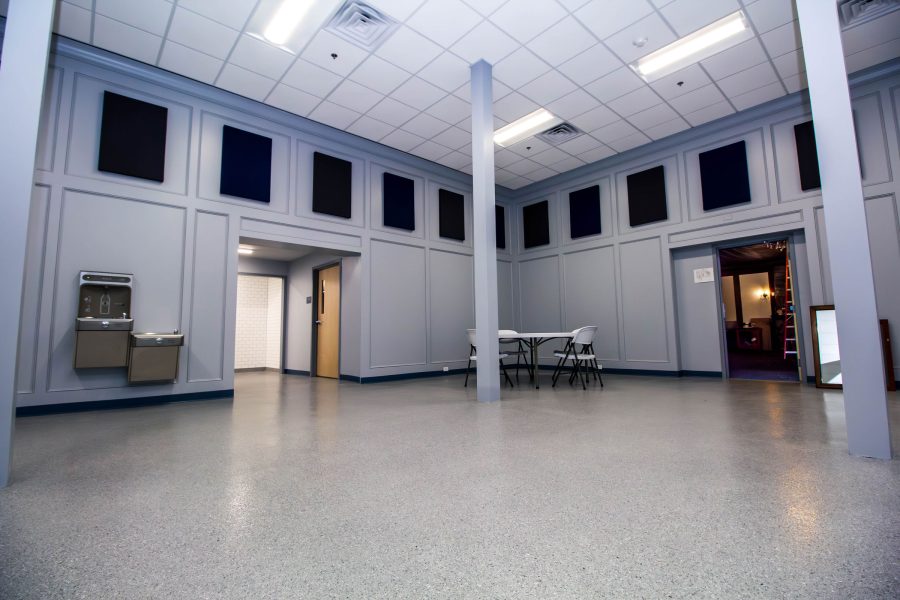
Calming and peaceful blues and purples are common in educational settings. Photo courtesy of Sherwin-Williams
Resinous floors’ biggest contribution to sustainability is their extended life cycle. The coatings can outlast VCT, quarry tile, and other flooring solutions by decades, preventing the frequent removal, replacement, and disposal of flooring components. A resinous floor can also be mended easily or act as the substrate for an entirely new floor if a project demands it.
“We look at what ends up in a landfill and how often you have to replace the product,” Zepeda says. “If a tile cracks you take it out, dispose of it, and replace it with a new tile. If something happens to a resinous floor you repair it onsite. Nothing is torn out; nothing is added to a landfill. With resinous floors there is no end of life—no landfill scenario whatsoever.”
Thanks to rapid-cure formulations, professional-grade resinous floors produce extremely low levels of VOCs compared to the epoxy systems familiar to homeowners. That means new installations, retrofits, and repairs can be performed without limiting access to critical areas of commercial buildings, schools, and health care facilities or endangering occupants.
The Sherwin-Williams lineup includes 30 products that satisfy LEED requirements for VOC emissions testing, and the company maintains strict compliance with regulations pertaining to hazardous chemicals, waste management, water, sanitation, and ventilation in production. “Anyone who’s purchased materials and done their own garage floor at home thinks, ‘Epoxy has such a strong odor,’” Zepeda says. “These commercial resinous flooring solutions are 100% solids, which means they have very low odor, and, in many cases, zero VOCs.”
Built for Durability
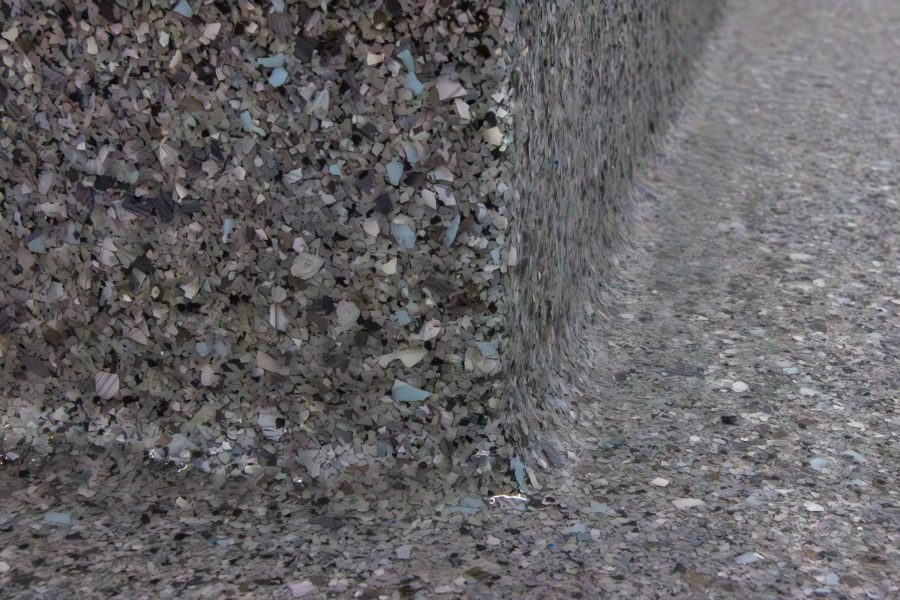
Cove bases are often built into resinous floors that need to be cleaned regularly to encourage drainability away from what would otherwise be 90-degree wall-to-floor transitions that could harbor dirt and bacteria. Photo courtesy of Sherwin-Williams
A variety of resinous coatings are available to tailor the floor’s durability to its purpose, from foot traffic to forklifts. Resinous floors can distinguish a hotel lobby or be designed to withstand water, chemical exposures, biohazards, and heavy industrial applications. “That’s the beauty of these systems; they can be built for any space or scenario,” Zepeda says.
Resinous floors are a good choice for areas that need to be cleaned regularly to preserve public health, including commercial kitchens, locker rooms, and restrooms. Because they are seamless and feature an integrated cove base, there’s no risk of dirt and bacteria building up and festering in caulk, corners, or grout with regular cleaning procedures.
“Say you go through an airport, and there’s carpet,” Zepeda says. “If someone loses their lunch on that carpet, there’s no way you can ever fully sanitize it. With a resinous floor you can thoroughly sanitize it.”
Color and Wellness
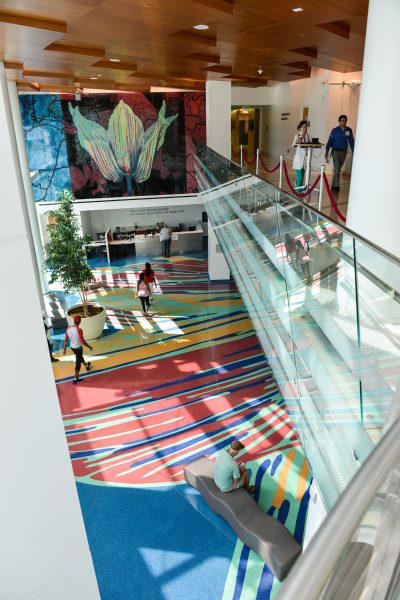
The use of color in resinous flooring installations can bring energy, cheerfulness, and a sense of calm to building occupants, with a wealth of color combinations available to set the desired mood. Photo courtesy of Sherwin-Williams
Beyond LEED, other certifications focus on the livability of the built environment. The WELL Building Standard has also expanded to include the importance of low impact colors and designing for inclusivity for all. As color research has taught us, our bodies can have physical and emotional reactions to color—reds are associated with energized emotions and increased heart rate, yellows and oranges are cheerful and can encourage conversation, and blues are calming and peaceful.
Many architects and builders now favor natural hues that support human health and well-being. “Color ties into sustainability,” says Amanda Lowery, marketing manager for Sherwin-Williams High Performance Flooring. “Even seeing the colors of nature in a space without a window can give you the benefits of a connection to nature.”
In resinous flooring, the most popular colors are neutrals that mimic natural stone aggregates. Sherwin-Williams identified Universal Khaki as its Color of the Year in 2026 Colormix Forecast; it’s a neutral that adapts to different interiors without compromising durability.
“With flooring we look toward colors that are always on-trend, come from nature, impact health and wellness, or are tied to branding colors,” Lowery says. “If a space is going to be sold, you want a neutral color that can go with whatever branding comes in. But if you’re designing a build that’s staying there for a prolonged period of time, you can get more creative.”
Customized and On-Brand
The floors offer thousands of color combinations and mix-ins to accommodate any application. “Mica can offer a natural or earthy feel,” says Jason LaBouve, president and CEO of Sheboygan, Wisconsin–based Torginol, which supplies a variety of mica, quartz, and metallic flake additives for resinous flooring. “There are a lot of tasteful ways to use this.”
In spaces that might cause anxiety, like health care settings, blues brings people down to earth, Lowery says. “In waiting rooms we often see a mixture of green and blue flakes. In education we see a lot of purple, which gives you the calming benefit of the blue, plus a little bit of energy from the red. It really sparks creativity.”
Mix-ins can match any Pantone color or brand guideline. A custom flake Torginol created for the University of Maryland, for example, included a mix of gray, white, and black flakes with a pop of yellow to match its logo. Flakes and coatings can also reduce glare, add slip resistance, and provide other benefits like sound dampening.
While resinous floors may not be the first consideration in a building’s design or efforts to earn environmental certification, they can support sustainable goals by offering lasting durability and cutting waste. Torginol plans to further improve sustainability by incorporating 20% recycled glass content from disused solar panels into its products.
“Designers and architects have a vision, and it usually doesn’t start with the floor,” Lowery says. “It starts with another material we need to coordinate with. That’s the beauty of being able to customize and mix these colors in different ways.”