Story at a glance:
- The construction industry generates more than 600 million tons of waste annually in the US, and circularity is increasingly moving from sustainability add-on to core business strategy.
- USG’s Take Back recycling program diverted nearly 10,000 tons of gypsum construction waste from landfills in 2025, while their product innovations are embedding circular thinking into manufacturing from the start.
- For building professionals, early coordination between owners, architects, contractors, and manufacturers is the single biggest factor in making circularity work on a project.
The building industry has been talking about circularity for years, but putting it into practice at the level necessary to drive measurable change is a different matter.
Circularity in construction—the idea of keeping materials in continuous use rather than sending them to landfill—has gained real traction as a concept. But operationalizing it at scale requires rethinking not just products but entire systems. And the industry, by most accounts, is still in the early stages.
“Circularity in construction means a closed loop system that eliminates waste and reuses materials,” says Srinivas “Dr. Vas” Veeramasuneni, chief technology officer at USG Corporation. “But the main aim is to preserve natural resources for future generations. It is a change from the linear model in which resources are extracted, made into products, and then become waste.”
The stakes are significant. The built environment sector accounts for roughly 50% of raw materials consumed globally and around 40% of CO2 emissions, according to the Ellen MacArthur Foundation. In the US alone the EPA estimates that construction and demolition debris totals more than 600 million tons annually; that’s more than twice the amount of municipal solid waste. Moving that needle means rethinking the full life cycle of building materials, from the drawing board through demolition.
Where the Industry Stands
Veeramasuneni describes the industry as somewhere between the early and middle stages of adoption, with momentum building but real barriers still in the way. “Circularity is still often treated as a sustainability add-on rather than a core business strategy,” he says. “People think it’s nice to have, but it has not reached the point where it is considered a must-have.”
Two obstacles stand out. The first is infrastructure: Job sites lack the systems for sorting, storing, and transporting materials back to manufacturers. The second is collaboration. Architects, contractors, building owners, and manufacturers often work in silos, with different sustainability goals and no shared mechanism to close the loop. “It’s not just recycling,” Veeramasuneni says. “You’ve got to make sure recycling happens with a minimal environmental impact. That can only happen when there’s good collaboration between different stakeholders.”
You’ve got to make sure recycling happens with a minimal environmental impact.
That’s beginning to change. Rising landfill tipping fees in several states are making diversion more economically attractive, and some states have moved to ban landfilling certain materials altogether. Meanwhile, a new generation of building professionals is putting circularity into project specifications, with building owners making it a condition of construction and architects writing it into their sustainability requirements.
“More and more, particularly the younger generation, people are looking to keep this planet the same way for future generations,” Veeramasuneni says. “Obviously there are a lot of regulations coming into play that are also putting pressure on construction to drive these things.”
Rethinking the Product Itself
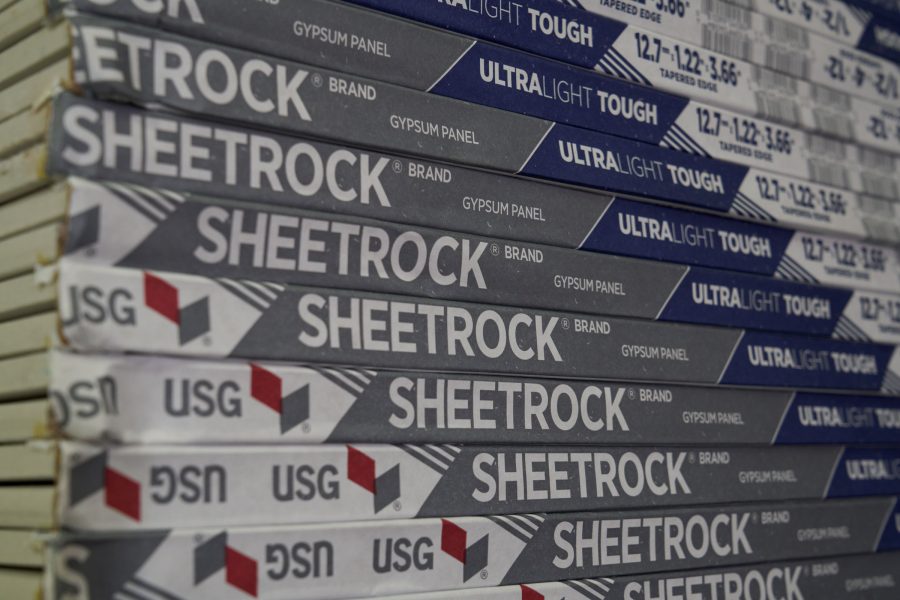
Photo courtesy of USG Corporation
For manufacturers circularity starts at the design stage—not at the dumpster. At USG that means sourcing reclaimed gypsum, using 100% recycled paper in wallboard production—a practice the company has maintained since the 1960s—and engineering products that are lighter, more durable, and easier to recover at end of life.
The recently launched Sheetrock® Brand UltraLight Tough Panels reflect this thinking. The half-inch gypsum panel is USG’s lightest and most durable product in its class, engineered with enhanced edge and corner protection to reduce jobsite damage and waste.
Because it’s lightweight, less water and energy is used during manufacturing, and more panels fit on a single truck—reducing the product’s carbon footprint across the supply chain. The panel’s noncombustible core is wrapped in 100% recycled face and back papers and has earned GREENGUARD Gold Certification for low VOC emissions.
“If you reduce the weight of the product but at the same time maintain its performance characteristics, you are actually saving a lot of raw materials,” Veeramasuneni says. “It is prioritizing sustainable design from the beginning. We use less raw materials, less water to manufacture, and then we put more product on the truck.”
USG has also pursued circularity through cross-industry material exchange. At its acoustical ceiling tile plant in Greenville, Mississippi, the company partnered with Knauf Insulation to divert fiberglass manufacturing waste that would otherwise go to landfill, using it as a substitute for mineral wool—a raw material that requires significantly more energy to produce.
The result was a ceiling tile with lower embodied carbon, reduced water usage in production, and performance that met or exceeded the original. USG plans to expand the use of this fiberglass waste into additional product lines in 2026, with projected embodied carbon reductions ranging from 8.4 to 28.4%. “What would have been a big landfill for our sister company, we were able to take it and use it in our product to make a higher performing product with less carbon emissions, less water,” Veeramasuneni says. “This is a true example of circularity.”
The Take Back Program in Practice
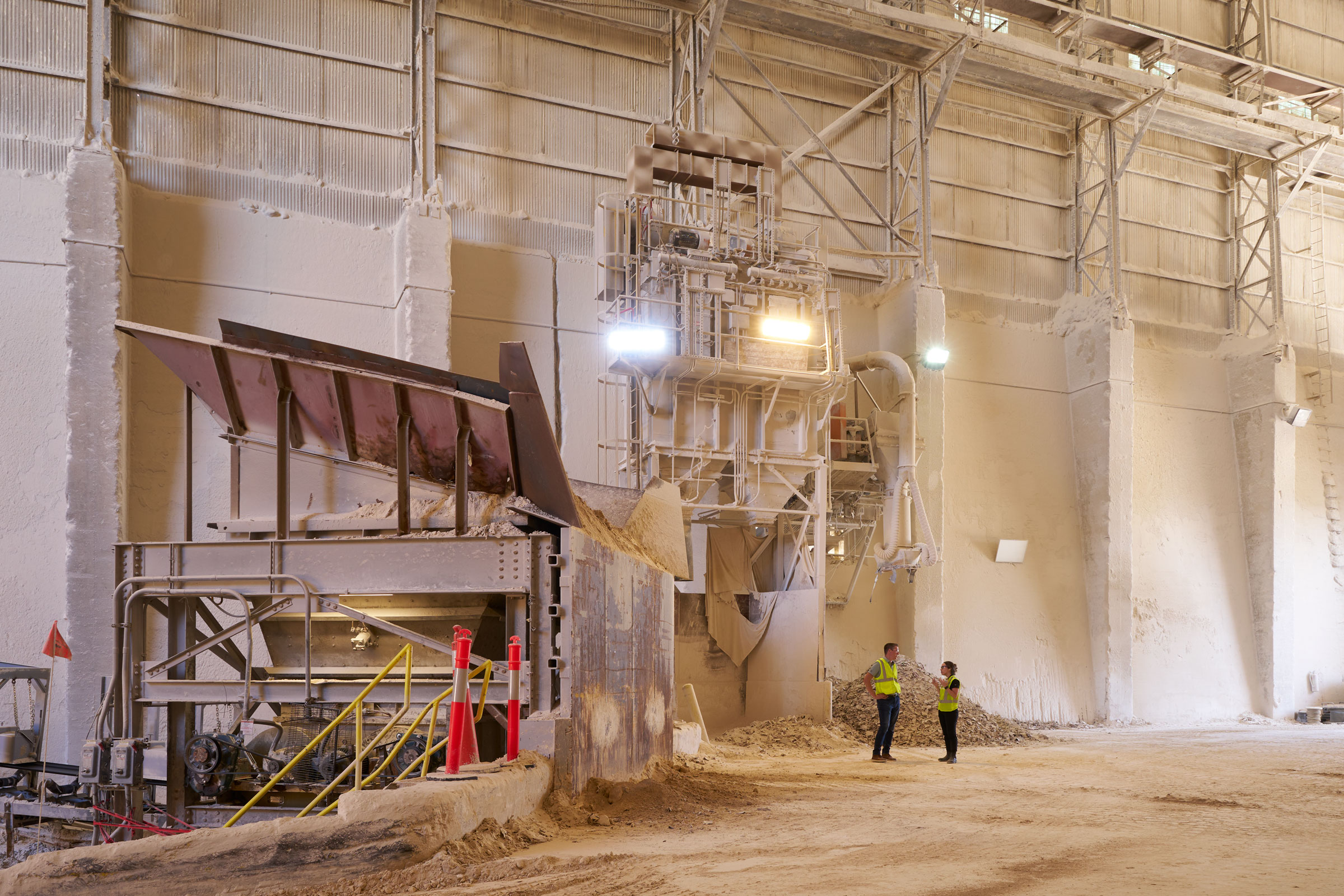
In 2023 USG launched its Take Back recycling program. The program focuses on clean construction waste—new gypsum scrap from job sites—and works with customers to route that material back to USG manufacturing plants, where it is tested, processed, and reintegrated into new products. “The model is customer-specific rather than one-size-fits-all,” Veeramasuneni explains. “We work with each customer to find the best solution depending on plant capacity, geography, and external constraints.”
In practice that means pre-construction coordination to establish a dedicated collection container onsite, an environmental analysis to confirm that the transportation logistics yield a reduction in carbon emissions, and quality testing when material arrives at the plant.
A project in Des Moines, Iowa, illustrates how the process works when everyone is aligned. The building owner entered the project with a clear requirement: All construction waste had to be diverted from landfill. That requirement cascaded through the project team. The general contractor, distributor, subcontractor, and USG coordinated early—before construction began—to map out a sorting and logistics plan.
Gypsum scrap was collected separately onsite, with a dedicated employee assigned to maintain the container and prevent commingling with other materials. The clean waste was then transported to USG’s plant in Sperry, Iowa, where 20 tons of gypsum board were recycled back into new products. The project reduced the overall carbon footprint associated with wallboard use by 17%. “The building owner, if they decide this is a must-have in their execution, then obviously the rest of the cycle will find ways to make it happen,” Veeramasuneni says.
In 2025 USG diverted nearly 10,000 tons of material from landfills through the Take Back program—enough to avoid close to 1,600 tons of CO₂ equivalent (tCO2e), or the equivalent of powering 225 homes for a year.
The program has its limitations. Geography is the main constraint. When a job site is too far from a USG plant for transportation to yield a net environmental benefit, the company helps connect customers with third-party recyclers or alternative use cases.
Gypsum construction scrap can be used in agriculture, cement production, and soil reclamation, among other applications. The program also currently focuses on new construction waste only. Demolition waste is more complex, given the presence of paints, coatings, and decades of environmental exposure to installed materials. USG is working on test protocols to eventually close that loop as well, with a goal of scaling into demolition projects in the near future.
The Road Ahead
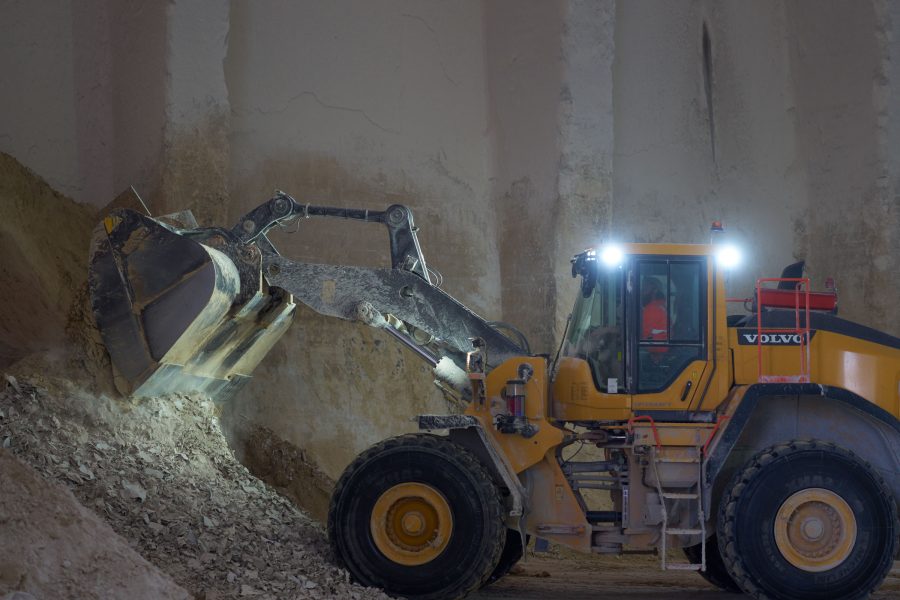
Photo courtesy of USG Corporation
Veeramasuneni sees three things that will determine how fast the industry moves over the next decade.
The first is infrastructure—sorting systems at job sites, storage, and transport networks that make material recovery practical and cost-effective at scale.
The second is transparency. Environmental Product Declarations (EPDs), material passports that trace raw materials through the supply chain, and AI-enabled sorting and tracking are all emerging tools that Veeramasuneni believes will become standard. “Transparency in communications with customers will increase credibility,” he says. “And I think it avoids discussions about greenwashing.”
The third is innovation. Building Information Modeling already allows designers to optimize projects for material efficiency and future disassembly. Robotics and AI are improving the purity and yield of recycled materials. These tools are beginning to reshape the economics of circularity in practical ways. “When the constraints come in, innovation actually flourishes and finds solutions,” Veeramasuneni says. “If people focus on innovation and invest in it to find solutions to those challenges, I think we can accelerate the journey.”
USG has set a target of zero waste from its manufacturing operations by 2030, alongside a 30% reduction in scope 1 and 2 carbon emissions over the same period. The company’s new Wheatland County, Alberta facility—its first new wallboard plant in decades—is being built from the ground up around sustainability: 20% lower carbon emissions, 25% less water, onsite solar, and a zero-waste-to-landfill design.
For building professionals looking to engage, the practical advice from Veeramasuneni is consistent: Get manufacturers involved early. The Iowa project succeeded because conversations happened before construction started, not after. “Please involve us very early in the process so we can really help and partner and collaborate to make this happen,” he says.