Story at a glance:
- As sustainability faces political and economic headwinds, a growing movement is finding environmental and financial value in the materials we already have.
- The industry has concentrated on energy efficiency and construction impacts for years while largely overlooking the opportunity for reuse.
Something encouraging is happening. Across the country designers, architects, contractors, manufacturers, and community organizations are rallying around a deceptively simple idea: What if we stopped throwing away perfectly good things?
There’s nothing revolutionary about reuse. What’s changing is the recognition of its potential to reshape how we design, construct, renovate, and furnish our buildings.
And the timing matters. Climate policy is increasingly politicized, corporate sustainability commitments are being reconsidered, and economic uncertainty is putting pressure on ambitious projects. Yet interest in circularity continues to grow, driven by environmental concerns and an increasingly persuasive economic argument.
The Case for Keeping What We Have
The scale of material waste is extraordinary. Construction and demolition activities generated 600 million tons of debris in 2018, more than twice the country’s municipal solid waste, according to the EPA.
For decades the green building movement has concentrated on energy efficiency and reducing the impacts of construction while largely overlooking the resources consumed through repeated cycles of refurbishment and replacement. Nowhere is this more apparent than in our interiors.
Buildings may stand for decades, but their interiors are frequently replaced several times over. Offices are reconfigured, hotels refurbished, and perfectly serviceable furniture, flooring, ceilings, and partitions discarded long before the end of their useful lives. All for Reuse estimates that more than 2.5 billion square feet of commercial space is renovated annually in the US, generating some 32 million tons of waste sent to landfill.
Every replacement requires raw materials, manufacturing, and transportation, carrying an embodied carbon footprint that could potentially be avoided. It also carries a financial cost, as businesses pay to remove existing materials, then pay again for replacements.
We’ve spent decades making new products less environmentally damaging. That work remains essential. But perhaps we haven’t spent enough time asking whether we need those new products in the first place.
The greenest product isn’t necessarily the one with the best environmental credentials. Often it’s the one that’s already here.
From Ambition to Implementation
Of course, if reuse were easy we’d already be doing far more of it. A new report suggests the problem isn’t a lack of enthusiasm. The 2026 Circular Materials Ecosystem Report, published by Build Reuse and USGBC, surveyed 520 professionals and found that 87% of demand-side respondents had seriously considered reclaimed materials, while 86% had incorporated them in the previous two years. But for most respondents, reclaimed materials featured in fewer than one in 10 projects.
The barriers are revealing. Architects cited uncertainty around availability and timing, contractors struggled to confirm supply, and reuse operators faced shortages of storage space. The report also identified a mismatch between available materials and the needs of commercial and institutional projects.
Then there’s risk. Designers and contractors need confidence around performance, compliance, warranties, and delivery. These are legitimate concerns, particularly where delays can quickly become expensive.
Yet reuse can also deliver real financial benefits. Retaining existing products can avoid the cost of purchasing replacements, while recovering and reselling materials can generate value from assets that might otherwise incur disposal fees.
We’ve spent generations developing sophisticated systems for specifying and purchasing new products. If reuse is to become mainstream, we need comparable mechanisms for existing materials.
A Glimpse of What’s Possible

At Greenbuild in New York this October, we had an opportunity to put these ideas into practice. Through the newly established Center for Circularity in Interior Design (CCID), we partnered with mindful MATERIALS to curate an 800-square-foot lounge around the theme of “circularity in practice.”
Our ambition was to create something more than another disposable trade show installation. The space brought together decommissioned and remanufactured office furniture, reclaimed timber, archival design classics, and experimental products made from industrial byproducts. Together they demonstrated the breadth of approaches available, from extending the life of existing products to finding new uses for materials traditionally considered waste.
Every element was considered with its next destination in mind. When the exhibition closed, furniture returned to its owners or moved on to its next use, and materials were recovered for future projects. Nothing was sent to landfill.
This wasn’t a claim of zero environmental impact. Transporting and assembling an exhibition still carries a footprint. But it demonstrated that temporary installations needn’t generate permanent waste.
Perhaps more importantly, thousands of visitors passed through, connecting designers and specifiers with businesses recovering, remanufacturing, and redistributing materials. Sometimes the most valuable thing we can do is simply get people into the same room.
Making Reuse Easier Than Disposal

The enthusiasm at Greenbuild reinforced a wider lesson: Circularity won’t become mainstream through individual projects alone. We need systems that make reuse an ordinary part of professional practice.
While conventional manufacturing benefits from established supply chains, successful reuse often depends on regional networks. Materials become available in particular places and timeframes, while their recovery, storage, and redistribution require local infrastructure. Long-distance transportation can quickly undermine environmental and financial benefits.
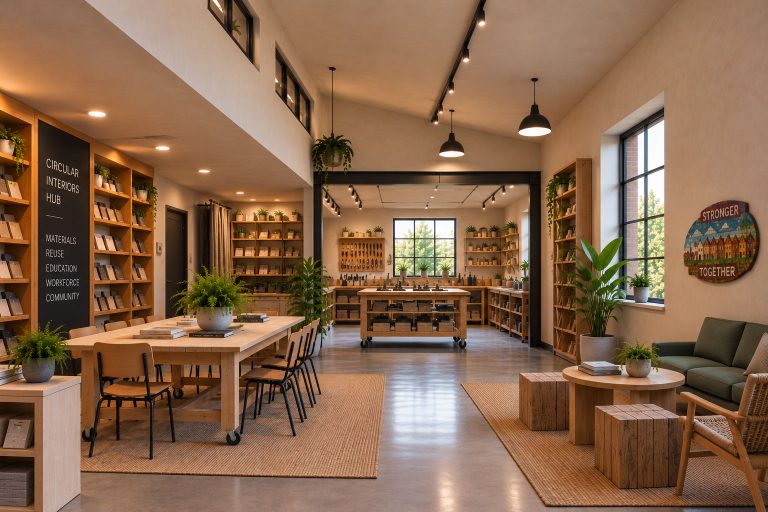
Encouraging precedents are emerging. In the UK Tipping Point East is connecting material recovery, storage, and redistribution to give building products a second life. In Boston CCID is working with Boston Building Resources to develop a Circular Interiors Hub, bringing together designers, contractors, manufacturers, and reuse organizations. The proposed pilot aims to build on the region’s existing ecosystem, identify gaps, and test whether a coordinated approach can be operationally effective and financially sustainable.
The ambition isn’t a centralized national system, but a network of locally grounded ecosystems, each making better use of resources already circulating within its region. Digital tools, including material inventories and product passports, can help. But technology must be accompanied by the infrastructure and relationships needed to turn information into action.
The Power of Precedent
One of the biggest obstacles to scaling reuse is the perception that it’s complicated, expensive, or risky. Sometimes it is, but successful examples can help challenge those assumptions. That’s what makes the inaugural Proving Reuse competition, organized by All for Reuse and Build Reuse, so timely. The initiative is collecting case studies demonstrating how recovered materials can be incorporated into buildings and interiors.
What we particularly like is its willingness to celebrate the ordinary alongside the extraordinary. Among its award categories is one recognizing the most “unremarkable” reuse project.
It’s a wonderful idea because while spectacular examples of adaptive reuse and material innovation can inspire us, the real transformation will come when reusing a door, a desk, or a 100 square feet of carpet tile is no longer considered unremarkable.
We need more evidence and accessible examples that designers can point to when making the case to clients. And we need to measure outcomes—not just waste diverted from landfill, but embodied carbon avoided, resources conserved, and money saved.
A Different Kind of Optimism
New businesses, partnerships, and regional networks are emerging to recover value from materials that would otherwise be discarded, creating opportunities for local employment, strengthening supply chains, and reducing our dependence on virgin resources.
For designers, reuse presents an exciting creative challenge: What new possibilities might emerge if we began projects by considering what could be retained, adapted, or recovered, rather than assuming everything must be new?
The opportunity is enormous, but enthusiasm alone won’t get us there. We need to turn successful examples into everyday practice, build the infrastructure and partnerships that make reuse commercially viable, and demonstrate that circularity can deliver on design, performance and cost. The real measure of progress will be when reuse is no longer the exception but simply part of how our industry works.
David Bergman contributed to this article.