Story at a glance:
- Making proactive roofing decisions can save customers lots of time and effort down the road.
- FiberTite Roof Systems’ KEE roof membranes offer durability and long-term performance that can nearly double the life cycle of a roof compared to other membrane options.
In design and construction, roofing can end up out of sight, out of mind. Building owners and occupants don’t look at the roof every day, and as long as it’s functioning the way it should, most people may not think about what’s overhead much.
But when there’s a problem like a crack, puncture, or leak, it can be extremely disruptive and costly to business operations, especially for critical facilities like hospitals, data centers, airports, and food processing facilities. That’s why treating the roof as a commodity can be a very expensive mistake. “It’s an important part of the construction of a building,” says Ray Makiejus, Midwest regional sales manager for Ohio-based FiberTite Roof Systems, a division of Seaman Corporation. “With any material or construction or assembly, it’s essential that it’s put together right and that you have good materials that’ll last.”
Plan Ahead
Photo courtesy of FiberTite
Makiejus says roofing makes up a very small percentage of the construction costs of a new building, while the majority of construction litigation relates to water intrusion. “It’s gotten better, but historically roofing decisions or replacements or even repairs have been reactive instead of proactive,” he says. “I was a consultant for over 20 years in designing roofs and systems and doing forensics, and we would always try to push the owners and our clients to think ahead. If you can catch something early on and get it before it turns into a major expense or problem, you’re better off.”
Budget constraints can be a factor, he says, as roofing does cost a lot of money. Many people look at that upfront cost, ask what will be cheapest, and gravitate to that solution. But Makiejus has begun to encounter more people thinking proactively. “You’re starting to see a lot more involvement from consultants, architects, and engineers in dealing with clients,” he says, adding that the design community and owners are also engaging more with credible organizations like the National Roofing Contractors Association. “People in those positions are now interacting more with building owners. They’re pushing that approach: ‘Let’s put you on a roof asset management type of program, catching things ahead of time.’”
He says long-term capital planning is starting to be considered more, too. “Life cycle cost analysis, sustainability—those types of things all kind of come into play. So that’s evolving.”
Forward-Thinking Benefits
Photo courtesy of FiberTite
When building developers and owners look more closely at things like roofing maintenance costs and life cycles from the outset, it helps them make smart decisions not only for the immediate future but also for years down the road. “Many people who hold on to their buildings for a long time are more invested,” Makiejus says. “If they’re a 50-year owner of their building they want something that’s going to last.”
FiberTite offers roofing options that can provide that kind of longevity; its commercial roof membranes are engineered with Ketone Ethylene Ester (KEE) technology that delivers durability, flexibility, and long-term performance. A KEE roof membrane is an advanced type of PVC roofing, and FiberTite is so named because its thicker, heavier, and denser yarns are packed into a very tight pattern to create an extremely tough base fabric.
Say PVC and people might think of pipes that are rigid, but for a roof membrane you need flexibility. A liquid plasticizer gets added to the formula to make standard PVC roofing membranes flexible, but that plasticizer can separate from the PVC over time due to chemical exposure and other factors, impacting the stability and effectiveness of the roofing.
In the Details
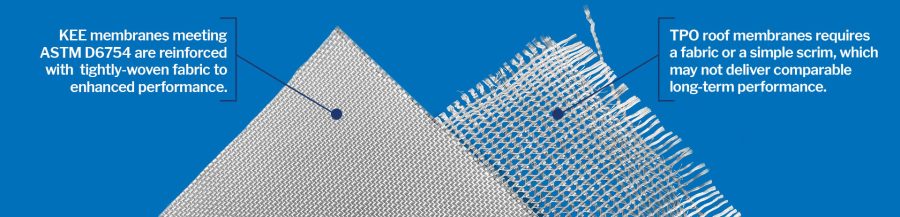
Image courtesy of FiberTite
FiberTite uses Elvaloy, a solid, high-molecular-weight KEE polymer. The top and bottom coats of the FiberTite single-ply roof membrane form a monolithic bond with the tightly woven fiber reinforcement layer, offering greater stability and durability than conventional reinforced thermoplastics with loosely constructed scrim. “The KEE polymer is similar to the weight of the PVC molecule, so it forms more of an alloy,” Makiejus says. “By incorporating that solid plasticizer it makes the membrane last longer.”
FiberTite KEE membranes offer strong protection from common causes of roof failure like fire, extreme weather, chemical exposure, and punctures. And while basic roof membranes made from thermoplastic polyolefin (TPO), polyvinyl chloride (PVC), and ethylene propylene diene monomer (EPDM) can offer as much as a 20-year service life, a more robust membrane like a FiberTite KEE membrane can nearly double that life expectancy.
FiberTite KEE roof membranes can be installed in a variety of roofing configurations, including adhered, ballasted, induction welded, and mechanically attached systems, as well as in a variety of colors. And while they might cost around 10 to 15% more upfront compared to some other options depending on installation method, they can lead to lower repair and replacement costs because they’re more durable and don’t need to be replaced as quickly as other roofing systems might need to, Makiejus says. He says they can result in a long-term total cost of ownership that is up to 48% less by comparison, according to a third-party study.
“Cost is always a big part of it, but you have to look at the big picture with costs,” he says. “Am I replacing this multi-100,000-dollar assembly in 10, 12, 15, 20 years, or can I pay a little bit more upfront and do it the right way to where it’ll last longer?”