Story at a glance:
- Layered access and wire-free locks can make campuses safer and easier to manage, but technology cannot compensate for a missing emergency plan.
- Access control should be considered before key decisions about wiring, circulation, and interior zoning are complete.
- Schools can keep everyday movement simple while requiring additional verification after hours or at sensitive spaces.
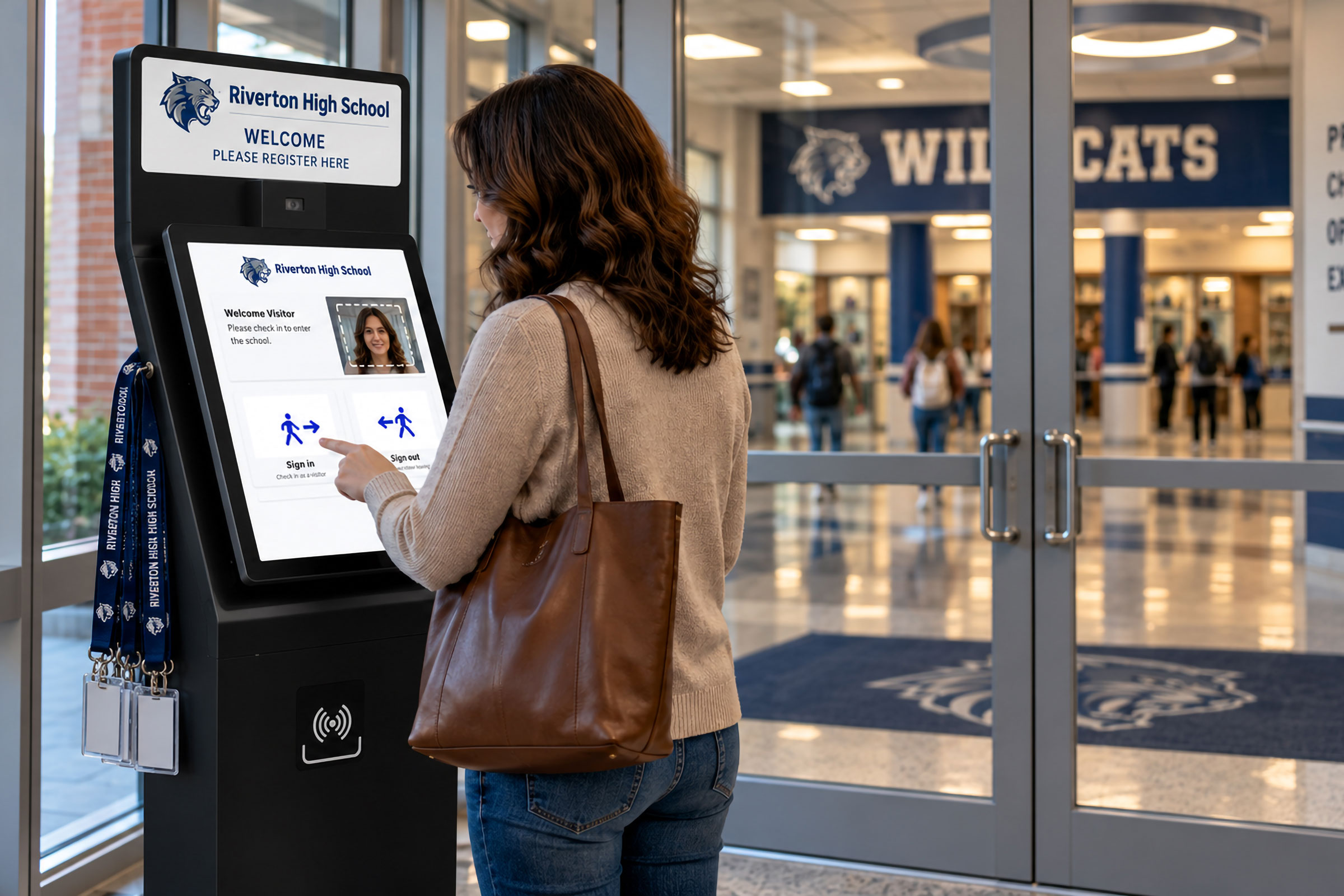
When Ron Shaffer visits his daughter’s school, a locked vestibule holds him while a visitor-management system scans his identification. Once cleared he receives a printed badge. If he moves beyond the waiting area, he gets a credential limited to the appropriate door. “That’s visitor management with AI that’s connected to the central nervous system of the school,” says Shaffer, business development leader at Salto Systems. “It’s a connected solution using modern tools the right way.”
The entrance establishes a checkpoint without turning the rest of the building into a maze of barriers. Electronic access connects that architectural layer to operating rules for students, staff, visitors and emergencies.
The Right People in the Room
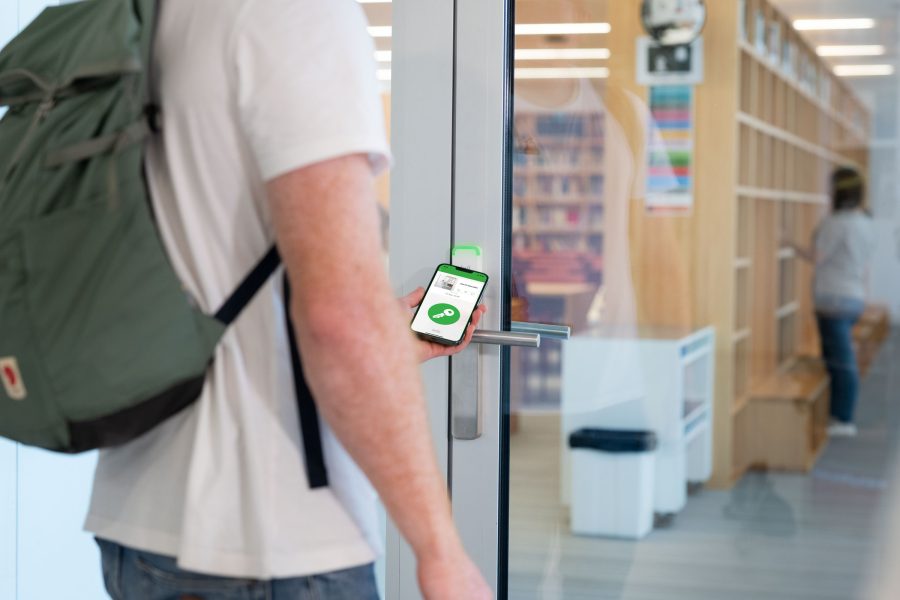
Photo courtesy of Salto
Access control once arrived near the end of a project as a door-hardware decision. It now belongs earlier, when teams are deciding how people will circulate, which areas require extra protection, and whether openings need conduit, wiring, and dedicated power. “With different types of access control you’ve got permitting, wiring, conduit, and electrical,” Shaffer says. “It comes now more in the middle, not the end, because of the infrastructure that has to be put behind access control.”
That conversation should include architects, IT, facilities, campus safety, administrators, and financial leaders. Shaffer notes projects often lose the balance between secure and welcoming because those groups are brought in after major decisions have been made. “The decisions are made in a silo,” he says. “Then when it’s time to execute, you have many stakeholders who push back because their voice was not heard.”
Layering does not have to add friction everywhere. Shaffer points to Princeton University, where access can be tap-and-go during the day but require both a card and PIN after 7pm. Sensitive science facilities can add protected entry points and two-step authentication. The credential remains easy to use in public areas while security increases with the risk.
The same principle applies across education, although the zones differ. K-12 schools generally exert tighter control over entry and visitors. University teams must coordinate residence halls, laboratories, libraries, athletic facilities, and public buildings with different schedules. In either setting Shaffer recommends identifying high-use doors, secure areas and who may enter them.
Lockdown and All Clear

Photo courtesy of Salto
Salto’s school-safety guide organizes emergency preparation around five Ps: planning, process, protocol, practice and preparedness, and prevention. Teams assess the building, map its openings, and determine which doors can be controlled remotely. They then document each potential lockdown, assign authority, and practice the response.
Technology cannot settle those questions. A classroom function like Salto’s AMOK mode can let an authorized user initiate a local lockdown from inside the room, while remote controls can secure a larger area. The operating plan must still distinguish between initiating a lockdown and ending it.
Shaffer recommends separating authority to initiate a lockdown from authority to end it. “The all clear should come from the first responders that arrive on campus,” he says.
Emergency access deserves equal attention. Local control must preserve egress from inside a room, while authorized responders need a dependable way through secured openings. “When you lock down and you don’t have practiced planning or procedures, you tend to lock out the first responders who need to get on campus and assist,” Shaffer says.
Lighten the Retrofit
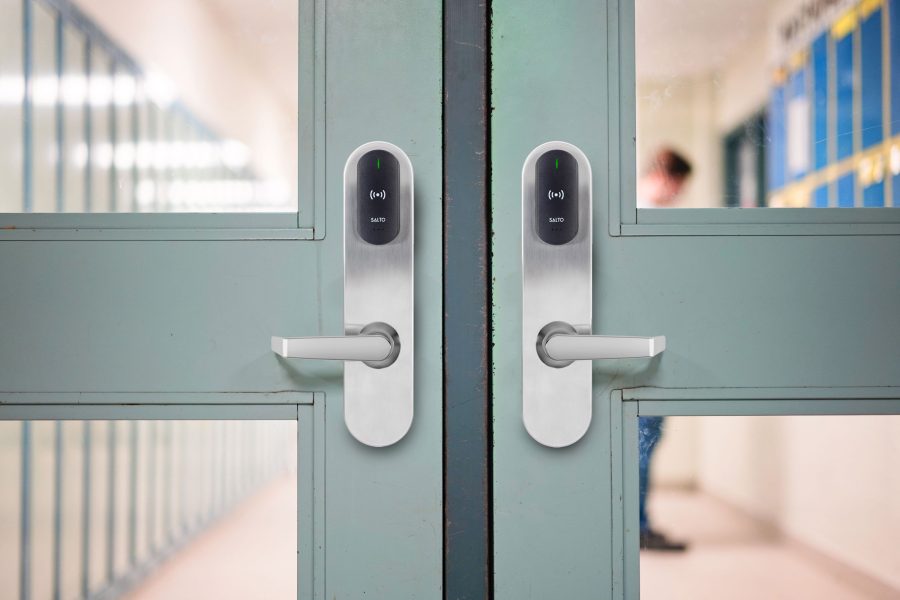
Photo courtesy of Salto
Wire-free locks can make electronic access practical in existing schools, including buildings where opening walls or pulling cable would be costly and disruptive. Shaffer distinguishes wire-free systems from conventional wireless hardware: A credential can carry access data to an offline lock and update the central system when it reaches a connected point.
That approach reduces wiring, power supplies, and electrical demand while allowing campuses to add locks as needs and budgets change. Access and video data can also help facilities teams understand when spaces are used. Shaffer says a lab that is consistently occupied from 2 to 6pm, for example, may not require the same HVAC, lighting, and security schedule at 8pm. Such use requires clear rules for data access, retention and privacy.
New hardware can strengthen a campus, but Shaffer considers planning the more durable safeguard. “You can have the best access control system on the market,” Shaffer says. “It can be your worst nightmare if you don’t have the right people at the table, the right process, and everyone understanding the planning.”