
Story at a glance:
- Time is money, and if an essential-but-small component of construction is missing, money is lost.
- Pre-construction planning makes the process all work so much better.
- Fastenal’s deep knowledge and software platform enable an uninterrupted supply of essential materials.
Most owners and investors in construction projects have high expectations for a few things, like quality workmanship, finishing on time, and staying within budget. The big materials intrinsic to these goals are obvious—steel, concrete, masonry, glass, building mechanical systems, and other major components that arrive on big trucks just when they are needed.
What gets less attention are the small things that are also essential to achieving goals. No less vital but smaller pieces include fasteners, MRO (maintenance, repair, and operations) and safety equipment, PPE (personal protective equipment) for workers, and general industrial hardware. Just as important, these smaller pieces need to be closely managed so they’re where they’re needed when they are needed. That requires personnel and software to oversee ordering, delivery, inventory, and distribution.
Avoiding Chaos

The construction industry is scaling rapidly, according to Mike Lizzi, a business development specialist at Fastenal who focuses on data centers, IT, and infrastructure. Fastenal provides supply chain management, inventory management, vending solutions, safety/PPE equipment, logistics, and MRO products to help avoid chaos in construction. Photo by Jason Hughes Photography
It’s easy for things to feel disorderly under hyperscale and hyper speed conditions. Fastenal, a wholesale distributor of industrial and construction supplies, provides supply chain management, inventory management, vending solutions, safety/PPE equipment, logistics, and MRO products to help avoid the chaos. This is especially critical on large-scale projects like data center construction, where hyperscale campuses with multiple buildings rise at hyper speed, often in remote locations. “Scaling is the term for how the industry is going right now,” says Mike Lizzi, a business development specialist at Fastenal who focuses on data centers, IT, and infrastructure. “It’s scaling at such a rapid pace, but it’s also chaotic.”
That chaos can potentially be caused by a supply chain hiccup that could determine whether a project finishes on time. The company often plays a role in sourcing connectivity solutions (copper and fiber cabling, for example), power distribution (switchgear and transformers), power and thermal management (environmental monitoring, high-density and liquid cooling systems), electrical (lugs, connectors, medium voltage cables), security (access control and analytics), and MRO and safety (fire safety equipment, first aid supplies, etc.). Miss on any of those, and the most sophisticated construction program in the world comes to a standstill.
Early Supply-Chain Engagement
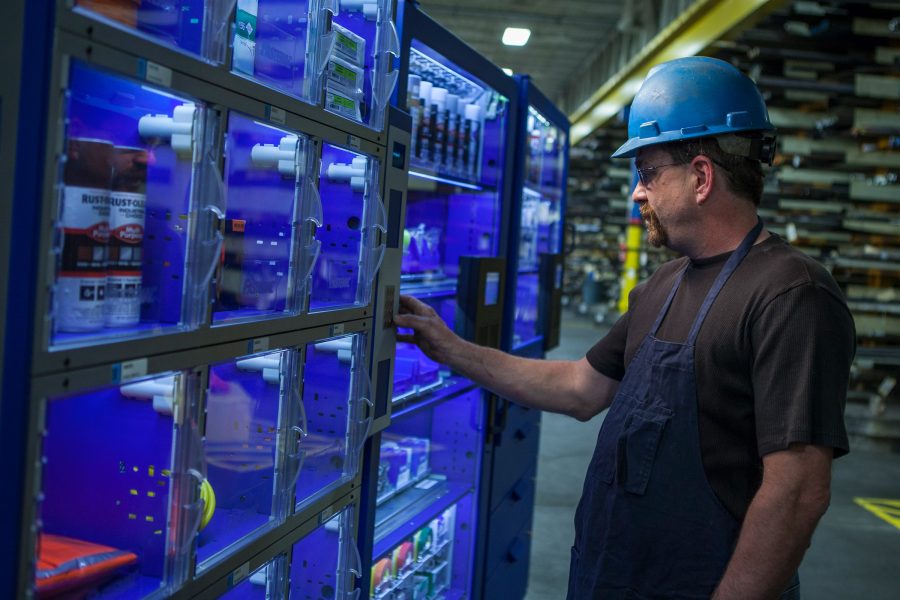
FASTVend locker units offer visibility into usage and controlled access. Photo courtesy of Fastenal
At what juncture does this management of the smaller things become integrated into the project? As early as possible, Lizzi says.
And it’s about more than just the total quantities of materials. An important conversation Lizzi wants to have with an architect, or the general contractor, is about timing. Consider what happens when timing is off. He says insufficient planning, absent of calendars, with a supply chain partner creates adverse consequences: schedule compression, reactive sourcing at premium cost, and logistics gaps that miss project milestones.
The alternative is what Fastenal calls a “plan for every part,” identifying long-lead categories early, building forward-positioned inventory buffers, and tying the replenishment cadence to project milestones. All of this is mapped out before the first crew arrives onsite.
But forethought isn’t always easy. “In general specs are frequently misaligned with real world availability,” Lizzi says. “It’s really driven by cost and lead times. Where Fastenal bridges the gap within that segment is itemizing real-time sourcing across vendors and geographics. Then what we do is recommend alternatives where needed, particularly if the supply chain is constrained and when there are supply alternatives.”
Data as a Management Tool
Fastenal’s analytics platform, FAST 360, is a digital tool that gives site-level managers real-time visibility into on-hand inventory and spending. An enterprise version, FAST 360 Analytics, aggregates data across multiple sites—useful for general contractors and owners managing concurrent builds—to identify consumption patterns, flag cost-saving opportunities, and drive standardization across a portfolio of projects.
Features of FAST 360 include inventory visibility, providing immediate answers to questions regarding what’s currently on hand and where it’s located; spend awareness, showing where purchasing dollars are going; and a consolidated portal in FAST 360 Analytics, providing a consolidation of supply chain factors and a program overview within a single interface. In essence it answers age-old questions: “Where is X?,” “Do we have any Y?,” and “Are we on budget?”
Adding complexity to the task, lead times for different items vary. “Where we can really help is what I deem a plan for every part,” Lizzi says. “That identifies long lead times and categories within that, having a plan for those parts, what the lead times are, and centrally sourcing those.”
The platform also reflects a broader philosophy, understanding that supply chain intelligence is as important as supply chain execution. “The purpose is to optimize the program,” Lizzi says. “Understand what their purchasing behaviors are, what they’re using it for, and leverage that for their benefit.”
The Future of Fast, Hyperscale Building
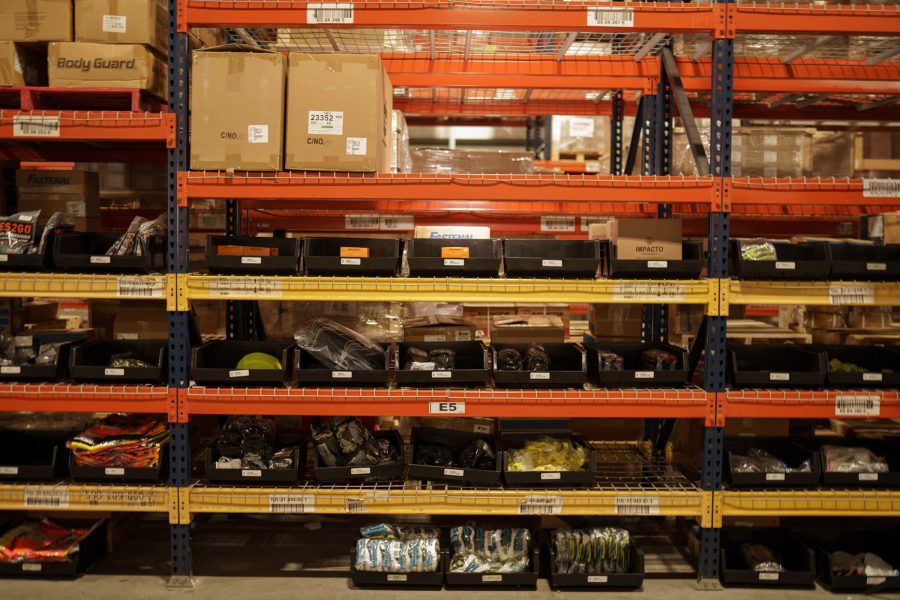
Photo by Jason Hughes Photography
In the diverse and broadly distributed construction world all over the globe, there are other companies that focus on supply chain management and timely delivery. “You can see it among multiple industries, multiple suppliers, and with multiple companies,” Lizzi says of others trying to standardize this level of service. The plan is to achieve optimum efficiency and customer satisfaction. “The first person or the first company out there that can do that in the next five years is going to be the winner.”
Lizzi says Fastenal’s approach is to bring in value-added resources within their organization to help the preplanning process and approach. “It’s our strategic engineers, our strategic value-added resources within the organization, like local onsite engagement, that will help build that supply and help build within that pre-planning phase.”