Story at a glance:
- Ludowici’s growing terra-cotta operation shows how a material with deep roots in architecture is at the center of conversations about durability, restoration, and innovative design.
- The 138-year-old company balances high craft with high tech, matching historic roof tiles and hard-to-capture colors for landmark buildings one day and using 3D printing and digital modeling to prototype new glazes and profiles the next.
With growing interest in technology and robotics, today’s manufacturing environments often feature automated systems, integrated software, and real-time production tracking. Yet some of the most compelling work in the built environment emerges where these digital advancements operate alongside craftsmanship refined over more than a century.
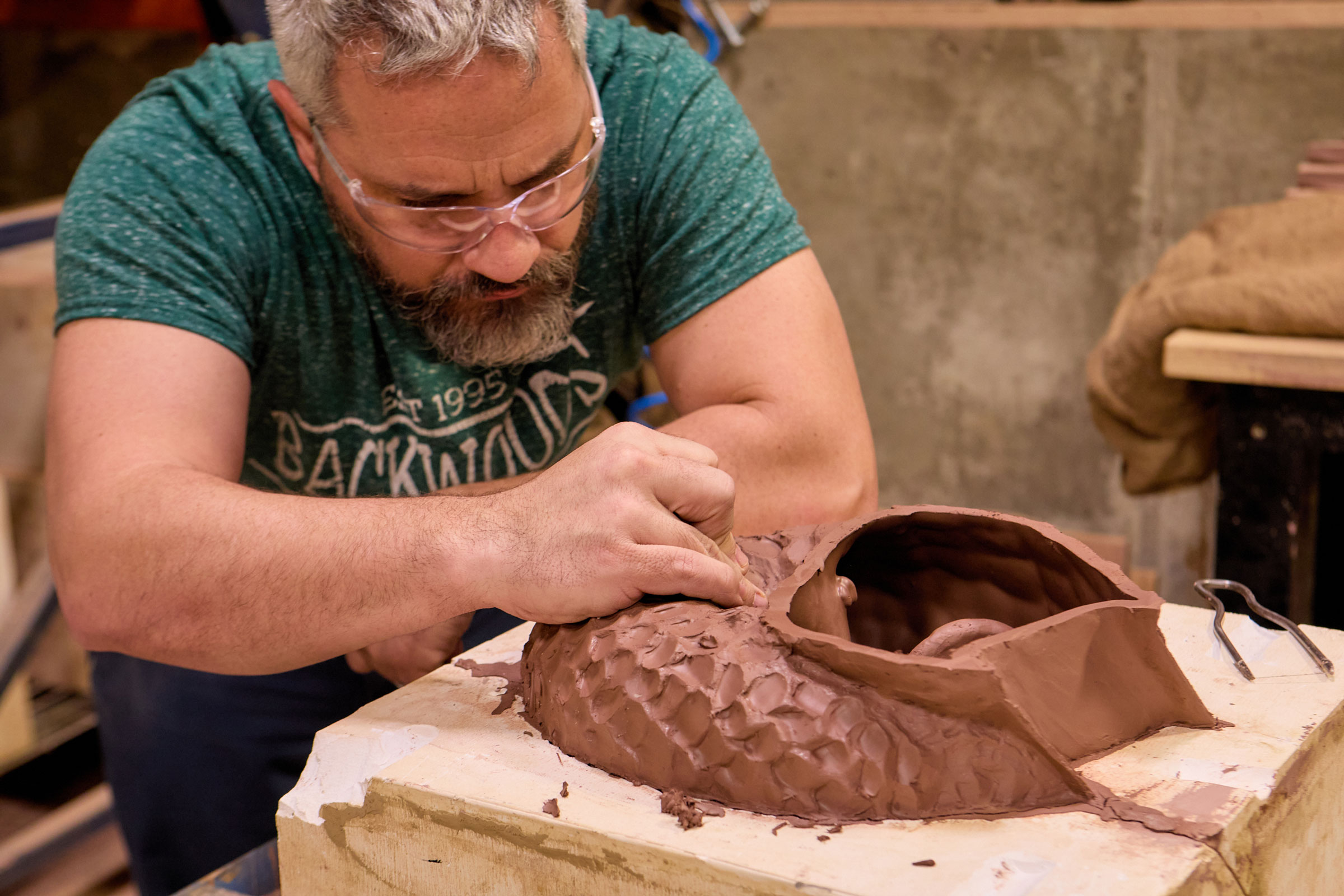
In New Lexington, Ohio—a town of just over 4,500 residents in an area rich in shale clay and fire clay—Ludowici’s Dan Harris shows me a large 3D printer in one room, churning out elaborate patterns for a refined slip casting process; on this day it results in an intricate hippocampus (the hybrid mythological creature that combines a horse’s head and a serpentine or fish body, often with wings) with many parts that slide together—some of those parts including hand-carved scales.
-
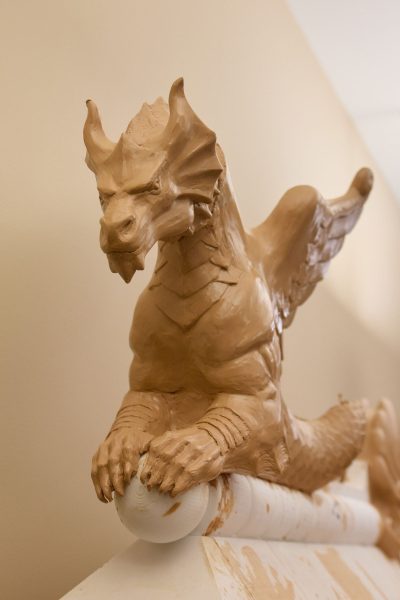
- Ohio Sculptor Alan Cottrill and his team were commissioned to sculpt a half-sized hippocampus—a hybrid mythological creature that combines a horse’s head and a serpentine or fish body, often with wings. Photo by Matt Reese productions, LTD
-
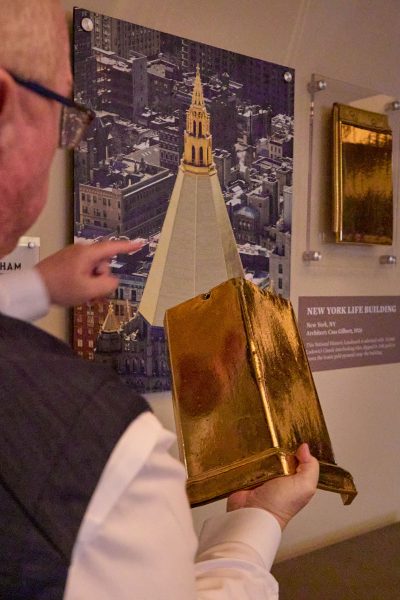
- Ludowici produced a gloss glazed yellow tile and shipped it to Evergreen Architectural Arts for gold gilding. The top of the New York Life Building is now comprised of 25,000 custom gold-leaf dipped terra-cotta tiles. Photo by Matt Reese productions, LTD
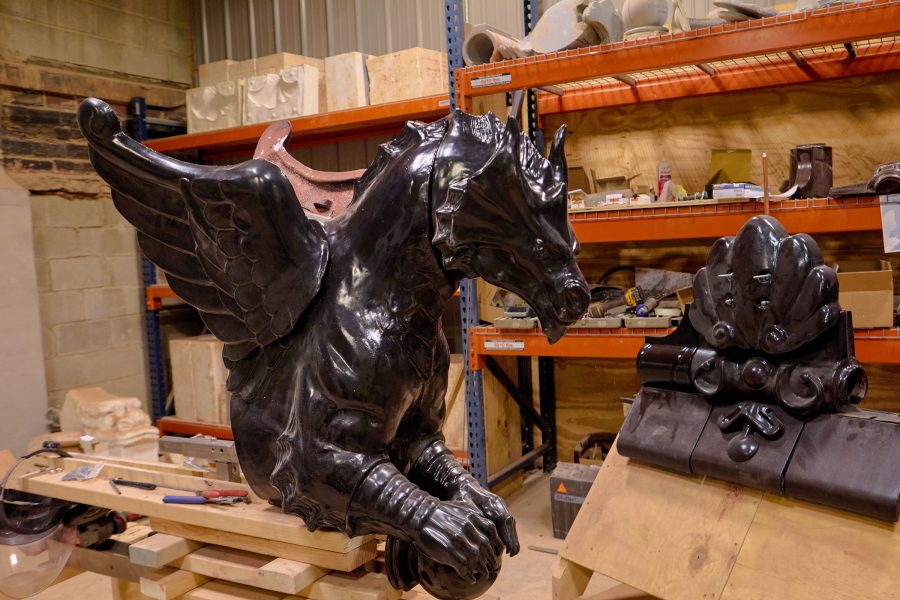
A clay sculpture of a hippocampus was 3D scanned in sections to make the various patterns needed to produce the final piece. Photo by Matt Reese productions, LTD
A short walk away and I’m standing in what is essentially a barn full of dirt—future clay hitting conveyor belts or waiting in heaping mounds in a more than century-old brick building, a cold breeze blowing in from doors open against the forest. It’s an incredible juxtaposition that shows what the circa 1888 company is capable of today on its campus of historic buildings repurposed for the future.
“There are not many terra-cotta manufacturers in the US, and those who do exist typically do scaled back versions of tiles, scaled back versions of color, just because of how complex it is,” says Rob Wehr, CEO of Ludowici. “That’s not us.” Instead, part of Ludowici’s success seems to stem from its “we’ll figure it out” nature. As far as they’re concerned, if there’s a will, there’s a way.
For example, Ludowici may not make a particular tile any longer, but if the need for a historic tile resurfaces, they will collaborate with the architect or building owner to design and engineer the tile to closely match the existing tile, says Harris, vice president of sales and marketing for Ludowici. “The most difficult part of our business is understanding the difference between what people say they want and what they actually need. Timing is another challenge; today’s ‘Amazon mentality’ has reshaped expectations around speed,” he says.
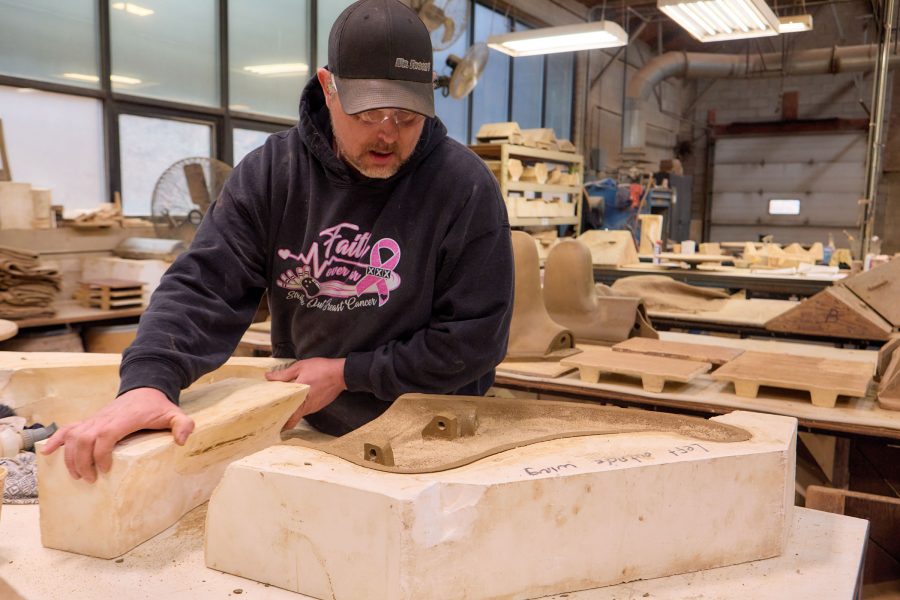
One day Ludowici started to experiment with sand—not just for texture, but to help the drying process. Photo by Matt Reese productions, LTD
Terra-cotta remains critical for preservation work, from color matching and profile replication to meeting modern performance expectations. Hand-pressing, carving, and finishing skills allow the team to deliver one-off details and restoration that machines alone cannot achieve, while newer tools like scanning and 3D printing help the team develop intricate custom pieces as well as more standard pieces quickly. Bridging the gap—manufacturing to preserve old or even rare techniques while developing new designs that will stand the test of time—is key. “Our clay tiles are on these buildings for hundreds of years,” Harris says.
And so, tradition and innovation sit hand-in-hand at Ludowici, where roughly 125 people work in the factory, some of them with many decades of experience. Long-trained craftspeople like Bob Buchanan have a reputation of problem-solving. “In the last five years Bob, our director of operations, helped get us into slip casting,” Harris says, noting that the shift also drove improved processes, enhanced line operations, and the transition of many batch processes to more efficient continuous production methods.
Now in its third year of operation, the slip casting area has enabled Ludowici to recreate intricate designs from the 1890s by combining modern technology with skilled artisanship—from detailed hippocampus elements as seen at the Bishop’s Palace in Galveston to the animal figurines, both mythological and real, featured on the Gate of Harmonious Interest in Victoria, British Columbia, installed by Grist Slate and Copper.
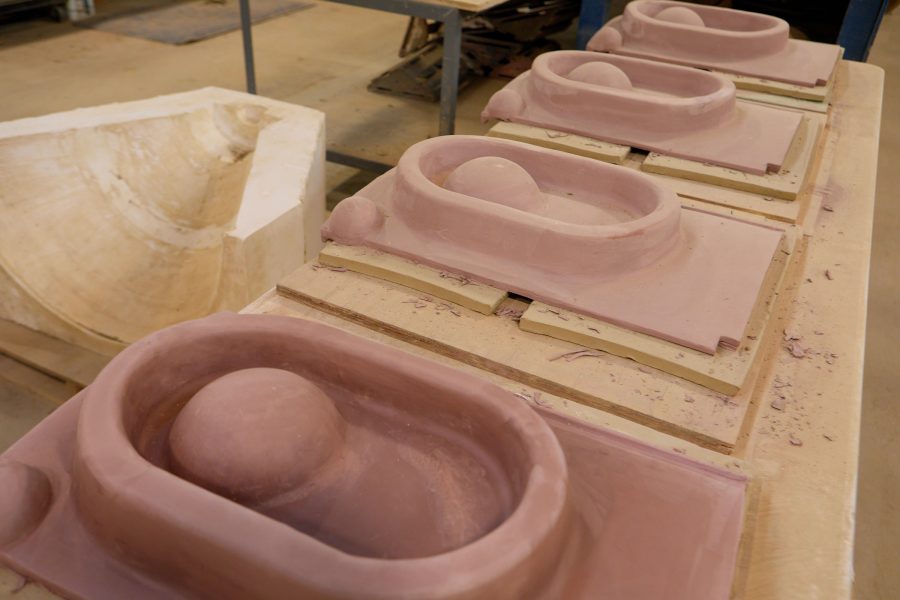
These pieces will ultimately find a home on top of the Bishop’s Palace in Galveston, the former home of Walter Gresham, a prominent attorney, politician, and railroad executive, who commissioned the home in the late 1880s. Photo by Matt Reese productions, LTD
A lot of testing happens organically on the job, including testing slip casting versus hand-packing, Harris says. “These are parts of the Bishop’s Palace (circa 1892),” he says, pointing to a row of large, still-pink building ornaments. “These were going to go up on the tower at the very high peak where the finial goes up. We need 13 of these, and we’ve tried slip casting, we tried pressing, and now finally we’re hand-packing them. They made this plaster mold and then they hand-packed it and trimmed it. When this releases, they’ll flip it over.”
One thing Ludowici has learned over the years is just how crucial drying is. One day they started to experiment with sand—not just for texture, but to help the drying process. “If we want this to dry a little slower, what if we put the sand on the inside where it can’t be seen? Maybe it’ll dry slower and won’t crack,” one employee said. Now they’ve been doing it that way for a few years. “That’s an example of someone who does this work all the time who said, ‘What if we try this?’ And now we do it on a regular basis,” Harris says.
That’s an example of someone who does this work all the time who said, ‘What if we try this?’
Ludowici produces a range of support systems to stabilize clay components during the drying process, including clay braces, setting mud, wooden pallets, and saddles, all designed to maintain form, prevent distortion, and ensure consistent quality through production. They are also currently experimenting with humidity. In a small back room the aforementioned hippocampus is in pieces while a humidifier fills the space with steam. The team was working to determine why particular pieces were cracking when Buchanan, a ceramic engineer, considered humidity, given that it was dry that time of year.
“As pieces become more complex and vary in thicknesses we must take more control in the drying process,” Buchanan says. “We have begun running different process variations with humidity generators, heaters, and plastic to control the temperature and humidity during the drying process.”
3D printing was used to create patterns for all the hippocampus, which is designed in pieces that will ship separately and then slide together. “This is kind of a test lab for us,” Harris says. “We have extruders out there. We bought this small volume pug mill and we’re extruding clay in a round form. We could be able to utilize it again—it’s not expensive to do it—but we’re trying to see if we do it this way, then we can invest in a much bigger type of process.”
Ludowici also recently purchased a new spectrophotometer to provide a basic color value that Ludowici’s David Jensen then uses alongside his own understanding of raw materials to design a glaze or engobe formula. “We’ve had people bring in jewelry and say, ‘Can you get something close to this?’ Harris says. He points to an original tile from a Principia college project, where roofs date back to the 1930s. “This is a battered, hand-crushed piece from the old school in Elsah, Illinois,” Harris says, turning over the worn tile. “Back in the day they would reach in with their hands with gloves on and spread slush material. We’d never done anything like this before.” He holds Ludowici’s own innovative result up to the original. “If you lay that up here, it’s very close. It looks like it’s been there for 150 years.”
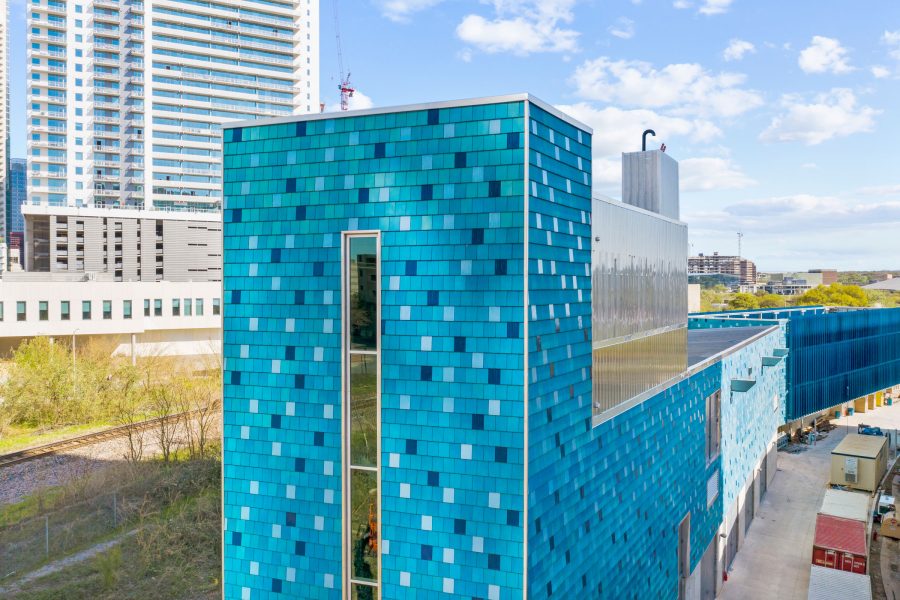
Similar to roof tile, Ludowici offers 58 standard colors and custom color options as well with NeXclad. Cotera Reed Architects used NeXclad 14 in Mediterranean Blue on the Austin Cooling Plant project in Texas. Photo courtesy of Ludowici
The Principia team was pleased with the outcome. “Ludowici can do things with clay tile that no other tile manufacturer in the world can do,” Old World Roofing’s Cullen Hagerty, who worked on the Principia project, previously told gb&d. “Their matching ability, from today’s tile to the tile of yesteryear, is unparalleled.”
Just as Buchanan experimented with slip casting, Harris says Jensen—who wears many hats as sample coordinator/glaze production scheduler, and color consultant—has pushed the limits of color and texture. “Developing new glazes and engobes is a tricky process, but it can be incredibly rewarding when they come out right,” Jensen says. “A lot has changed in how ceramic colors have been formulated over the past century-and-a-half, so it’s always very satisfying to find a modern, non-hazardous way to replicate a historic look.”
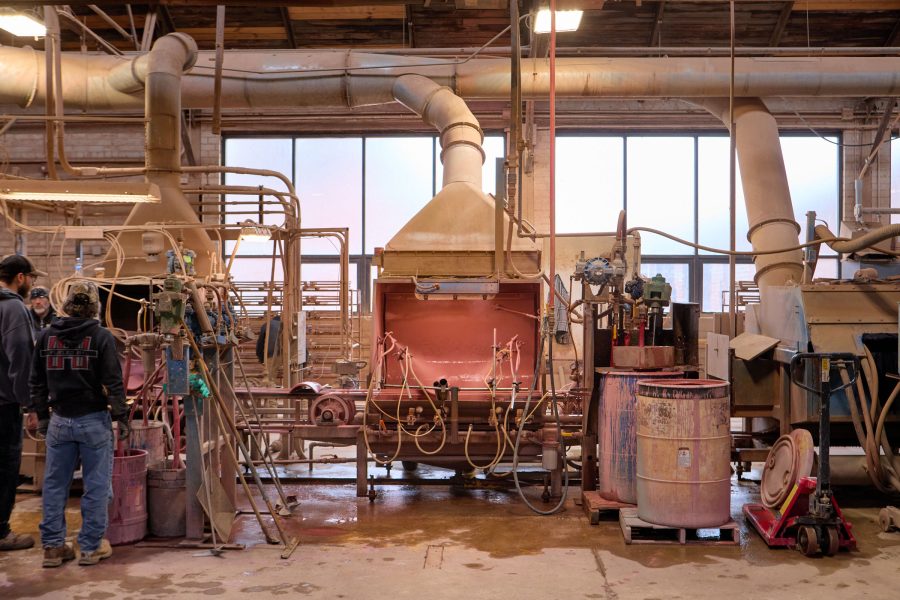
Custom colors are developed in the lab to meet specific customer needs and ultimately fill 55-gallon drums alongside standard colors. Photo by Matt Reese productions, LTD
Ludowici is planning for the future, both with its recently opened $2.1 million storage addition as well as plans for another building, where two of their larger presses will move (they currently have seven presses total). Once the new building opens the company will add another automated line, Harris says.
When the new building is completed, Ludowici will have a continuous line, as the automated line feeds into the cars moving product. Harris says it’s a five- to seven-year buildout. Already he expects payback on the addition to be three years. “The value we gain by bringing tile to market quickly is significant—not only in cost efficiency, but in our ability to keep our artisans and workforce producing the world’s best roof tile and wall cladding without interruption.”
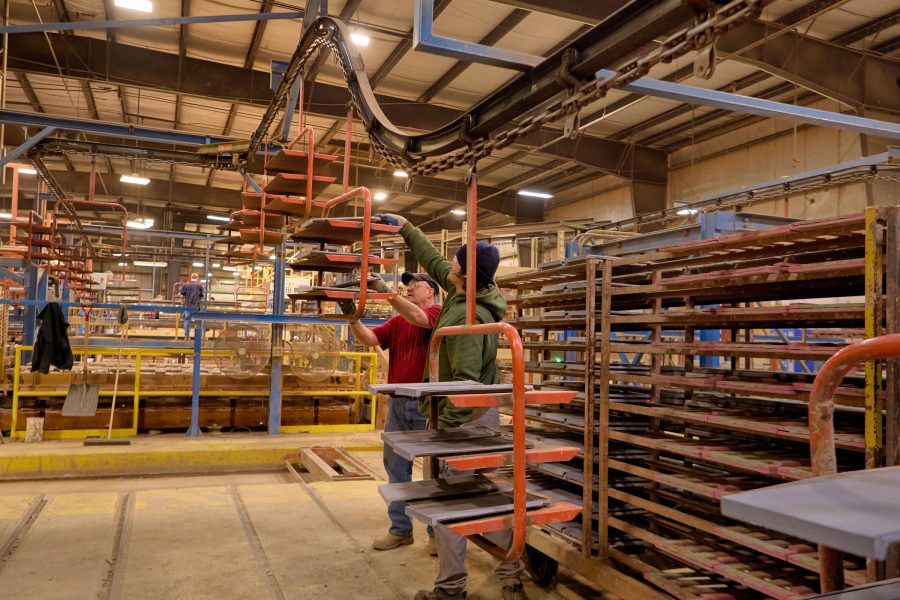
One line churns out thousands of Spanish curved tiles a day, while another area is highly specialized. Here, clay tiles are set out to dry before going to glazing. Photo by Matt Reese productions, LTD
Neither Harris nor Wehr expects Ludowici to go fully automated, though. “If production were fully automated, flexibility would be limited—fewer SKUs, fewer color variations, and fewer custom options—because true customization can’t be easily programmed into a robotic process,” Harris says. “And if you’re only doing a one-off custom set of pieces, why would you invest in robotic gear to do it?” He points to large-scale brick manufacturers who rely on fully automated systems—where machines pick, move, and cut with precision and speed. “That model is built for volume and uniformity,” he says. “Our process is fundamentally different. We operate in a premium space, where the focus is on complexity, craftsmanship, and architectural intent. We may produce less, but each piece carries the value of the time, skill, and expertise required to create something truly distinctive.”
-
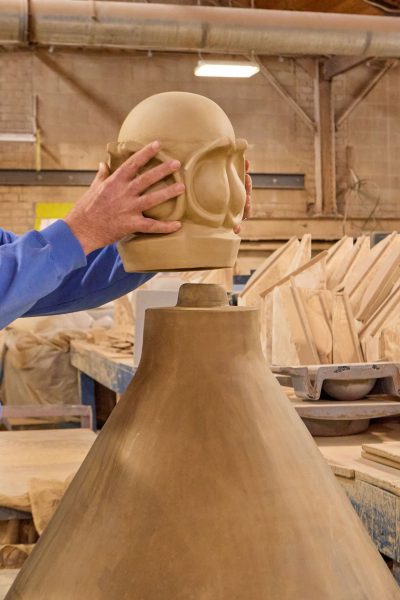
- Extra clay drops off and gets crushed and repurposed. On this day a ton of leftover clay works its way into a large ball, a piece that will soon be on top of a church. “That’s one big piece of mud,” Harris says. “That’s all hand-packed.” Photo by Matt Reese productions, LTD
-
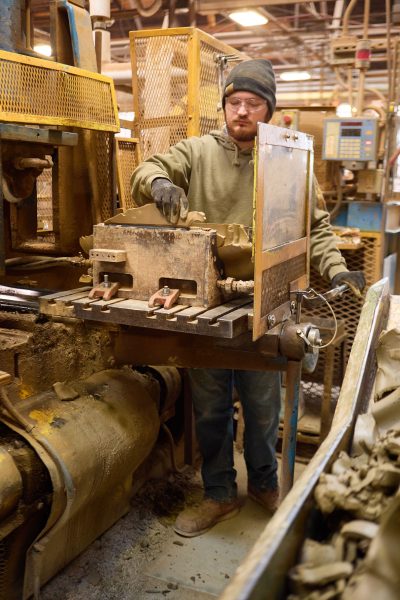
- Ludowici press operator Charlie West works with the clay. Any left over is repurposed. Photo by Matt Reese productions, LTD
Wehr says Ludowici is preserving a timeless craft that not just anyone can do while innovating and preparing for the future. They’ll never go fully automated simply because some pieces are too special. “Where we really focused is on modernizing the front end of the process, before they actually start making the pieces,” Wehr says. “The design, engineering, all that stuff on the front end. It was a two-dimensional drawing that went to the shop floor and then had to be crafted into a 3D pattern. That required people with amazing skills to be able to take a 2D drawing and create a 3D pattern physically. I don’t want that to go away either, but we need that to happen a lot faster than what was happening before, and so you use those new technologies to allow that to occur faster and more efficiently.”
3D printing and scanning, for example, helped Ludowici achieve a printed finial for historical restoration of a school much quicker than traditional methods.
Today Ludowici clients include everyone from Disney to the Department of Commerce, from beloved Buddhist temples and Chinese gates in major cities to the massive buildings dotting the National Mall. Much has changed since Wehr first joined the company as part of the marketing team in 2004. His background in engineering and love of architecture connected him with people at Ludowici, back when their Ohio campus didn’t even have a paved parking lot. He credits his predecessor, Tab Colbert, for bringing him onboard and sharing his vision. Wehr says Colbert knew terra-cotta had a special place in US architecture. “That’s what he kept telling me. ‘We’re going to get this thing going in a better direction, and we’re going to start making money. We’re going to redo this place.”
Looking ahead, Harris says terra-cotta cladding is the biggest opportunity and innovation to be excited about, with $1.3 million in sales last year. Colorful interlocking tiles are on full display inside Ludowici’s “Factory of Ideas,” which opened in 2007 after much renovation of the former pack barn near the railway. Clay tiles have been used as cladding for years in Europe, but only more recently caught on in North America.
Ludowici’s NeXclad True is the newest terra-cotta cladding solution, designed to install with a flush surface texture and endless colors. “Ultimately this is going to be the future,” Harris says, emphasizing how Ludowici is innovating to continue to make it lighter and easier to install while maintaining strength. “Because it’s small format and we can customize the color and texture, designers can transition and blend it with a lot of other materials, like wood, brick, and stone.”
Ludowici continues to share their message via CEUs to architects. Seemingly endless color, texture, and even more intricate profile designs are no problem, plus building owners have a sustainable product with an extremely long service life with NeXclad True. “Small format terra-cotta cladding is being shaped by a convergence of advanced manufacturing, performance-driven design, and renewed interest in authentic, long-life materials. For architects it opens up a level of creative and technical flexibility that few facade systems can match.”