Story at a glance:
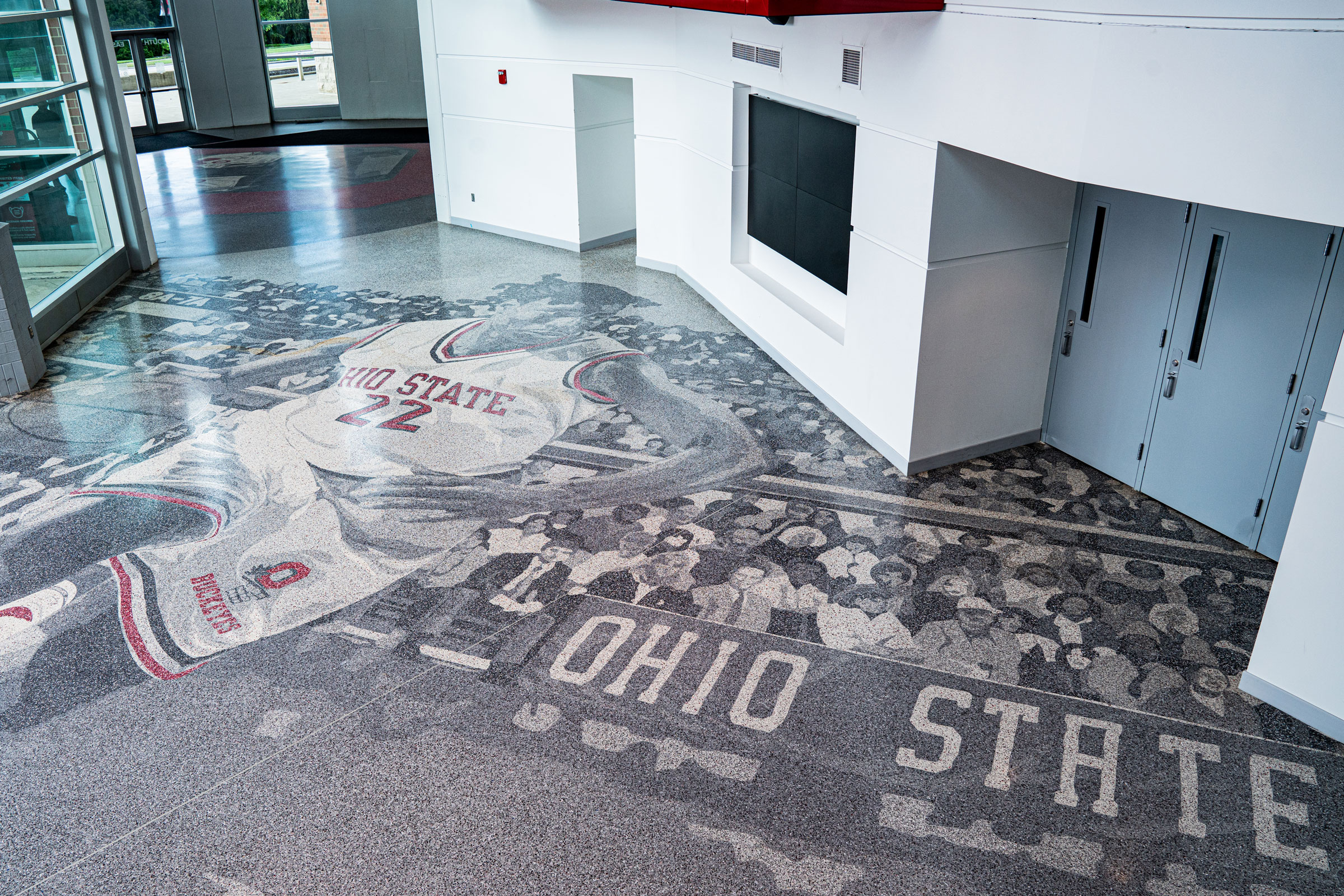
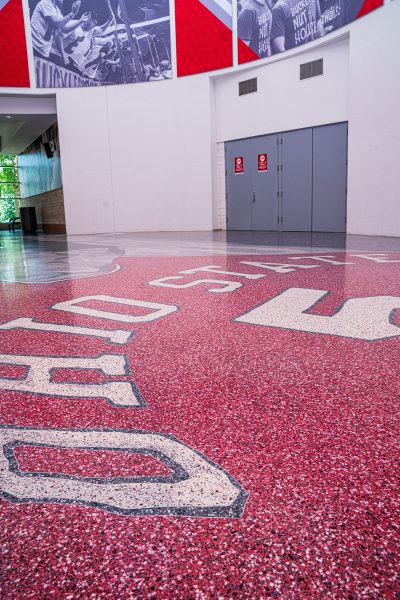
- Completed in 1998, Ohio State’s Jerome Schottenstein Center arena features six elaborate floor “murals” depicting its winning athletic programs in epoxy terrazzo.
- Terrazzo can withstand heavy use for decades with minimal maintenance, offering lower lifetime costs than any other floor system or covering.
- Installed directly onto a concrete substrate, terrazzo’s life cycle can easily outlast that of the building without needing replacement or adding to landfills.
Since 1998 students and sports fans entering The Ohio State University’s Jerome Schottenstein Center arena—home to OSU’s men’s and women’s basketball and men’s ice hockey teams—have been greeted by expansive murals depicting the athletic legacy of the Big 10 school. But the murals don’t hang on the walls; they are underfoot.
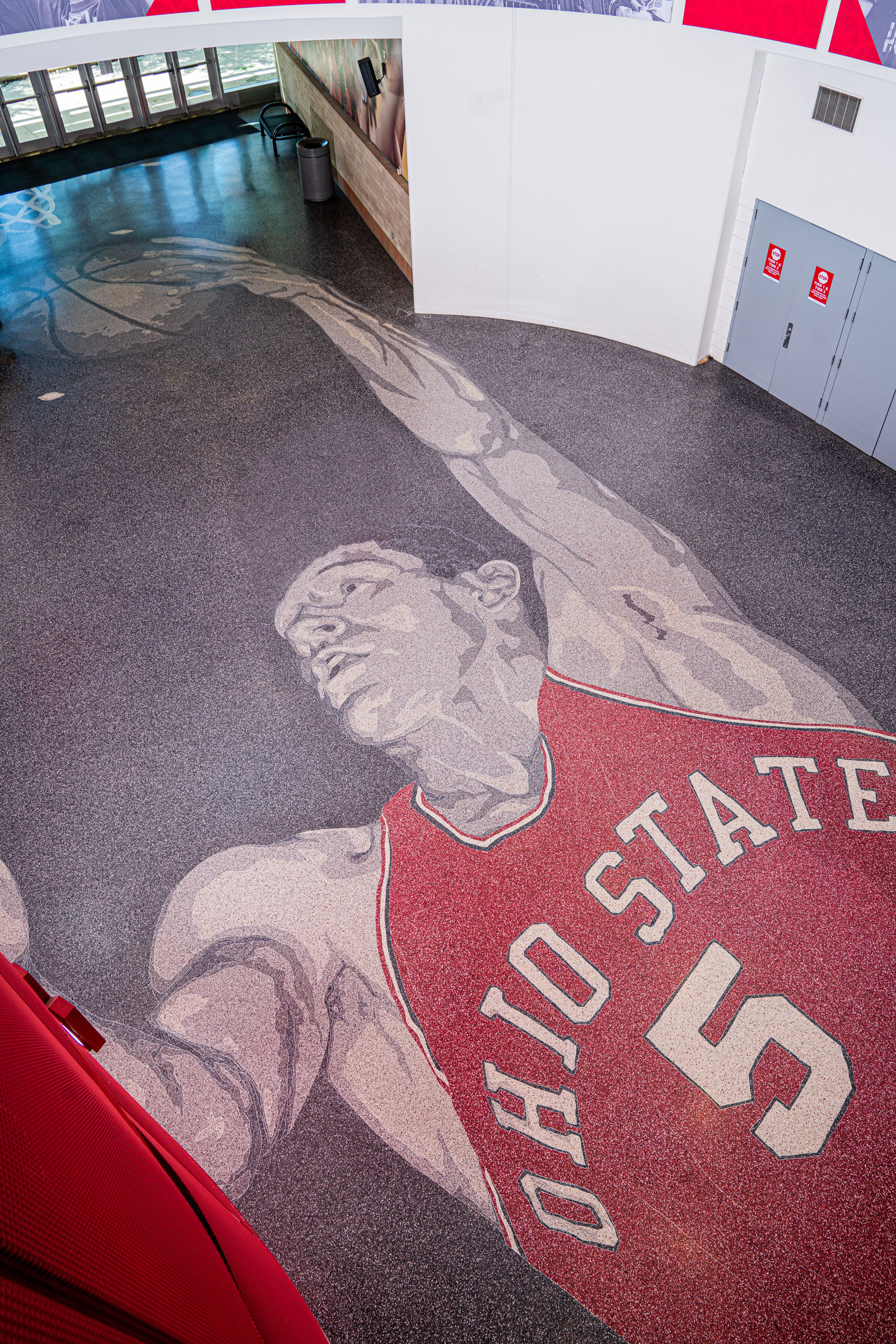
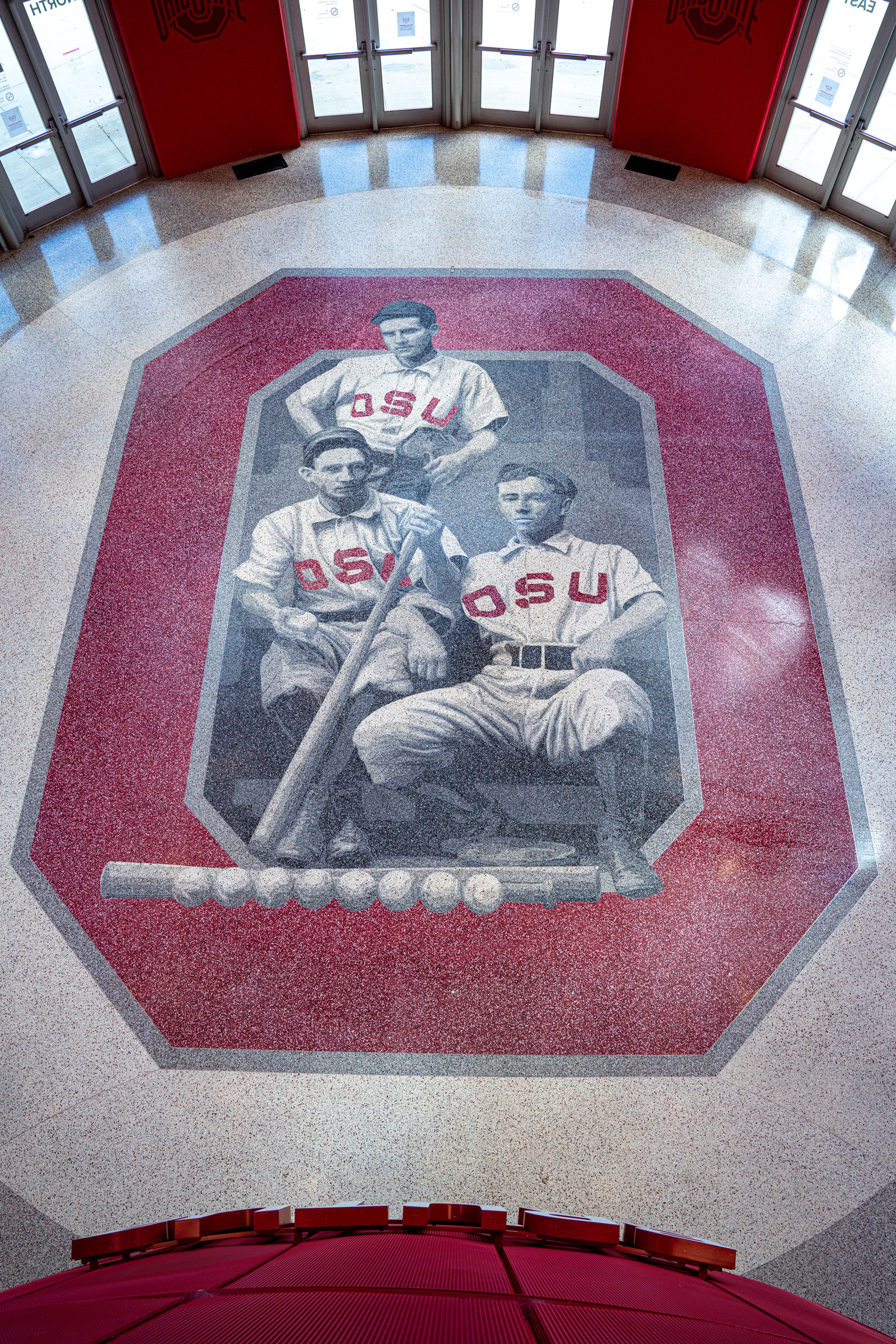
Designed by celebrated conceptual artist Alexis Smith and collectively known as Larger Than Life, the six images are cast in stone with long-lasting epoxy terrazzo. They cover more than 71,000 square feet at the arena’s entry points and celebrate OSU athletes in Buckeye scarlet and gray.
“Ohio State wanted to highlight the history of athletics at their school,” says Casey Ball, global market director of Sherwin-Williams High Performance Flooring. “They decided to look to terrazzo to tell the story.”
An Intricate Installation
-
- Photo by Kelly Ann Photography, courtesy of Sherwin-Williams
-
- Photo by Kelly Ann Photography, courtesy of Sherwin-Williams
The project took more than 8,350 gallons of epoxy resin and 115 tons of stone, glass, and shell chips. Each segment of the artwork took six weeks to install, and the Schottenstein Center was ultimately named the 1998 Terrazzo Job of the Year by the National Terrazzo & Mosaic Association. Architecture firm Moody Nolan served as one of the primary architects for the building and supported the specification of terrazzo flooring for its longevity and design capabilities.
Smith, along with several OSU architecture students, drew each image on the poured concrete substrate; installers then placed more than five miles of zinc wire dividers on the lines and hand-poured each color of mixed terrazzo. “Once they have the divider strips in, it’s paint by numbers,” says Mark Merrifield, market segment manager for Sherwin-Williams High Performance Flooring.
Variations in color and shading allow surprising detail. One mural features NBA Hall of Famer John Havlicek, a Buckeye who went on to play with the Boston Celtics. On another, the faces in the crowd behind ’90s women’s basketball star Averill Roberts include the artist, athletic director, architects, and installers who contributed to the center’s construction.
A Surprising Sustainable History
Terrazzo has been a sustainable option since it was invented during the Renaissance. Reusing excess marble, Venetian stoneworkers bound chips with cement and poured terrace floors (hence the name), ground the surfaces with a weighted stone, and sealed them with goat milk. “Terrazzo is the original recycled content,” Merrifield says.
Using epoxy resins as a binder, today’s terrazzo is denser and less fragile than that of the Renaissance. It offers designers a range of colors and can include chips of glass, mirror, and other materials in addition to marble and crushed stone. The Schottenstein Center’s hockey-themed floorscape, for example, includes mother-of-pearl to make the ice shimmer.
Lasting Without Waste
-
- This photo shows the wall to floor transition with a cove base. Photo by Kelly Ann Photography, courtesy of Sherwin-Williams
-
- Photo by Kelly Ann Photography, courtesy of Sherwin-Williams
Recent revisions to the product category rule for epoxy terrazzo rates its life cycle to last that of the building that contains it. As a result the material produces less waste than flooring options like VCT or ceramic tile, which wear out and eventually need replacement, according to some experts.
Poured in place, terrazzo essentially becomes part of the building structure. “Other types of floors and floor coverings will eventually end up in a landfill,” says Mike Starner, marketing manager for Sherwin-Williams High Performance Flooring. “Terrazzo bonds directly to the substrate and lasts forever.”
The longevity of terrazzo and its reduced environmental footprint have been recognized in a new product group definition published in the Sustainable Minds Transparency Report. The recently published “Part B: Product group definition | Resinous floor coatings | Part B #25-007,” released February 5, 2026, notes that terrazzo stands out among resinous options because it bypasses the traditional cycle of removing and recoating top system layers, drastically reducing its long-term environmental footprint. The 18-member committee responsible for this recognition of terrazzo as a premier sustainable choice included four representatives from Sherwin-Williams.
Terrazzo is a good choice for any building designed to last a long time and withstand lots of foot traffic—airports, government buildings, schools. And it’s a fraction of the cost of other options like luxury tile, Starner says. “You get great aesthetics and the lowest life cycle cost.”
Easy Maintenance
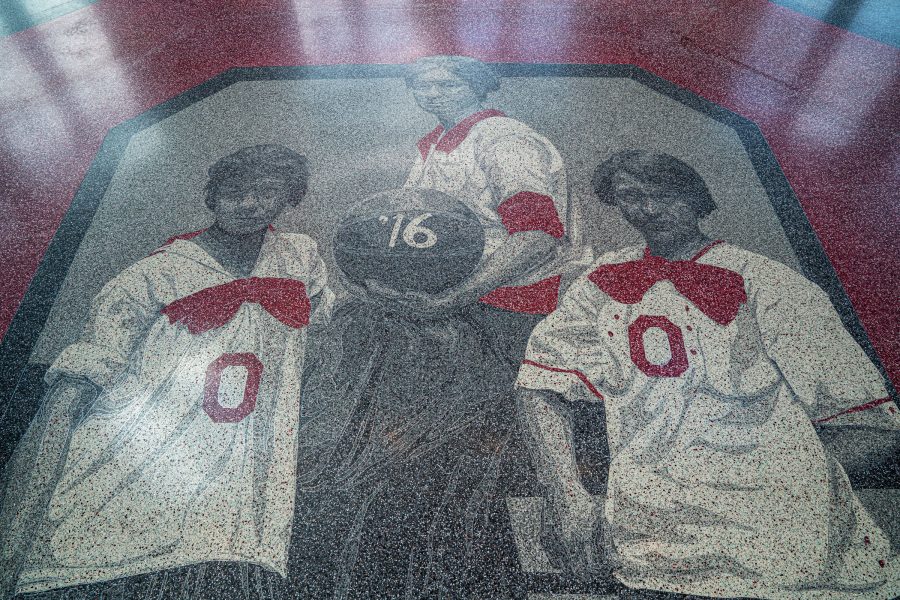
Photo by Kelly Ann Photography, courtesy of Sherwin-Williams
Contractors must limit inconsistencies in the substrate to create a clean canvas for installation. They will also often add a crack suppression membrane before pouring terrazzo to ensure future concrete cracks do not project through the finished floor. The terrazzo is then ground flat and grouted with additional epoxy to make it impervious to dirt and grime.
Maintenance is simple—a dust mop or wet mop is usually all that’s needed on a daily basis; many large installations use floor scrubbing machines. Depending on traffic, terrazzo needs to be polished periodically to return to its original luster.
Most terrazzo floors feature “sacrificial” coatings of sealers and waxes to protect against spills and dirt and provide slip resistance. Similar to waxed floors, facilities should strip the sacrificial coatings and reapply them every one to two years depending on traffic and wear.
Lasting a Lifetime
Nearly three decades and millions of footsteps later, the Schottenstein Center’s murals still pop. Together they are a testament to the durability of terrazzo and a lasting homage to the school’s history in sport. The floor “is kind of a beacon for the university,” Ball says. “They love the fact that it tells a story.”
”Athletics is about human movement, expression of emotion, [and] accomplishment through physical, improvisational, and intellectual effort,” athletics director Andy Geiger told OSU’s The Lantern in 1998. “The artwork is evocative of the spirit of Ohio State [and] of what a university should be about.”
“Terrazzo gives designers an opportunity to leave a signature mark and tell a story that’s going to be around for a long time,” Merrifield says. “People are going to walk across it and experience it for many years.”