Story at a glance:
- Top architects are turning to mass timber for sustainable, human-centric designs.
- In 2018 five CLT plants were in operation in the US; today that number has more than doubled.
- Two DLR Group projects illustrate how the American-grown material is applied across different contexts.
Mass timber is gaining momentum across the US, and with that growth comes an urgent shift toward strengthening domestic sourcing. After years of depending on European and Canadian suppliers, expanding US production is becoming essential to scale adoption and meet market expectations.
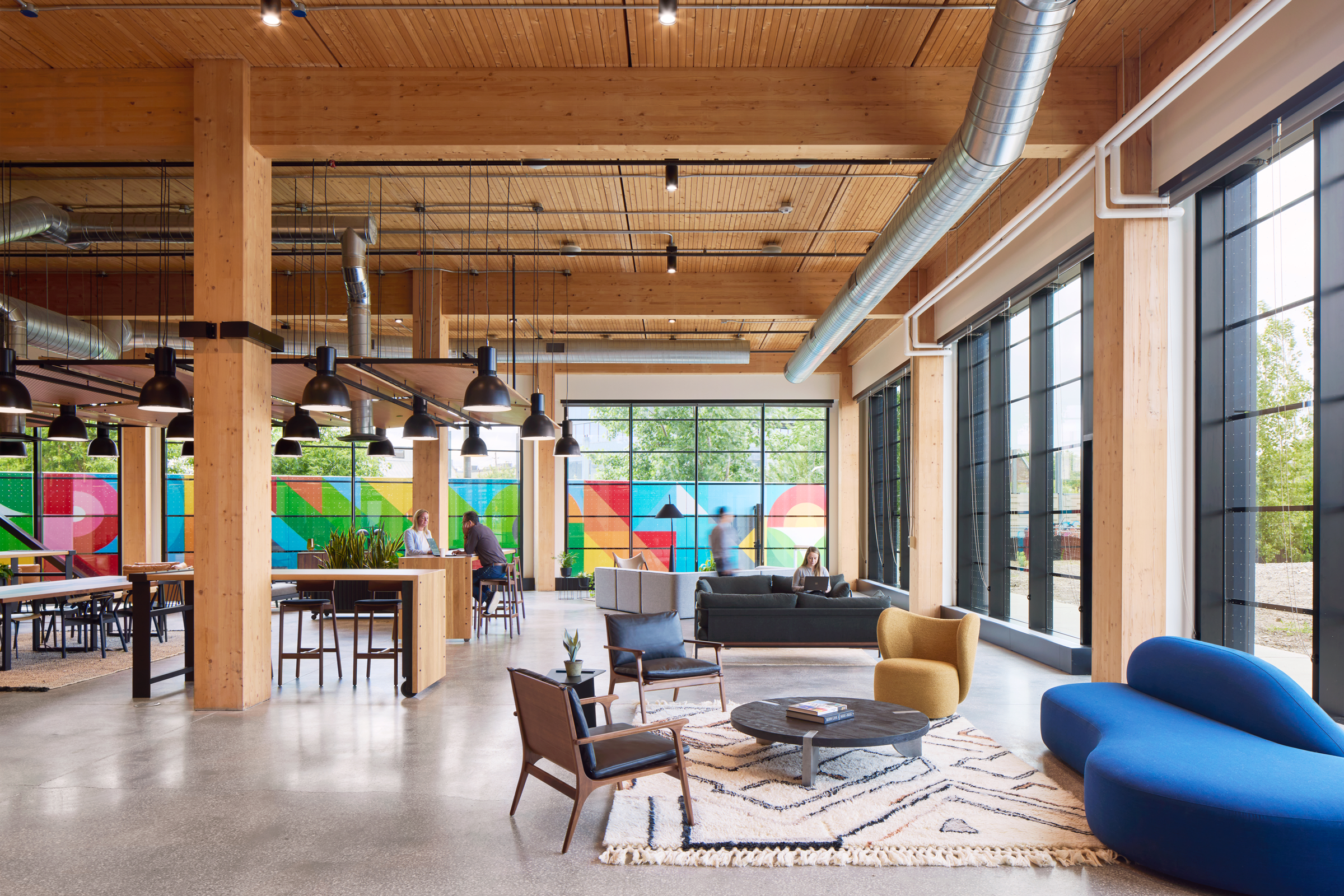
Mass timber continues to prove its value as a material that supports low-carbon performance, elevates the user experience, and introduces an authentic connection to nature within interior spaces. For more than a decade DLR Group’s work with mass timber has been guided by a commitment to sustainable, human-centered design.
The firm’s first T3 (Timber, Transit, Technology) project with Hines in Minneapolis showed timber’s scalability for large commercial projects while enhancing occupant well-being. Today, with more than four million square feet of mass timber designed, DLR Group continues to advance its approach centered on material honesty, human health, and ecological responsibility across a range of building types.
Mass timber’s appeal extends beyond its reduced embodied carbon. Wood’s natural grain introduces warmth, variation, and tactile depth, creating spaces that immerse occupants in a sensory connection to the natural world. The material also provides practical advantages: prefabricated components are assembled offsite, which can shorten construction schedules by up to 25% compared to steel and concrete timelines, reduce noise, dust, and traffic, and simplify logistics. These efficiencies improve project delivery, reduce risk, and create market differentiation, as timber buildings stand out as innovative and visually striking, often supporting premium lease rates and higher tenant engagement.
Despite mass timber’s advantages, adoption has faced challenges. Upfront costs are higher than traditional steel or concrete, and limited domestic supply historically required importing timber from Europe and Canada. As demand accelerates and codes evolve, attention is now turning to the growth of US producers who can offer greater capacity, shorter lead times, and more resilient supply chains.
American Timber Manufacturing on the Rise
In 2018 five cross-laminated timber (CLT) plants were operational in the US; today that number has more than doubled to 13 facilities, with more on the way. This expansion is reshaping the supply landscape by shortening lead times, improving logistics, reducing long-distance transport (and therefore embodied carbon), and aligning production more closely with US codes and sustainability standards, improving efficiency and predictability in the process.
Domestic manufacturing also strengthens rural economies, supports responsible forest management, and reconnects communities to the forests that supply their materials. Thoughtful growth remains essential, since structural timber requires careful stewardship to maintain long-term ecological and economic resilience.
As US producers expand and diversify, more projects are demonstrating how locally sourced timber can support performance goals and reinforce a deeper connection to place. Here are two DLR Group projects illustrating how this American-grown material is being applied across different contexts, each for distinct reasons.
9th and High: The Future of Sustainable Student Living
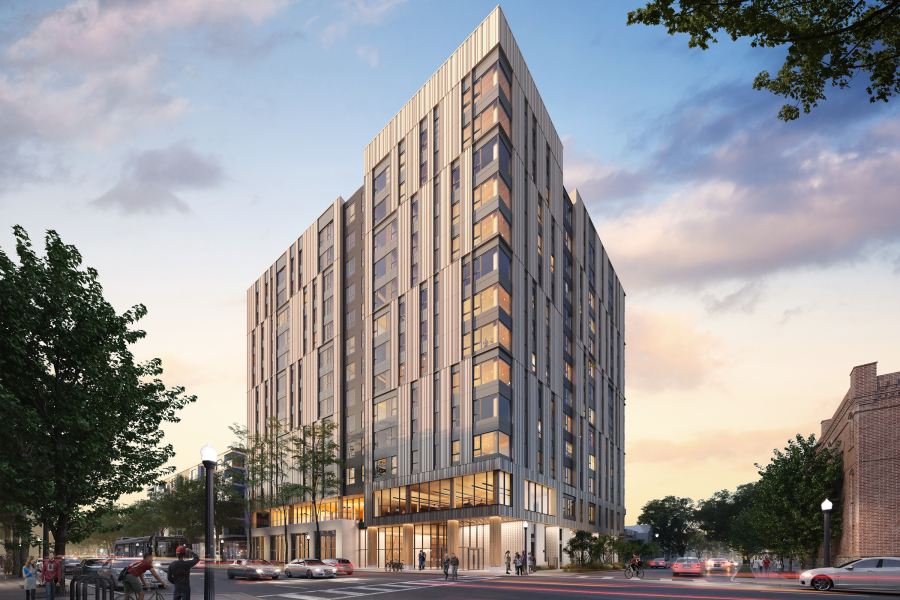
9th and High is Columbus’ first mass timber project. Image courtesy of DLR Group
Rising 13 stories in the heart of Columbus, Ohio, 9th and High will be the city’s first mass timber project and tallest mass timber student housing building in the US once constructed.
Designed by DLR Group in partnership with developer Harbor Bay Ventures, the 242,000-square-foot structure uses CLT and glulam columns sourced from SmartLam North America’s newly expanded facility in Dothan, Alabama. Mass timber was chosen not only for its environmental benefits but for its warmth, texture, and ability to support an efficient construction timeline.
Mark J. Bell, CEO of Harbor Bay Ventures, described the project as the “epitome of innovation,” noting that it addresses “so many important topics, including sustainability, affordability, forest management, an evolving workforce, and American timber production.” By weaving together traditional and contemporary design elements, 9th and High respects the neighborhood’s historic character while creating engaging spaces for students to live, learn, and connect.
Forefront Structural Engineers, in collaboration with SmartLam, is leading the structural design of the mass timber systems, incorporating domestically sourced CLT floor panels and Alabama-grown glulam columns and beams. The team also integrated concealed connectors from Columbus-based Simpson Strong-Tie to achieve a two-hour fire resistance rating, demonstrating how regional manufacturing can support high-performance timber construction.
“This project was optimized for the North American supply chain, proving we can build tall mass timber cost-effectively in the Midwest with our own forests,” says Josh Dortzbach, CEO of Forefront Structural Engineers, noting that the structure will sequester 1,128 metric tons of carbon dioxide equivalent (CO₂e)–comparable to more than 2,100 round-trip flights from Columbus to Key West. By advancing domestic material sourcing at this scale, 9th and High sets a new benchmark for future large-format mass timber development across the country.
The Aplin Center: Authentically Texas
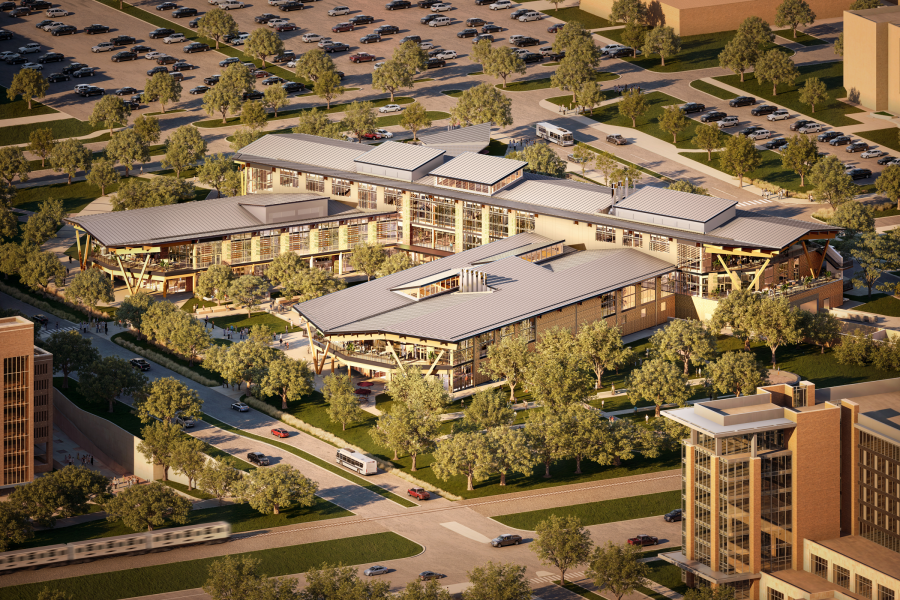
Designed by DLR Group, the Texas A&M University Aplin Center brings the science and business of the food industry together under one roof. Rendering courtesy of DLR Group
At Texas A&M University in College Station, Texas, the Aplin Center is redefining hospitality, retail, and marketing education. Developed by Buc-ee’s founder Arch “Beaver” Aplin III, the 3.5 million board-foot mass timber building will serve as the university’s new front entrance and bring science, business, and hands-on learning together under one roof.
Designed by DLR Group in partnership with Pickard Chilton, the project features glue-laminated columns and beams alongside CLT floor and roof panels sourced from Texas sawmills.
From the outset the vision for the project was that anyone entering the building would see immediately that every timber element came from Texas. This local mass timber sourcing story reinforces the connection to place, allowing the building to tell the story of the state’s forests and the people who manage them. The design balances transparency and focus, combining hospitality-inspired public areas with dedicated academic spaces that propel collaboration, creativity, and exploration.
By embedding education, experimentation, and storytelling into the architecture, the Aplin Center becomes a living incubator, preparing students to innovate while celebrating the local context and authenticity of Texas timber.
What’s Next?
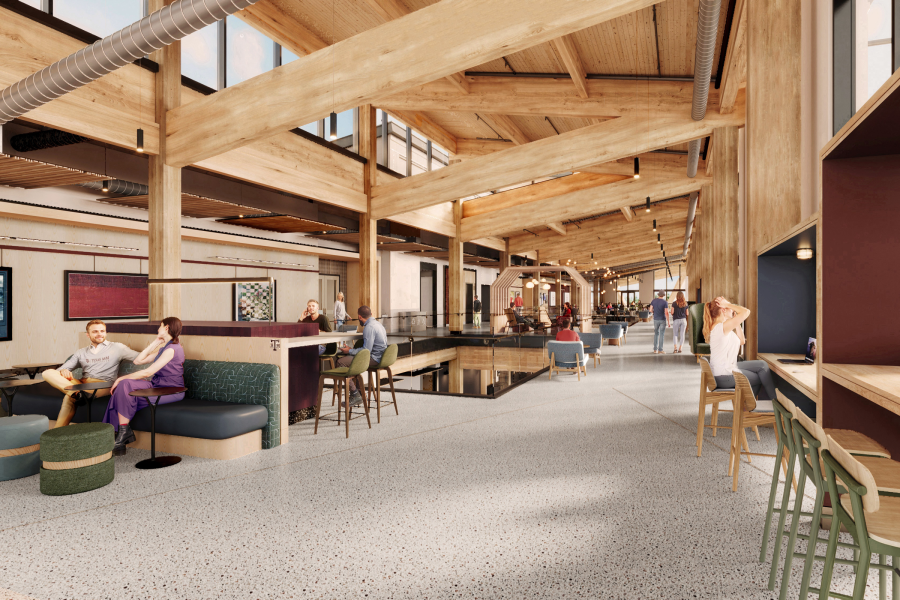
Texas AM Aplin Research Center. Rendering courtesy of DLR Group
As mass timber becomes more commonly considered, a future is emerging where material provenance is celebrated. Just as consumers increasingly seek to understand where the products in their lives are sourced, from food to fashion, why shouldn’t the same transparency apply to the places they inhabit? Entering a building and knowing where every beam and panel came from, including the forest, the sawmill, and the community, could become a defining part of design. Domestic production supports this vision while ensuring quality, traceability, and regional economic benefits, while also contributing to faster project delivery, strengthened local economies, and reduced transportation-related carbon impacts.
Mass timber is more than a material; it’s a medium for environmental stewardship, immersive design, and storytelling. Structural innovation and sustainable sourcing combine to create spaces that feel authentic, resilient, and inspiring while demonstrating ecological responsibility, technological capability, and commercial potential.
One day, understanding a building’s materials at every scale will not just be possible but expected—a true testament to design that honors both place and planet.