Story at a glance:
- USG has innovated nearly every product and performance enhancement since its origins in 1902. USG Sheetrock® Brand UltraLight Tough panels is one of the latest, as are the USG Mars™ and Juno™ High-NRC Acoustical Panels.
- More than 80 experts across fields work in labs at the USG Corporate Innovation Center, developing and testing the building industry solutions of tomorrow.
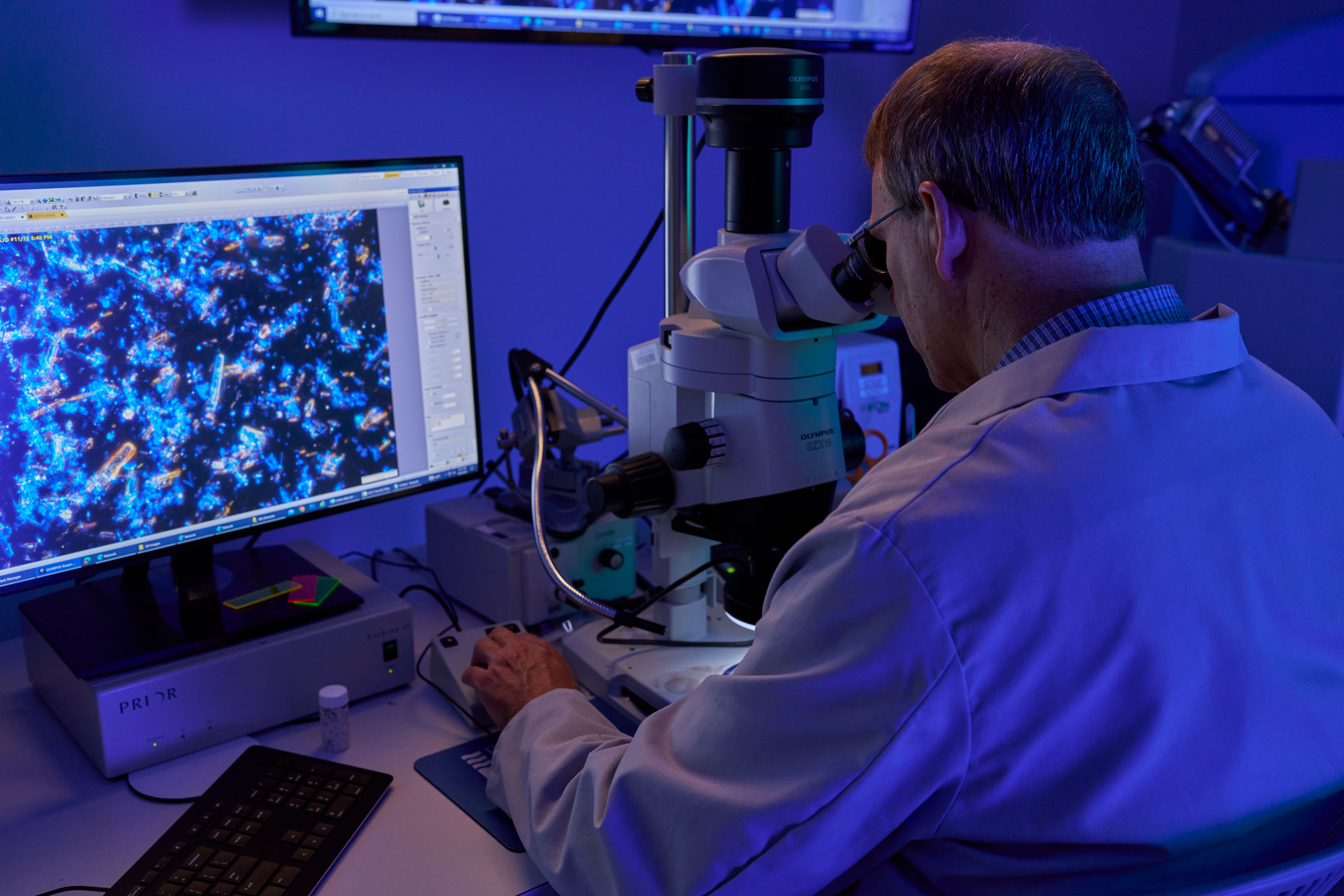
Some of the greatest minds in science are dreaming big inside USG’s Corporate Innovation Center (CIC). A lot of listening and experimenting combined with, at times, a handful of “magic foo-foo dust,” results in some of the most innovative building products on the market at the 200,000-square-foot campus in Libertyville, Illinois. There, more than 80 experts—from an authority in starch to material scientists and chemists to an expert in bubbles who’s worked on everything from shower gels to vaccines—have been hired to break barriers, redefining performance and sustainability in construction.
“We have PhDs, we have technicians, we have engineers. Everyone is working together,” says Mark Hemphill, who’s worked for USG for 29 years and is now vice president of innovation, leading the CIC.
Hemphill says that makeup of teams makes USG uniquely qualified to solve industry challenges, and they specifically seek the brightest minds in various areas of industry to do so. “We purposely hire. As an example, we put starch in wallboards; it’s a binder system. We hired a PhD from the cereal business who’s an expert in starch chemistry. He invented the modern-day starch we use that’s proprietary to USG.”
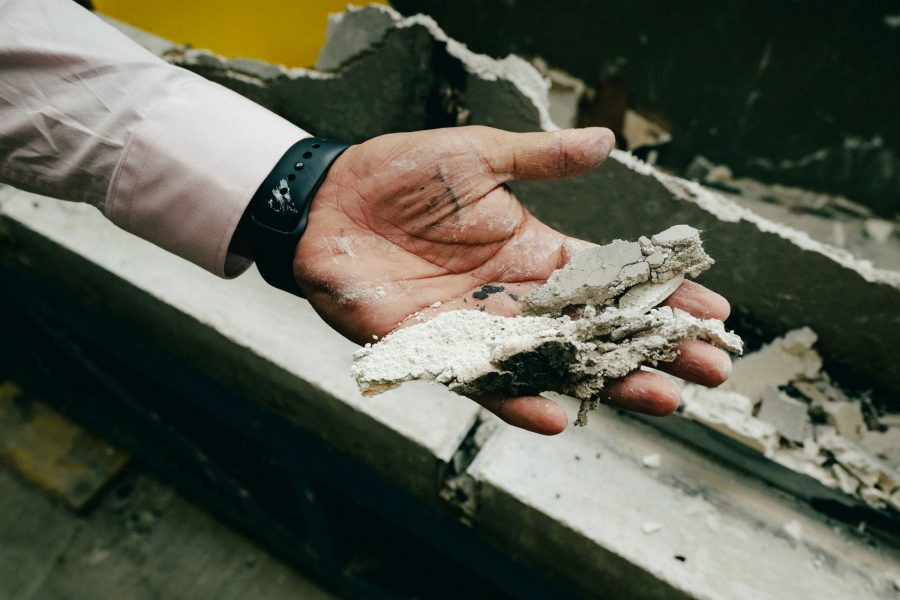
Gypsum is a brittle material, especially as you reduce weight, but USG figured out a way to deliver both a lighter weight solution while enhancing edge durability, where most damage occurs. Photo by Lyndon French Photography
Touring the CIC in early 2026, I heard stories like these and more, meeting some of the humble geniuses behind today’s most exciting building products—including solutions like the Sheetrock® Brand Ultralight Tough Panels, the latest solution developed from more than a century of innovation from USG, including the 2010 invention of lightweight wallboard. “We revolutionized wallboard in this country. We took out 30% weight of the product, and that forced everyone else to follow,” Hemphill says of the 2010 invention. “Whenever you take weight out of wallboard you take out water. That means it’s less energy to manufacture, and it’s lighter, which means it’s more product on the truck and fewer trucks on the road.”
Being lightweight is important for safety and sustainability, while customer feedback made it clear to USG that durability was essential. From handling and delivery to the jobsite, having a lightweight solution is easier on teams and equipment as well as the installer/finisher, with cleaner installations and less damage and waste.
“Whenever you built a building back in the ’80s your ceiling would be a five-eighths wallboard. You needed it because of the sag resistance. It was strong, it was heavy, and it was dimensionally thick, so it wouldn’t sag,” Hemphill says. “USG came around in the late ’80s, early ’90s, and we invented this thing called half-inch interior ceiling board. We replaced this heavy five-eighths panel with this half-inch product that was 400 pounds lighter per MSF. The contractors really loved it. We used a little bit of different foo-foo dust in that to give us the sag resistance.”
Powerful Processes
-
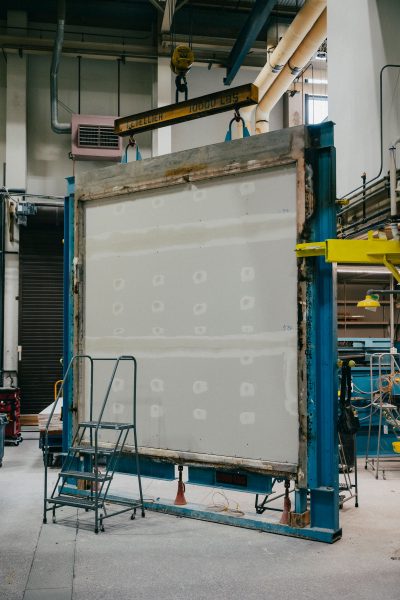
- The gypsum panel lab creates and tests gypsum and wallboard products. Photo by Lyndon French Photography
-
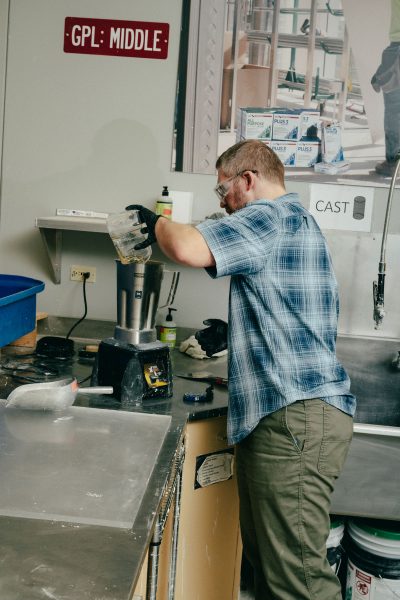
- The labs are like a kitchen for science, complete with special ovens and even the “breadmaker,” a small appliance that looks like a traditional mixer in which a powder is combined with water and USG’s proprietary mixture before being poured into forms to see how it holds up. Photo by Lyndon French Photography
Ideas born in the CIC can come to life faster, says Kara Bosnic, senior marketing and brand manager at USG. “From the beginning we have been the innovators and the disruptors of construction materials, starting with drywall. We are the inventors of modern drywall,” she says. “Now, 125 years later, we have so many things in our portfolio that have all been delivered from this building and these people.”
Innovation is built into USG processes. While about 85% of employees’ time in the CIC is spent supporting USG’s core business, 15% of the time is committed to coming up with the next transformational products. “We have to continue to dream,” Hemphill says.
Today USG has more than 2,700 active patents in the industry. USG’s Innovation Board meets three times a year, and employees are invited to present any and all ideas at those meetings before getting the green light.
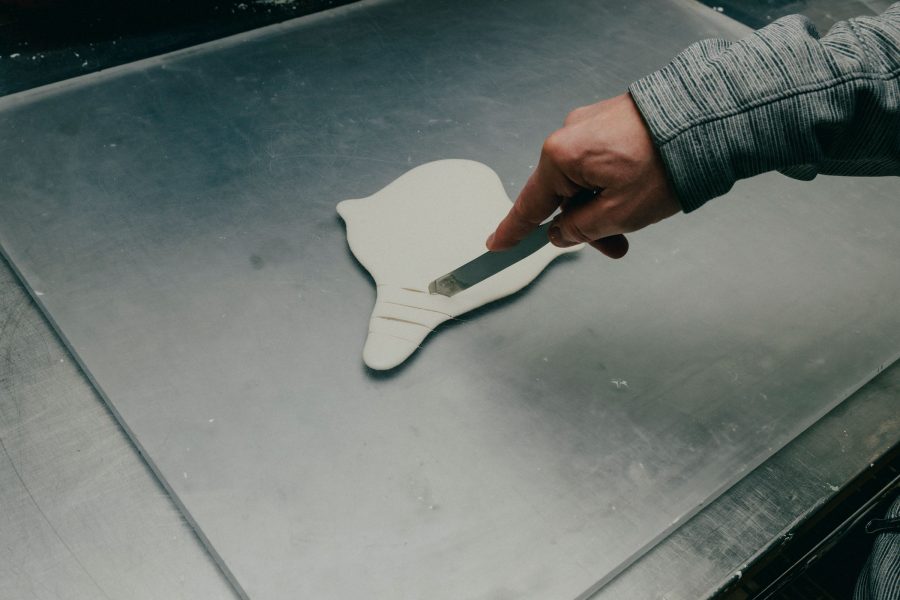
Photo by Lyndon French Photography
Generally the labs are where employees can try new things and quickly pass/fail them, delivering successes to the market faster. USG has labs dedicated to ceilings, gypsum panels, performance surfaces, performance substrates, as well as an analytical lab. They also have technicians in a fire test lab conducting full-scale fire tests and technicians in a full-scale acoustical lab blasting sound to test for the acoustical performance and more. They even have a machine that shoots balls of ice, ensuring their innovations will hold up to hail.
An open dialogue is core to USG’s innovation processes. Listening goes a long way, and the learning never ends. That open exchange is part of what makes USG so successful, says Will Frank, who works in the Ceilings Lab. He started at USG in 1995. “It’s part of the culture here. I see it in a lot of areas of the company. There’s no fear or hesitation. You’re trying to figure out how to get the job done, and you can have this exchange of ideas. It’s a good environment for it.”
Even a quick break in the cafeteria can lead to brainstorming a new solution, he says. Listening to one another across departments and trying new things is how USG Sheetrock Brand UltraLight Tough Panels came to be, says principal researcher Annamaria Vilinska, in the wallboard division, recalling the back and forth as they worked to solve for durability and a lighter weight without increasing cost too much. “We were brainstorming different ‘foo-foo dusts,’” she says, as the team likes to refer to their proprietary mix. “It’s a lot of trial and error.”
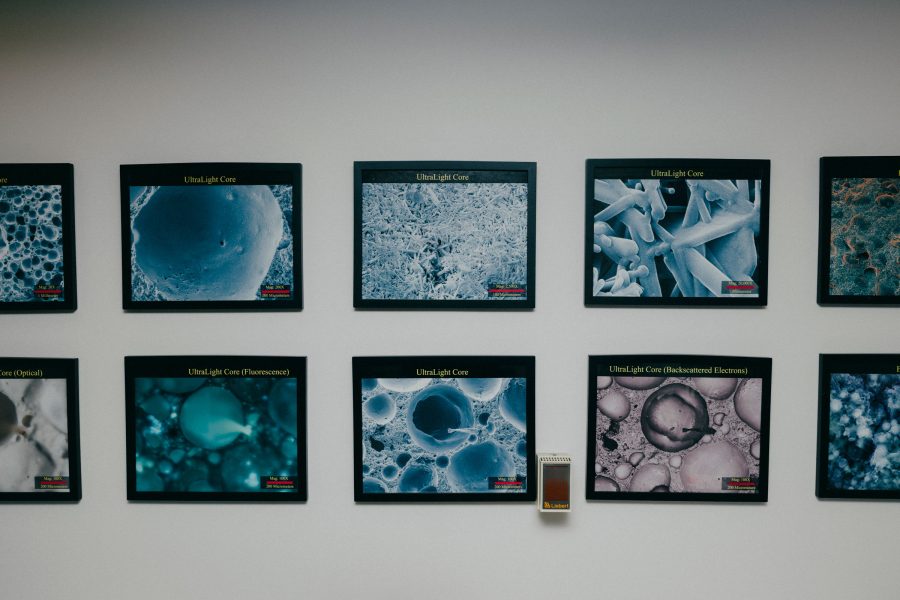
Photo by Lyndon French Photography

“Wallboard is made up of a bunch of crystals, but they’re much, much smaller.” Photo by Lyndon French Photography
USG Sheetrock Brand UltraLight Tough Panels ultimately builds on the brand’s Ultralight panels, which was itself the result of many years of innovation. “Ultralight Tough took it to the next level. We wanted to make it lighter and more durable. We were also aware of the limits of what you can do with gypsum,” Vilinska says.
Innovation always starts with the needs of the customer, Vilinska says. “You cannot really innovate without solving someone’s problems.” That problem could sound relatively simple—“This is too heavy; we need something lighter.”
“We know there is a shortage of labor and a shortage of skilled labor,” Vilinska says. “If you can make something lightweight, like the gypsum board, it is going to improve the efficiency at the jobsite. So we are solving for that. When it comes to the Ultralight Tough, it’s really the durability of it. Our customers need a board that will not break on them while they are installing it.”
When a potential solution has value, employees are able to keep testing and see it through, sometimes following happy accidents you never saw coming. “If there is value for the customer, we are definitely free to follow the path,” Vilinska says, pointing to Ultralight Tough as an example. Those working on the gypsum board were trying to make it even lighter, without realizing they could also make it stronger, she says.
“Typically this is how innovation happens. You’re trying to solve for one thing and you end up with a solution for something else. A significant portion of inventions are really by accident. It’s really about having ideas and putting them into practice, trying different things and having an open mind that it’s not necessarily going to solve what you think.”
Innovation Overhead
-
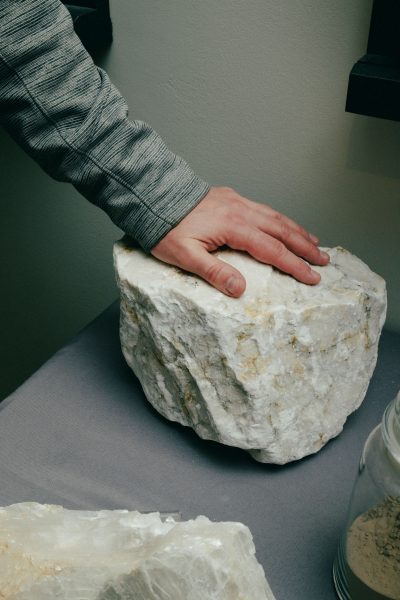
- Photo by Lyndon French Photography
-
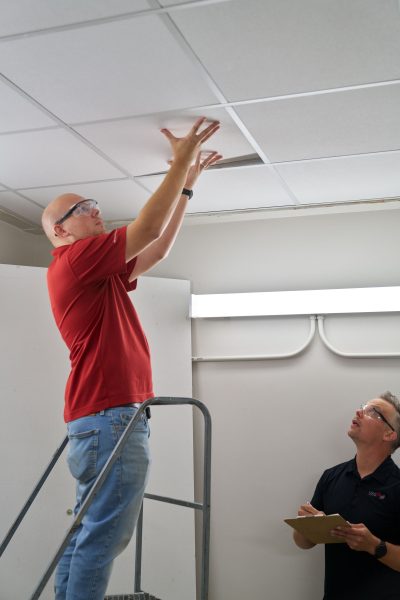
- Researchers at USG’s Acoustical Lab prepare a ceiling installation for testing and evaluation. Photo courtesy of USG Corporation
USG also recently launched the Mars High-NRC Acoustical Panels and the Juno High-NRC Panels, building on the company’s long history of acoustic excellence, having also invented the first acoustical ceiling tile. USG Mars™ and USG Juno™ High-NRC/CAC Panels are the first mineral fiber solutions to meet an NRC of 0.95/CAC 30. That level of NRC performance has typically required fiberglass in the past. Now installers have less “itchy” fiberglass to deal with while getting a high-performance, thin, durable panel that is easier to install.
These solutions enable seamless design, a direct reflection of customer feedback, Frank says, as designers wanted something sleeker. “‘We want the edges to look nicer,’” he says they said. “So this became a catch-all project. These things got combined—the need for higher performance, the need for better looking edges—and then USG went one step further. That’s a good-looking tile.”
While your average person might not notice the super-smooth edges of the acoustic tile when it’s installed, designers and architects will certainly notice, Frank says. “From a customer standpoint, design is changing. The aesthetics of that white side down tile, the square with grid, is very dated. The more we work to make it smoother and make it more aesthetically pleasing, the more apt designers will implement it to work for the spaces they need to create,” he says. “You and I have both been in buildings where it’s gorgeous, but I can’t hear you. We can’t have a conversation. We’re trying to solve for design intent and performance realities.”
We’re trying to solve for design intent and performance realities.
All of the characteristics of the mineral wool mattered in this invention. “That’s where the innovation happens,” Hemphill says. “Those are the primary characteristics we are studying, in addition to how to process this in our manufacturing facilities. Anyone could make it in the lab but try scaling it up at speed; that’s the challenge.”
In the USG lab spaces employees take time to experiment with solutions like these, Vilinska says. When they find something that seems to work, they follow it over to the plant to start trialing on a larger scale. “Making it in the lab is one thing. Scaling it up at multiple plants has its own set of challenges.”
Vilinska says she and her colleagues are tasked not just with developing standout products like these but seeing them through to make sure they’re manufacturable. And that’s a good thing. “That is really unique about USG; you are part of the whole cycle. We are not detached from the final product. Oftentimes there’s the opportunity to be there from inception all the way until it’s being sold on the market and the customers start using it,” she says.
Having this level of expertise and talent under one roof gives USG a huge competitive advantage. “We can test products really quickly. We can do it all internally. We have experts in basically every single field of product performance,” Hemphill says. “It helps us be innovative and be really efficient at developing new products.”