Story at a glance:
- Accelerators play a critical role in maintaining productivity and quality throughout the winter construction season.
- Accelerating admixtures shorten set time and speed early strength gain, which is critical for maintaining productivity in cold weather.
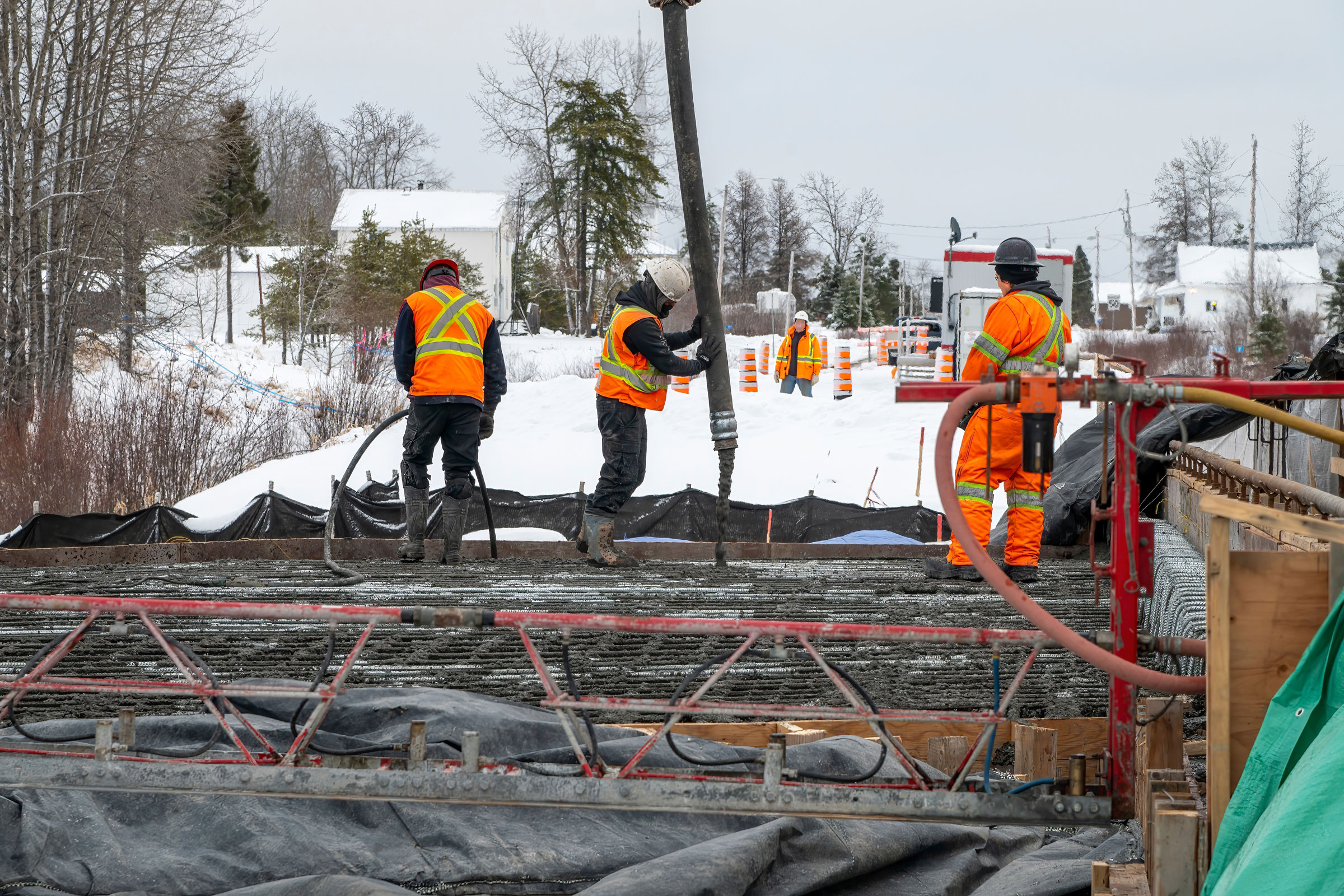
As temperatures drop, concrete placement becomes more challenging. Cold weather slows hydration, delays strength gain, and can derail project schedules. The right approach and the right admixtures can keep your concrete performing at its best, even when the thermometer plunges. Accelerators play a critical role in maintaining productivity and quality throughout the winter construction season.
Concrete construction in cold weather demands deliberate planning, execution, and protection to ensure strength, durability, and schedule adherence. According to the American Concrete Institute (ACI) 306 “Guide to Cold Weather Concreting,” conditions qualify as cold weather when, for more than three consecutive days, the average daily air temperature is below 40°F and the air temperature does not exceed 50°F for more than half of any 24-hour period. Even during transitional seasons protection during the first 24 hours is required to avoid freeze damage.
The Winter Challenge
The kinetics of the crystal-growing hydration process is heavily influenced by temperature, according to the Arrhenius equation. When cold-weather conditions arise, there are a few concerns to keep in mind:
Strength development slows: For every 18°F drop in temperature, setting times double, leaving the concrete vulnerable for longer.
Hydration slows or stops: At around 25 to 27°F, enough pore water freezes to halt hydration. Expansion from ice (roughly 9% more volume than liquid water) can cause internal stress and lasting damage.
Heat loss to cold subgrades: Warm concrete placed on a cold surface can cool rapidly, risking freezing before adequate strength develops.
Objectives of Cold-Weather Concreting
Photo courtesy of Chryso, Shutterstock
The goals are straightforward but critical:
● Prevent early-age freezing damage.
● Ensure concrete reaches safe form-removal strength (typically ≥ 3.45 MPa / 500 psi).
● Maintain curing conditions that support normal strength development without excessive external heat.
● Limit temperature gradients and rapid cooling that could cause cracking.
Planning and Best Practices
Success in cold-weather concreting starts with planning:
1. Hold a pre-placement meeting among contractors, producers, and specifiers to align on realistic expectations, cold-weather methods, protection, and monitoring.
2. Adjust mix temperatures. ACI 306 provides minimum concrete temperatures by section size and ambient condition; for instance, 60°F for thin sections when air is around 30°F.
3. Protect freshly placed concrete until it reaches at least 500 psi strength. Use insulated blankets, heated enclosures, or form heaters as needed.
4. Monitor internal temperatures, not just ambient air. Embed temperature sensors or record core temperatures to ensure compliance with ACI guidance.
5. Minimize haul time and heat loss. Warm aggregates and mixing water can help but don’t replace protection and admixture use. Full loads lose less heat compared to partial loads.
How Accelerators Help
Accelerating admixtures shorten set time and speed early strength gain, which is critical for maintaining productivity in cold weather. For example, Chryso’s complete accelerator portfolio is designed to deliver consistent performance in freezing conditions.
Chryso’s accelerator range includes:
● Chryso Polarset – Non-chloride, non-corrosive accelerator ideal for reinforced or post-tensioned concrete, providing reliability down to 20°F.
● Chryso Daraset 400 – Non-chloride accelerator balancing workability and early strength, especially effective in mixes with supplementary cementitious materials (SCMs). Daraset provides faster set and increased early strengths.
● Chryso Daraccel – Chloride-based High-performance accelerator for fast-track schedules and precast applications. (Chloride-based accelerators can increase the potential corrosion of steel reinforcement. When using Chryso’s Adfil®Strux fibers for light construction, Daraccel would be fine.)
● Chryso TurboCast – Non-Chloride accelerators offering maximum economy where corrosion risk is not a concern.
Key benefits of using accelerators:
● Helps maintain pours and production on schedule in freezing or time-critical conditions.
● Provides early strength for faster form removal.
● Offers non-chloride options for reinforced or post-tensioned concrete.
● Reduces cold-weather variability.
When used correctly accelerators can extend workable temperature ranges, as low as 20°F without halting hydration. This enables safe, efficient winter placement without sacrificing performance.
Practical Implementation Tips
Perform trial mixes under expected field conditions to confirm set times and early strength.
Sequence batching properly. In most cases accelerators tend to work better when added toward the end of the batch cycle.
Adjust dosages as conditions change. For large pours accelerator dosages can be adjusted so that the entire slab sets around the same time.
Use temperature sensors to record concrete temperatures.
Balance cost and value. While accelerators add upfront cost, they shorten protection periods, reduce heating expense, and prevent costly rework.
Pour With Confidence
Cold weather doesn’t have to stop progress. Accelerator technologies keep concrete projects on schedule in freezing conditions, protect reinforcement, and ensure early strength without compromise.
With careful planning, temperature management, and the right admixture strategy, projects can stay on track, meet performance targets, and deliver durable concrete that stands the test of time.