Story at a glance:
- Lake|Flato’s Heather Holdridge separates sustainable from regenerative work and argues the real test is the practice, not the project.
- Trinity University, Ryerson Woods, and Lake|Flato’s own office show what portfolio-wide accountability looks like.
“Regenerative” is among the most elastic terms in sustainable design, so Heather Holdridge, partner and director of design performance at Lake|Flato, starts by narrowing it down. “Sustainable means we’re doing less harm, but regenerative means we’re actively restoring and adding capacity to ecological systems or human systems,” she says. “A building can hit every efficiency target and still just be neutral, taking nothing extra from the world but giving nothing back either.”
The harder question is what makes a practice regenerative rather than a building. “A regenerative practice is defined by whether that same systems-level thinking about material, water, energy, equity, and community shows up by default in every single project regardless of budget or client commitment,” she says.
Holdridge has been testing that standard since 2008, when she joined Lake|Flato as its first dedicated sustainability hire. The design performance group she leads is now five people inside a 154-person firm.
1. Join the AIA 2030 Commitment—& Report Everything
The AIA 2030 Commitment asks signatory firms to work toward carbon-neutral buildings by 2030 and to report predicted energy performance annually across the whole portfolio rather than a selection of it. That reporting rule is the mechanism. “The 2030 Commitment does require you to report energy data on every project, not just the highest performers,” Holdridge says. “You can’t point to just a few net zero or award-winning projects and assume that represents the entire practice.”
What it surfaces is honest and sometimes uncomfortable. “We are forced to look at the underperformers, the clients who may have cut energy scope, the building types where we may still be far behind.”
In 2025 Lake|Flato submitted 87 projects totaling more than 16.2 million square feet, with a net predicted EUI reduction of 49%. Years of that data gave the firm what it calls stealth sustainability—a baseline of best practices built in internally because, she says, it doesn’t cost extra to do them well. “Since we do have that data across our entire portfolio, it tells us which practices belong in that baseline,” she says.
The hardest part is getting energy models run consistently, and staff drift toward whatever trend is newest. “Operational energy is still the biggest lever we have as a profession,” she says.
2. Set Performance Goals Specific to the Project

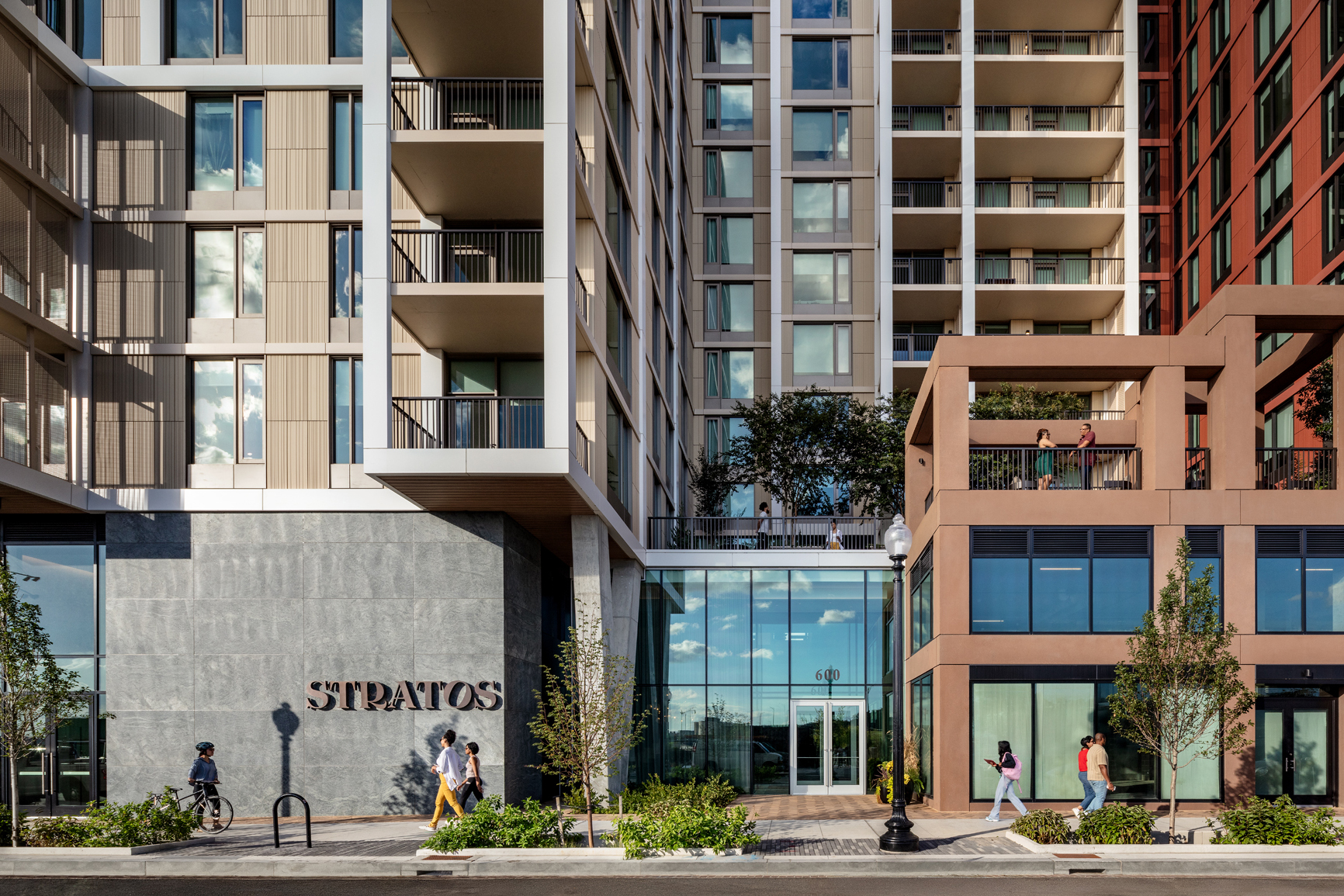
Lake|Flato designed Trinity University’s Business and Humanities District in San Antonio with the goal of no net increase in campus energy. Photo by Robert Benson, courtesy of Lake|Flato
Lake|Flato opens projects with an integrated design workshop and sets goals the project itself justifies rather than a checklist applied across the board. At Trinity University’s Business and Humanities District in San Antonio, stakeholders set six goals, starting with no net increase in campus energy despite a new building.
Deep energy retrofits of two existing buildings under historic designation, plus a moderately sized PV array, offset nearly all the new construction’s load. District energy rose 1%. “We did not quite meet their goal, but we missed it by only 1%, which I think we can call a win,” Holdridge says. On embodied carbon she says reusing those buildings and building the new one in mass timber were the two most impactful strategies available.
Specific goals also surface issues a checklist won’t. An EPA EJScreen analysis run as a design input flagged traffic-proximity pollution and extreme heat, so buildings were oriented to shield gathering spaces from the street, with overhangs and shade trees reducing heat at the pedestrian level. Bridges, elevators, and gently graded paths replaced circulation long fragmented by steep topography. “That was a direct response to early integrated design workshop input from students and faculty, not generic ADA compliance,” she says.
3. Align Consultants & Engineers From Day One

Inside Trinity University. Photo by Robert Benson, courtesy of Lake|Flato
Holdridge treats team alignment as structural rather than procedural. A regenerative practice, she says, is embedded in “how you staff, how you track data, how you engage with clients, how you select consultants,” and doesn’t depend on a single champion.
The kickoff is where that happens. Lake|Flato ran an integrated design process at Trinity and again at the Ryerson Woods Education Facility in Lake County, Illinois, convening stakeholders before design began. At Ryerson the team chose Phius ZERO knowing in a building that small the envelope would dominate, so the envelope, the penetrations, and every detail there would carry the performance—a decision the whole team has to hold from the outset. “If you wait until schematic design or later, the performance is not going to hold if it’s a late add,” Holdridge says.
4. Track Measured Post-Occupancy Performance
With a portfolio spanning single-family residential to large institutional work, the firm measures against each project’s own goals rather than running one evaluation on everything. “If you don’t know how your project is performing, it’s not performing well,” Holdridge says.
At Ryerson Woods an energy dashboard the project didn’t need to meet net zero lets visitors see performance in real time, and the Lake County Forest Preserves’ facilities engineer and owner group monitored it meticulously. When consumption briefly outran the solar array—exactly in line with the energy models, since net zero is annual rather than daily—they got concerned at the first drop in the roller coaster, then fine-tuned as they occupied the building. “Design gets you close,” Holdridge says. “We wouldn’t have met it unless we had the operations and ownership getting us across the finish line.” She hasn’t seen that level of engagement among most of their users.
Lake|Flato’s headquarters office in San Antonio is the counterexample. Sizing the solar array against pre-renovation utility bills underestimated the outdoor air load in a 1920s concrete building that previously had no meaningful ventilation. Mid-construction the firm decided to house servers for all its offices there. The submetering designed to catch both never got installed and is being retrofitted now. “Without that data we’re speculating instead of managing energy,” she says.
5. Give One Person Real Authority

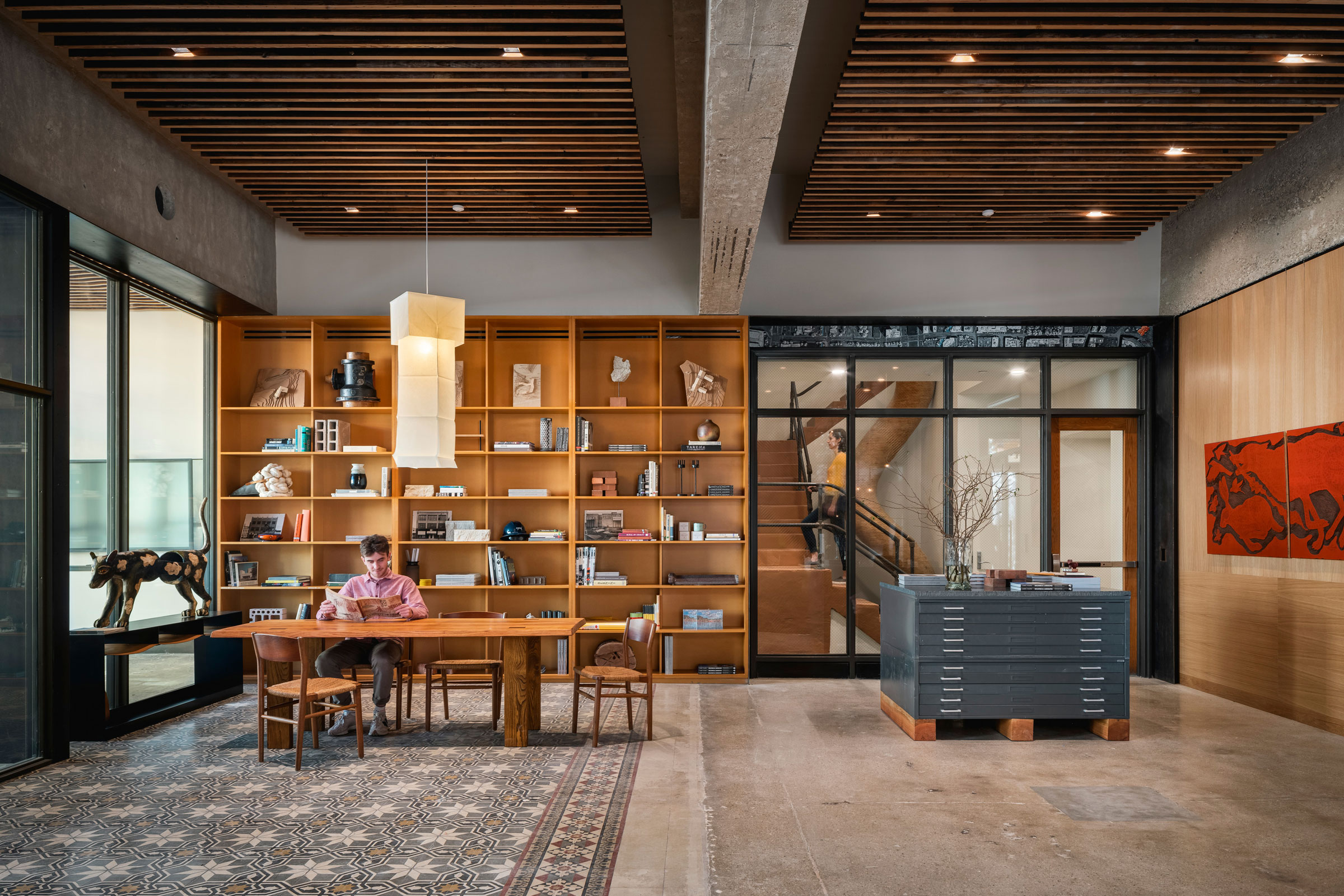
Inside Lake|Flato’s own office. Photo by Robert G. Gomez, courtesy of Lake|Flato
Holdridge is realistic about firm size. “Even if you can’t staff a department, someone still needs to own it,” she says.
Lake|Flato has grown past that threshold—the design performance team exists now and isn’t one person anymore—and she reads that as a signal to everyone in the office, from architecture to human resources. It demonstrates, she says, that the firm treats performance as a core practice with dedicated staff and budget, not something someone is championing on the side.
It shows up in recruiting, too. Candidates arrive asking pointed questions about sustainability and equity, and the 2030 Commitment, the JUST label, and B Corp certification are what the firm answers with. “That’s become a genuine differentiator for us,” Holdridge says. “New hires want to work somewhere that holds itself to a really high standard.”