Story at a glance:
- The Populous-designed Covenant Health Ballpark in Knoxville, Tennessee, was named Ballpark of the Year in its first season. Its design focused largely on creating an immersive, connected fan experience.
- More than 36,000 square feet of cross-laminated timber in the roofing system saved 434 metric tons of carbon—the equivalent of taking 92 cars off the road.
- By using CLT the project saved more than 55 tons of steel, which ultimately saved about 313 metric tons of carbon dioxide and another 121 metric tons of greenhouse gas emissions.
Take me out to the ball game at “America’s friendliest ballpark.” The Populous-designed Covenant Health Ballpark in Knoxville, Tennessee, welcomed the Knoxville Smokies back to the Marble City in 2025 after a 24-year hiatus. Named Ballpark of the Year in its first season, the dazzling new baseball diamond ushers in a new chapter in Knoxville’s 120-plus-year history of Minor League Baseball.
With 70-plus home games each season in the Minor League, Jason Ford, senior architect at Populous, was set on designing a ballpark that championed the fan experience while honoring the tradition of the game. “The one thing about baseball we tell people is it’s the one sport we can impact how the game is played with how we design the ballpark, from the dimensions to the outfield, the amount of foul territory, angles, and things like that,” he says. Ford got his start in baseball working on Petco Park, home to Major League Baseball’s San Diego Padres, and has led minor league pursuits at Populous for the past 12 years.
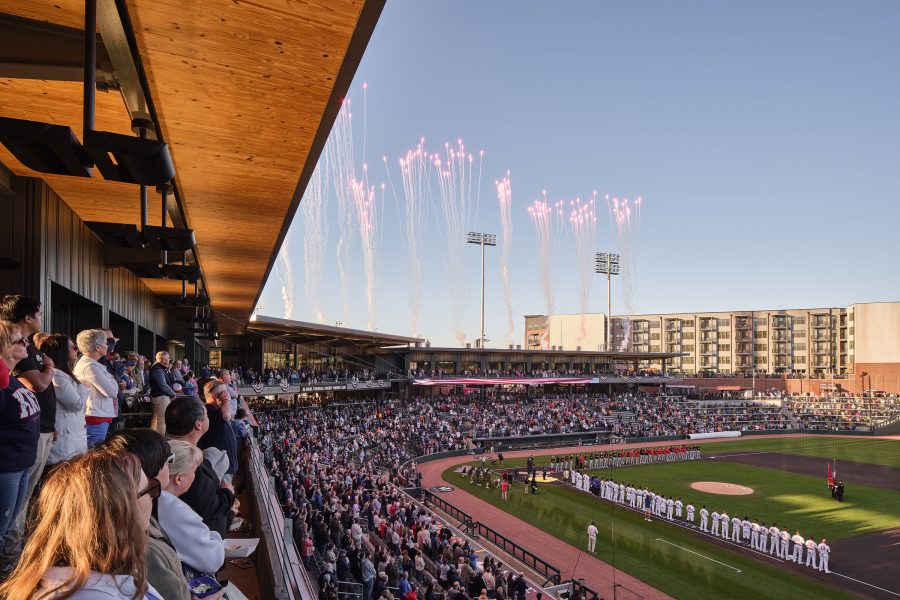
Covenant Health Ballpark ushers in a new era of Minor League Baseball in Tennessee. Photo by Keith Isaacs, courtesy of Populous
“We always try to orient the ballpark pretty much in the same direction, which is to the northeast in the northern hemisphere,” Ford says. “If you can do that then you’re taking care of site constraints in terms of sunlight. And then comes the fun part of, depending on what size site you get, trying to make a ballpark fit on that site.”
In Knoxville the site in question was previously dominated by surface parking for an abandoned slaughterhouse. “It was a pretty scary site,” Ford admits. But the location’s 10-minute walking proximity to the lively Old City, with galleries, bars, restaurants, and music venues on its historic streets, felt right for America’s favorite pastime.
“Baseball belongs downtown. It belongs in a setting where you’ve got a lot of activity going on, where you can just walk up and come to a game,” Ford says. “It enhances the livability of a city.”
You’ve got to have an environment that, when people walk away at the end of the night, they don’t really care what the score was. Did they have a great experience?
The vibrancy of an urban setting, too, only bolsters what it means to spend the day at the ballpark, especially in the minors. “Minor League Baseball is probably one of the hardest sports to design around, because at the end of the day, what’s on the field is not there to win—it’s there to develop,” Ford says. “You’ve got to have an environment that, when people walk away at the end of the night, they don’t really care what the score was. Did they have a great experience? Did they have great food?”
Perhaps why baseball, more than any other sport, caters to the fan experience is because it’s not constrained to time. During the 2025 Major League Baseball season, the average game time was two hours and 38 minutes, with only three games going for more than three hours and 30 minutes. But prior to the introduction of the pitch clock, limited batter timeouts, and other time-saving measures in 2023, the 2022 season had 232 games go beyond the three-hour-30-minute mark. The year before, in 2021, that number was 391. Baseball endures.
“Most people cannot sit through a nine-inning game. People are constantly getting up, going to concession stands, using the restroom, going to the team store. But they’re also meandering around ballparks. They’re walking around and finding different places to watch a game from,” Ford says. “The biggest change in the last 15 to 20 years is the 360-concourse, where you’re never away from the action. You can get up, you can walk around, but you’re not missing the game that’s being played on the field.”
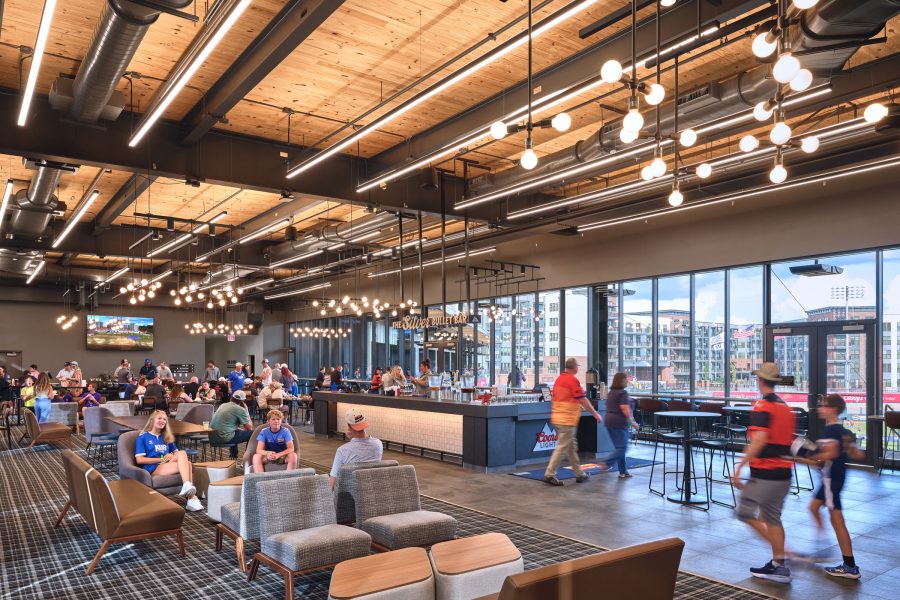
With 70-plus home games each season, Ford says the team they had to design Covenant Health Ballpark to champion the fan experience to keep people coming back—even with six games played a week. Photo by Keith Isaacs, courtesy of Populous
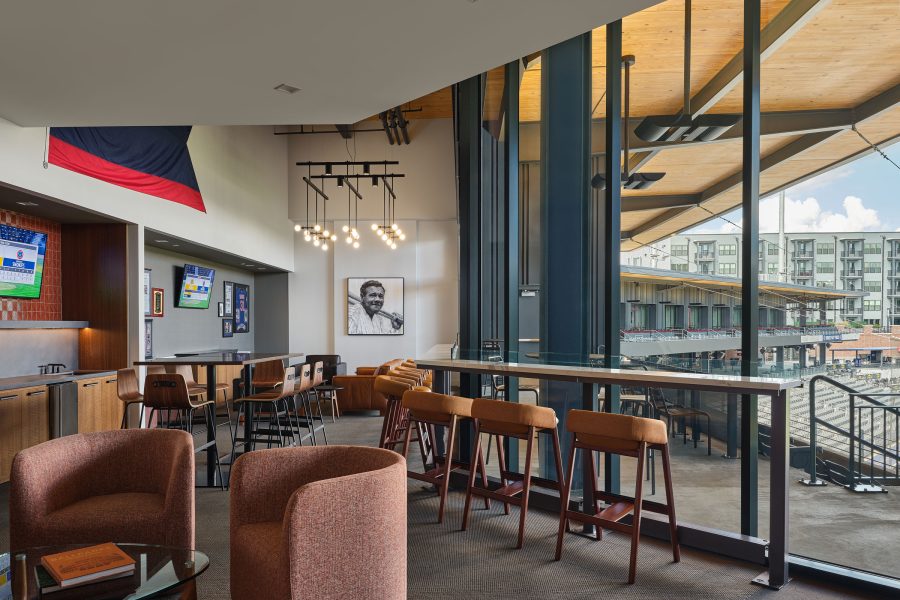
No matter where you are in the ballpark, every space was designed to keep fans connected to the game. Photo by Keith Isaacs, courtesy of Populous
For that reason maintaining a sense of connection throughout Covenant Health Ballpark was key. Seating, food, bars, retail—all of these places become their own destination, a different avenue to experience the game away from the field of play. The fan experience is immersive: Premium clubs, suites, and elevated general seating blend with casual spaces, while the field’s iconic Tennessee-shaped videoboard (the largest in Minor League Baseball) and distributed AV systems keep an energetic atmosphere throughout.
Architecturally, the ballpark’s blend of masonry, steel, and glass nods back to the character of East Knoxville. “We had this big superblock, and one of the design requirements in Knoxville is you have to break that block up into smaller chunks. If you were driving down Jackson Avenue, you don’t want to see this big, long facade,” Ford says. The team looked to buildings in the Old City for inspiration—typically two- or three-story buildings, many clad in red brick—and its history as an industrial hub in the late 19th century.
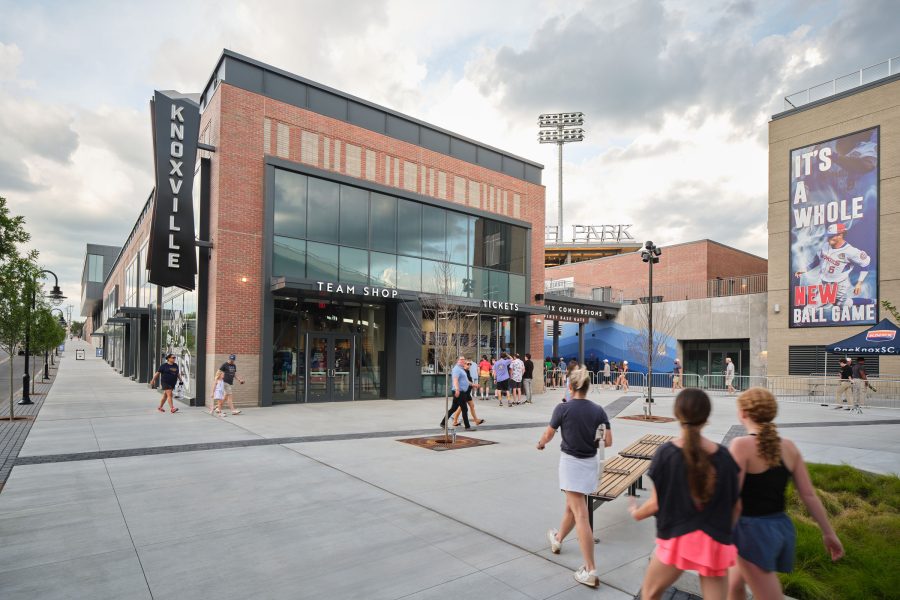
Red bricks were chosen for the facade as a nod to the architectural history of Knoxville’s Old City. Photo by Keith Isaacs, courtesy of Populous
The result is an homage to East Knoxville’s roots—a mixed-material, airy facade that feels like an extension of downtown, with exposed structural elements throughout that harken back to Knoxville’s grit. “A lot of the materials came from the Old City,” Ford says.
Because the original site was mostly concrete, the field itself helped turn the park into a more sustainable space, collecting stormwater and rainwater runoff. The roofing system also includes more than 36,000 square feet of cross-laminated timber—an aesthetic choice that came with big environmental benefits. “By using CLT we saved over 55 tons of steel, which ultimately saved about 313 metric tons of carbon dioxide and another 121 metric tons of greenhouse gas emissions,” Ford says. “The total savings on that was over 434 metric tons of carbon benefit, which is the equivalent of taking 92 cars off the road or operating 46 homes for a year.”
Like many cities, Knoxville is still growing. Ford says there is an estimated $500 million worth of redevelopment in the area immediately adjacent to the ballpark, all privately funded, to be completed within the next decade.
But the Smokies were founded in 1897, and since then the team has witnessed many changes—in the game, in the city, in the world—all while continuing to give Eastern Tennessee something to root for. The team has endured, and Covenant Health Ballpark, both in its vision and scale, was designed to endure, too—like baseball itself, into nine innings and beyond. No pitch count can hold the park back.