Story at a glance:
- Data centers and hospitals demand high-performance building envelopes that balance speed of construction with durability, reliability, and sustainability.
- Integrated waterproofing and air barrier systems help protect critical infrastructure from water intrusion, environmental contaminants, and costly operational disruptions.
- As climate risks and embodied carbon concerns grow, building envelope innovations are increasingly focused on resilience, long-term performance, and whole-building systems thinking.
Building faster, more durable, highly efficient buildings has never been more in demand. “The biggest challenge today is delivering an incredibly high-performing building at an unprecedented speed,” says Lisa Semling, waterproofing segment manager for GCP at Saint-Gobain North America.
Semling has been in the building materials industry with Saint-Gobain for eight years and says data centers have become critical infrastructure, especially as they increasingly support areas like cloud computing, AI workloads, financial systems, and health care networks. “There is significant pressure to bring facilities online as quickly as possible. Owners and developers are compressing schedules in ways we haven’t seen before, and every component of the building needs to support that accelerated timeline.”
At the same time, the performance expectations have never been higher, she says. “Data centers house sensitive equipment and require continuous operation. Water infiltration, uncontrolled air leakage, or moisture-related issues can have significant operational and financial consequences. A building envelope that may be acceptable for a traditional commercial building often isn’t acceptable for a mission-critical facility.”
Industry experts are also seeing more scrutiny around sustainability and embodied carbon. “Many hyperscale operators have aggressive environmental goals, so they’re looking for envelope solutions that support both speed of construction and long-term building performance, while helping meet broader sustainability objectives,” Semling says.
She says the most successful projects find a way to balance and achieve three competing priorities—speed, reliability, and sustainability. We recently talked with Semling to learn more:
gb&d: How do GCP solutions help to solve building envelope challenges for speed and performance?
Lisa Semling: Our role is to help customers remove complexity and reduce risk while maintaining performance. That starts with solutions that enable faster installation and greater schedule certainty. For example, primerless air barrier technologies help reduce application steps and can extend installation windows during cooler weather conditions. Simplified detailing solutions like GCP’s PREPRUFE® Liquid Flashing help contractors address challenging transitions and penetrations more efficiently while maintaining continuity throughout the building envelope.
Below grade, bonded waterproofing systems like PREPRUFE help create confidence that critical infrastructure will remain protected long after construction is complete. In a data center, where reliability is a top priority, owners want solutions that minimize risk and protect assets throughout the life of the building.
We also see increasing interest in restoration and rapid-return-to-service technologies. Products like GCP’s SILCOR® 900MP allow waterproofing work to proceed while helping projects maintain demanding construction schedules.
Beyond individual products, what differentiates today’s approach is a systems mindset. We are increasingly helping project teams connect waterproofing, air barriers, fireproofing, and resilience strategies into a coordinated building envelope solution rather than treating them as separate disciplines.
Saint-Gobain’s recent work with industry partners has demonstrated that a more holistic approach to envelope and structural design can support both carbon reduction and life cycle performance objectives, which aligns well with the goals of many data center developers today.
gb&d: How are construction demands for data centers changing?
LS: The pace of change is remarkable. A few years ago speed was the primary concern. Today speed is simply assumed. Owners now expect rapid construction while simultaneously demanding greater energy efficiency, resiliency, durability, and sustainability.
We’re seeing larger campuses, larger structures, varied foundations, and facilities located in a wider variety of climates and geographies. As a result envelope systems must perform under increasingly diverse environmental conditions.
A few years ago speed was the primary concern. Today speed is simply assumed.
Another shift is the growing emphasis on life cycle performance. Owners are looking beyond initial construction costs and asking how systems will perform 10, 20, or 30 years from now. They understand that operational interruptions often have a far greater cost than the original building materials.
Finally, sustainability expectations continue to evolve. Whether driven by corporate environmental commitments, local regulations, or investor expectations, more data center owners are evaluating embodied carbon, material efficiency, and building longevity as part of their decision-making process.
gb&d: What is the biggest building envelope challenge when it comes to constructing hospitals?
LS: Hospitals are among the most demanding building types because there is effectively no tolerance for failure. Health care facilities operate around the clock and often contain highly sensitive equipment, critical patient care areas, surgical suites, pharmacies, laboratories, and emergency services. If a water intrusion event occurs after occupancy, the impact goes far beyond repairing a leak. It can disrupt patient care, impact equipment, create infection control concerns, and lead to significant operational costs.
Because of this, hospital owners tend to take a long-term view of building envelope performance. They are not asking whether a system will perform during construction. They want confidence that the building will continue performing decades into the future.
Hospitals also present unique environmental considerations. Many projects are built in urban locations or on redeveloped sites where soil gases, methane, and volatile organic compounds may be present. Designers often need solutions that address waterproofing and environmental protection simultaneously.
In many ways hospitals embody the building envelope industry’s ultimate goal: creating structures that protect people, assets, and operations for generations with minimal disruption.
gb&d: How do GCP solutions solve that challenge?
LS: Hospital owners are looking for reliability, redundancy, and long-term durability, which aligns particularly well with bonded waterproofing technology. GCP’s PREPRUFE waterproofing systems utilize an HDPE membrane that bonds directly to concrete. Unlike traditional systems that can allow water to migrate laterally between the membrane and structure, this bonded system helps isolate potential breaches and limit water migration paths. That characteristic is especially attractive in healthcare facilities, where locating and repairing leaks after occupancy can be exceptionally difficult and disruptive.
Beyond waterproofing performance, many hospital projects require protection against environmental contaminants. PREPRUFE systems can serve as effective methane barriers and can help mitigate the migration of certain volatile organic compounds, including contaminants like benzene, toluene, trichloroethylene, and perchloroethylene.
This creates an integrated solution that addresses multiple risks with a single installation. Owners appreciate that approach because it simplifies assembly design while enhancing overall building protection.
For health care facilities, waterproofing is not simply about keeping water out. It is about preserving indoor environmental quality, maintaining operational continuity, protecting capital investments, and supporting patient well-being over the life of the building.
gb&d: How are construction demands for hospitals changing?
LS: Today’s hospitals are being designed with a much stronger focus on resilience. Health care owners recognize that their facilities must continue operating through extreme weather events, power disruptions, flooding events, and other environmental challenges. Building envelope performance has therefore become a critical component of resilience planning.
At the same time, health care systems are increasingly evaluating life cycle costs rather than first costs. They understand that a waterproofing repair beneath an occupied hospital can be exponentially more expensive than investing in a higher-performance solution during initial construction.
Sustainability is another growing consideration. Hospitals often operate continuously and consume significant resources, so owners are looking for ways to improve efficiency, durability, and long-term environmental performance. The discussion is no longer simply about constructing a hospital. It’s about constructing a resilient healthcare asset that can serve its community reliably for decades.
gb&d: What is the biggest misunderstanding involving the building envelope today?
LS: One of the most common misconceptions is that building envelope performance is determined by products alone. In reality most failures occur at transitions, interfaces, penetrations, and detailing conditions where different systems meet. You can have the best waterproofing membrane, the best air barrier, and the best roofing system available, but if those systems are not properly integrated, the building remains vulnerable. I often describe the building envelope as a chain. Its performance is only as strong as its weakest connection.
Another misconception is that waterproofing, air barriers, roofing, fire protection, and durability strategies should be evaluated independently. Increasingly owners and designers are recognizing that these systems must work together as one continuous protective layer around the building. That systems-thinking approach represents one of the biggest evolutions taking place in our industry.
gb&d: What excites you most about the latest building envelope innovations?
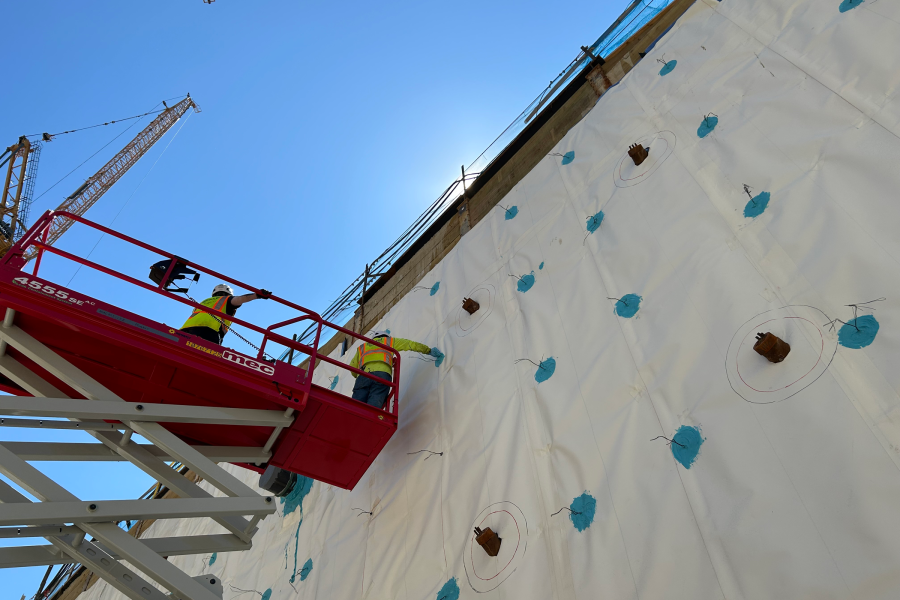
Photo courtesy of GCP
LS: The most exciting development is the industry’s movement toward fully integrated building envelope systems. For years products were often specified independently. Today building teams are asking a broader question: “How do all six sides of the building work together to improve durability, sustainability, occupant comfort, and resilience?” That shift has accelerated innovation in transition detailing, compatibility between systems, and ease of installation.
GCP’s PREPRUFE Liquid Flashing is an example of solutions developed specifically to address historically difficult areas of the building envelope. Integrated systems like Saint-Gobain’s 6Sides+, also reflect this evolution by aligning materials, detailing, and technical support across the full building envelope, from foundations through vertical walls and into roofing assemblies. This approach brings together below-grade waterproofing, air and weather resistive barriers, roofing, and additional critical elements to building performance like glazing systems, fireproofing, and interiors, that are designed, tested, and supported to work together.
What excites me most is that innovation is increasingly occurring at the system level rather than simply at the product level. The industry is becoming more focused on continuity, constructability, and long-term performance.
gb&d: What does the future hold?
LS: One of the most interesting topics is the continued growth of low-carbon concrete. As designers incorporate more supplementary cementitious materials and new concrete technologies to reduce embodied carbon, it’s important that waterproofing systems evolve alongside those changes. Understanding long-term compatibility and performance will be critical.
I also believe resilience will become one of the defining design drivers of the next decade. Architects and engineers are increasingly designing for floods, severe storms, hurricanes, wildfires, temperature extremes, and other climate-related challenges.
When you look at Saint-Gobain’s focus areas of moisture resilience, fire resilience, and overall building durability, those priorities align directly with where the market is heading. The buildings of the future will need to do more than meet code requirements. They will need to protect occupants, remain operational during disruptions, and continue performing in increasingly challenging environments.
gb&d: What else should architects and engineers know regarding the building envelope?
LS: I would remind designers that below-grade waterproofing is one of the few systems in a building that only gets one opportunity to be installed correctly. Once foundations are poured and backfilled, access becomes extremely limited. If problems emerge years later, repairs can be invasive, costly, and disruptive to occupants. That is why designing with long-term performance in mind is so important. The decisions made during design development and construction will directly influence how that structure performs for decades.
As an industry we spend a great deal of time discussing sustainability, resilience, and durability. Building envelope systems sit at the center of all three conversations. Tomorrow’s resilient buildings are being constructed today. Every detail we design, every system we specify, and every installation decision we make contributes to the legacy performance of that structure for the next 25, 50, or even 100 years.