Story at a glance:
- HDR Civic Design Director Kate Diamond treats energy performance and community benefit as a single design decision rather than competing line items.
- At the Orange County Sanitation District headquarters, waste heat the agency couldn’t otherwise use now heats the building, lowering the cost of reaching net zero.
- In Los Angeles County a closed landfill is becoming a regional park whose exhibits will confront the site’s history directly.
In public architecture, energy performance and community health are typically pursued on separate tracks—one measured in energy models and payback periods, the other in outreach meetings and program requirements. Kate Diamond, civic design director at HDR, has spent nearly 50 years treating them as a single decision. “We design nothing in isolation,” she says. “I believe that design is an ecosystem, and cost and function and community and environmental sustainability, resiliency—everything has to be considered really simultaneously.”
For public clients the link is close to mechanical: Lower life cycle costs mean an agency isn’t forced to raise rates or taxes on the people it serves. She describes the stakes in healthy and sustainable design in human terms. “It’s not the planet we’ll lose; it’s the people on the planet we’ll lose. And so it always ties to community benefit.”
Capturing Waste Heat at OC San
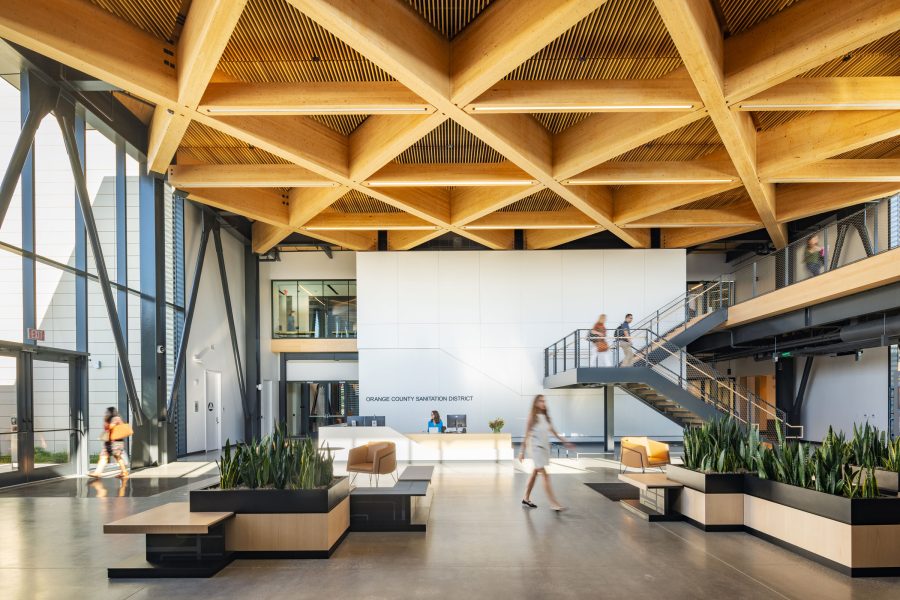
HDR designed the 109,000-square-foot Orange County Sanitation District Headquarters Complex in Fountain Valley, California. Photo by Dan Schwalm, courtesy of HDR
That overlap of sustainability and community health is a central feature of the 109,000-square-foot Orange County Sanitation District Headquarters Complex (OC San) in Fountain Valley, California. OC San already runs a central plant capturing biogas off its digesters and used most of the resulting hot water at Plant One. A portion sat at the wrong temperature for the agency’s purposes.
HDR’s engineers found a use for it. Rather than let that heat discharge into the air or water, the team piped it across the street to the new headquarters, where it now provides 100% of the building’s heating. The move closed the gap to net zero operational energy and cut the upfront cost of the photovoltaic array needed to get there. The hybrid mass timber structure—chosen partly because the saturated site rewarded a lighter building—reached a 58% reduction in embodied carbon.
The pedestrian bridge carrying that water serves a second purpose, allowing staff to cross heavily trafficked Ellis Avenue without affecting through traffic. Siting the headquarters right off the plant site mattered for similar reasons; communities “do not love expansion of wastewater treatment plants,” Diamond says. The agency meets or exceeds the code requirements protecting adjacent neighbors, and the expansion does not change that.
The community health benefits are most visible in the building’s public function. OC San hosted roughly 3,000 visitors a year before the new headquarters, which was designed around that traffic with an indoor/outdoor exhibit and tour touchpoints throughout. “There are a surprising number of children—from very young ones who love to learn where poop goes, to high school students interested in engineering careers, to an amazing percentage of public health doctoral students and researchers, because we’ve all learned post-Covid how much wastewater treatment can tell you about the health of the community,” Diamond says.
Designing for Access in Flagstaff
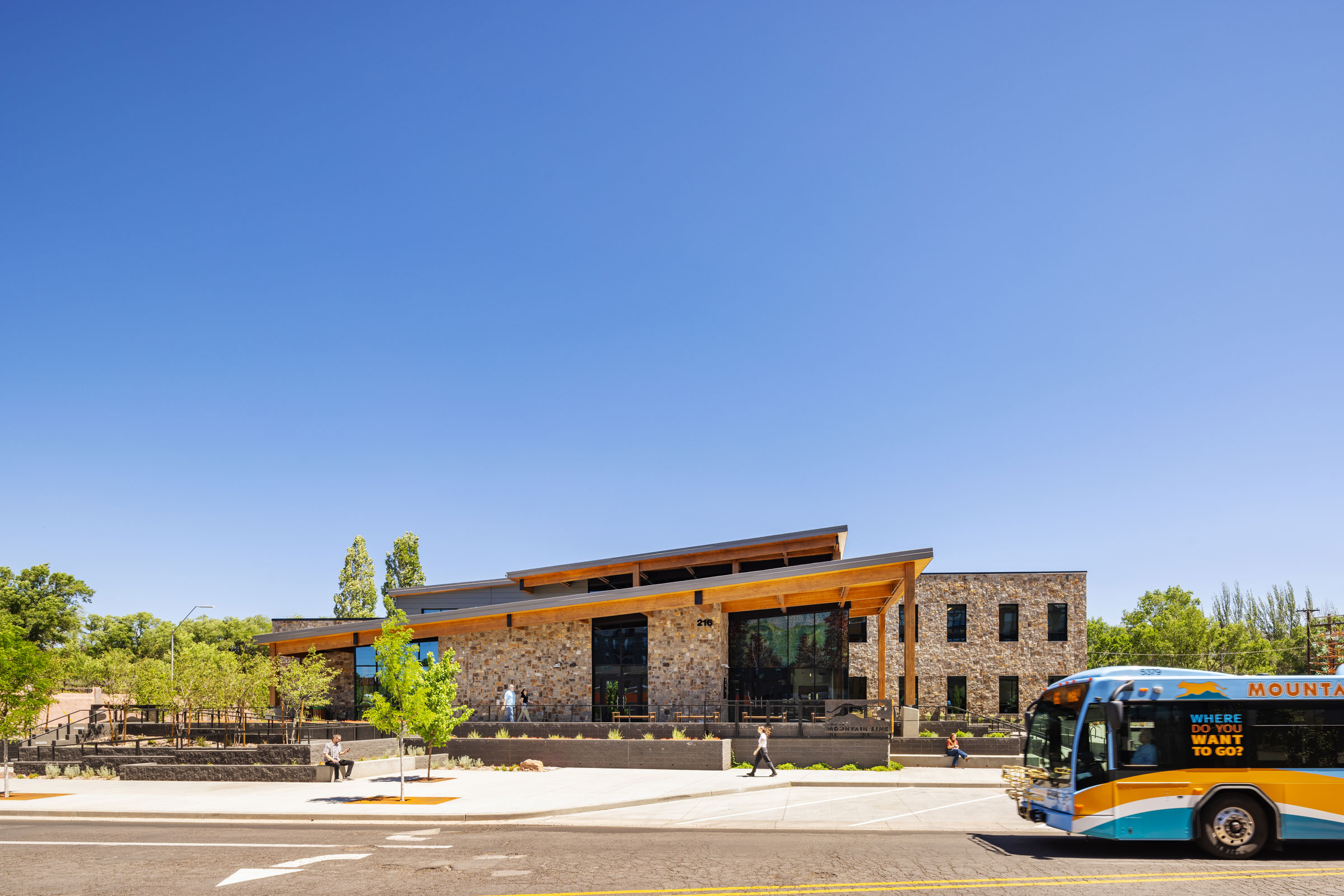
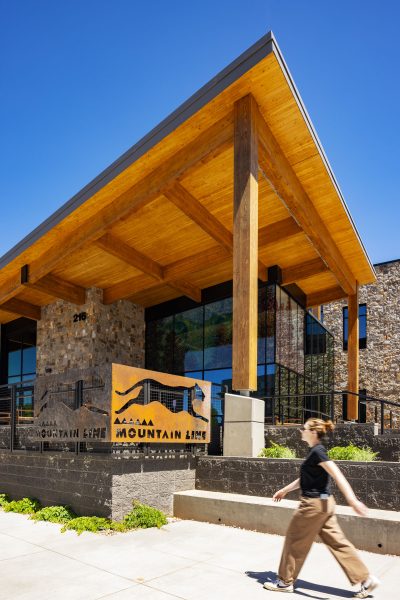
At the Mountain Line Downtown Connection Center in Flagstaff, the construction manager estimated mass timber would carry a 250% premium over steel. “I said, no, it won’t,” Diamond says. “They said, ‘Prove it.’” A local contractor confirmed it after consulting the firm behind Arizona’s first mass timber project. The 22,000-square-foot center cut embodied energy more than 30% against steel.
The health benefits begin with transit itself—shorter transfers and better access to a pedestrian-oriented downtown. Universal design governs the rest: ramps at every public entrance, restrooms with adult changing tables, paratransit access, a board room doubling as a community venue, and public art.
That program came from residents via an active disabled community committee that reviews Flagstaff projects. “They said, ‘We don’t want to have backdoor access,’” Diamond says. Phase two, pending an Army Corps flood control project, adds a pocket park and photovoltaic canopies over the bus bays.
Reclaiming a Landfill
Diamond’s most ambitious current project sits on the closed Puente Hills Landfill in Los Angeles County, once the second-largest in the US. With community input, LA County has renamed the project Esperanza Hills Regional Park; its centerpiece is the Hilda L. Solis Environmental Justice Center.
The commission arrived open-ended. Norma Edith García-González, director of LA County Parks and Recreation, said she wanted the county’s first environmental justice center. “ I said, ‘What do you mean by that?’” Diamond recalls. “They said, ‘We don’t know. Would you please write the program?’”
Part of the program’s answer is the site’s own history. The landfill was created to solve a public health crisis—the dangerous smog produced when thousands of private incinerators burned trash across LA County—and then became its own burden, generating odor, noise, and truck traffic that damaged both quality of life and property values nearby. The exhibition will address that history openly and at length.
The center targets LEED Gold, net zero operational carbon, a 50%-plus embodied carbon reduction, and a 50% cut in potable water use. Outreach drew 400 to 500 people to community meetings, and what residents asked for is in the plan: better horseback, bicycle, and pedestrian access, plus a new bus line under negotiation. Most LA County parks close at sunset; this one is modeled to run until 10pm. “We want to have the kind of place where young people can hang out and do good things,” Diamond says.
Making the Cost Case
-
- Photo by Dan Schwalm, courtesy of HDR
-
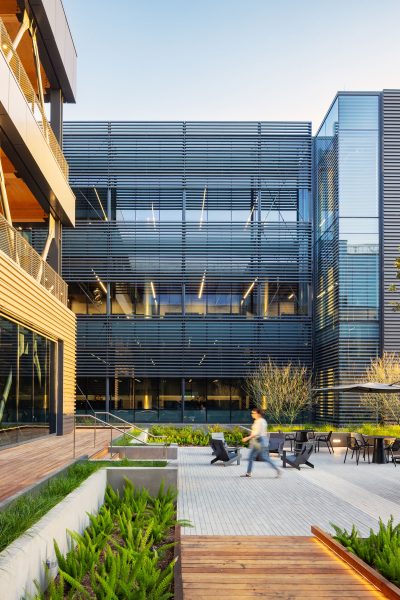
- At the Orange County Sanitation District headquarters, waste heat the agency couldn’t otherwise use now heats the building, lowering the cost of reaching net zero. Photo by Dan Schwalm, courtesy of HDR
Each of these projects required persuading a public client that performance would not arrive at a premium. Clients span a wide spectrum of interest in sustainability, and no single approach reaches all of them.
If she had to name one, it would be a command of the numbers—“maintaining an in-depth understanding of the cost and value of sustainable strategies and being able to prove that most do not add cost to the construction,” she says.
Orienting a building to minimize solar heat gain in a cooling-driven climate costs nothing. A high-performance envelope does carry initial costs, but the right engineers can offset much of it by right-sizing the mechanical system.
With certain clients the team stops using the language of green design altogether. “For some we simply stop talking about sustainability but use it as an internal design driver,” Diamond says—passive strategies first, from orientation to healthy material selection. “We sell the design as functional, responsible, and beautiful and when they fall in love with the project they don’t go back and quiz us about unseen sustainability strategies.”
The budget conversation is finally about a longer time horizon. The goal, Diamond says, is to find solutions that make a building’s users healthier, reduce an agency’s operating costs across the 50-plus years most civic buildings remain in service, and contribute to the health of the surrounding community—all within the construction budget of a standard building of similar size and function.