Story at a glance:
- Environmental Product Declarations (EPDs) verify that modern steel production can be a low-carbon material choice.
- Bull Moose Tube stands out as one of the few steel pipe and tube producers in North America with aggressive emissions reduction targets.
- Bull Moose Tube is using low-GWP steel to change green building design.
In its simplest form green building follows a few essential principles: site orientation to take advantage of natural light and solar heat; energy and water conservation to protect natural resources; and the selection of sustainable materials to reduce the environmental footprint of new construction, particularly regarding carbon emissions.
To help builders differentiate among materials making sustainability claims, Environmental Product Declarations (EPDs) emerged in the late 1990s. These verified documents function like nutrition labels for construction materials, providing a transparent look at how a product impacts the environment throughout its entire life cycle. EPDs are governed by Product Category Rules (PCRs)—a set of standardized guidelines that ensure similar products can be accurately compared. Today analyzing EPDs is a fundamental step in designing green buildings.
“Bull Moose Tube has really been ahead in the industry,” says Richard Morales, the company’s manager of field application engineering. “The steel industry must eliminate that heavy-carbon myth. Electric arc furnaces [EAFs], which make most US steel, have drastically reduced steel’s carbon footprint compared to legacy blast furnace methodology. It really has changed the way we do business in the industry, and now we can prove it with EPDs.”
An Overseas Influence
Established in 1962 with US headquarters in St. Louis, Bull Moose Tube is owned by Caparo Group, a diversified global association of businesses predominantly focused on steel. Caparo Group is headquartered in London, a corporate structure that directly influences Bull Moose Tube’s advanced sustainability goals. “When you compare building codes between the US and Europe, Europe is way ahead of us, and I don’t think anybody will argue that,” Morales says. “By being maintained as a UK company, we’re definitely motivated to stay on top of the sustainability wave.”
There are very few steel pipe and tube producers operating with firm emissions reduction targets, but Bull Moose Tube includes them as part of its UK financial and climate disclosures, says Nate Carruthers, Bull Moose Tube’s director of business strategy and marketing. “In 2025 Caparo established a target to reduce Scope 1 and Scope 2 emissions 25% by 2030 across its North American operations (of which Bull Moose Tube makes up the vast majority of emissions). This year we developed a Scope 3 baseline for these operations and are targeting a 15% reduction by 2035.”
These metrics follow strict international greenhouse gas accounting standards. Scope 1 emissions comprise direct greenhouse gas emissions from activities owned or controlled by an organization, like the combustion of natural gas for heating or onsite manufacturing. Scope 2 emissions encompass indirect emissions generated from the consumption of purchased electricity, heat, steam, or cooling supplied by an external utility grid. Scope 3 emissions represent broader value-chain emissions that are more difficult to control, including emissions tied to purchased raw materials, transportation, downstream processing, and end-of-life treatment after products leave Bull Moose Tube’s facilities.
The Power of Co-Location
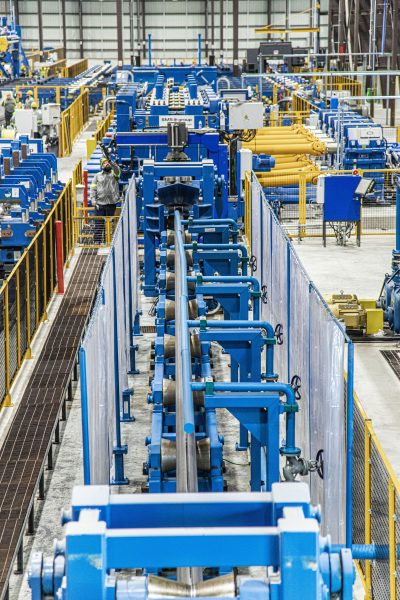
The decision to build a new tube mill on the exact same campus as Steel Dynamics’ Flat Roll Group in Sinton, Texas, in 2023 has helped drive down Scope 3 supply chain emissions. Because Bull Moose Tube receives its EAF-produced steel coil directly from Steel Dynamics, the Sinton plant boasts an industry-low global warming potential (GWP) of 1.06 metric tons of CO2e per metric ton of tubing. For comparison, the Steel Tube Institute’s members average a significantly higher GWP of 1.71 metric tons of CO2e per metric ton of tubing.
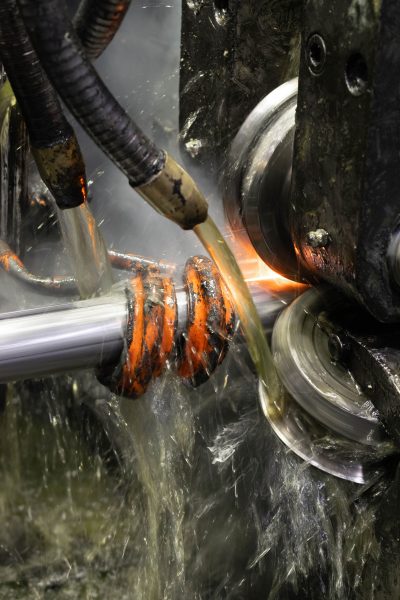
“From a sustainability standpoint Steel Dynamics’ EAF-produced steel is some of the lowest GWP coil available. The largest part of our carbon footprint is the coil we buy—90% plus. Then there’s transportation to our state-of-the-art Sinton facility, which is minimal because Steel Dynamics’ rail spur runs directly to our facility. The last piece is the pipe and tube production itself,” Carruthers says. “Building on Steel Dynamics’ campus was not only a unique opportunity to be on a flat-roll campus, but it also allowed us to eliminate freight costs and emissions between our plants.”
Unlike basic oxygen furnaces (BOFs), which manufacture steel from extracted raw materials and fossil fuels, EAFs melt recycled scrap metal at extremely high temperatures using high-power electric arcs. An independent study conducted by CRU Group found that steel produced by US EAF steelmakers features a carbon intensity approximately 75% lower than steel made by traditional BOFs.
“Legacy steel production with basic oxygen furnaces is the carbon-intensive method,” Morales says. “That’s where our challenge lies: We must educate the masses that we are using coil made from recycled scrap and electricity to melt that scrap steel—not raw materials and coal. Bull Moose Tube is not waiting for future technology. We are leveraging the existing, optimized recycling loop now, and it is drastically lowering our product’s embodied carbon.”
Morales adds that steel is uniquely suited for a circular economy because it can be infinitely recycled without losing its inherent strength or structural quality. However, because the manufacturing processes of individual steel components vary wildly, EPDs are vital to providing market clarity.
The Future of Sustainability
Despite shifting policy priorities from the US federal government, decarbonization mandates continue to accelerate at the state level, paired with aggressive green-building benchmarks from private-sector owners. “There are several states that are very proactive and requiring Buy Clean Acts,” Morales says. “Aggressive private-sector sustainability goals also are taking shape; data centers come to mind.”
Carruthers says hyperscale data center project owners like the Amazons, Metas, and Microsofts of the world have strict net-carbon-neutral goals, “which is good for us because we can produce some of the lowest GWP material out there. And we’re always looking at new opportunities to lower those numbers further or at least provide solutions.”
Bull Moose Tube currently offers two distinct types of EPDs: one showcasing its steel tube and pipe made exclusively from EAF-produced coil (low-embodied carbon EPD) and another for products made from a blended mix of EAF- and BOF-produced coil (standard EPD).
“As more EAF production is brought online in the US we will naturally see an increase in the percentage of EAF coil we purchase, which is going to benefit our numbers. Now that we’ve established our Scope 3 baseline, it will make sense to update our EPDs when we see positive changes in our coil mix (not just updating every five years),” Carruthers says. “As long as our customers value low-embodied-carbon tubing, we will continue to improve upon and update our data.”
Carruthers and Morales stress that structural engineers and developers should consider Bull Moose Tube as a partner early in the architectural design process to properly evaluate low-embodied carbon options. Once a steel order is placed, its GWP profile is locked into the project’s footprint, making early EPD research critical. “I received a text this morning from one of our salespeople for a project coming in 2027,” Morales says. “They want EAF coil, and they want it to have 90%-plus recycled content. Sometimes the requirements are the lowest-GWP values possible on the project, and sometimes it’s a specific recycled content percentage. EAF-produced steel is always going to win that battle, and Bull Moose Tube can prove it.”