Story at a glance:
- Flooring plays a critical role in improving indoor air quality, comfort, and wellness in schools.
- Modular flooring solutions can help schools balance healthy environments with long-term performance and maintenance needs.
- As educational spaces evolve, architects are increasingly viewing flooring as a wellness decision—not just a finish material.
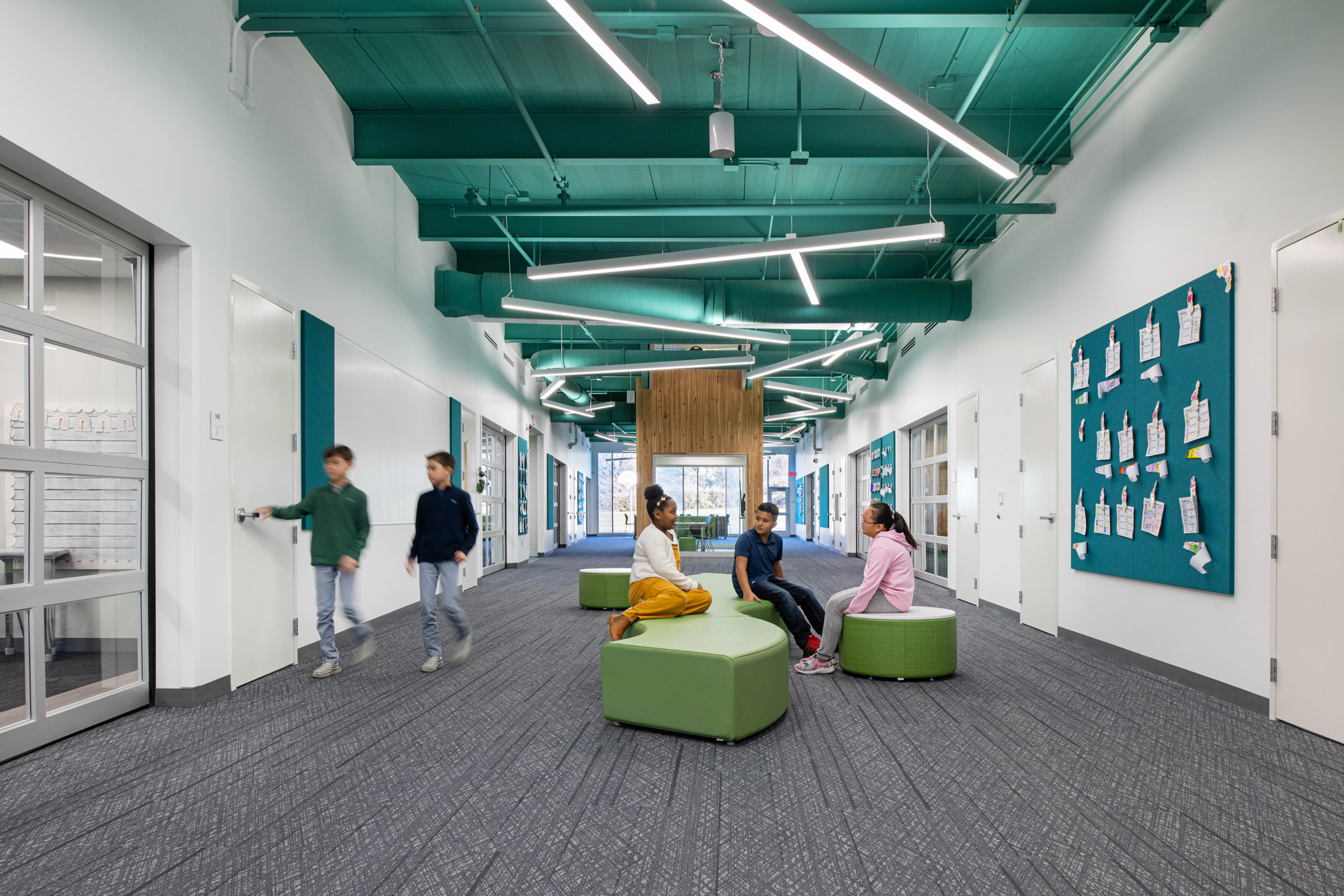
It’s no secret students and teachers spend thousands of hours inside school buildings each year, making the indoor environment just as important as the curriculum itself. While lighting, ventilation, and furniture often dominate conversations around healthy learning environments, flooring is increasingly gaining attention for its ability to improve indoor air quality, reduce physical fatigue, and create more comfortable spaces for learning.
That’s why flooring has become far more than an aesthetic decision for today’s architects and designers. It has become part of a broader strategy to support wellness from the ground up.
“Flooring can absolutely influence indoor air quality,” says Brandon Kersey, director of business development and segment manager for education at Dalton, Georgia-based J+J Flooring. “One of the biggest advantages of a textile composite flooring like Kinetex is that it can sequester particles and keep them from becoming airborne.”
Unlike hard-surface flooring, which allows particles to become airborne with every footstep or air current, Kersey says Kinetex helps trap particles until they can be removed through routine cleaning. “Those particles can get up into your breathing zone,” he says. “With Kinetex the texture dissipates those air currents and holds particles down until they can be removed with a HEPA vacuum or sanitized.”
Creating Healthier Learning Environments
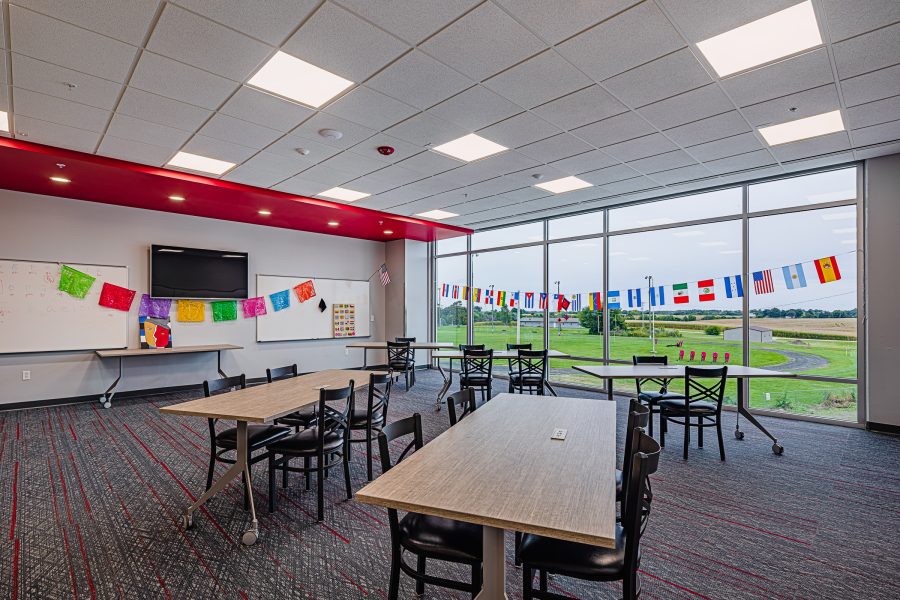
Photo courtesy of J+J Flooring
Healthy buildings begin with healthy materials, and flooring has become an increasingly important part of that conversation.
School districts today expect flooring to meet stringent indoor air quality standards while also contributing to a healthier environment over the life of the building. “From a health standpoint, schools want products that pass indoor air quality protocols,” Kersey says. “That’s become a baseline expectation. Beyond that they’re asking how easy the flooring is to clean and whether it helps promote healthier air by keeping particles out of the breathing zone.”
Those conversations have become routine during the design process for architects as well. J. Christopher Ball, principal architect and president of Ball Architects in Springfield, Missouri, says healthy environments require balancing numerous building components, but flooring often provides one of the greatest opportunities to improve occupant experience. “When we have a product that is durable and looks good but also addresses acoustics, it’s an easy choice,” he says.
Although acoustics remain an important consideration, Ball says creating healthier classrooms also means selecting materials that contribute to overall occupant comfort while standing up to years of daily use.
Comfort That Supports Learning
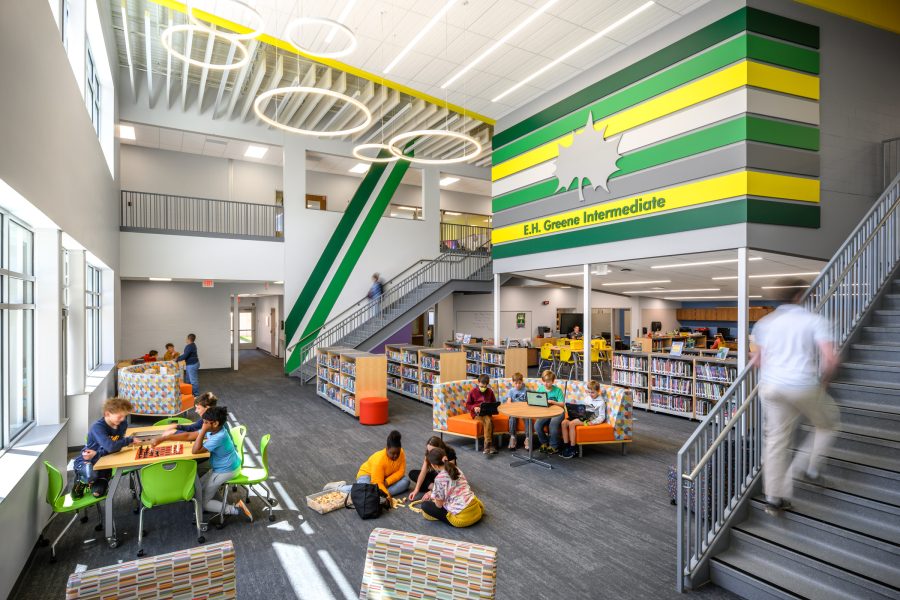
Photo courtesy of J+J Flooring
The benefits of flooring extend beyond indoor air quality. After all, students spend considerable time on classroom floors, while teachers often remain on their feet throughout the day. “Having something that is not cold and hard certainly contributes to a better atmosphere,” Kersey says. “It also reduces the wear and tear on the body.”
For educators that difference can be especially meaningful. “A teacher may be on their feet eight, 10, sometimes 12 hours a day,” Kersey says. “If you have a floor that can dissipate some of that impact energy, it can help prevent fatigue and other physical issues.”
Ball has seen those benefits firsthand in educational projects. “Usability goes way up,” he says. “We see classrooms with Kinetex used for group meetings and other non-traditional uses because the space is better. The rooms are simply more comfortable when the acoustics are balanced.”
That comfort also supports the evolution of today’s classrooms, where students are expected to collaborate, move throughout the room, and learn in a variety of settings rather than remaining at traditional desks.
Designing for Flexibility
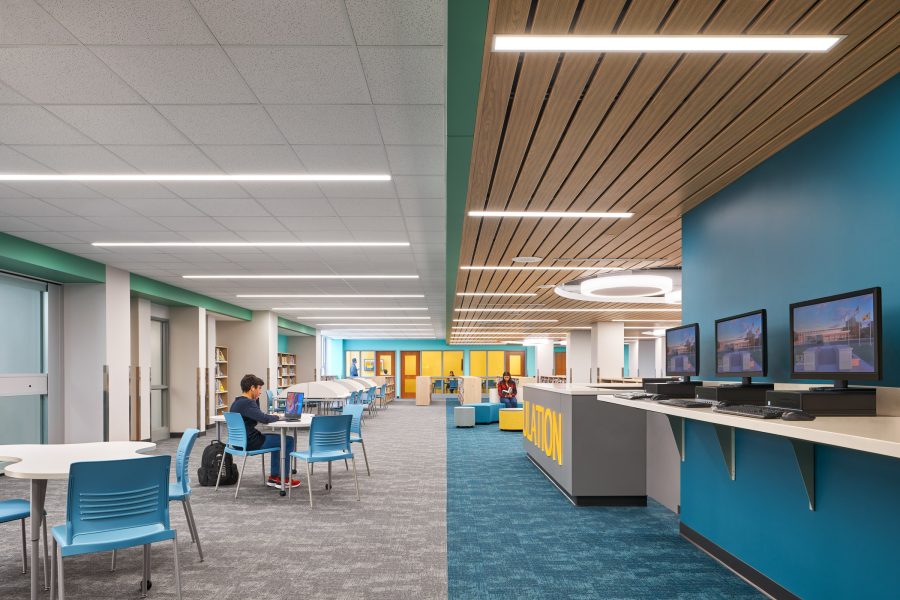
Photo courtesy of J+J Flooring
As educational spaces become more flexible, architects are increasingly looking for flooring systems that can evolve alongside changing teaching styles. Ball says his firm’s use of Kinetex has expanded significantly over the years. “We have evolved from using Kinetex in offices, libraries, and computer labs to using it in multi-purpose spaces, classrooms, hallways—pretty much everywhere but kitchens and bathrooms,” he says.
Modular flooring systems have played a significant role in that shift. Kersey says modular products make repairs and renovations far less disruptive because damaged sections can be replaced individually instead of requiring an entire floor replacement. “It’s much less disruptive,” he says. “You don’t have to remove as much infrastructure or furniture, and if one module is damaged, it’s much easier to replace.”
Maintenance also becomes easier over the life of the building. Because Kinetex uses polyester fibers without traditional dye sites, Kersey says stains are less likely to permanently bond with the material, while hot-water extraction dries in about one-third the time required for traditional carpet. “That means the floor can be cleaned more effectively and be back in service much quicker,” he says. “Those are big factors when you’re talking about maintenance.”
Looking Beyond Initial Cost
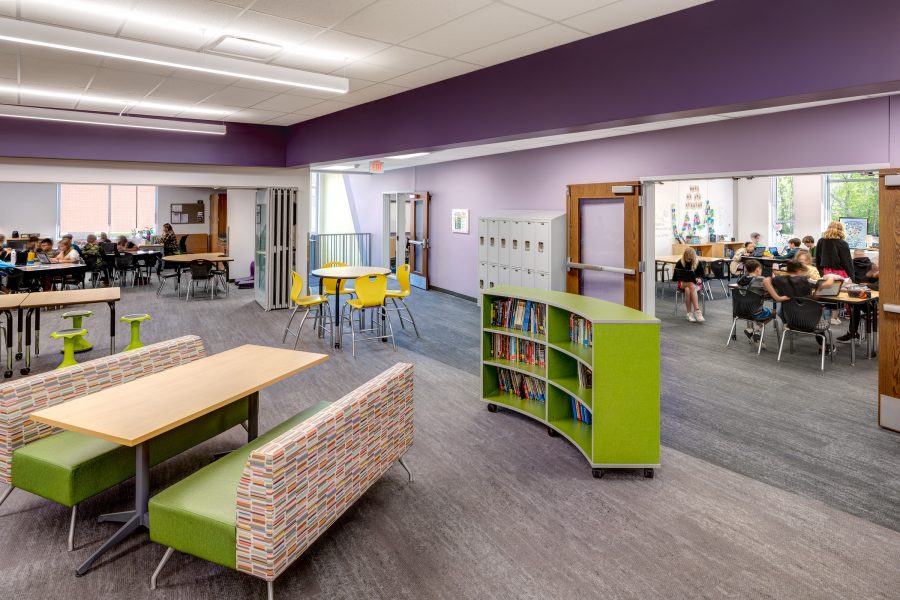
Photo courtesy of J+J Flooring
School budgets are always under pressure, making cost one of the most important factors in material selection. But both designers and manufacturers say focusing only on initial installation costs can overlook the bigger picture. “You can get caught in the trap of only looking at the initial cost of the project,” Kersey says. “That’s not the full story. You really need to look at the true cost of ownership, including ongoing maintenance.”
Ball agrees those conversations should happen early during design development, and he regularly reaches out to his representative to discuss options and new products, as those conversations help the team evaluate what will perform best over the long term.
“We’ve seen the pendulum swing back toward soft-surface flooring,” Ball says. “People realized there were some negatives with hard surfaces in these environments, from acoustics to slip resistance. When you combine those benefits with everything Kinetex offers, it creates a very unique combination.”