Story at a glance:
- Gensler’s Andre Brumfield approaches every project embedded in community, studying a site’s social, cultural, and physical history before shaping any design response.
- In his framework, community residents function as a “spiritual client,” one without a formal agreement but with the power to give meaning and direction to any project.
- Northside Forward, a $1.5 billion community-authored revitalization plan for North Minneapolis, demonstrates what equitable development looks like when a neighborhood becomes the true author of its own future.
Plans come and go in cities everywhere, as urban designer, planner, and architect Andre Brumfield will tell you. There is no shortage of master plans, corridor studies, and community visioning documents—many of them well-designed, well-intentioned, and gathering dust. What’s harder to come by is development that actually lands.
As a design director and principal at Gensler, Brumfield has spent more than two decades working across public agencies, private developers, and nonprofit organizations to advance neighborhood revitalization and equitable development in some of America’s most disinvested communities. His work ranges from Chicago’s Plan for Transformation—the landmark effort to redevelop the city’s high-rise public housing stock—to Northside Forward, a 10-year, community-authored plan designed to guide $1.5 billion in equitable investment across North Minneapolis. Along the way he has taken on leadership roles with the Chicago Plan Commission, the Urban Land Institute, and the American Institute of Architects, and he’s become one of the country’s most recognized voices on the relationship between design and community resilience.
Central to his practice is a conviction that community development involves three distinct clients. There are the public sector agencies—planning departments, housing authorities—and the developers and nonprofits that hold the formal contracts. And then there is what Brumfield calls the “spiritual client,” or the neighborhood itself. That third relationship, he argues, is the one most often underestimated. And it’s the one that ultimately determines whether a project succeeds.
Brumfield recently sat down with gb&d to discuss how history shapes the built environment, why trust is the most undervalued resource in community development, and what it really means for a neighborhood to author its own future.
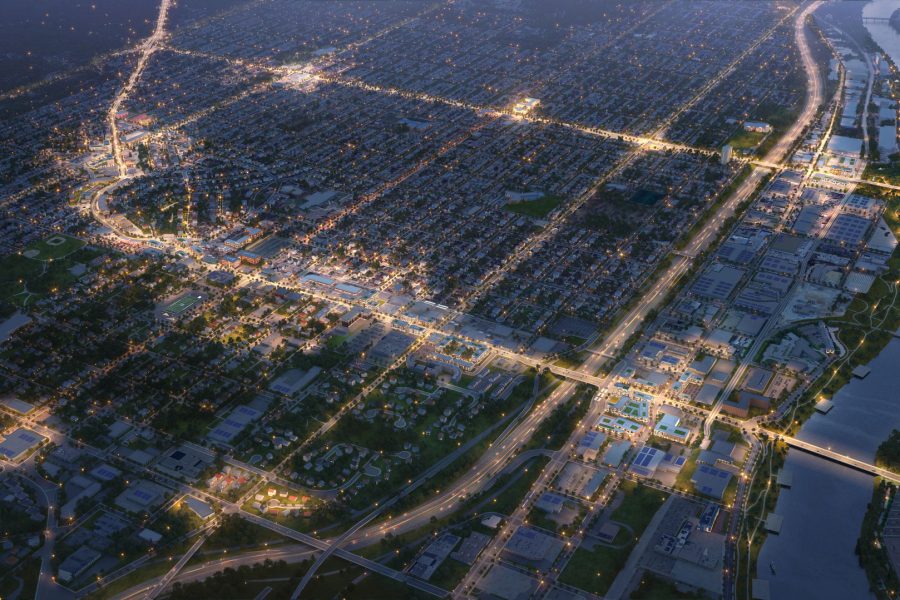
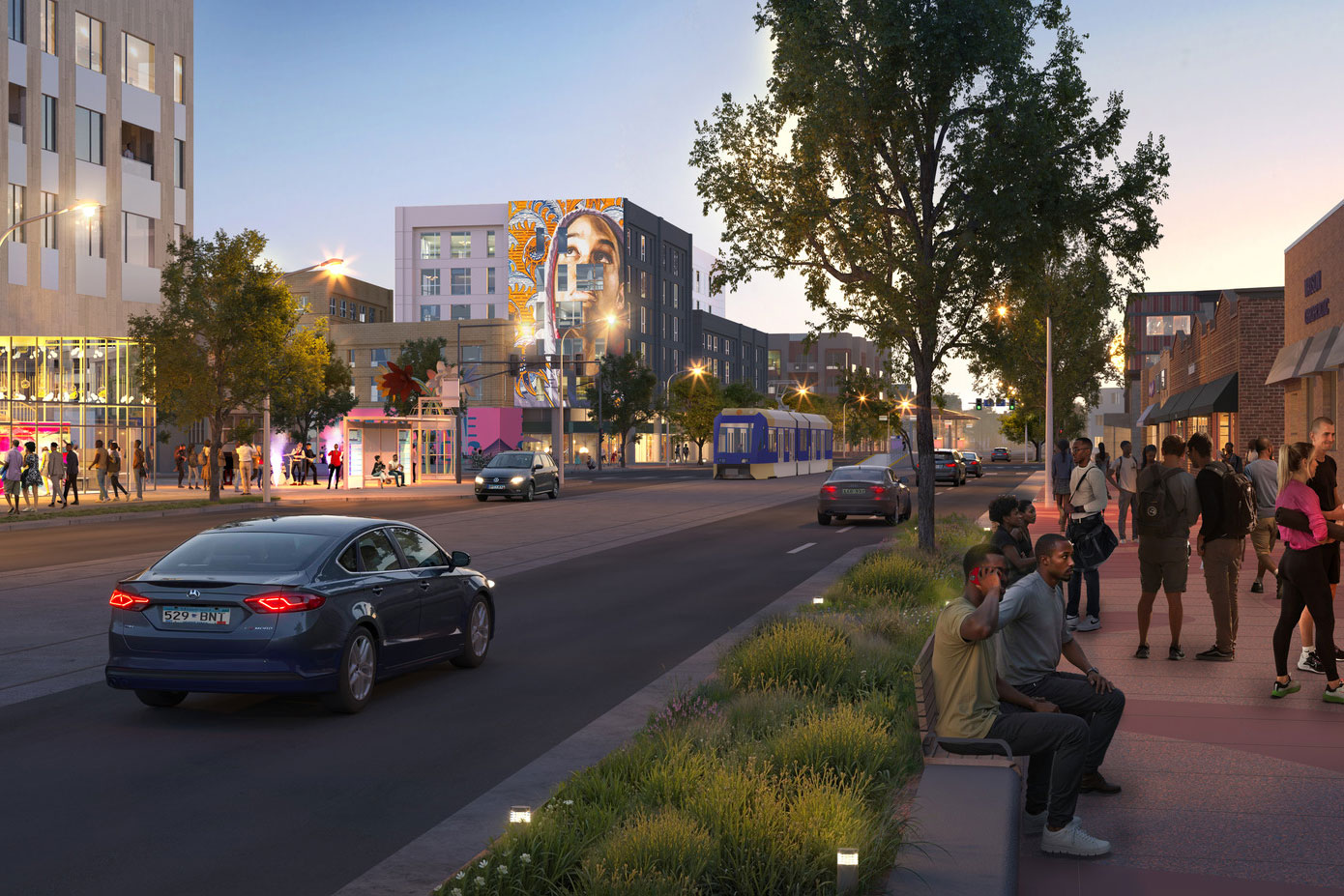
The Gensler-designed Northside Forward project offers a data-driven framework for inclusive, transit-oriented development. Rendering courtesy of Gensler
When you begin working in a neighborhood, what’s the first question you ask?
The first question is really: Who are the players? Who are the influencers in the neighborhood, the stakeholders in that immediate area who we have to connect with? I also always want to understand the history of a given site in terms of its development potential. Why hasn’t it worked? Why wasn’t the previous player successful here? And then it’s about understanding what’s missing in the community, whether it’s residential, retail, services, and how this development can encourage additional economic activity beyond just filling a site.
How does the history of a place shape your design approach?
It’s foundational. Especially in neighborhood revitalization, you have to understand the history, not just from a cultural standpoint but physically. I think of myself as a kind of anthropologist of the built environment. I’m obsessed with how neighborhoods evolve, how cities evolve.
I’ve done a lot of affordable housing and public housing redevelopment in Chicago, working closely with the Chicago Housing Authority. I was always obsessed: When we think about the towers that came down during the Plan for Transformation, what was there before those high-rises came? What were the key elements of that earlier urban fabric that we could actually reinstall in a more contemporary way? The goal wasn’t to bring the site back to the community. It was to bring the community fabric back onto the site.
You’ve described communities experiencing “planning fatigue.” What drives that, and what does it cost?
“Time kills deals” is a common expression. But in the space I tend to work in, time also kills the spirit and trust in the community. We’ve seen it over and over—communities where they’ve been through this before. They’ve seen the grand plans. They’ve heard it’s going to be different this time.
Part of what drives the delay is structural. Too often our mixed-income and affordable housing efforts are over-reliant on low-income housing tax credits. The credits are incredibly competitive, and when a development doesn’t secure them in a given cycle, the project stalls. Everything the community has been promised is now deferred another 12, 18, 24 months. Meanwhile that site is still sitting empty. All you know, if you’re living in that community, is that the promises that were well-intentioned are not being kept. That’s what breaks trust. And trust, once broken, is very hard to rebuild. These places become over-planned and under-invested.
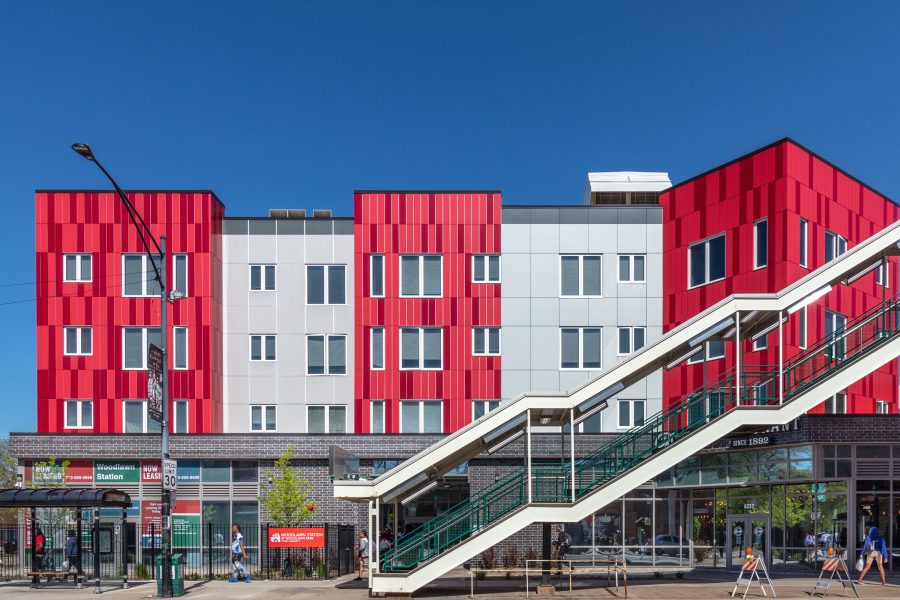
Woodlawn Station in Chicago was completed as part of the Phase 1 strategy of Gensler’s 550-acre neighborhood master plan and as part of a HUD Choice Neighborhood Initiative grant. The mixed-income development is adjacent to the Green Line “L” Station. Photo by Lee Bey, courtesy of Gensler
How do you think about the community itself as a client?
I think about it in terms of three clients. There’s the public sector—planning departments, housing authorities. There’s the developer or nonprofit we’re under contract with. And then there’s what I call the spiritual client. That’s the community. That’s the resident.
What meaningful engagement looks like in practice, for me, is being honest with residents about what’s coming, even when the timeline is uncertain. Helping them understand their rights. What does a right to return mean? What does a housing voucher actually get you? And more broadly, what other opportunities might this change unlock for them in terms of employment, in education, in proximity to institutions they may not have previously had access to? The design is really just one output of a much larger system. If we’re only talking about the building and not about the lives of the people who will live in and around it, we’re not doing our job.
What does “community-authored” mean on a project like Northside Forward?
Northside Forward was, from the beginning, meant to be community-based in a meaningful way. Our client was the African American Leadership Forum, led by Adair Mosley, one of the most respected voices in the Twin Cities, with deep roots in the Northside community. That relationship gave us what I’d call decent cover to come in as outsiders and help shape a revitalization strategy. Because the trust wasn’t in us. It was in the leadership at the table.
What also made this plan different is that it wasn’t just about urban design and architecture. It was built around five pillars: design and development, education, health and wellness, economic development, and accountable leadership. About two-thirds of the way through the planning process, each pillar was assigned a community champion: a leader who would take those themes forward and define near-, mid-, and long-term priorities. The plan was never meant to be a document. It was meant to be a living framework, one that the residents and organizations in Northside would own and drive forward themselves.
That also means being honest about the fact that there’s no such thing as a linear path. Things are always going to knock you off course. Market forces, policy shifts, changes in population, gaps in public investment. The framework has to be able to absorb those shocks and keep moving. That’s why having a community champion embedded in each pillar matters so much. The momentum doesn’t live with us. It lives with them.
What is Gensler’s role once a plan like this is in motion?
We see ourselves as conduits. It’s not so much about bringing our lessons from Chicago or Detroit or Nashville and saying here’s what worked, apply it here. It’s about identifying where the shared challenges are and connecting communities with people and organizations who have actually addressed them. We’ve put communities in touch directly with foundations, with employers, with institutions working on education and career pathways. Sometimes the most valuable thing we can do is make an introduction. The work we do travels not because we’re importing solutions, but because we’re helping communities find each other.