Story at a glance:
- A hospital in Atlanta is a case study in how health care facilities can align sustainability goals with mission-driven care and long-term performance.
- Design strategies on the project resulted in a 12% reduction in embodied carbon and the introduction of smog emission limits for concrete mixes.
Hospitals face mounting pressure to deliver care more efficiently while meeting higher expectations for sustainable design. Too often those efforts add costs without clear benefit. At Children’s Healthcare of Atlanta Arthur M. Blank Hospital, our design team at ESa, together with engineers from Walter P Moore and WSP and consultants at WorkingBuildings, set out to prove another path was possible—one where sustainability supports patient care, health, and long-term value.
Just a year after opening the project is already changing how the industry thinks about what’s possible. At 2 million square feet, Arthur M. Blank Hospital is the first project in Georgia to achieve LEED v4/4.1 Building Design & Construction for Healthcare certification, the most widely used green building rating system. It’s also the largest healthcare project in the US to achieve this certification.
The 70-acre campus gave ESa’s architects and their partners a rare opportunity to test ideas at scale. Today the hospital stands as a case study in how health care facilities can align sustainability goals with mission-driven care, budget discipline, and long-term performance
From Green Space to Patient Space
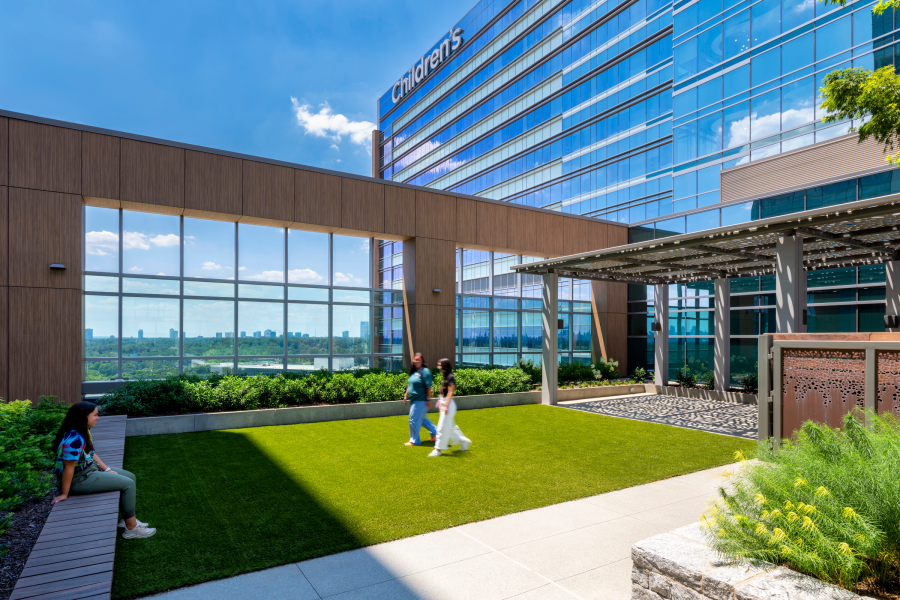
Photo by Jeremiah Hull, courtesy of ESa
Sustainability was never treated as a checklist at Children’s. The hospital’s vision and site allowed teams to continue pursuing sustainability practically. Designers embraced a “nurture through nature” philosophy, weaving natural elements into both the campus and the clinical environment to promote well-being.
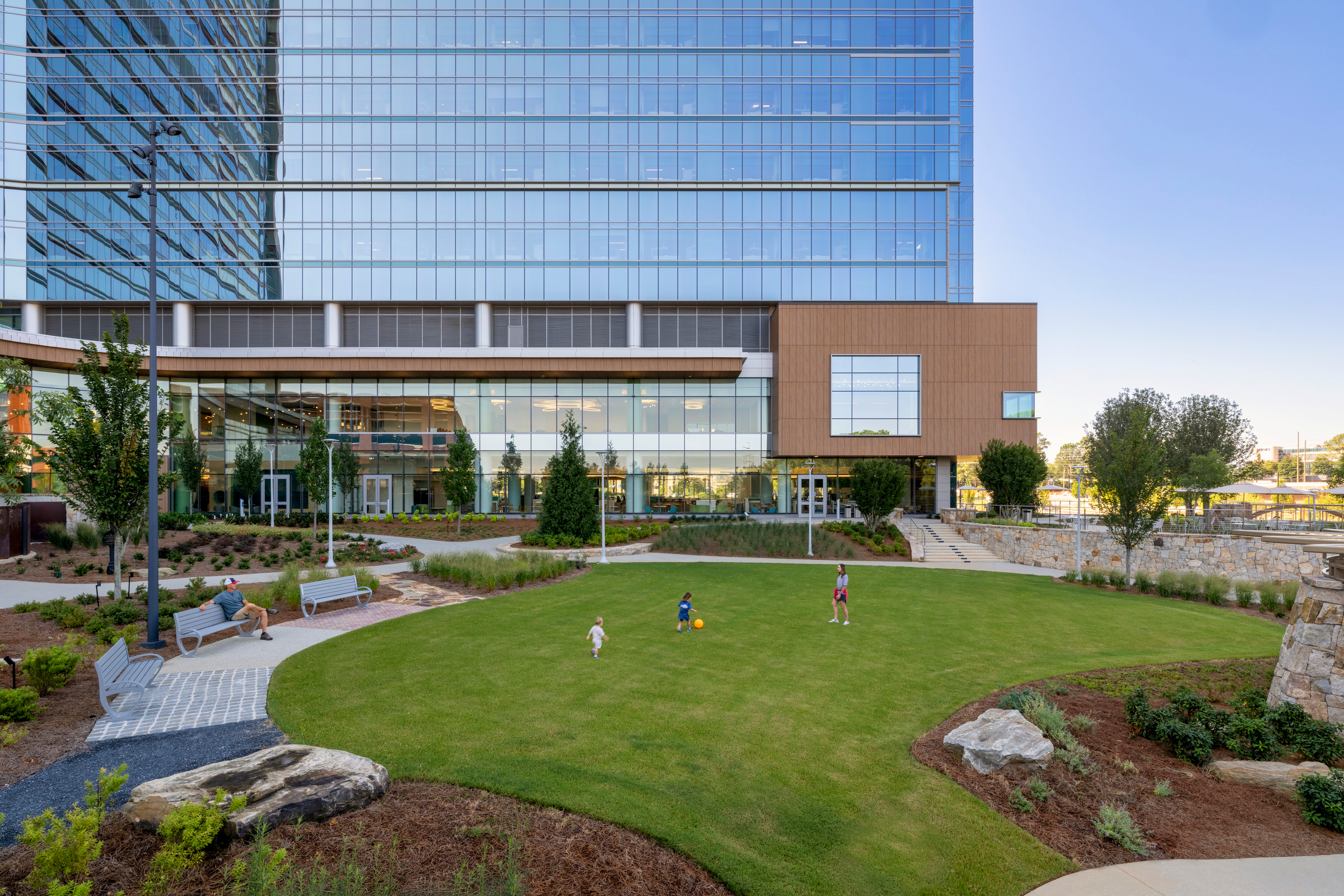
The Children’s team secured and planned the site years in advance, allowing the designers to prioritize access to nature at every turn. More than 20 acres of the campus are dedicated to green space, with miles of walking trails connecting patients, families, and neighbors to the outdoors. Approximately 41% of the site remains open, and 87% of that area is vegetated with native and adaptive plants that cut outdoor water use by 57%.
Inside, daylight, natural finishes and transparent connections to outdoor terraces extend that sense of calm and connection. All inpatient areas have views of the outdoors, reinforcing the healing link between people and the natural world. Their goal was always to create a destination of respite, rather than just a hospital. We brought in as much daylight as possible because it can lead to better patient outcomes and more healing environments.
Designers also incorporated nature-inspired play for pediatric patients, including a “forest” of sculptural trees that anchors the main lobby and outdoor play areas for children and their siblings. The Zone, a play area where kids can be kids, connects the indoors and outdoors, while the Aflac Cancer and Blood Disorders Center offers immuno-compromised patients access to a rooftop terrace for fresh air and views of the campus without having to leave the hospital.
These features show how biophilic design can promote both healing and sustainability. That same balance extended to the hospital’s systems and structure, where teams found ways to reduce carbon and energy use without driving up costs.
Sustainability within Budget and Schedule
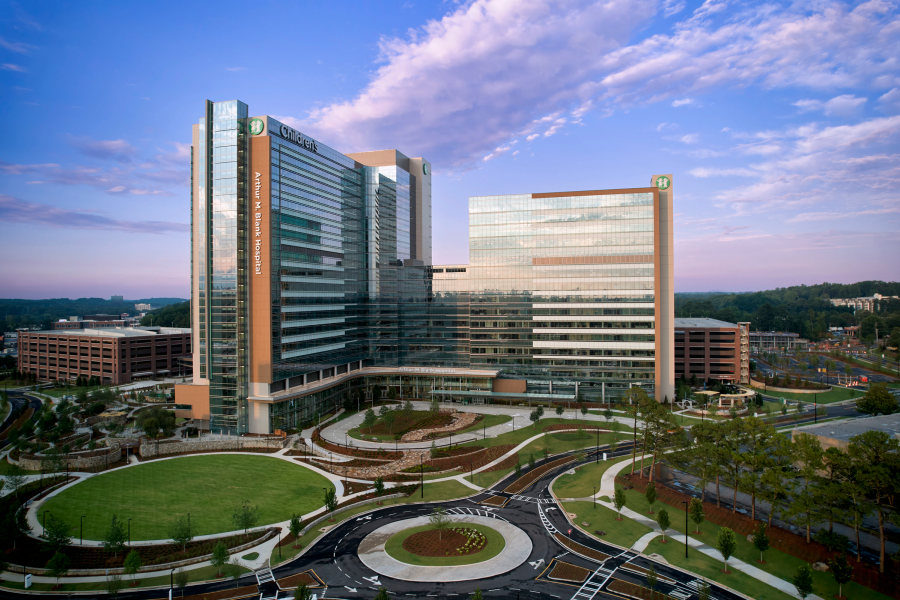
Photo by Jeremiah Hull, courtesy of ESa
Significant sustainability gains came in the less visible parts of the project—its structure and systems. Teams used a whole-building life cycle assessment from early design through completion to guide decisions, setting targets not only for carbon but also for regional health concerns like smog and acidification. Those benchmarks pushed the market to deliver new solutions without adding cost.
By sourcing materials locally the team further reduced transportation emissions and supported budget goals, demonstrating that sustainability can be cost-effective. The result was a 12% reduction in embodied carbon and the introduction of smog emission limits for concrete mixes, a first for many working on the site. “This is the only project we’ve done where we specified maximum smog emission limits for concrete mixes on the drawings,” says Kelly Roberts, senior principal and managing director of the Atlanta structures group of Walter P Moore. “It drew that connection between materials and health.”
Mechanical systems were also designed with efficiency and clinical performance in mind. Engineers eliminated preheat coils and optimized air-handling strategies to meet strict air-change requirements while cutting energy use and operational costs. Dedicated outdoor air units reduced consumption, and lighting controls kept the hospital below its energy budget. A building monitoring system now tracks energy use down to the electrical panel, helping staff identify inefficiencies and maintain long-term performance.
Together these strategies led to a 10% reduction in overall energy use. “Financial sustainability is just as important,” says Douglas Lacy, senior vice president at WSP. “Every dollar saved in building operations is a dollar that can benefit patient care.”
From One Project to Industry-Wide Change
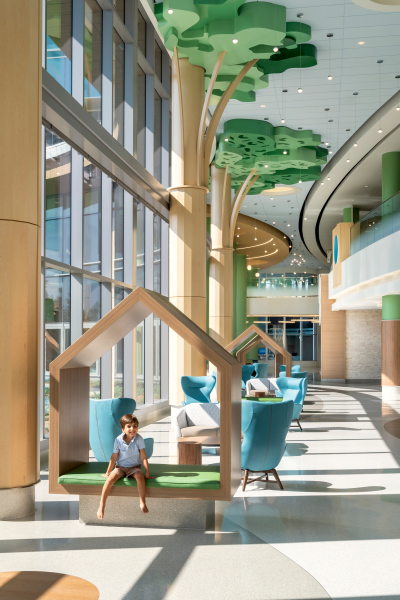
Photo by Jeremiah Hull, courtesy of ESa
Children’s is influencing projects beyond its own campus. For example, concrete supplier Argos developed new mixes to meet the hospital’s sustainability goals and smog emission limits, and those materials are now being used across the region. “When you’re doing things at scale, you can do a lot more things that are experimental and cutting edge,” Roberts says. “That then transfers to the rest of the market.”
The project also showed that strategies often associated with pediatric care, like outdoor play areas and creative biophilic design, can benefit patients across ages and their families. “Older patients, caregivers, and family members value opportunities for respite and play, too. Those features unfortunately just tend to often be downgraded in adult hospital facilities,” says Ross Wallace, senior sustainability consultant at WorkingBuildings.
When you’re doing things at scale, you can do a lot more things that are experimental and cutting edge.
Formal post-occupancy evaluation is still underway, but early feedback underscores that sustainability isn’t an add-on. It is integral to patient care, community health, and the long-term resilience of the facility.
For the team the takeaway is clear: Sustainability and health care are inseparable. Hospitals are about the wellness of the occupants, which is also what sustainability is about—the wellness of people and the wellness of the environment. They should go hand in hand.