Story at a glance:
- Many viable repair strategies exist to extend a building’s life, allowing contractors to stabilize the walls, redistribute loads, and address localized failures while preserving the original facade.
- Helical beaming can be used to restore load-bearing capacity over openings, or it can also be used as a temporary shoring means, allowing for longer than typical spans without shoring posts.
- Helical beaming is appropriate for sagging lintels, lintel replacement, flashing repair at shelf angles, and situations where an owner needs to create or enlarge an opening in a masonry wall.
The greenest building, as the saying goes, is the one already standing. It’s a simple idea: Every building that gets torn down and replaced requires vast amounts of new materials and generates construction waste.
The scale of the challenge is significant. Close to 2 million commercial buildings in the US are more than 50 years old—a number that grows by one every year. A significant portion of those buildings feature brick facades that are showing their age: sagging lintels, failing flashing, corroded shelf angles, and masonry that has lost some or all of its load-bearing capacity. Left unaddressed, these conditions create genuine life safety concerns. Chunks of masonry falling from a deteriorating facade are rare, but when they happen, the liability for building owners and contractors is consequential.
The traditional response to these conditions has been time-tested and resource-intensive: Shore up the wall with posts, corbel out the masonry above an opening, remove and replace entire courses of brick, or in the most extreme cases, demo the facade and start over. Each of these approaches requires significant labor, generates debris, consumes new materials, and produces results that can be disruptive to building occupants for weeks or months.
For a building industry increasingly accountable for the full environmental impact of its work—embodied carbon included—these approaches carry a cost that goes beyond the job estimate. Yet every year contractors and building owners choose demolition or wholesale reconstruction for aging masonry facades—not because it’s the best option, but because they don’t realize how many viable repair strategies exist to extend a building’s life. At the heart of many of these strategies is a common goal: restoring structural integrity without tearing down and replacing the entirety of the existing structure.
Depending on the distress condition present, supplemental lateral or gravity anchoring may be required. Some remediation options could include friction-based Stitch-Tie helical anchors, adhesive-based Grout-Tie anchors, or brass expansion-type Grip-Tie anchors. Anchor selection is highly dependent on the conditions present; field testing is always recommended when anchoring into existing masonry to ensure the most appropriate anchor is selected.
Within the bed joints, Stitch-Tie Bar supplementary horizontal joint reinforcement could also be used where vertical or stair-stepped cracking is present. The new joint reinforcement is laid within the bed joints, spanning the crack, reconnecting, or “stitching” the two sections of the masonry facade back together, allowing the weakened wall section to move together as one.
These repair strategies allow contractors to stabilize the walls, redistribute loads, and address localized failures while preserving the original facade. When any masonry repair is performed, the underlying root cause must also be addressed. If only the symptoms are fixed, there is a possibility that the distress to the facade could return in the future.
These approaches minimize material use and generally reduce disruption by having a shorter repair cycle than full removal and replacement. With the construction industry emphasizing embodied carbon and resource conservation, masonry restoration is a better option in many cases.
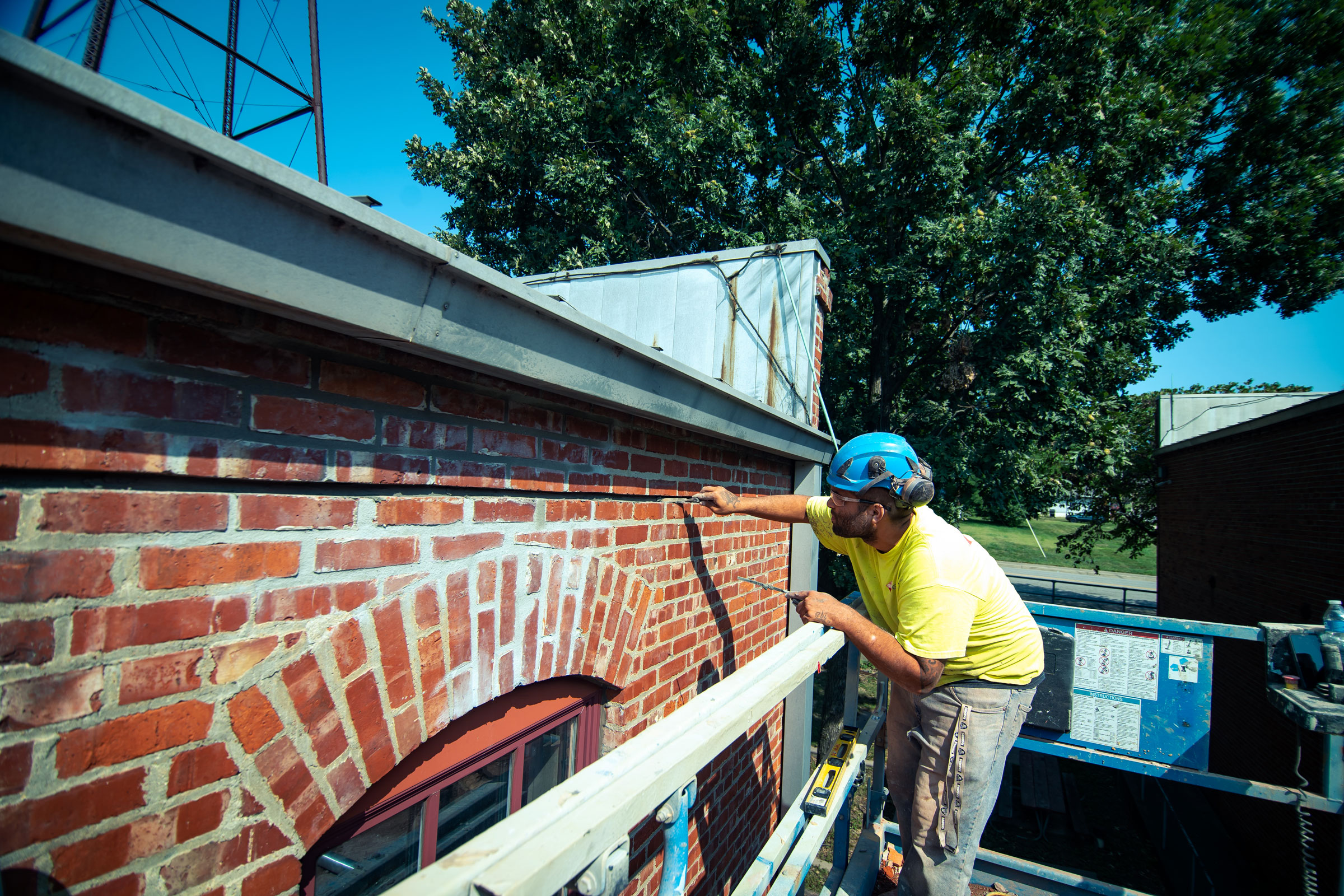
Among the various repair strategies, an application of the Stitch-Tie Bar supplemental horizontal joint reinforcement is a particularly efficient and underutilized option, called helical masonry beaming, or helical beaming, for short. Like crack-stitching, it uses the Stitch-Tie Bar within the bed joints of the masonry, but the joints are further reinforced. Two rows of two helical bars are inserted into the joints with SureGrout, a cementitious grout. When the grout begins to cure, a composite beam is formed within the existing masonry facade.
This application can be used to restore load-bearing capacity over openings, or it can also be used as a temporary shoring means, allowing for longer than typical spans without shoring posts. This approach leaves the surrounding masonry largely untouched, where repairs can possibly be performed at a fraction of the cost of conventional repairs. For an industry committed to both performance and sustainability, it is one of the most practical tools available.
Where to Use Helical Beaming
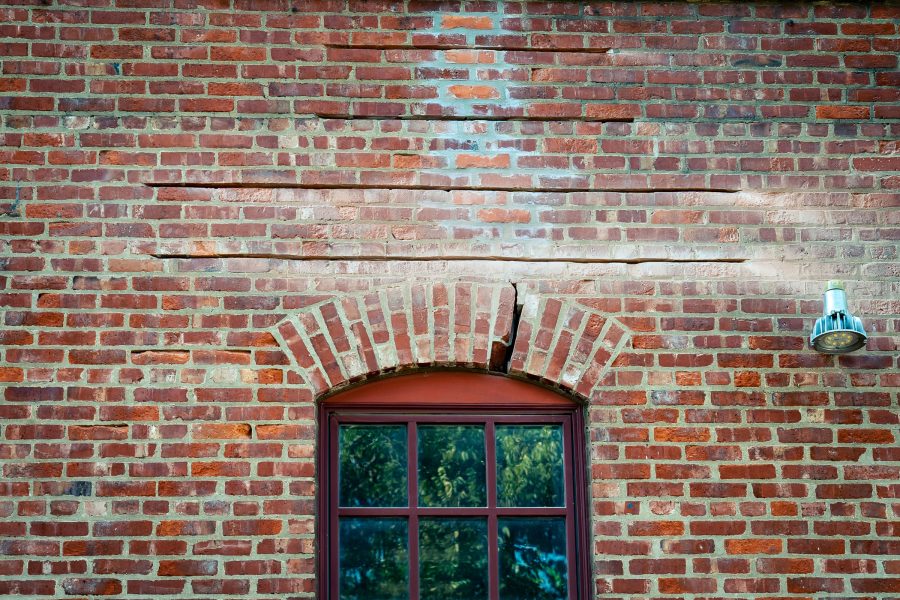
Photo courtesy of PROSOCO
The applications are broader than many contractors realize. Helical beaming is appropriate for sagging lintels, lintel replacement, flashing repair at shelf angles, and situations where an owner needs to create or enlarge an opening in a masonry wall. In multi-wythe construction (common in older commercial buildings), the beaming can be installed on both the interior and exterior wythes to further increase capacity. The technique is also limited to a maximum span of 11 feet, 10 inches, though experienced practitioners have developed workarounds for situations that fall just outside that boundary.
Critically, the repairs are virtually invisible post-installation. The bars are set back into the mortar joint, and the slot is repointed with mortar matched to the existing wall. A trained eye standing at arm’s length would have difficulty identifying where the work was done. For historic buildings, another category where preservation is inherently the most sustainable choice, this is not a minor advantage.
When the Textbook Doesn’t Quite Apply
Real buildings don’t always cooperate with standard specifications. A recent job led by my colleague John Montecalvo, a technical specialist who has made it something of a personal mission to expand helical beaming’s reach, illustrates both the technique’s flexibility and the ways it can be customized with some creative problem-solving on the job.
Standard helical beaming practice calls for at least 20 inches of wall on each side of an opening to give the beam adequate bearing. On this particular job, the left side of the opening had 20 inches and then some. The right side did not. A conventional repair approach would have treated that asymmetry as a hard stop—time to bring in shoring posts, remove more brick, and absorb the added cost and complexity. Montecalvo took a different approach; he cut into the side wall perpendicular to the opening to pick up the required bearing distance, then bent the Stitch-Tie Bars to run along the side wall before continuing across the span.
The solution worked. When Montecalvo later presented photos of the repair to a gathering of the International Concrete Repair Institute in Massachusetts, the response from the room was something close to disbelief. “They didn’t know something like this could be done,” he says. It’s a reaction that speaks to both the ingenuity of the solution and the broader awareness gap that still surrounds the technique. A method capable of solving problems that most contractors assume are intractable remains largely unknown to the professionals who could benefit most from it.
The Numbers are Hard to Dispute
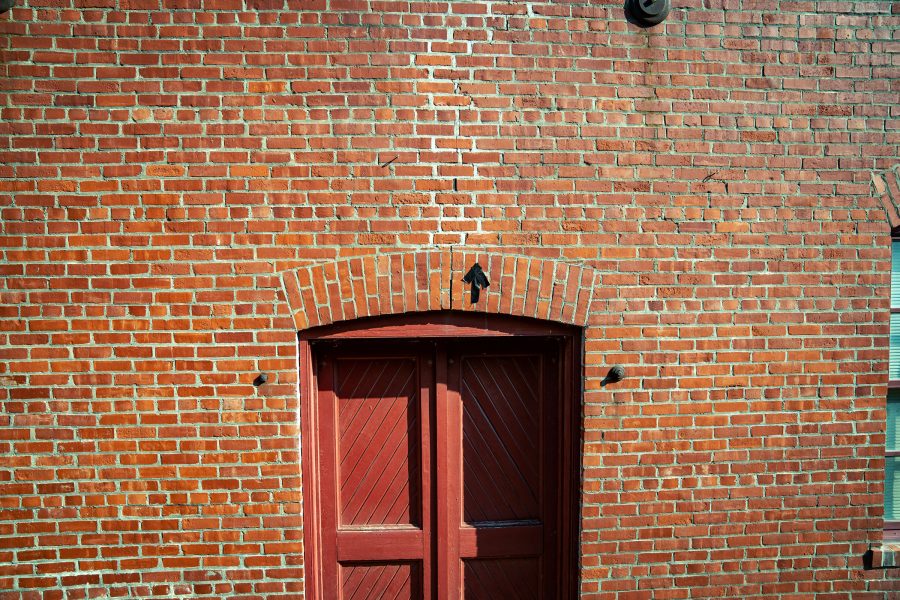
Photo courtesy of PROSOCO
Beyond its environmental case, helical beaming makes a compelling economic argument. Replacing a steel lintel and three courses of brick using conventional methods runs approximately $195 per lineal foot. Helical masonry beaming on the same repair runs at approximately $70 per lineal foot—less than half the cost. On a single 5-foot window opening, that’s the difference between a $975 repair and a $350 one. Scale that across a full facade restoration, and the savings become a significant line item in any project budget.
The labor savings are equally meaningful. Conventional methods require shoring posts positioned every few feet, which limits the size of materials that can be installed and increases the complexity and the safety risk of the work. Helical beaming can often span an opening entirely without shoring, giving crews unobstructed access and substantially reducing time on the wall.
There is also a less obvious benefit when it comes to water management. Flashing repairs performed without beaming typically require sheet products that must be overlapped where shoring posts interrupt the installation. Each lap is a potential point of water intrusion. Helical beaming eliminates the need for those posts, allowing for longer, uninterrupted flashing runs and fewer vulnerabilities in the building envelope.
The Real Barrier is Awareness
If helical beaming is so effective, so economical, and so aligned with the principles of sustainable building practice, why isn’t it more widely used? The honest answer is inertia. Restoration crews default to what they were trained on. Most were trained on shoring posts and corbelling, because those were the dominant methods when their mentors learned the trade. Helical beaming has been available as a technique for years, but it hasn’t been widely taught in training programs, and it rarely comes up in continuing education for the architects and contractors who specify and execute restoration work.
That is beginning to change. The volume of inquiries reaching the engineers and technical specialists who work with this method grows week over week. Contractors who have used it once tend to use it again because the results speak for themselves, and the economics are difficult to walk away from once you’ve seen them firsthand. The reaction in that Massachusetts conference room—the genuine surprise that a technique this effective existed and that most of the room had never heard of it—is becoming a familiar scene at industry gatherings.
A Sustainability Case that Doesn’t Require a Rebate
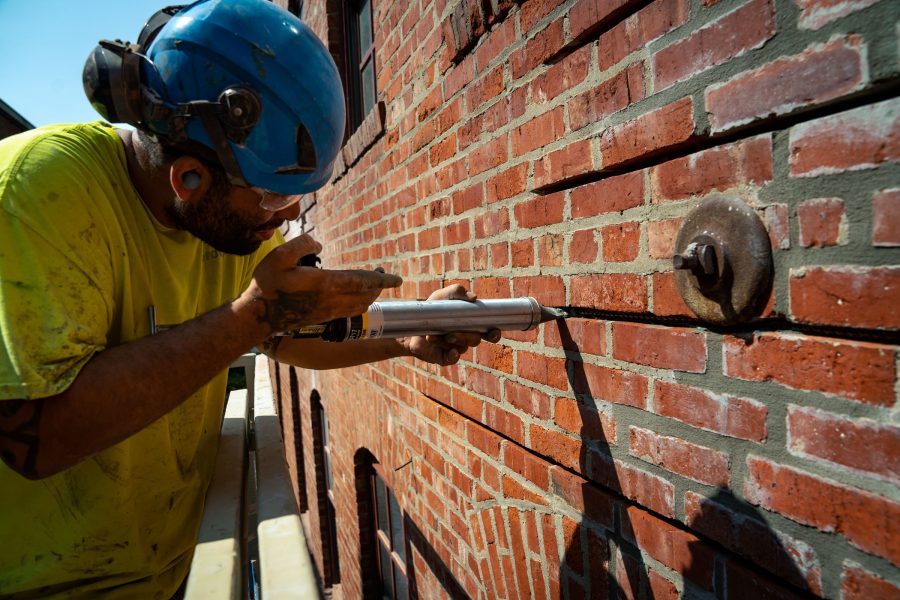
Photo courtesy of PROSOCO
The green building conversation has, understandably, been dominated for years by energy performance: insulation values, air barrier continuity, HVAC efficiency, and renewable energy generation. These remain critical. But as the industry matures in its understanding of whole-building environmental impact, the embodied carbon embedded within existing structures, and the value of preserving it, is coming into sharper focus.
The greenest building really is the one already standing, especially when it can be repaired and kept in service rather than being replaced. Every brick in a standing wall represents energy that was already spent: to mine the raw materials, fire the kiln, transport the product, and lay it in place. Tearing that wall down and replacing it doesn’t just cost money. It costs carbon. Restoration anchoring and horizontal joint reinforcement applications like crack-stitching and helical beaming keep those bricks in place, preventing that embedded energy from becoming waste while also giving the building decades of additional service life.