Story at a glance:
- Limberlost Place is a new 10-story, net-zero educational building on George Brown College’s campus in Toronto.
- The net-zero project puts the versatility, durability, and sustainability of timber on full display and seeks to be a model for the future of low-carbon construction.
- The building uses biophilic principles to emulate the experience of ambling through the woods on a clear day.
When Limberlost Place, a 10-story educational building in downtown Toronto, opened to George Brown Polytechnic College students in fall 2025, it marked a historic moment for timber construction in Canada and beyond.
As Canada’s first tall timber assembly occupancy tower, Limberlost Place demonstrates the safety and versatility of mass timber—and serves as a model for the future of the low-carbon material.
The Strength of Concrete with 60% the Emissions
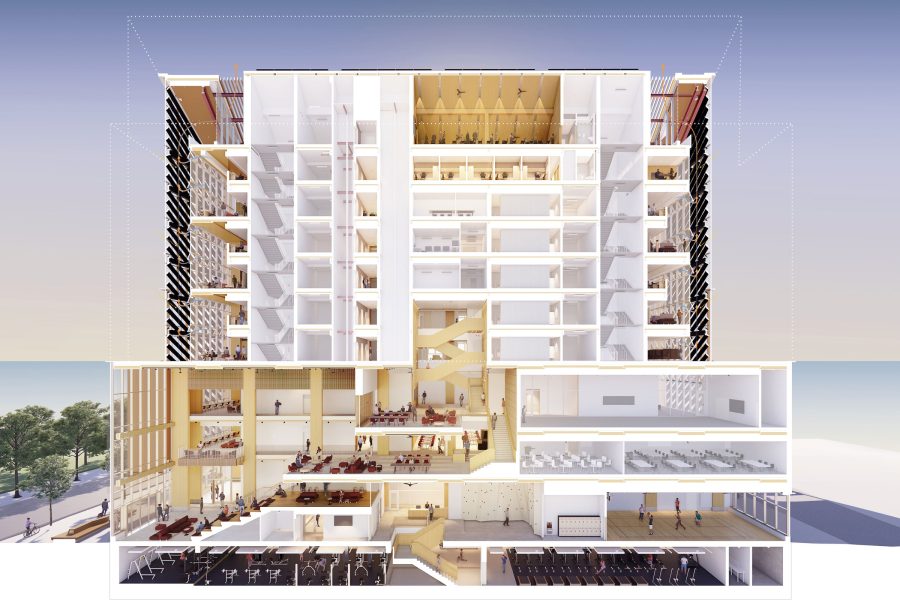
Rendering courtesy of Moriyama Teshima Architects
Limberlost Place is an example of mass timber construction, which uses timber as a skeletal material for a building in order to reduce its carbon footprint.
Mass timber design, while most popular in Europe, has made its way to North America with advances in cross-laminated and glued-laminated timber. These materials fuse pieces of wood together to emulate the strength and performance of a solid trunk that would take decades to grow. “It allows us to leave our old-growth forests alone and actually use smaller bits of lumber,” says Carol Phillips, a partner at Moriyama Teshima Architects and the design lead of Limberlost Place.
The timber components of Limberlost Place tout a strength-to-weight ratio that’s comparable to concrete with a fraction of the environmental impact.
Research suggests mass timber construction can reduce the carbon footprint of a multi-story building by up to 40% compared to steel or concrete, with the building itself acting like a type of carbon storage.
Ancient Material, Modern Construction
-
- Photo by Doublespace Photography, courtesy of Moriyama Teshima Architects
-
- Photo by Doublespace Photography, courtesy of Moriyama Teshima Architects
To bring Limberlost Place to life, Phillips and her team partnered with Acton Ostry Architects in Vancouver and Nordic Structures, a supplier based in Montreal.
The timber used for the project is a blonde, strong wood harvested from black spruce forests in northern Quebec that are protected by Canadian law. “Canada has one of the best forestry management systems. It assures that anybody who’s actually working in the forests is doing so with sustainability, stewardship, and regeneration of the forests in mind,” Phillips says.
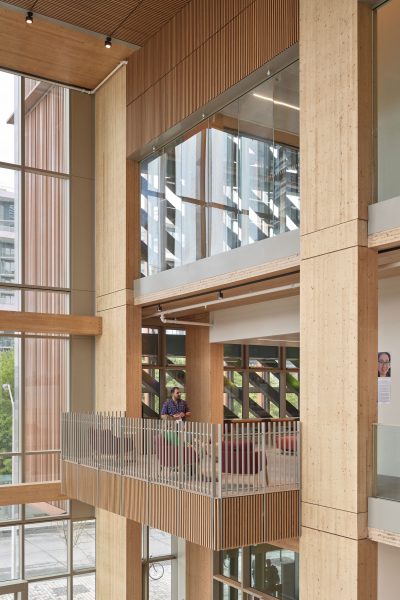
The supplier made a point to collect small branches that would otherwise be left behind, incorporating them into the building’s columns and beams. “Because they’re skinny trees they have lots of branches, so there are a lot of knots in the wood. It has a very particular characteristic to it that’s beautiful,” Phillips says.
Nordic Structures then prefabricated the majority of the building’s structure to minimize onsite construction. “All the panels came with the holes in them for pipes or plumbing that needed to be passed through. Every panel had a QR code so we knew exactly where it was going,” Phillips says.
She estimates that less than a dozen unanticipated holes needed to be cut across the entire 203,329-square-foot building—a testament to Nordic’s precision and ability to apply modern construction methods to an ancient material.
Getting in the Zone
Limberlost Place is designed to fit 3,400 people at a time across its classrooms, offices, and recreational spaces. With such high occupancy comes certain regulatory challenges. “We had to go through a process of what’s called alternative compliance with the building code to demonstrate that our building was as safe as, if not safer than, conventional construction,” Phillips says.
Ultimately, with the help of Fast + Epp structural engineers, they were able to prove to the city that their timber design was strong enough to withstand the foot traffic and stay structurally sound in the case of a fire—paving the way for future projects to do the same.
A Walk in the Woods
-
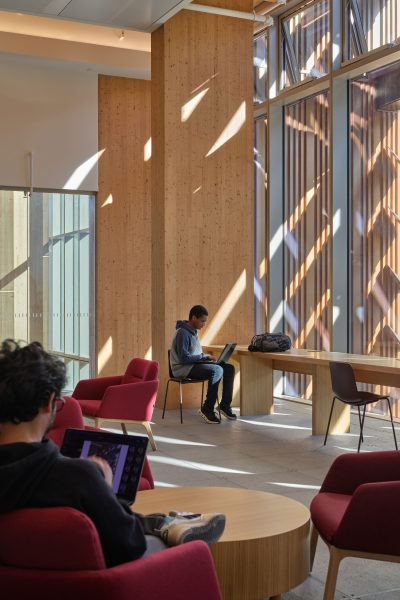
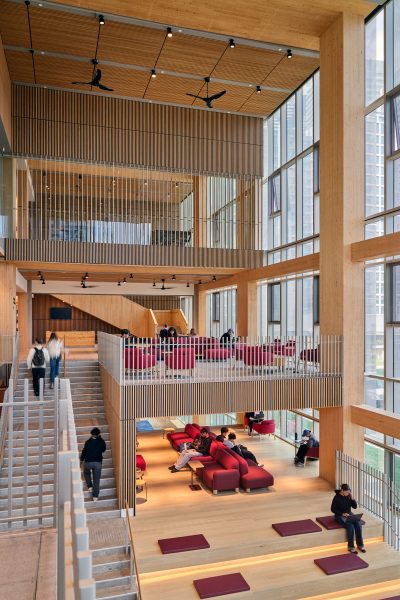
- An airy “learning landscape” spans three stories with a design that mimics a clearing in the forest. Photo by Doublespace Photography, courtesy of Moriyama Teshima Architects
-
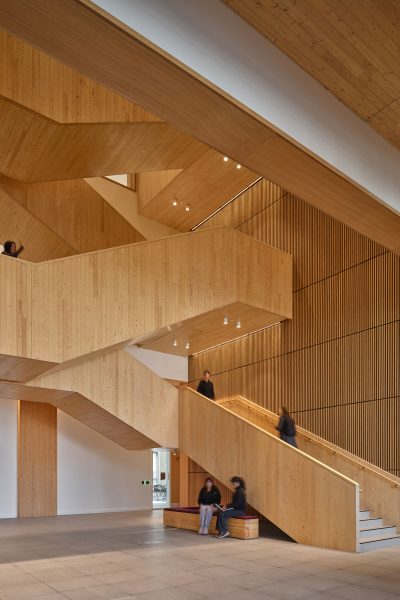
- A central staircase shows off the grain of the black spruce wood. Photo by Doublespace Photography, courtesy of Moriyama Teshima Architects
When conceptualizing Limberlost Place, Phillips says she was careful not to “ask too much” of the timber material, which, in its natural form, is quite rigid. In many ways her design process was about allowing the timber to dictate how the building would look and feel.
Perhaps it’s no surprise that walking through Limberlost Place feels a lot like ambling through a forest path. Airy, cathedral-like spaces evoke clearings in the trees, while smaller outcoves mimic being cocooned under a canopy.
Phillips hopes that the choice to leave interior wood exposed—knots and all—helps students feel at ease in the space. “When there is so much pressure on youth to be perfect in social media, I love this idea that this material is perfectly imperfect,” she says.
The design also features biophilic principles like prospect and refuge, allowing students to find seclusion while still feeling part of the larger space. “A lot of these students are commuter students who spend their entire day on campus. They need choices and spatial variety,” Phillips says.
Net-Zero Innovation
Beyond being a marvel in timber construction, Limberlost Place is a showcase in net-zero design that meets the city of Toronto’s goal to reduce reliance on fossil fuel use in public buildings. “The building is incredibly ambitious beyond the timber. We use a prefabricated envelope system with gaskets that actually exceed passive house standards for air tightness,” Phillips says.
It also features innovative solar chimneys that utilize the natural buoyancy of air to regulate temperature. Two multi-story chimneys are made using double chambers of glass stacked with “heat shelves” that attract heat from the sun, acting as passageways through which air can circulate. “[They] are essentially engines that pull air in and through the building,” Phillips says, creating a more comfortable environment and reducing the need to turn on the air conditioning or heat for much of the year.
A rooftop solar array, energy recovery ventilators, and radiant ceiling heating and cooling panels add to the energy-efficient portfolio of the all-electric building.
An Adaptable Learning Lab
-
- Photo by Tom Arban, courtesy of Moriyama Teshima Architects
-
- Photo by Tom Arban, courtesy of Moriyama Teshima Architects
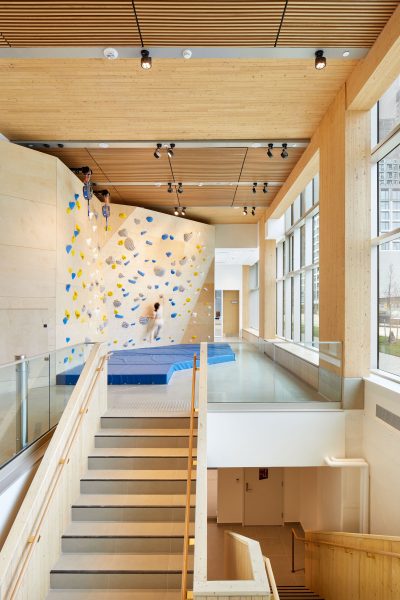
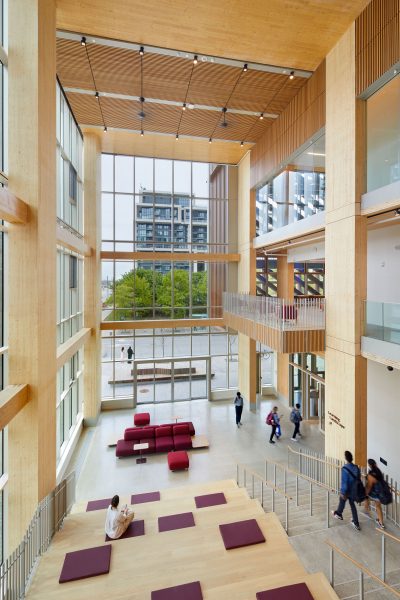
Home to George Brown’s architecture programs, Limberlost Place provides a unique opportunity to not only study in a net-zero building but to learn from it. “The building doesn’t think for you. The building forces you to engage with the systems around you,” she says.
The expansive windows in every classroom are manually operated, for example, inviting students to create their own learning conditions with the help of an automated system programmed to glow green when it is a good day to let some fresh air in.
Phillips hopes the project serves as a learning lab for the wider community, too. Moriyama Teshima Architects and their partners have hosted nearly 500 tours so far, to diverse stakeholders including other contractors, developers, and other architects. They hope that their transparency will ultimately help others embark on similarly ambitious low-carbon projects of their own. “I’m sure Limberlost will be eclipsed very, very soon,” Phillips says. “But I wish everybody the best of luck because I think that this is what has to happen.”