Story at a glance:
- As a leading innovator in electronic access control, Salto pushed to see how they could remove hardware from an entry point entirely.
- Salto developed a smart intercom system that eliminates hardware by utilizing the ubiquitous smartphone.
The world’s earliest locks appeared in Egypt more than 4,000 years ago. Known as pin tumbler locks, they were made mostly of wood and included a bolt and pins that dropped into a hole to prevent a door from opening. A large wooden key then pushed the pins up and opened the door. Generations of human ingenuity not only required better security for homes and businesses than these early locks but also improved upon the simple design. In fact, in today’s world, using a key to unlock a door is practically passé.
As an innovator in electronic access control, Salto’s research and development team wondered if the next big thing in security could remove hardware from an entry point entirely and rely instead on something everyone carries around all the time: a smartphone.
“Each step in the history of access management stripped away a layer—a piece of hardware or a physical token—to get closer to a frictionless experience,” says Jeff Roberts, director of business development for Salto North America. “Smart intercoms were a big step; they moved the platform to the cloud, but they still left a piece of hardware at the door. The industry already proved you can manage access from the cloud and put video calling on a resident’s phone. The question remained: Does the visitor side of the experience still need dedicated hardware? We think the answer is no.”
The company’s solution—Salto XS4 Com with iGO—is a cloud-based smart door intercom that has eliminated the mounted panel from the entry point. What sets the intercom apart is iGO, a small identifier—either a polycarbonate plate (about 4 by 6 inches) or sticker for metal or glass—placed at the door. The vandalism-proof plate or sticker contains a QR code and NFC tag that transform a user’s smartphone into the intercom. iGO’s plate and sticker are available in multiple language versions and include braille.
BYOD: Bring Your Own Device

The visitor’s and resident’s phones are the intercom. Photo courtesy of Salto
Designers strive to make green buildings more energy- and materials-efficient as well as minimize their embodied carbon and waste. For these reasons components and systems are scrutinized before specification. However, Roberts notes the intercom has historically avoided scrutiny because it is a necessary part of the entry package.
“There’s real material there: wiring runs, mounted panels, power connections, and a replacement cycle every several years,” he says. “The most sustainable version of any building system is the one with the fewest parts. If you can deliver the same experience with a cloud platform and QR code instead of a wired panel, that’s not an incremental improvement; that’s an entire category of material removed from the building.”
When a visitor approaches an entry using XS4 Com with iGO, rather than operating what can be an intimidating panel system, he or she scans or taps the iGO plate or sticker at the door. A Progressive Web App (PWA) then opens in the visitor’s browser. PWAs perform like a native app on a device without being downloaded from an app store. A video call is initiated to the resident, who taps his or her smartphone to unlock the door. (Visitors and residents must be using iOS 16, Android 12, or newer operating systems.)
Removing hardware doesn’t mean removing rigor.
“The smartest hardware in the system just walked through the front door,” Roberts says. “Every resident and every visitor already carries a smart device with a screen, camera, mic, and data connection. By building the system around those existing devices—not just as a companion app alongside the access hardware—you remove an entire class of manufactured objects from the building’s life cycle.”
XS4 Com with iGO not only eliminates the physical intercom panel that is produced, shipped, mounted, powered, maintained, and eventually discarded, but it also removes conduit runs and rough-in coordination with an electrician. Fewer trades and material deliveries result in less time and money on a construction project.
Eliminating Hardware, Improving Security
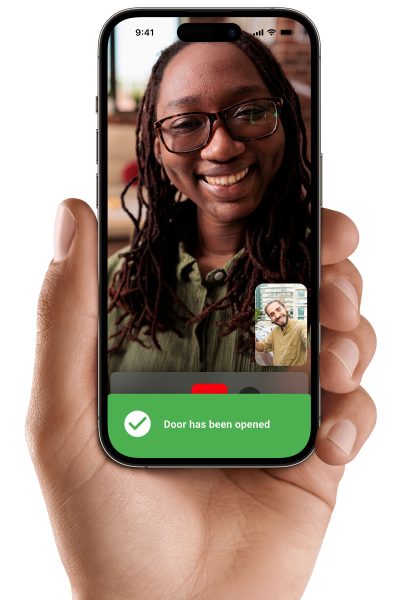
A small identifier on the door—iGO—initiates a visitor’s smartphone to open a web app and video call the resident for entry. Photo courtesy of Salto
XS4 Com ties into the building’s broader access system—locks, credentials, and entry points—with Homelok, Salto’s residential access management platform, via a single cloud dashboard. XS4 Com with iGO also can be used in commercial buildings, like offices, health care, education, and hospitality. It integrates with the Salto KS access control system for commercial buildings. Regardless of building type there are no limits on the number of users per unit or the number of floors, entrances, units, or site admins. “Scaling a cloud-based system with no entry panel means adding a few more QR codes,” Roberts says. “The economics of reduction gets better the bigger the building gets.”
Salto maintains strict security protocols to ensure building entry points remain safe. Geofencing confirms the visitor is standing at the entry point when a resident is called; access cannot be triggered from down the street. Video calls to residents use WebRTC, or Web Real-Time Communication, which contains mandatory encryption using Datagram Transport Layer Security, a protocol that prevents eavesdropping, tampering, and message forgery.
“Removing hardware doesn’t mean removing rigor,” Roberts says. “The platform is ISO 27001-certified [the international standard for Information Security Management Systems] and GDPR-compliant [the European Union’s General Data Protection Regulation] with end-to-end encryption on every video call. The fewer physical components in a system, the fewer attack surfaces.”
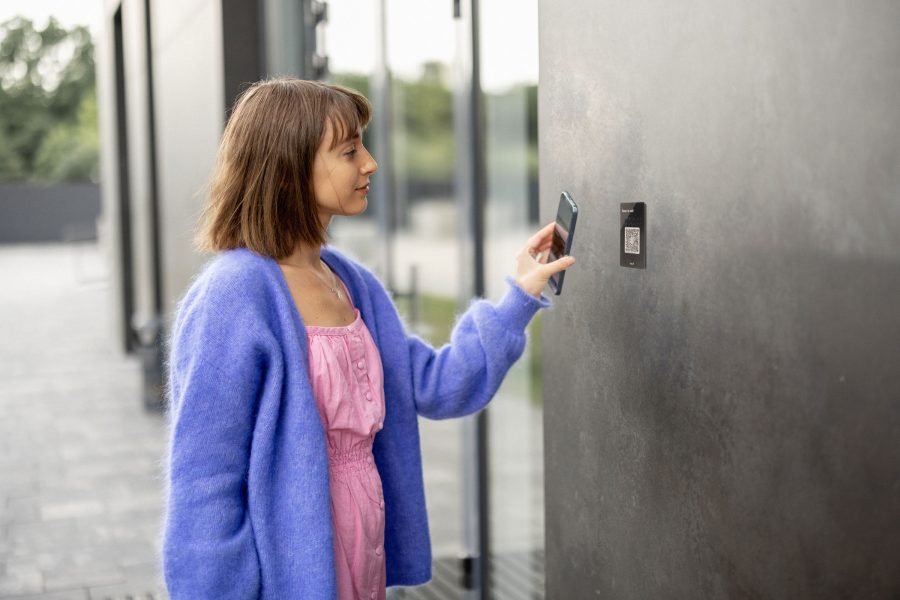
The platform maintains rigorous security standards, including ISO 27001 certification, end-to-end encryption, and geofencing. Photo courtesy of Salto
A building owner or property manager controls and updates the XS4 Com system via the cloud. He or she no longer has to re-key a unit after a renter moves out; instead, an update is made in the cloud interface. This results in a lower maintenance footprint for the building’s operating life.
XS4 Com with iGO is one element of a modern access control system that is futureproofing buildings by requiring no hardware and less labor. But, according to Roberts, this is only the beginning of how technology continues to enhance access control.
“The end state of access technology is no barriers at all—no keys, no cards, no panels, no codes—just you and the door, and the door knows who you are. Your identity becomes your access credential,” Roberts says. “iGO is a step on that path. The physical infrastructure between a person and entry keeps shrinking. At some point it will reach zero. That’s the future we’re building toward.”