Story at a glance:
- A decade-long collaboration in Phoenix shows what happens when an institution treats its campus as a living system.
- Architects on this desert project show the strengths of regenerative design as a growth strategy in addition to an environmental one.
Regenerative design is usually described in functional terms: It’s a building that gives back more to its site than it takes—more energy than it consumes, more water than it draws, more ecological value than it removes. That definition is accurate, and it’s the right place to start, but it’s also narrow. It describes what a building does to its acre of ground and stops there.
The Desert Botanical Garden in Phoenix offers a wider view. Over a 10-year collaboration with architect Matthew Salenger of coLAB Studio and 180 Degrees Design + Build as co-architect and builder, regenerative design at the garden did not simply lower the operating costs of individual buildings. It functioned as an engine of institutional growth. During the same period that the new campus came out of the ground, the garden’s net assets rose more than 400%. The two facts are not unrelated, and the relationship between them is the more interesting story.
From Hoop Houses to a World-Class Campus
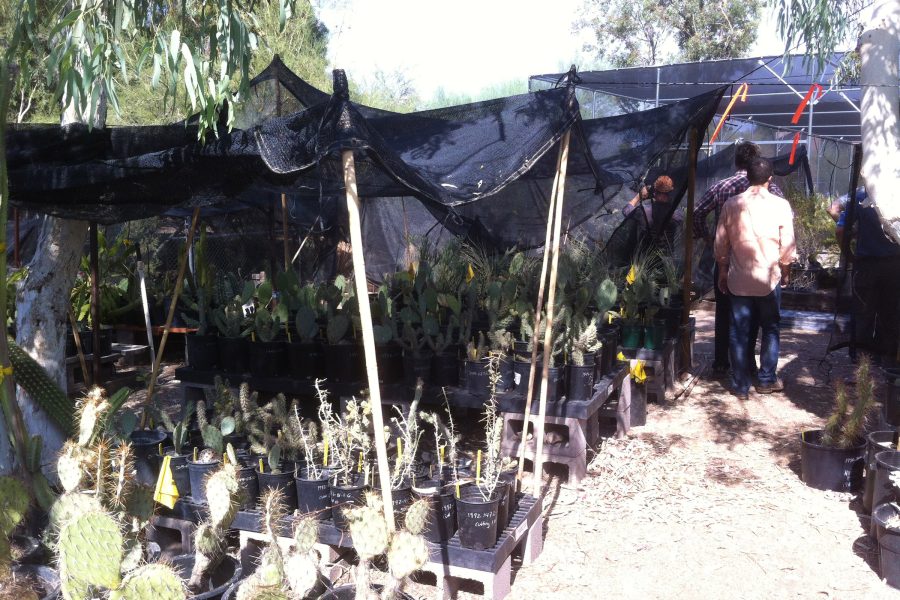
Examples of the original hoop houses and shanty shade structures. Photo by Matthew Salenger, courtesy of 180 Degrees Design + Build
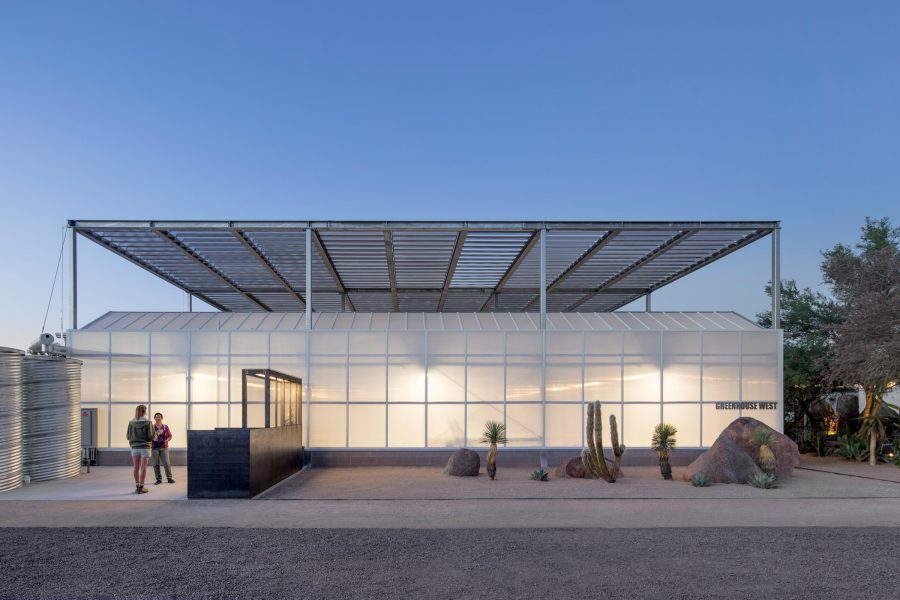
Greenhouse West, part of the Hazel Hare Center for Plant Science at the Desert Botanical Garden. Photo by Bill Timmerman, courtesy of 180 Degrees Design + Build
It helps to remember where the garden started. In 2013 the institution that holds one of the most significant collections of arid plants on earth was running its plant science operation out of lean-tos and hoop houses that were never meant to be permanent. The temporary exhibit pavilion could not host the caliber of exhibitions the garden wanted to mount. The people doing world-class horticultural and conservation work were doing it in facilities that had been improvised, in some cases, for more than 30 years.
Salenger led the master planning effort, and 180 Degrees came aboard to translate an ambitious regenerative vision into buildings that could actually survive a Phoenix summer and satisfy City of Phoenix life safety code.
Before anything was designed the team ran a series of integrative design process workshops, a method developed by Bill Reed and 7group that grows directly out of regenerative thinking. Putting garden staff, scientists, and the design and construction teams in one room at the very start, when decisions were still cheap to change, is a large part of why the Hazel Hare Center for Plant Science worked.
What followed was not a single project but a phased, decade-long build-out of the Hazel Hare Center for Plant Science. The fully automated greenhouse, passive house conservation laboratory, and dedicated exhibit gallery is described now by horticulture center staff as the nerve center of the garden. A second greenhouse is planned.
This was never a campaign to put up sustainable buildings one at a time. Regenerative design is a process that begins with the ecology of a place and then expands outward to include systems, materials, and programs. It asks an institution to treat its physical assets not as fixed overhead but as active extensions of its mission.
When the design strategies are coordinated from the earliest stages, the result is a network of decisions that reinforce one another instead of a collection of one-off green features. Passive cooling, rainwater harvesting, high-performance envelopes, healthy interiors, biophilic principles, reclaimed materials, and site-sensitive programming stop being separate line items and begin working as a single system.
Buildings That Earn Their Keep
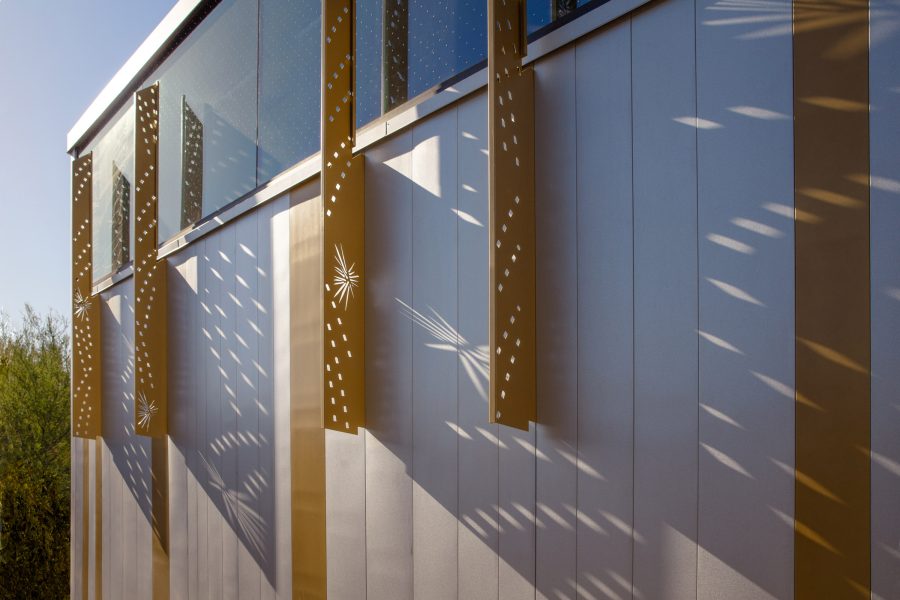
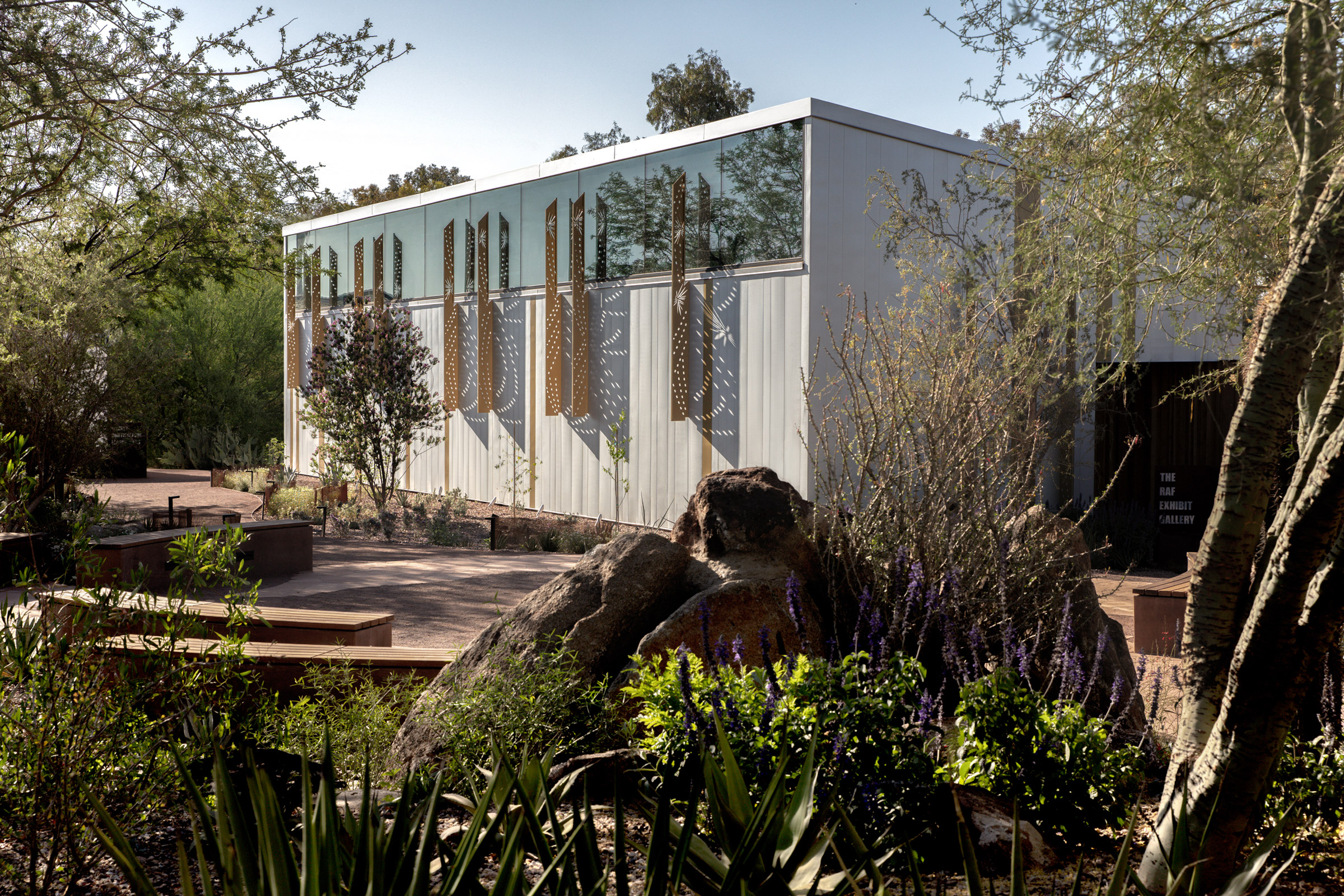
The RAF Exhibit Gallery’s perforated aluminum fins provide natural cooling to the metal cladding building. Photo by Bill Timmerman, courtesy of 180 Degrees Design + Build
Each building on the campus was designed to do real work in one of the harshest climates in North America, where summer temperatures regularly exceed 115 degrees Fahrenheit, and ultraviolet radiation is relentless.
Greenhouse West, the first structure completed under the master plan, protects some of the largest and rarest agave specimens in the world beneath a motorized aluminum louver canopy that tracks the sun and can create distinct micro-environments bay by bay.
The Ahearn Desert Conservation Laboratory, which safeguards more than 4,000 seed accessions, was built to passive house standards, as were the RAF Exhibit Gallery and the learning lab, with insulation values well above code and interior temperatures that hold steady year-round. At the conservation lab the team worked from the Sonoran Desert’s own biophilic vocabulary: The skeletons of cactus were precision-cut into the facade as artwork, and the hearty internal structures of native cactus were set between panels of polycarbonate, so visitors come upon a piece of the desert where they would never expect to find it.
The RAF Exhibit Gallery is shaded by metal fins whose shadows fall across its facade as a kind of artwork, and those same fins keep the building cooler through the summer, when the sun swings around to strike it from the northeast and northwest.
The Horticulture Center, evaporatively cooled and wrapped in an optimized envelope, gives staff and volunteers a true working home for the first time, with north-facing clerestory windows that cut reliance on artificial light and healthy materials chosen to improve indoor air and reduce employee absenteeism.
What these buildings share is that their beauty and their performance are never separate. The fins that pattern the RAF’s facade with shadow are also shading its wall; the cactus cut into the conservation lab is also the building’s argument for its place.
Lower energy and water use, durable assemblies, and healthier interiors are not abstractions on a botanical campus. They translate directly into a smaller operating burden, plant collections that thrive rather than merely survive, and staff who can do better science in better conditions. Those are the conditions under which an institution grows.
When Efficiency Becomes Growth
This is where the financial picture comes in. According to ProPublica’s Nonprofit Explorer, the Desert Botanical Garden’s net assets grew from $15.7 million in 2011 to roughly $79.8 million in 2025, an increase of more than 400%. No single building produced that result, and it would be dishonest to claim design alone did. Growth like this comes from leadership, programming, membership, philanthropy, and a regional appetite for the institution’s mission.
But regenerative design was woven through all of it. A campus that costs less to run frees money for mission. Buildings that protect irreplaceable collections make the institution more credible to the scientists and donors who fund conservation. Spaces designed for world-class exhibitions can host them, which draws visitors, which deepens community connection, which unlocks new funding. Better facilities make a stronger case to a major donor than a hoop house ever could. The campus did not sit outside the garden’s growth as a sustainability line item; it was one of the mechanisms of that growth. The 400% figure is the quantitative shadow of something that was already observable on the ground.
That is the part of regenerative design that the standard “gives back more than it takes” definition leaves out. Giving back more than the building needs is the functional use of a site. It is real and it matters. But it is only one layer.
Institutions as Living Systems
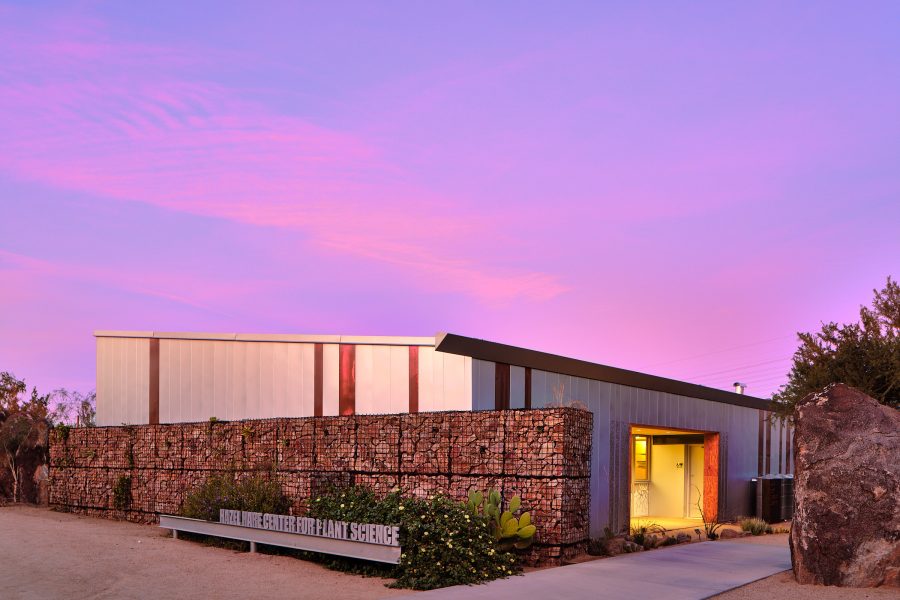
The Ahearn Desert Conservation Laboratory is part of Hazel Hare Center for Plant Science at the Desert Botanical Garden. Photo by Austin Trautman, courtesy of 180 Degrees Design + Build
The deeper idea, in Salenger’s framing, is regenerative development, a far wider view of where and how we build than regenerative design alone.
The premise is that any organization, whether commercial, governmental, or nonprofit, has its own internal living system, and that the goal of every living system, natural or human-made, is to grow and evolve over time by producing more energy than it consumes. A healthy permaculture plot is the natural model—a complex web of reciprocal exchanges that, understood properly, becomes more productive the longer it runs. An institution can work the same way. So can a design firm. coLAB Studio was itself formed as a living system of complementary parts that exchange energy, ideas, talent, and economics; 180 Degrees grew from small projects and a small internal community into a firm capable of building a campus like this one, energized by its employees and by collaborators like coLAB along the way.
What makes the model regenerative rather than merely sustainable is attention to position. The practical questions are always the same: What is putting energy into us, and what are we putting energy into? At the Desert Botanical Garden, those questions point in two directions at once. The garden draws energy inward from the larger community that sustains it, its members, its donors, the city of Phoenix, everyone who tells someone else it is worth visiting. At the same time it pushes energy outward, engaging scientific study across Arizona to grow its conservation work and strengthen the Sonoran Desert’s ecosystem for education and research. Going out to expand that science is not a side activity; it is central to the project’s mission.
Regenerative development asks an institution to hold those systems together—the community it is embedded in, the institution itself, and the higher purpose it serves. For the garden that higher purpose is the desert itself. By gathering science and growing plants to repopulate communities of native Sonoran Desert species, the garden gives back to the larger biome in a widening field of energy and care. When multiple entities align around a shared, healthy living system this way, the grouping becomes what regenerative practitioners call a guild, the way a gardener comes to understand a permaculture.
Seen through that lens the Desert Botanical Garden campus is not the end product. It is the visible part of a much larger exchange between the garden and its city, its donors, its scientists, its visitors, and the firms that designed and built it. Regenerative development adds the dimension that pure functional design omits. It asks how a project can put energy into its community, including those less fortunate, at every level it touches.
What it Means for Other Cultural Institutions
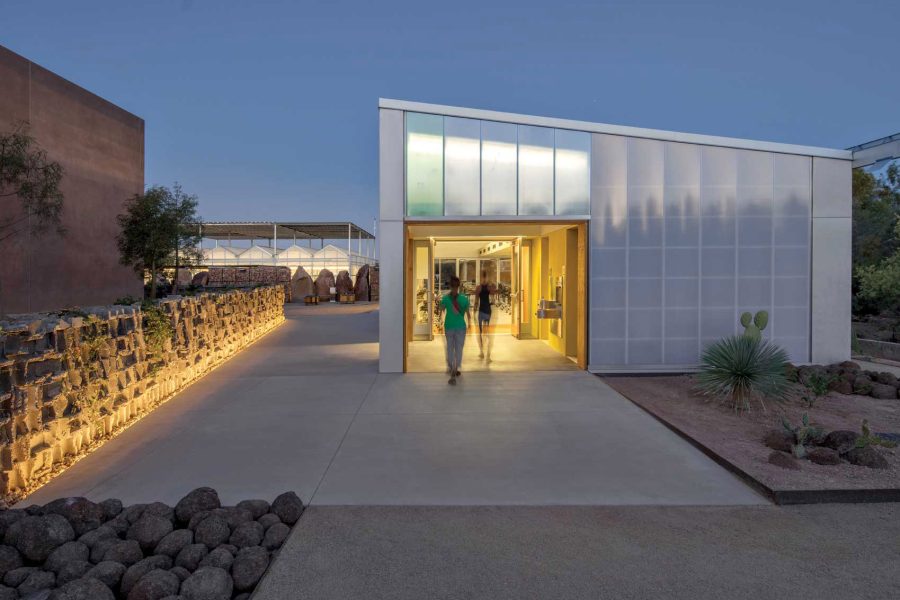
Visitors enter the Marley Horticulture Learning Lab, a rectangular building wrapped with gray, blue, and green polycarbonate panels that allow diffused light into the interior. Photo by An Pham, courtesy of 180 Degrees Design + Build
There is a connective thread here that goes beyond one garden in the desert. Cultural institutions tend to treat their buildings as costs to be minimized and sustainability as a virtue to be signaled. The Desert Botanical Garden’s decade of work suggests a different posture—that a campus, designed regeneratively and coordinated from the earliest planning stages, can be one of the institution’s most productive assets, lowering the cost of the mission while raising the institution’s capacity to pursue it.
The Sonoran Desert is a demanding place to test that idea, which is exactly why it is a useful one. It punishes soft, decorative decisions and rewards close attention to how systems actually perform.
An institution that learns to read its own position the way a gardener reads an ecosystem, understanding what feeds it and what it can feed in return, stops treating its buildings as fixed overhead and starts treating them as living systems that are adaptive, efficient, and deeply aligned with purpose. That shift, more than any single louver or rainscreen, is what grew the Desert Botanical Garden.