Story at a glance:
- The economics of data center construction means delays are very expensive, perhaps more so than other types of construction.
- A supply chain disruption can have a domino effect on interdependent contractors.
- Fastenal’s system is digitally automated, assisted by experienced and skilled humans to keep it operating at peak performance levels.
There are much taller buildings in the world than most data centers. The high floor-load capacity of DCs and the cooling needs of operations pretty much require a broad, single-story layout. And it might take longer to build a hospital or research campus or corporate headquarters because those facilities are complicated multiuse buildings, which require accommodations for throngs of workers and visitors.
But the construction of a data center is subject to exceptional financial pressure. The imperative is to build fast to exacting standards and to achieve completion on a strict schedule. This pressure is immense—driven largely by a race for next-generation technological advantages as well as to achieve a return on investors’ money. Any general contractor or subcontractor that messes up the process and schedule is at risk of reputational damage and a loss of future business.
Mike Lizzi, with Fastenal for nearly 20 years, understands the critical importance of supply chain reliability and customer responsiveness. As a vertical business development manager he leads Fastenal’s strategy across the data center, IT, and infrastructure markets, helping customers improve uptime, standardize procurement, and optimize their supply chains. He has witnessed the problems that can occur within the somewhat Byzantine ecosystem of data center construction. Any hiccups in the process might start small but escalate quickly. “If you look at a construction pattern, if there’s a failure it’s usually due to one crew stops,” Lizzi says. “That creates a domino effect down the chain of other sub-GCs.”
From Missing Supplies to Work Stoppages

These work sites very often have several hundred workers daily, ideally operating in an impressive choreography that relies on materials, tools, skills, and tech-driven management. But the dance easily stumbles if equipment of any kind, including that which Fastenal provides, is not working or is not available. “If those employees lack their safety gear, that starts a delay right there,” Lizzi says.
Multiply that by the scale of a modern hyperscale build, where schedule slippage on these several billion-dollar projects can mean huge sums of money lost in a delayed delivery of the facility, and the math of a missing box of gloves or other gear gets real.
To understand the calculation you can drill down into lost labor costs. The $65 per hour average wage multiplies quickly when critical materials aren’t on-hand. “If you have 150 workers idle for five hours, you lose more than $48,000 in direct labor costs,” Lizzi says.
That’s bad enough. But the key financial drivers of data center construction are in what’s delivered and when. Cloud storage and online services drive companies to pay high rent to run digital apps through these computing powerhouses. These are contracted under long-term leases that deliver to DC owners a rapid return on investment shortly after it comes online. A delay of a month or a week or even a few days adds up to losses that would disappoint investors—and badly.
Challenges and Opportunities

To be clear, this vulnerability to slowed schedules and wasted labor costs is almost predictable given the complexity of people and independent companies involved. Unlike a shopping center or an apartment complex, a hyperscale campus doesn’t run through a single general contractor and its subs. “You’ll have an overall GC, and they’ll have multiple sub-GCs,” Lizzi says. Then there are “multiple electrical sub-GCs and multiple mechanical GCs,” often 20 to 30 vendors deep—all interdependent, all sequenced against one another.
That fragmentation is the problem Fastenal’s point-of-use model is built to solve. Rather than pushing every trade toward a single centralized supply crib, Lizzi describes a more supply chain approach. “Fastenal’s positioning for data centers is not a one-size-fits-all crib. It’s a tailored combination of inventory, vending machines, bin systems, kitting, vendor managed inventory, all configured to fit the site’s needs.”
The company positions supplies from multiple cribs, closer to where crews are working in the broad footprint of the project. This reduces time workers spend walking or waiting, which is by definition non-productive. “Now you’re getting into a Lean Six Sigma methodology because we’re reducing walk/wait time.”
Modern Industrial Vending
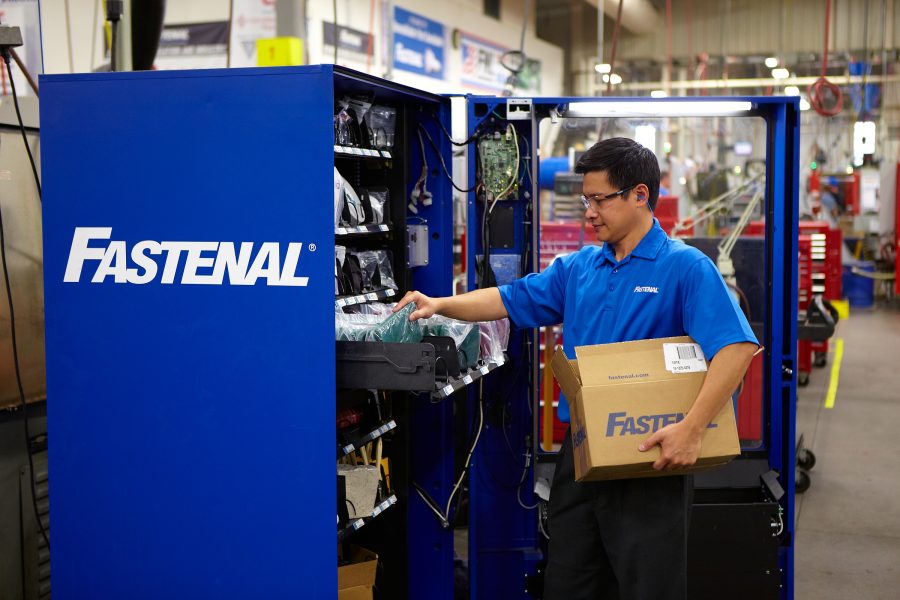
Data center builds don’t run 8am to 5pm. With multiple shifts covering nights and weekends, Fastenal’s vending infrastructure is designed to function without anyone standing behind a counter. Lizzi says the program provides around-the-clock access to critical supplies using automated reordering points, allowing access controls, and giving usage tracking, plus local support. This means night shifts, weekends, and offsite personnel all have access to those consumables instead of waiting for their staff cribs to open.
That access is backed by automated replenishment, where vending machines track inventory against preset minimums. “When an item gets below that minimum it sends us a notification,” Lizzi says. At that point backup slots covering any single item that is running low are replenished. For bulkier materials Fastenal uses an RFID-tagged two-bin Kanban system. “When that first bin is empty you have a backup stock you push forward.” That then triggers a signal to the servicing location for restocking.
Every transaction is tied to the individual pulling it. Workers swipe their badge, which registers them as the person who’s going to receive that item. “That data now goes to the cloud,” Lizzi says. “The result is a measurable shift in behavior. Our vending machines cut consumption by at least 30% or more because of control and visibility. When you put limitations and accountability to items, people tend to use what they need versus grabbing more than what they need.”
All of it rolls up into Fastenal’s Fast 360º analytics platform, giving GCs real-time visibility into usage, spend, and supply chain performance. Fast 360º is an exclusive digital dashboard on the firm’s e-commerce platform that gives customers centralized visibility into their supply chain, inventory levels, and purchasing spend across multiple facilities.
The model traces back to Fastenal founder Bob Kierlin, whose original vision was industrial vending. This automated data-driven supply model, invented and developed to optimal use by Fastenal, is now embedded in data center construction sites nationwide.
That said, Lizzi is quick to note that automation hasn’t replaced human relationships at the center of it. “Data center construction and operations need human interaction more than anything,” he says. “On a jobsite where 4,000-plus workers can be moving across a single campus, and where extended commutes between work zones are common, that combination of automated access paired with a partner who understands the site is what keeps the schedule and the budget intact.