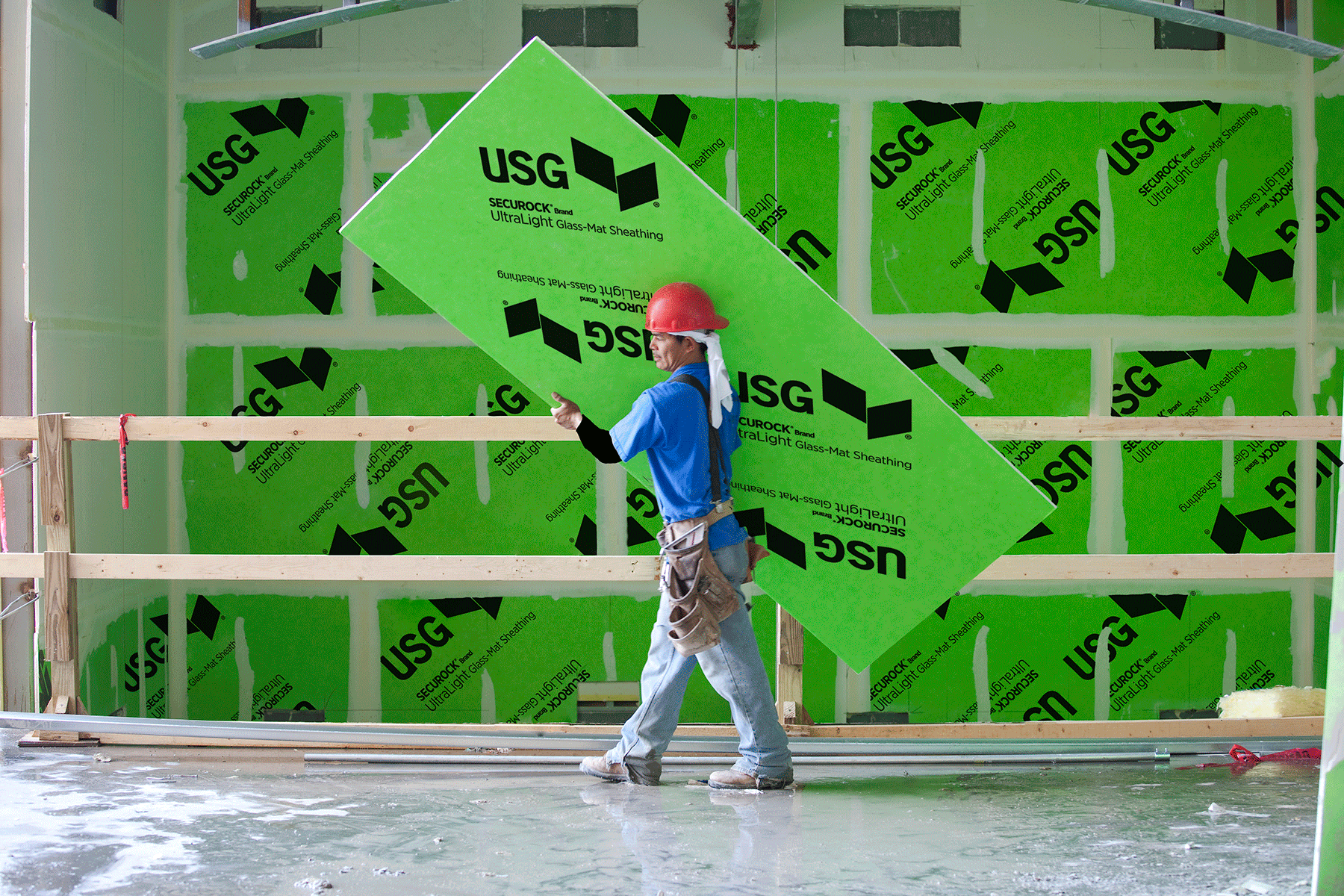
Story at a glance:
- Severe convective storms generated $208 billion in insured losses globally over the past three years, with hail accounting for as much as 80% of those losses—and building codes are responding by merging resilience and sustainability requirements together.
- USG Corporation’s Securock Brand Weather Defense Roof Board became the first product to achieve FM approval for roofing systems under the new Very Severe Hail standard, a gap customers asked the manufacturer to fill.
- A building designed to withstand the stresses of its lifetime requires fewer repairs, fewer replacements, and less material—a direct sustainability benefit.
The building industry has often treated resilience and sustainability as separate conversations—one about surviving disasters, the other about reducing environmental impact. The convergence of climate risk, tightening building codes, and hardening insurance markets is collapsing that distinction fast.
“Resilience and sustainability are deeply connected, and the building industry can no longer afford to treat them as separate disciplines if we are trying to build better buildings,” says Stacy Simpson, sustainability manager at USG Corporation. “Sustainable design reduces a building’s impact on the environment, and resilient design reduces the environmental impact on a building.”
The logic is straightforward. A building designed to withstand the stresses it will face over its lifetime requires fewer repairs, fewer replacements, and less material consumption. Every avoided replacement is avoided carbon emission. “When you design for resilience you are inherently designing for sustainability,” Simpson says.
The economics back her up. The National Institute of Building Sciences’ landmark Natural Hazard Mitigation Saves study found that adopting more stringent building codes saves $11 for every $1 invested, while adding only about 1% to construction costs.
The Hail Belt Wake-Up Call
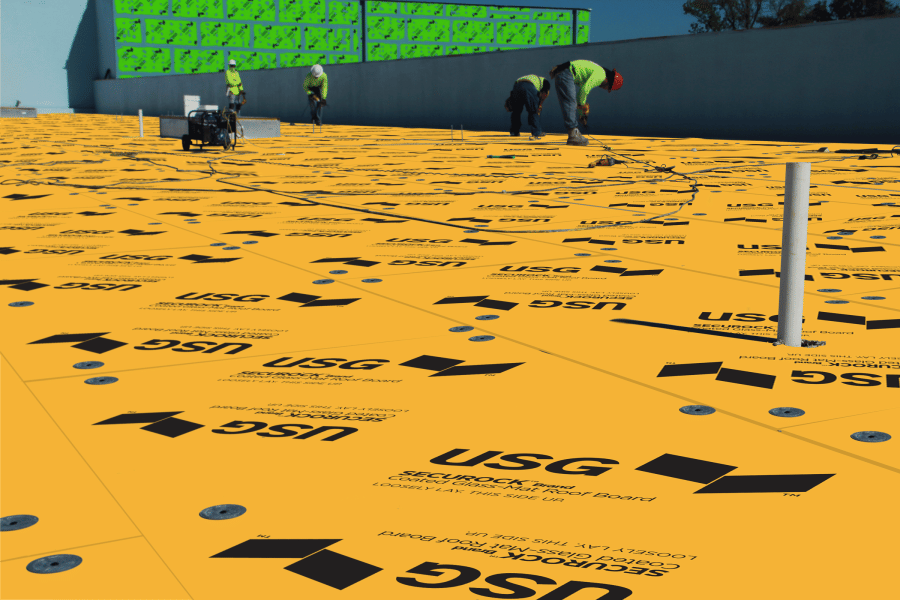
USG Securock Brand solutions provide durable, long-standing exterior systems. Photo courtesy of USG Corporation
Few threats illustrate the convergence better than hail. Insured hail losses have topped $10 billion annually in the US for 15 consecutive years, and hail accounts for roughly 70% of average annual property losses from severe convective storms, according to the National Center for Atmospheric Research. Globally, Gallagher Re data cited by Allianz Commercial puts insured losses from these storms at $208 billion over the past three years, with hail driving 50 to 80% of the total.
Customers told USG there was a gap in the market for resilient building materials that could withstand hail. The company’s answer, the Securock Brand Weather Defense Roof Board, became the first product to achieve FM approval for roofing systems in Very Severe Hail (VSH) conditions. “It also delivers resistance to fire, moisture, mold, and foot traffic,” Simpson says, making it a durable, long-term solution across EPDM, TPO, and PVC commercial roofing systems.
The resilience-sustainability link is embedded in the product’s purpose. “The less you have to change that material, the better it is for sustainability,” Simpson says. Even buildings outside FM Global’s requirements now specify VSH-approved systems, including in hurricane-prone regions where owners simply want tougher roofs.
Codes as the Convergence Point
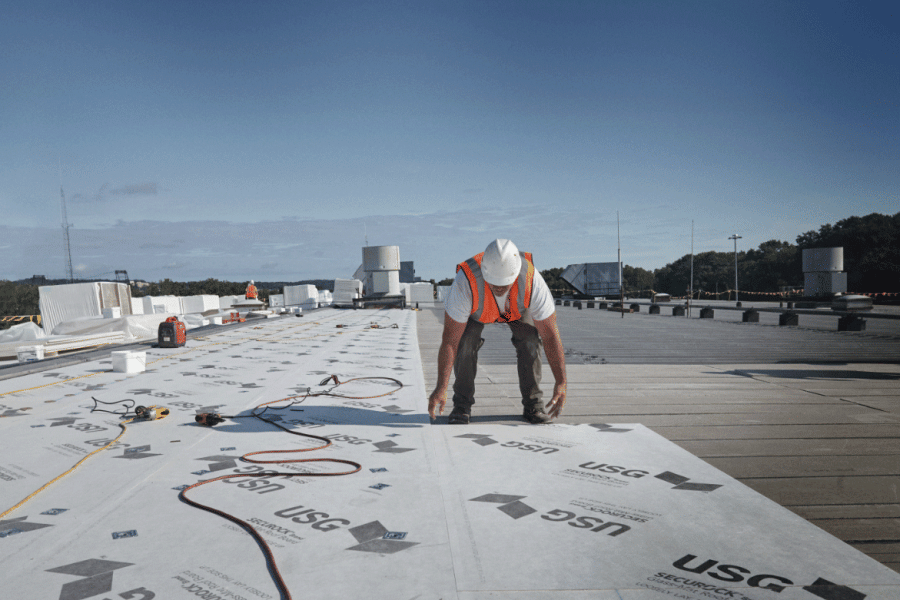
Resilient roofing systems protect building performance and longevity. Photo courtesy of USG Corporation
Insurance is guiding the industry toward resilience, while codes are steering it toward sustainability—and increasingly these efforts intersect and reinforce each other. If insurance is pulling the industry toward resilience, codes are pushing it toward sustainability—and increasingly doing both at once. “Codes are one of the most powerful drivers of change in our industry, and we are seeing sustainability and resilience requirements converge in ways that are reshaping what project teams need from their material suppliers,” Simpson says.
California’s 2026 code cycle offers a preview. The state’s new standalone Wildland-Urban Interface Code requires ignition-resistant construction in fire-prone areas, while CALGreen’s mandatory embodied carbon requirements now apply to projects as small as 50,000 square feet. Simpson says wallboard isn’t yet covered—structural components like steel and insulation concrete came first—but it’s coming. “We will have the embodied carbon available for all our products when California requires it.”
Codes are one of the most powerful drivers of change in our industry, and we are seeing sustainability and resilience requirements converge in ways that are reshaping what project teams need from their material suppliers.
For WUI compliance some jurisdictions list fire-rated gypsum panels like Sheetrock Brand Firecode X for certain wall assemblies, while USG Securock Brand Exterior Sheathing serves exterior applications like soffits and behind cladding.
What happens in California rarely stays there. Simpson points to USG’s joint compound pails as an example. “We’re moving to post-consumer resin in all of our pails. Now that New Jersey and California have limits, it’s going to be all of the United States rather than just in those areas,” she says.
Still, Simpson is candid that the regulatory floor sits too low. “I don’t think codes are strict enough for sustainability, which is unfortunate. I believe we are definitely lagging in comparison to other countries,” she says, pointing to Europe’s harmonized, mandatory energy efficiency and decarbonization targets as a contrast to the regionally variable US framework.
That’s part of why she volunteers on the LEED v5 Design and Construction Consensus Committee, working under the USGBC to develop and maintain the rating system. “Each participant is aiming for the same goal—to make LEED certification an achievable but rigorous standard,” she says. Voluntary standards often shape the codes that follow, she says.
Transparency is the Price of Entry
-
- Photo courtesy of USG Corporation
-
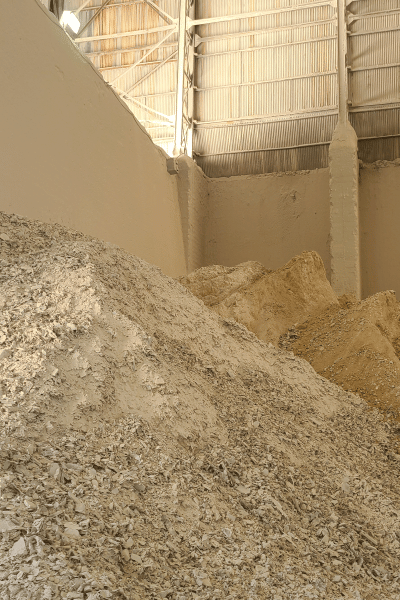
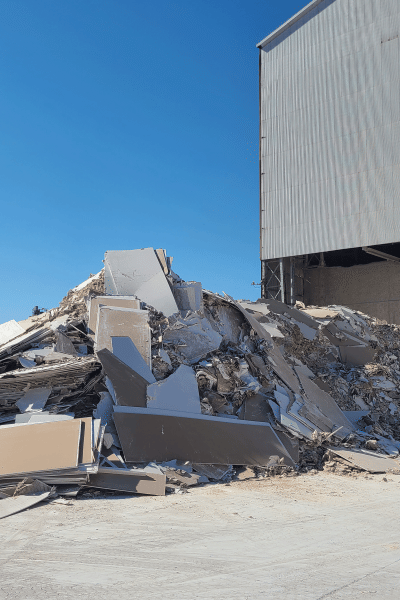
- Gypsum waste and reclaim at manufacturing is part of closing the loop on manufacturing waste and returning material to the process. Photo courtesy of USG Corporation
Five years ago an Environmental Product Declaration (EPD) was a unique differentiator. “Today it’s become more of a baseline expectation, and in some jurisdictions a compliance requirement,” Simpson says. Design teams now feed EPDs into whole-building life cycle assessments and use Health Product Declarations (HPD) and Declare Labels for chemical avoidance—screening out PVC, Red List chemicals, and PFAS.
USG made its transparency investment early, publishing EPDs since 2013 and HPDs since 2014. Today roughly 90% of USG products—1,248 product models—carry an EPD, and approximately 87% have an HPD or Declare Label. That depth has practical consequences. Simpson describes a longtime customer advancing healthier building practices who requires chemical disclosure down to 100 parts per million to screen out flame retardants, antimicrobials, and PFAS. With more than 1,000 CDPH 01350 (low VOC emitting)-compliant product models carrying Declare Labels, USG could support the work readily.
To make the documentation easily searchable, USG partnered with EcoMedes to power the USG Sustainability Tool, putting every certification in one place. “It’s so much easier for project teams to go there rather than having to search the internet,” Simpson says. It complements a broader partnership portfolio: verified science-based targets through SBTi—USG is one of only a handful of building material manufacturers with them—alongside founding membership in USGBC and work with the International WELL Building Institute and ILFI.
Making the Case on Total Cost
For building professionals facing budget pressure or skeptical stakeholders when pitching sustainable or resilient products with potentially higher upfront costs, Simpson’s advice is to change the frame. “The most practical starting point is to reframe the conversation around total cost and total risk, not just upfront material cost,” she says. “A more resilient, durable product may cost more at specification, but when you account for reduced maintenance, fewer replacements, and lower life cycle emissions, the value case becomes much stronger.”
At a minimum she says project teams should be asking manufacturers three questions: Do you have EPDs and HPDs for your products? Do your products have documented performance in the climate conditions relevant to this project? Can you help us meet the specific code requirements we’re working towards?
Looking out five to 10 years, as insurance markets, codes, and climate stress converge on the built environment, Simpson believes the industry is underestimating one thing above all. “The speed at which the convergence will move from voluntary to mandatory, and the degree to which transparency will be the price of entry,” she says. Sustainability credentials and resilience performance will increasingly need verified data and independent certification behind them.
The manufacturers who lead will be the ones who were doing the work before it was required, Simpson says. USG has used 100% recycled paper on its wallboard for roughly 60 years, invented lightweight drywall, and recovered and reintegrated materials across its manufacturing network for decades. “That legacy is not a marketing claim; it’s a track record,” Simpson says. “The project teams that partner with manufacturers who can demonstrate that kind of depth will be the ones best positioned for what is coming.”