Story at a glance:
- An expert at HKS shares his thoughts on the realities of regenerative design in industry conversations.
- Rather than simply minimizing harm, regenerative design asks how buildings can create positive value.
- Regenerative design focuses on creating tangible benefits in the places we love.
In recent years the design and construction industry has seen a subtle shift from the familiar language of sustainability to a new, sexier term of choice: regenerative design.
As a result of this shift firms across the industry are racing to position themselves as leaders in what is suddenly treated as an emerging field. Twenty years into my career as a sustainably minded architect, I recently joined HKS, a well-established global firm, with a job title that had never existed before—regenerative designer. But what is regenerative design, and what does this shift mean?
Over the past 25 years increasingly progressive building performance codes and frameworks like LEED have made sustainability a shorthand that most designers and builders implicitly understand for the most part. An energy model here, a green roof there, some bike racks, low-VOC paints, and low-flow fixtures, and you have more or less fulfilled your obligation. However, “sustainability” as a banner or a call to arms has failed to inspire. As the old conference joke goes, if someone asks how your marriage is and you answer sustainable, you are probably in trouble.
Regenerative design, by contrast, with its focus on net-positive outcomes, feels ambitious, optimistic, and just mysterious enough to capture people’s imagination. It has quickly become the industry’s new buzzword, but is regenerative design a new paradigm or just clever rebranding? Here are some thoughts from a practicing regenerative designer.
From Reducing Harm to Creating Abundance
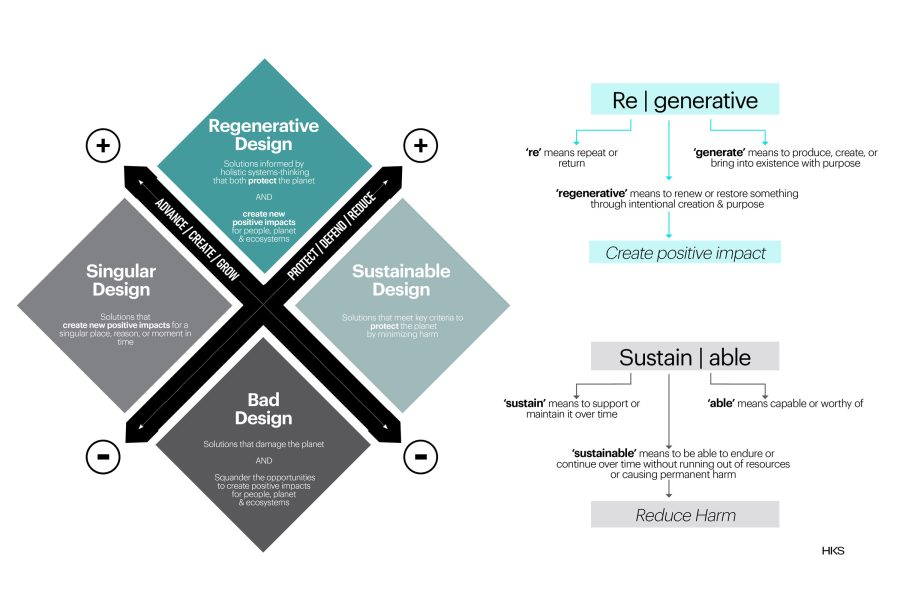
Sustainable design has traditionally focused on minimizing the harmful impacts of construction through reduction: less energy, less water, less carbon, fewer toxic materials, and so on. While necessary, this language of restraint can be difficult to rally around. For building owners sustainability has been framed around responsibility and sacrifice—what you must give up rather than what you stand to gain.
Regenerative design flips that equation. Rather than simply minimizing harm, regenerative design asks how buildings can create positive value. Net-positive energy, water, and ecological strategies demonstrate that responsible design does not have to mean austerity. It can mean vitality, abundance, and opportunity. That is a far more compelling vision for people to get behind.
From Global Responsibility to Creating Local Impact
Graphic courtesy of HKS
Sustainability often focuses on architecture’s contribution to addressing global issues. We are told that buildings account for 20% of potable water use and roughly 40% of total carbon emissions. We are told how the extraction and manufacture of construction materials negatively impact global health and so on. While true and alarming, those statistics can also feel abstract and distant. Consequently, the impact of any single project seems like a drop in the ocean, making it difficult to see how local action meaningfully moves the needle on global challenges.
Regenerative design re-scales this conversation, bringing it back to the specific places we love and have the greatest ability to influence. It focuses on creating tangible benefits where we are, by eliminating utility bills, improving access to clean air and water, providing habitat for birds, bees and butterflies, and growing local food that supports community health. These outcomes are not theoretical. They are immediate, visible, and directly beneficial to the places we work and the people we care about.
From Prescriptive Checklists to Actual Performance
Another notable difference between traditional sustainability framing and regenerative design is the approach to “proving it.” For the generation that grew up with LEED, “proving it” meant designing to meet the prescriptive requirements of the third-party vetted checklist. Rigorous research from savvy experts created metrics that defined the thresholds architects and engineers designed to meet. The operative word here is “designed.” If you could design to the prescriptive requirements on paper, you got the credit and the story ended. There was no focus on whether the projects performed as drawn or modeled. As a result many designers and project teams looked for the easiest path to compliance, often without considering if their design decisions resulted in meaningful impact.
The focus is not on the intent, but on outcomes.
Regenerative design changes the definition of proving it to be about performance in the real world. To claim that a project is regenerative, it must demonstrate that it produces net-positive impacts. The focus is not on the intent, but on outcomes: Does the project produce more clean energy than it consumes? Does it close water loops? Does it protect habitat and restore ecology? As a result, due to their rigor, it’s simpler to separate truly regenerative projects from those that choose the path of least resistance.
All in all, when people ask me if regenerative design is just “sustainability on steroids,” I can honestly answer that it is not. In my experience regenerative design represents a fundamentally different approach—one that is less concerned with what architecture should do and more interested in what architecture can do. Concepts like net-positive energy, water, or carbon can feel overly technical, abstract, or unrealistic. However, when applied specifically to the places and people we care most about, regenerative design shifts the conversation to what we love and what is worth fighting for. It creates a new framework for impact that goes beyond doing less harm to something that truly connects and resonates with people.