Story at a glance:
- Ballston Duplex introduces missing-middle housing to a single-family-zoned neighborhood in Arlington by replacing one home with two thoughtfully designed residences.
- The project uses a stepped massing strategy to balance increased density with neighborhood context while delivering modern, light-filled living spaces.
- Designed for net-zero readiness, the homes achieve LEED Gold (Platinum pending) and multiple high-performance certifications that support long-term sustainability.
In Arlington, Virginia, where zoning has long prioritized single-family homes, the Ballston Duplex offers a compelling alternative. Designed by Teass \ Warren Architects, the project transforms a site once limited to one residence into two high-performance homes, demonstrating how thoughtful infill can address housing demand, sustainability, and neighborhood context at once.
Completed in March 2024, the 6,416-square-foot duplex sits on a 0.19-acre lot in the Ballston neighborhood. By introducing two units where only one would typically be allowed, the project embodies the concept of “missing middle” housing, a growing movement aimed at increasing density through smaller-scale, context-sensitive development. “The only thing you could put there by right was a single-family house,” says Charles Warren, principal at Teass \ Warren Architects. “But there was a special exception that allowed for two units, which we thought made a lot of sense given the location.”
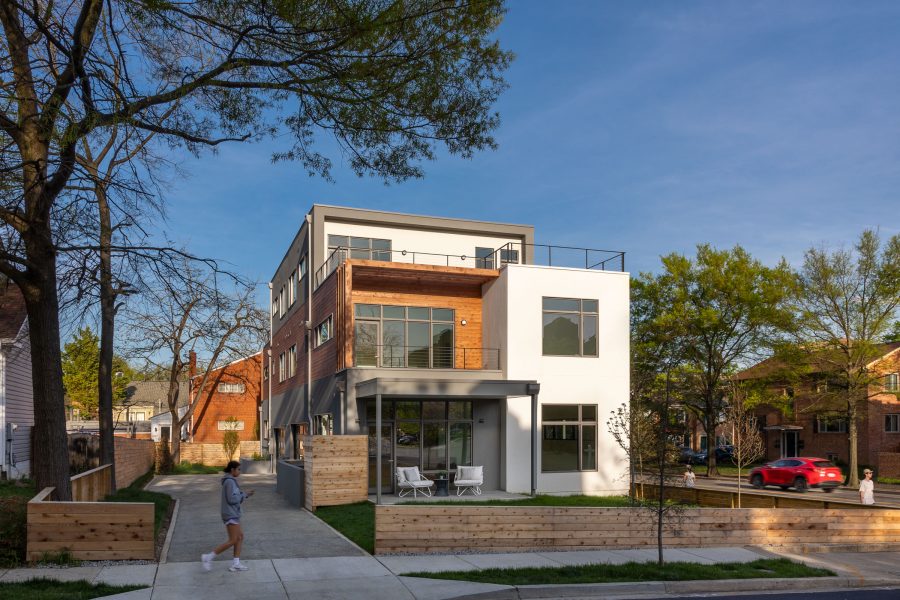
A stepped massing strategy concentrates height at the center of the building while transitioning down toward the surrounding residential neighborhood. Photo by Kate Wichlinski, courtesy of Teass \ Warren Architects
That location is central to the project’s rationale. “It was a great opportunity to add density in a place that already supports it,” Warren says.
Situated within walking distance of the Ballston Metro and multiple transit options, the site lends itself to a more compact, transit-oriented form of development. At the same time it occupies a challenging position between the high-traffic Washington Boulevard and a quieter residential neighborhood, requiring a design that can respond to both conditions.
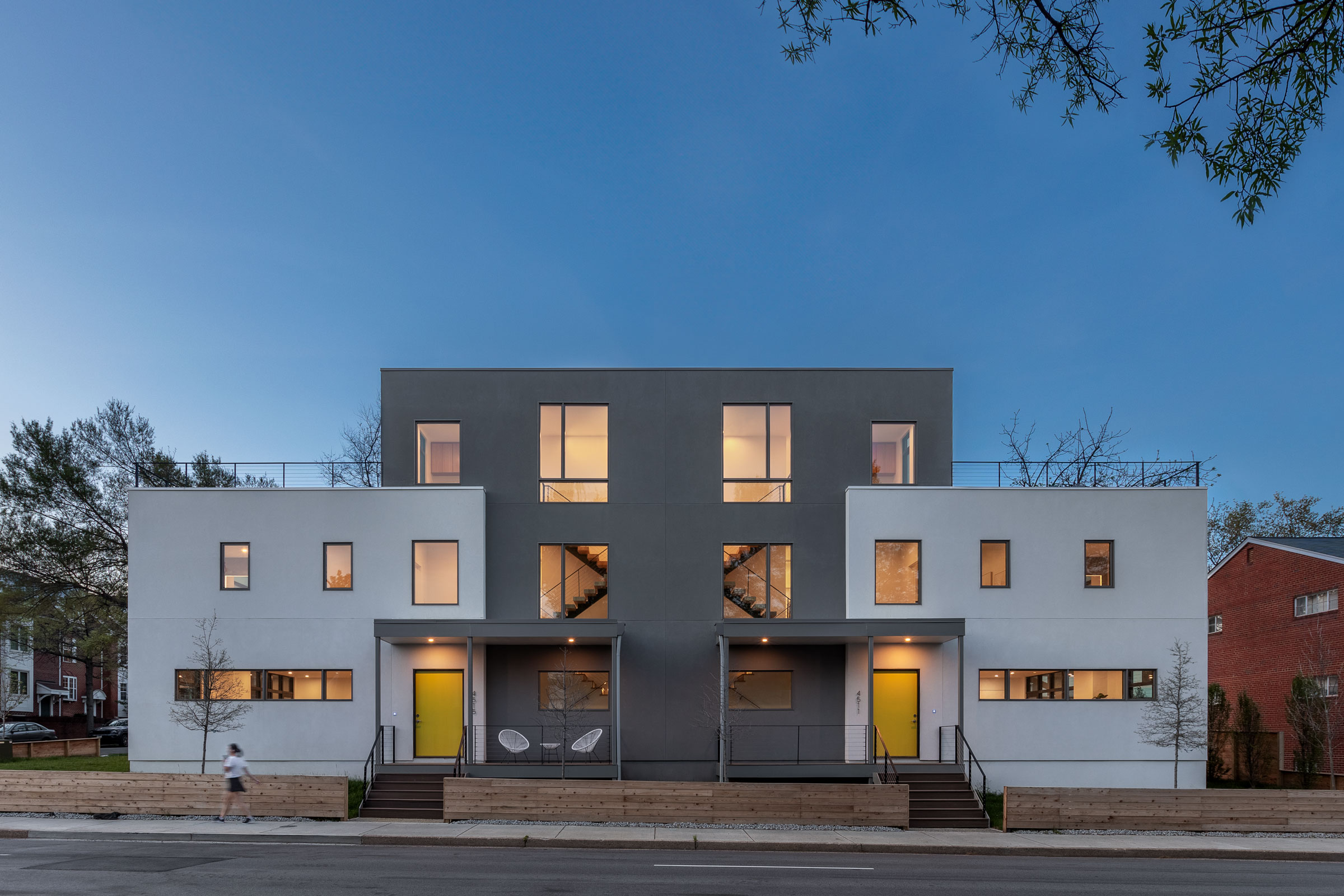
To navigate this duality, the architects developed a massing strategy that concentrated the building’s height at its center and gradually steps it down toward the neighborhood. A three-story volume anchors the project along the boulevard, while two-story and one-story elements transition the scale toward the adjacent homes. “We concentrate the massing in the middle and step it down as it approaches the neighborhood,” Warren says. “It’s about responding to both the busy corridor and the quieter residential context.”
The result is a building that reads differently depending on vantage point. Along Washington Boulevard it presents a more solid, urban edge. From the residential side it softens in scale and materiality, reinforcing its connection to the surrounding homes.
The project balances modern design with traditional elements, helping it integrate into an established neighborhood while advancing sustainable urban infill. Photo by Kate Wichlinski, courtesy of Teass \ Warren Architects
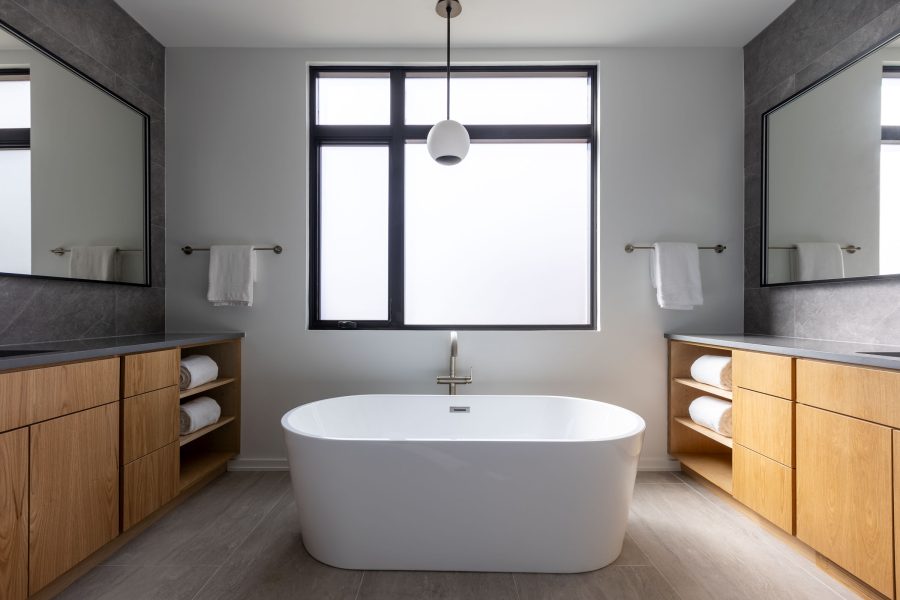
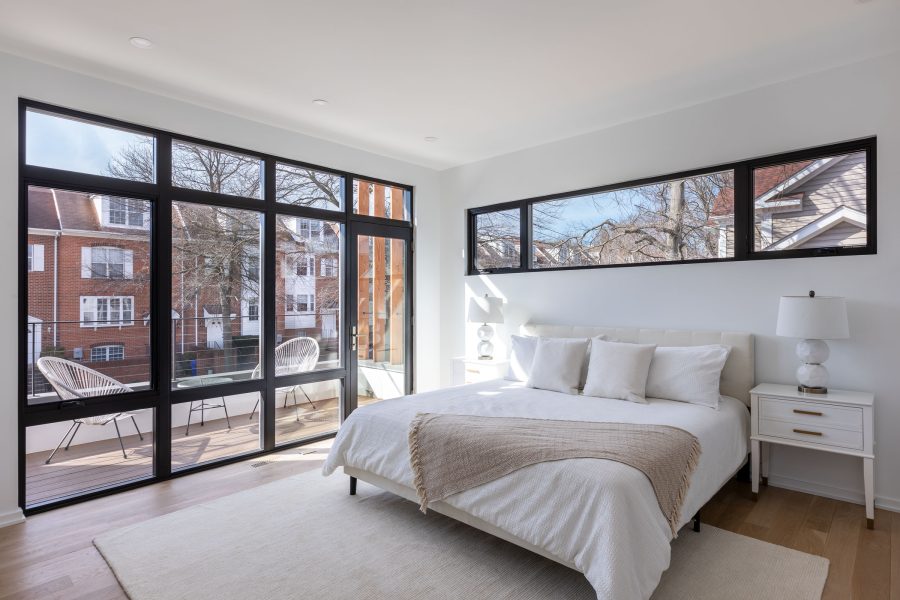
Large windows and open layouts create light-filled interiors that prioritize livability within a compact urban footprint. Photo by Kate Wichlinski, courtesy of Teass \ Warren Architects
While the design is distinctly modern, it draws from traditional elements to create a sense of familiarity. Proportions, porches, and material transitions help integrate the structure into its context, while clean lines and expansive glazing establish a contemporary identity. Inside, the homes are designed to maximize natural light and livability, with open layouts and carefully planned spatial relationships.
Outdoor space is reimagined as well. Instead of traditional rear yards, the project incorporates roof decks, offering elevated areas for entertaining and relaxation while making efficient use of the site. “We had to rethink how outdoor space works on a site like this,” Warren says. “The roof decks give residents usable space without sacrificing density.”
Off-street parking and two-car garages meet zoning requirements without detracting from the overall design intent.
Sustainability plays a central role in the project’s design as well. “We’re net-zero ready,” Warren says. “The homes are prepped for solar, so once the panels are installed, they can achieve net-zero performance.”
-
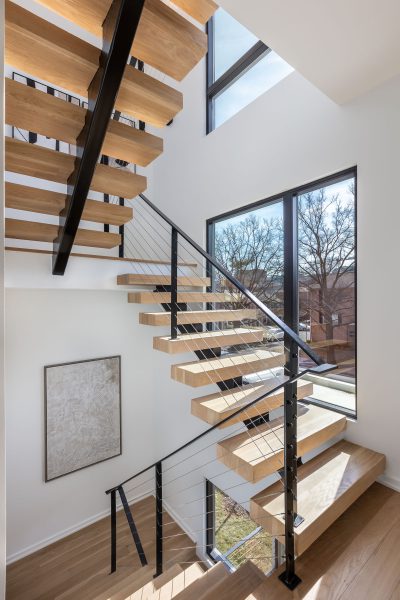
- Photo by Kate Wichlinski, courtesy of Teass Warren Architects
-
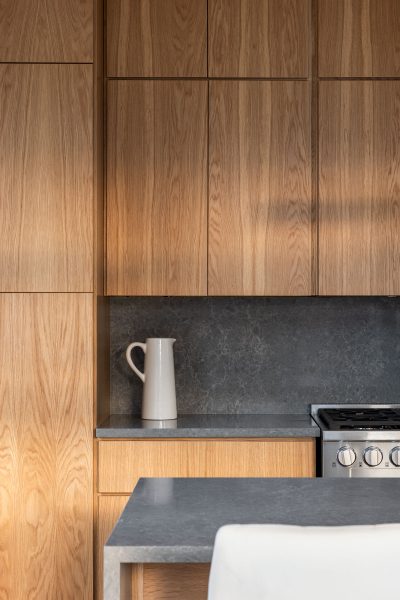
- Photo by Kate Wichlinski, courtesy of Teass Warren Architects
The project has already achieved LEED for Homes Gold certification, with Platinum pending, along with Arlington Green Choice Silver, ENERGY STAR certification, EPA Indoor airPLUS designation, and DOE Zero Energy Ready Home status.
A range of strategies supports these certifications, including a high-performance building envelope, energy-efficient mechanical systems, heat pump water heaters, and ENERGY STAR appliances. Together these features contribute to a HERS Index of 45, positioning the homes well below typical energy consumption levels. “We were really looking at it holistically—how all the systems work together to get us to that net-zero-ready target,” Warren says. “Indoor air quality was also a big component of it. Air sealing and indoor air quality were areas we had to be really careful about to meet our performance goals.”
Rather than simply layering on sustainable features, the design team took a strategic, data-driven approach to performance. By analyzing cost and energy savings, the team identified which systems delivered the greatest impact. “There are combinations of systems that give much more bang for your buck,” Warren says. “Some things you’d expect to be beneficial—like triple-glazed windows—don’t make sense in our climate when you look at the payback period.”
This approach ensures sustainability is both effective and economically viable, an increasingly important consideration as high-performance design becomes more mainstream.
While the finished project is straightforward in its execution, getting there proves far more complex. The duplex required a 4.1 Site Plan approval, a process that involves extensive community engagement and coordination with local stakeholders. “It takes about two years to get through the zoning entitlement process,” Warren says.
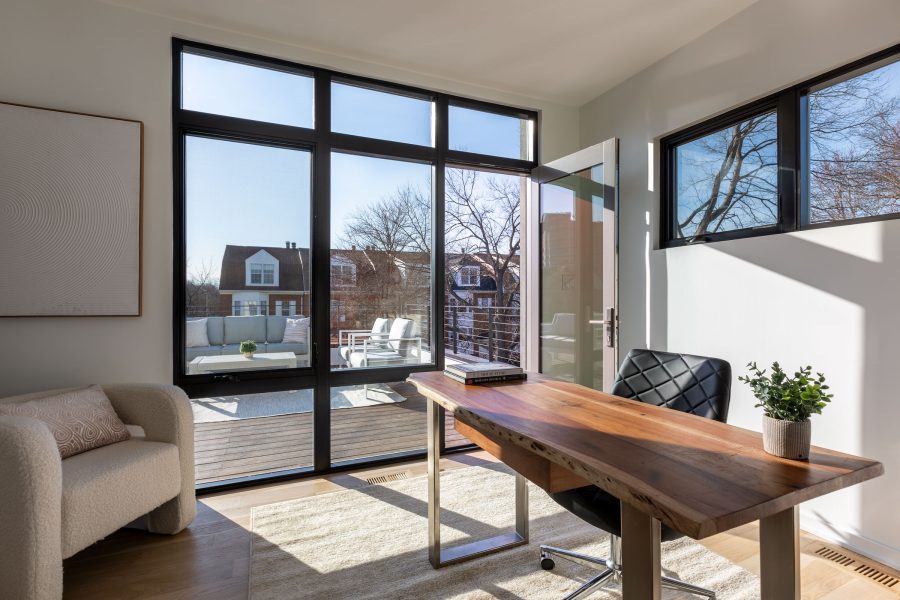
Roof decks replace traditional rear yards, offering functional outdoor space while maximizing density on the site. Photo by Kate Wichlinski, courtesy of Teass \ Warren Architects
Approved in May 2021 after months of consultation, the project highlights the challenges of introducing new housing typologies into established neighborhoods. At the same time it underscores the potential for these projects to serve as catalysts for broader change.
By delivering two attainable housing units in a location previously limited to a single home the Ballston Duplex demonstrates how incremental density can expand housing options without dramatically altering neighborhood character.
Its proximity to transit and walkable amenities further enhances its impact, reducing reliance on private vehicles and supporting a more sustainable urban lifestyle.
For Warren and his team, the project also offers valuable lessons for future work. Bringing energy consultants into the process earlier, for example, allowed for more informed decision-making and better integration of performance strategies from the outset.
Ultimately the Ballston Duplex reflected a broader shift in how residential development is approached. Rather than prioritizing maximum size or exclusivity, it focused on efficiency, adaptability, and environmental responsibility.
As cities across the country continue to grapple with housing shortages and climate challenges, projects like this suggest a path forward—one that embraces density in a measured, context-sensitive way while delivering high-performance, livable spaces. “Projects like this show that you can increase density in a way that still respects the neighborhood,” Warren says.