


The Build Ahead 2027 · Question 04 / 10 · Partner perspective
With
 Phil GoodinManaging Director, Autex Acoustics North America
Having recycled content in your product—even having a lot of recycled content—is no longer good enough in 2027. That’s according to Phil Goodin, managing director of Autex Acoustics North America. The industry has gone from asking “Is there recycled content?” in a product to “How much recycled content?” he says.
One big challenge is recovering products after they leave the factory. Autex aims to pilot approaches to product recovery in North America heading into 2027, and its roadmap calls for a globally available takeback scheme for interior acoustic products by 2030.
Manufacturer takeback programs are great when they work, Goodin says. “Two of our products—one in Australia and one in New Zealand—have formal takeback schemes where we turn old products into new panels,” he says. ASL Reclaim is made from uncontaminated Acoustic Soffit Liner (ASL) offcuts and used panels returned through the company’s ASL takeback program in Australia and fed directly back into manufacturing. Each panel has a unique appearance while maintaining full acoustic and thermal performance. In New Zealand ReForm panels are made from more than 90% reclaimed PET from Autex’s own manufacturing waste and key industry partners’ offcuts.
“In the larger markets there’s obviously a geographical challenge of trying to sort that out,” Goodin says. Autex’s California pilot takeback program explores opportunities to scale up in the US. “You need recycling in every state to make that work,” he says. The California pilot is “a little test to see how we can challenge the industry to figure out solutions so we have more places where we can do this kind of stuff.”
If you want to be specified, you should have a closed loop option for your product.
Phil Goodin, Autex Acoustics North America managing director
Goodin acknowledges a need for more robust recycling infrastructure in many places across the US, as a lot of products reportedly “can” be recycled, but that doesn’t mean they will be, as you can’t send just anything to your area recycling center. “If somebody has plastic, a plastic recycler knows what to do with it, but you spread that across fiberglass and other products, and it’s challenging to find ways to recycle a lot of it. That’s where you have to put in the work to find how you’re going to deal with your waste stream.”
Any serious manufacturer wanting to do good for the environment and succeed as a business needs to move toward closed loop options if they aren’t already, Goodin says. “If you’re complacent and give a general statement like ‘can be recycled,’ you’re not going to be a trusted player in the market. If you want to be specified, you should have a closed loop option for your product.”
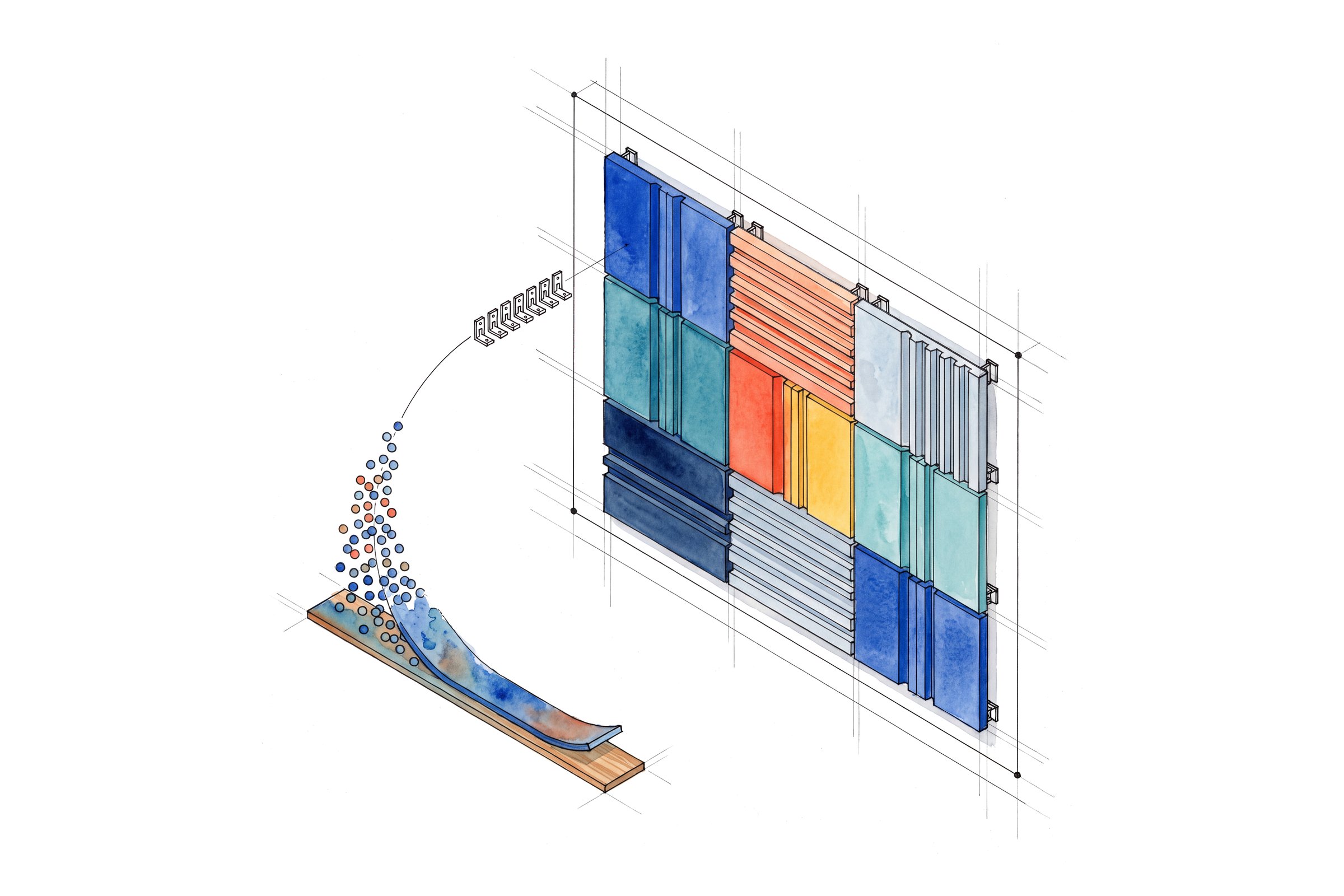
Goodin expects designers will start demanding more closed loop solutions, too, eventually only specifying those types of products to ensure they can easily be recycled. Autex has built design for disassembly into its product development, so new products are designed with end of life in mind, and the company aims to have 100% of its portfolio designed for disassembly by 2030. “Can this be easily assembled, easily installed, have parts separated, and then go through their own recycling channel?” he says they ask of each new design. “That’s how we make our SpinFix wall mounts and our hardware for our ceiling systems. We make them out of our own recycled waste.” SpinFix is an adhesive-free, clip-on, clip-off mounting system. Its 100% recycled PET clips are friction-welded to the back of the panel, so acoustic panels can be easily affixed to walls, removed, and recycled, without adhesive contamination.
While the recycling road ahead in the US is challenging, Goodin says it can be done. “It’d be really interesting to look at finding recycling partners in each market and seeing what they can do now.” The current machinery available is quite limiting, he says. That’s why Autex says they invented the first-ever PET fiber pelletizer designed specifically for acoustic textiles, so they can handle their own waste, converting factory offcuts and end-of-life products into RePET pellets used to make new components, including mounting hardware. The company says more than 250,000 kilograms of material have been repurposed through the process since the technology launched in 2022.
In 2024 Autex brought its pelletization technology from its home base in New Zealand to the US. “Fibers and panels are quite fibrous, and they can tangle the machines. That’s why we invented our own machines. Now we can use our own manufacturing waste. We feed it through and it slices and dices, and the product is carried out the other end and used for our own hardware. It’s fully circular. The next step will be bringing product back from customers.”
Large design firms like Gensler have their own approved product lists in which manufacturers have to submit third-party verified information about what’s in a product, Goodin says. Gensler’s Product Sustainability Standards established sustainability performance criteria for the top 18 most commonly used, high-impact product categories in their projects, everything from acoustic ceiling panels to carpet tile to gypsum board and, in their most recent update, access flooring. “I think we’ll ultimately see that every product category needs to meet their criteria,” Goodin says.
As design firms continue to set up their own material databases with detailed needs, he expects the industry to continue to rise to meet them. “One of the good things about Autex is we’ve always challenged the status quo. We used to have 45% recycled content in Cube™, the base material for most of our products, and then we went to 60%, and then we went to 80%. And this was always a minimum. There’s a lot of greenwashing in the industry; someone can say, ‘Our product has up to 60% recycled content,’ so that could be 1% or it could be 59%. As material disclosures are forced by design firms as they update their own approved product catalogs, it will start to move the industry and it will lead to higher recycled content overall.”
Indeed, he says the market is moving beyond the relatively simple question of “How much recycled content does this product contain?” toward questions like: Can it be disassembled? Can individual components be separated? Can the manufacturer take it back? Can the material actually enter a verified recycling stream? And what happens after the first installation?
That shift is consistent with the direction of federal procurement and product data initiatives. An EPA label program (Criteria for Product Category Rules to Support the Label Program for Low Embodied Carbon Construction Materials), for example, is designed around standardized, verifiable product information rather than broad sustainability claims, according to the EPA. Its criteria began requiring more rigorous data practices in 2026.
Goodin says he’s fascinated to see how the industry will continue to evolve in 2027. “In some of the other markets we operate in, it’s sustainability first and sustainability only. In America it’s still pockets of people who care enough to make decisions based on a company’s sustainability policy, but those pockets are growing. I think it’ll keep evolving and, from Autex’s point of view, we hope everyone catches up. We challenge the industry to come up with their own solutions. One company or a handful of companies doing it in America is not really going to move the needle. We must challenge each other to do better as manufacturers.”
