Story at a glance:
- City sustainability officials and building and design professionals share how Portland, Maine, is one of the country’s most sustainable cities.
- Read more about the inspiring, sustainable projects happening in Portland, including ongoing development at Old Port Square, the Longfellow Hotel, the Portland Museum of Art expansion, and the Riverton Trolley Bike Park.
Coastal views and access to nature combine with pedestrian-friendly streets home to great restaurants and bars, plus rich history, art, and architecture in Portland, Maine. People from all over find themselves drawn to this colorful, creative city on the Casco Bay—both as tourists and as transplants.
Portland may be home to just 70,000 residents, but its amenities make it feel like so much more. “Portland really punches above its weight in terms of urban feel,” says Troy Moon, sustainability director for the city. “We have a lot of cultural opportunities. There’s a really great music scene here now. There’s a really solid art scene. The restaurants, of course, are world-class.”
Portland really punches above its weight.
A commitment to nature is evident in everything the city does, too, from new developments to historic preservation to planning for the future of the waterfront. In every discussion the environment seems to come first, and the people benefit as a result.
“People have deep respect for the environment in Portland,” Moon says. “A lot of the things we do in terms of environmental policy are all about protecting the bay. We have robust stormwater requirements, and we really have an environmental ethic here, which helps contribute to the quality of life and the desire for people from other parts of the world to visit us. We’re really blessed; those environmental attributes make this a nice place to live.”
Design for Walkability
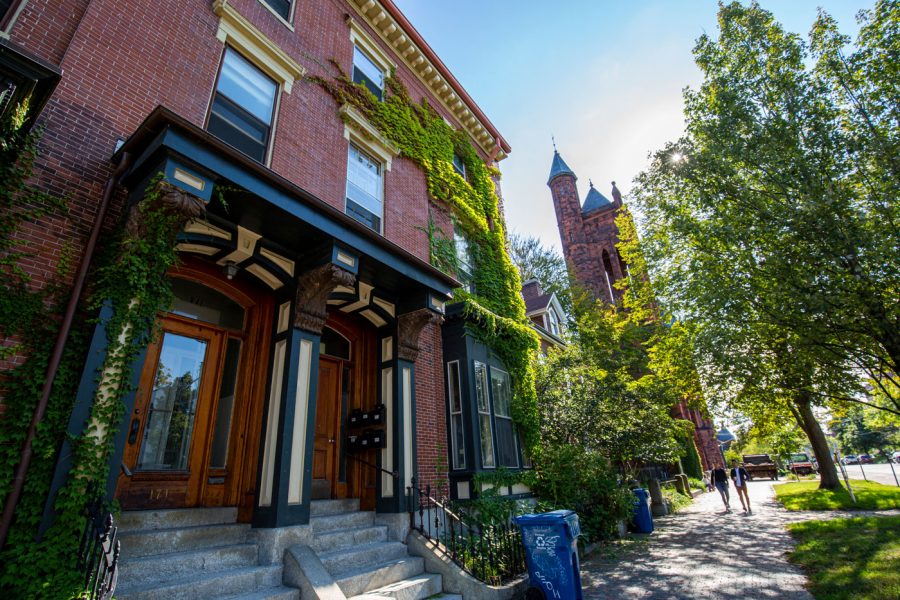
Portland is known for its walkable streets with historic, ivy-covered brick homes. Visitors can choose from guided or self-guided walking tours, including from the Maine Historical Society. Photo by Serena Folding, courtesy of Visit Portland
The city recently updated its Land Use Codes, removing parking minimums and adding parking maximums, plus providing opportunities for more density in buildings in Transit Oriented Development zones. “Like many other communities we’ve seen across the country, we eliminated parking minimums,” says Kevin Kraft, director of planning and urban development in Portland. “We require parking nowhere in the city, but we have parking maximums. We put an upper limit on the amount of parking spaces you can provide on a site.”
The measure was widely supported and built on a 2020 regulation that said if a site was within a quarter-mile of a bus route, it did not have to provide parking. “That was almost 80% of the city’s land already, so it wasn’t a huge jump,” Kraft says. He says the city wants developers to provide parking based on true market demand, not a future or worst-case scenario.
Parking was a key talking point in the city’s Climate Action Plan, too, Moon says. “We want people to get around the city without driving in cars. We’re seeing more and more people coming into Portland who may be from other parts of the country and maybe don’t feel the need to have a car.”
More housing in Transit Oriented Development Zones—highly walkable areas with access to public transportation—made good sense, Moon says. “It’s part of building that sustainable lifestyle into our codes and regulations.”
A Net Zero Future
Photo by Serena Folding, courtesy of Visit Portland
When it comes to new buildings, material choices also have a sustainable focus, Kraft says. Portland passed a bird-safe buildings ordinance in 2024. “The purpose of the Bird Friendly Building and Design Requirements … is to reduce bird mortality from windows or other specific building features known to increase the risk of bird collisions,” reads the City Council minutes. “For non-residential buildings, larger mixed-use buildings or commercial buildings, they have to require bird-safe glass,” Kraft says. “The new project that the Roux Institute is constructing along the waterfront is going to include all bird-safe glass. We approved the tallest building in northern New England in December. It’s over 30 stories tall. That building will be designed with fully bird-safe glass.”
Five years ago the cities of Portland and South Portland joined forces to create and adopt their Climate Action Plan called One Climate Future. They are working to reduce community-wide greenhouse gas emissions by 80% by 2050 and use 100% clean energy for municipal operations by 2040, among other goals. So far the cities have installed 50 EV chargers; generated more than 63 million kWh of solar power, saving more than $5 million; and adopted the state’s first Energy Stretch Code, improving the efficiency of new buildings by 30 to 35%. In Portland part of building better included creating those Transit Oriented Zones. They also enhanced stormwater and heat mitigation requirements. All newly constructed or gut-rehabbed city buildings in Portland were required to be net zero energy or net zero energy–ready starting in 2026.
Moon grew up in Maine and has lived in Portland for 30 years. He says the city has a long history of passing policies that meet high environmental standards. “People have really come to expect that here,” he says.
Those policies protect plentiful green spaces—nearly 1,500 acres of dedicated outdoor open space and almost 50 miles of diverse trails, for example. “That includes everything from traditional manicured parks to forested areas and urban meadows we’ve established recently to promote a different approach to managing open space so we can have more habitat for pollinators,” Moon says.
The city has “probably the most comprehensive restrictions on pesticide and fertilizer use in the country,” he says, and works to prevent stormwater runoff into the bay that the local economy—from fishing to tourism—relies on.
Planning Resiliency
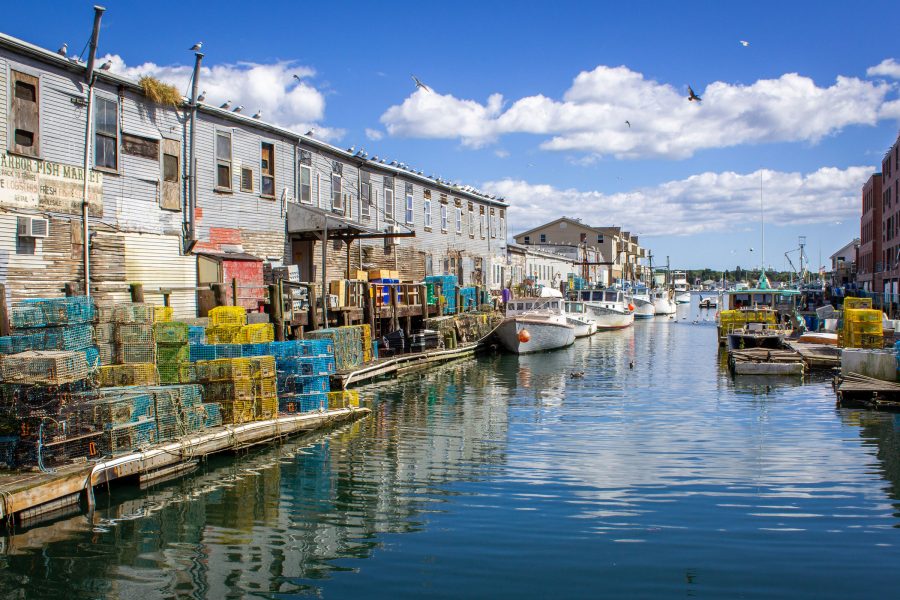
Portland, Maine, boasts more than 350 years of shipping, fishing, commerce, and travel on the waterfront, combining private and public piers for a full range of commercial marine activities. Photo by Serena Folding, courtesy of Visit Portland
Building and community resilience were other big parts of the Climate Action Plan, especially given the city’s location on the water. “A lot of communities, including us, are thinking about resilient infrastructure. How do we get seawalls and roads and bridges prepared for the impacts of climate change?” Moon says.
Part of the Land Use Code rewrite included creating a new zone—the Coastal Flood Resilience Overlay Zone, Kraft says. The city looked at areas where they anticipate sea level rise impact and enacted regulations to limit what can be allowed on a building’s ground floor. “In some areas where we anticipate flooding, say five feet, the building’s first floor needs to be elevated above that point or you can’t have critical uses on the first floor.”
The city participated in developing a new flood model even before the Coastal Flood Resilience Overlay Zone. “Typically the older models either use a FEMA-based map or pick a sea level rise elevation and draw a bathtub-type line around where the height is,” Moon says. Portland uses a hydrodynamic model that incorporates many elements to figure out where flooding will occur. “We based it on 3.9 feet of sea level rise, plus a 100-year storm. So 3.9 feet of sea level rise is what we anticipate by 2100, and then add the 100-year storm on top of that.”
He says impending sea level rise is the city’s biggest challenge, and the city plans to focus on that problem heavily in the next two to three years. “We’re a coastal community getting ready to figure out what we’re going to do to prepare,” Moon says. A recent storm brought the highest tide ever recorded, with water rising to the edge, and in some places over, the popular downtown Commercial Street. Community conversations will center around what infrastructure interventions to consider and what additional changes need to be made to the Climate Action Plan.
Social resilience also makes communities stronger in times of need, Moon says, and Portland is committed to focusing there, too. “Looking at examples over time in communities that have faced disasters, research has shown that those places where people have strong social networks recover more quickly. We’re trying to use that model to engage our community in really positive ways and get people to work together,” he says.
A new program called Sustainable Neighborhoods creates opportunities for neighbors in different parts of the city to get to know each other and develop relationships that will make them more socially resilient, Moon says. As part of that, a mini grant program recently awarded up to $500 to 30 neighborhood groups with at least three people working together to propose an activity involving different neighbors. The groups did everything from host a community dinner to a pet parade to gardening activities.
While challenges lie ahead, this ongoing work is full of exciting opportunities from a planning perspective, Kraft says. “It’s a very rural state, so it’s still very car-dependent. We don’t have the same robust public transit as Boston or Chicago. But Portland being an urban center and having a good bus network—how do we continue to have smart, sustainable growth to help encourage that uptick in public transit ridership or walkability?”