Story at a glance:
- Architects are challenged with incorporating new housing, parks, and public spaces within the dense built environments of existing cities.
- Projects like the Wild Mile and the High Line show two approaches to urban infrastructure that also build community and connectivity.
Across the US much of our urban infrastructure—from bridges to highways to bus shelters—needs to be upgraded or replaced. Our cities rely on aging systems that are straining to meet today’s challenges, like easing commutes and mitigating extreme heat. It’s easy to think that these infrastructural challenges require large-scale solutions that will take decades to implement. But sometimes the big idea is a small intervention, and that small intervention can make a big impact.
Can a bridge originally built for cars, for instance, be reconfigured to accommodate bike lanes, pedestrians, green spaces, and wildlife corridors?
As architects and urban designers we believe in the importance of working at every scale. While our projects in developing regions often present the opportunity for grand urban visions, more often the greater challenge today is to incorporate new housing, parks, and public spaces within the dense built environment of existing cities. This work often calls for strategic, surgical interventions, working site-by-site to create a cumulative positive impact that can ultimately be felt at the scale of the city.
In the past most urban infrastructure was designed to address a single problem; today we see an opportunity to address multiple goals in every project. Can a bridge originally built for cars, for instance, be reconfigured to accommodate bike lanes, pedestrians, green spaces, and wildlife corridors? By reengineering our cities we can create the conditions for shared prosperity, flourishing natural systems, and enhanced quality of life.
Rewilding Urban Waterways


In my home city the Chicago River was originally a network of wetlands until, about 150 years ago, it was reshaped to serve industrial production and distribution. Steel mills, lumber yards, and factories built along the banks altered the river’s ecology and heavily polluted the waterway with waste and runoff.
It’s a problem that’s impacted many cities throughout the country. Our work with the city and Urban Rivers, a nonprofit dedicated to cleaning Chicago’s rivers and restoring natural ecosystems, demonstrates how new infrastructure can fulfill various needs at once. Residents on Chicago’s North Side called for public access to the river, requesting safe, accessible routes linked to citywide greenways as well as opportunities to support public education and recreation.
The result is the Wild Mile, a floating eco-park that establishes a home for wildlife and reclaims this section of the river’s North Branch as a civic space. The project began in small steps. In 2021 we installed a 400-foot-long garden with kayak docks, boardwalks, bike paths, and habitat zones supporting both people and wildlife—restoring the wetlands that historically thrived along the river’s banks. This relatively small-scale intervention was a proof-of-concept for a system of biophilic infrastructure that could eventually be deployed at key locations along the waterfront.
In contrast to today’s hardened edges and seawalls, the Wild Mile’s floating infrastructure, with plant roots extending underneath, reintroduces the gradual transition between land and water that native species depend on. Since opening nearly 100 species of birds and 70-plus species of fish have been spotted by the River Rangers, a volunteer-based initiative that collects data on the evolving ecosystem. Throughout the year students visit the park to learn from scientists about habitat restoration.
An additional 300 linear feet opened in 2024, and as funding grows the park will reach its mile-long goal. For cities throughout the country it serves as a replicable and scalable model, proving that nature and aquatic infrastructure can thrive in a dense urban setting.
Transforming Two Pivotal Blocks
In a city praised for its walkability, one crowded intersection of Manhattan had long presented a tangle of obstacles. To get from Pennsylvania Station, the Western Hemisphere’s busiest transit hub, to the High Line—a former elevated rail line transformed into a park—pedestrians had to traverse highly trafficked roads, the congested entrance to the Lincoln Tunnel, and a staircase to the High Line.
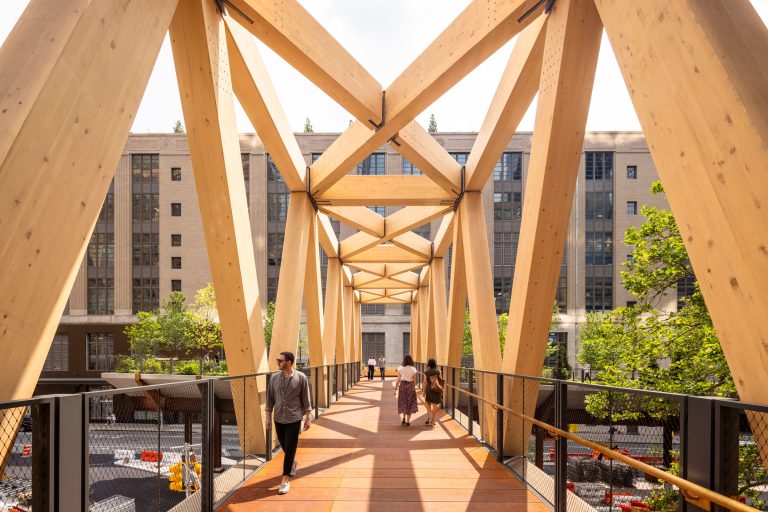
New York State, Friends of the High Line, and Brookfield Properties had a vision to provide safer, more enjoyable pedestrian access. Working with Field Operations, SOM created the Connector: a 600-foot-long, elevated walkway linking the station and its new concourse at Moynihan Train Hall with the High Line.
The Connector is composed of two pedestrian bridges. The first bridge, built of mass timber, provides an inviting passageway above the traffic emerging from the tunnel. The second bridge, lined with trees, introduces the immersive landscape of the High Line. Deep and continuous soil beds built into the structure support these trees, which were selected to attract birds and native pollinators while shading pedestrians as they enter the park.
SOM engineered both bridges to minimize connections to the ground, allowing traffic to continue uninterrupted. Above, thousands of visitors cross the Connector every day, including residents looking to spend a day on the High Line and commuters on their way to work—a significant impact for such a small structure. And the project demonstrates the viability of mass timber, a sustainable material, as an alternative to steel and concrete for bridge design.
Providing Comfort for Transit Riders

Los Angeles has an extensive bus transportation network, with one of the highest riderships in the nation. Yet, in 2022, only about a quarter of LA’s 8,000 bus stops provided any shade or shelter. Like many cities we work in, this is an increasingly urgent concern in a warming climate. An initiative by StreetsLA, a division of the city’s Department of Public Works, is dramatically improving this experience. Its Sidewalk and Transit Amenities Program, or STAP, is bringing 3,000 new and upgraded shelters and 450 shade structures to neighborhoods across the city, prioritizing communities with the greatest need through the city’s heat and equity indexes.
SOM, in collaboration with Designworks and Studio One Eleven, designed the shelters and shade structures as a kit of parts—flexible, scalable, and adaptable to each site and its existing infrastructure. An interchangeable set of elements, including a frame, canopy, modular seating, ad panel, smart lighting, back and side panels, and trash receptacle, allows for more than 170 configurations to address each community’s specific needs. Digital screens display bus tracking, public alert systems, and weather notifications that these bus stops hadn’t previously provided.
More than 400 bus shelters, developed by smart mobility operator Tranzito and transit advertising specialist Vector Media, have been built so far. They’ve offered essential protection from the sun, improved nighttime lighting, enhanced the streetscape, and provided valuable service announcements riders may not otherwise have access to. Easy to build and standing just 12 feet tall, the shelters demonstrate how we can deliver big city thinking through small interventions.
Like the Wild Mile and the Connector, the new bus shelters in LA demonstrate what’s possible when public agencies and the private sector work with designers to invest in civic infrastructure. Each of these three examples is different, but they all show us that city building is a collective act. An individual city agency, nonprofit institution, or private developer often cannot achieve these solutions on their own; building civic infrastructure requires strategic collaboration. By following the roadmap these projects provide, cities across the US can bring measurable improvements to the public realm.