Turning Ethical Supply Chains into Action

Story at a glance:

  • The fifth annual Design for Freedom Summit 2026 took place in Connecticut in March 2026.
  • The event brought together more than 550 leaders across architecture, construction, manufacturing, policy, and academia.
  • Ethical sourcing is beginning to move from the margins into mainstream practice.

Construction material supply chains are among the most complex and least understood systems in the built environment. Spanning multiple tiers, geographies, and intermediaries, they are typically opaque; obscuring where materials come from, how they are processed, and under what labor conditions.

While carbon and environmental performance have become increasingly measurable over the past two decades, ethical sourcing remains comparatively underdeveloped, lagging well behind in terms of data, standards, and market maturity.

This was the backdrop to the fifth annual Design for Freedom Summit at Grace Farms in Connecticut in March, where the focus was not on defining the problem, but on advancing solutions. Bringing together more than 550 leaders across architecture, construction, manufacturing, policy, and academia, the summit reflected a movement gaining traction. One that is beginning to translate awareness into action.

Over five years Design for Freedom has helped establish a shared language around forced labor in building materials while creating practical entry points for the industry—from research and pilot projects to cross-sector collaboration. What emerged this year was a clear sense of momentum: Ethical sourcing is beginning to move from the margins into mainstream practice.

Scaling Ethics: From Materials to Data Centers

Photo by Melani Lust, courtesy of Design for Freedom Summit

A defining theme was scale. As the rapid expansion of AI and digital infrastructure accelerates demand for materials, the complexity (and risk) embedded within global supply chains is intensifying. A panel on data centers explored how one of the fastest-growing sectors in the built environment can reconcile performance demands with responsible sourcing.

Initiatives like the iMasons Climate Accord point to how quickly this space is organizing, aligning owners, operators, and suppliers around carbon measurement and reduction. What is becoming clear is that the systems being developed to track embodied carbon and procurement can also serve as a foundation for greater supply chain transparency and accountability.

This shift is beginning to register across adjacent frameworks. Updates to the IWBI’s WELL Building Standard reflect a move toward a more flexible, performance-driven platform, emphasizing continuous monitoring and outcomes. In parallel, the International Living Future Institute is advancing this agenda through the development of Declare Equity; a new product-level label focused on human rights, fair labor, and social impact, bringing these considerations directly into material specification.

Together these developments signal a recalibration of building performance, expanding beyond operational and embodied carbon to include the supply chains and labor conditions embedded within materials.

Materials as Leverage

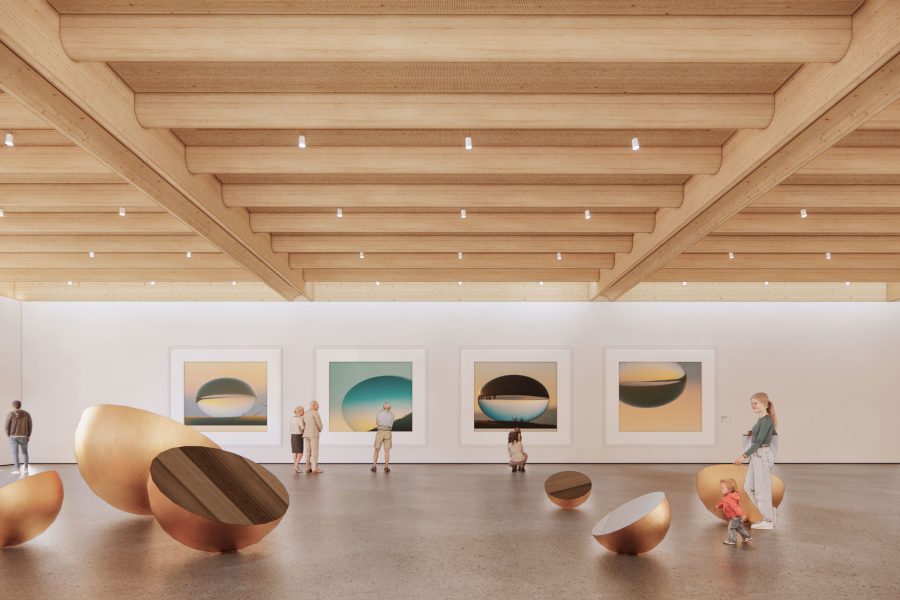
The “With Every Fiber” exhibition, a long-term installation at Grace Farms dedicated to material supply chains, grounds these conversations in physical form. Designed as both an exhibition and a research platform, it brings together artists, designers, and engineers to explore the origins, impacts, and future of building materials.

This year’s focus on pigment, glass, and stone pointed to a deeper question: What does it take for a material to be both low carbon and ethically sourced at scale? A thread running through Steve Webb’s work on tensioned structural stone suggests a possible answer, but with a caveat. Advances in engineering and fabrication are making stone newly viable as a structural building system, raising the prospect of a broader resurgence in its use. But its environmental and ethical credibility is closely tied to proximity. When sourced locally, through shorter, more legible supply chains, stone can offer lower embodied carbon and greater transparency around extraction and labor conditions.

Circular Glass and Collective Agency

Photo by Melani Lust, courtesy of Design for Freedom Summit

Breakout sessions reinforced a shift toward practical, solutions-oriented dialogue. A workshop on circular solutions for the glass supply chain highlighted real progress in recycling infrastructure and closed-loop systems, while also surfacing the fragmentation that continues to limit scale.

Participants were invited to engage directly, mapping barriers and identifying leverage points across the value chain. The tone was notably collaborative. As one participant reflected, “If every one of us saw our role as the most critical one—imagine what we could get done.”

Forests, Culture, and Risk

The day closed with a broader reflection on cultural context and risk in global material supply chains, particularly timber. Toshiko Mori spoke to the need to understand forests not simply as resources, but as living systems embedded within cultural, ecological, and economic contexts.

The discussion reframed timber supply chains as sites of both opportunity and vulnerability, where questions of stewardship, indigenous knowledge, and long-term ecological health intersect with global demand.

Taken together, the summit reflected a field in transition. Ethical sourcing is beginning to move from the margins toward the mainstream, but the systems required to support it are still emerging. The direction is clear. The work now is to scale it.

The Future of Health Care is Practical Sustainability

Story at a glance:

  • A hospital in Atlanta is a case study in how health care facilities can align sustainability goals with mission-driven care and long-term performance.
  • Design strategies on the project resulted in a 12% reduction in embodied carbon and the introduction of smog emission limits for concrete mixes.

Hospitals face mounting pressure to deliver care more efficiently while meeting higher expectations for sustainable design. Too often those efforts add costs without clear benefit. At Children’s Healthcare of Atlanta Arthur M. Blank Hospital, our design team at ESa, together with engineers from Walter P Moore and WSP and consultants at WorkingBuildings, set out to prove another path was possible—one where sustainability supports patient care, health, and long-term value.

Just a year after opening the project is already changing how the industry thinks about what’s possible. At 2 million square feet, Arthur M. Blank Hospital is the first project in Georgia to achieve LEED v4/4.1 Building Design & Construction for Healthcare certification, the most widely used green building rating system. It’s also the largest healthcare project in the US to achieve this certification.

The 70-acre campus gave ESa’s architects and their partners a rare opportunity to test ideas at scale. Today the hospital stands as a case study in how health care facilities can align sustainability goals with mission-driven care, budget discipline, and long-term performance

From Green Space to Patient Space

health care sustainability 02

Photo by Jeremiah Hull, courtesy of ESa

Sustainability was never treated as a checklist at Children’s. The hospital’s vision and site allowed teams to continue pursuing sustainability practically. Designers embraced a “nurture through nature” philosophy, weaving natural elements into both the campus and the clinical environment to promote well-being.

The Children’s team secured and planned the site years in advance, allowing the designers to prioritize access to nature at every turn. More than 20 acres of the campus are dedicated to green space, with miles of walking trails connecting patients, families, and neighbors to the outdoors. Approximately 41% of the site remains open, and 87% of that area is vegetated with native and adaptive plants that cut outdoor water use by 57%.

Inside, daylight, natural finishes and transparent connections to outdoor terraces extend that sense of calm and connection. All inpatient areas have views of the outdoors, reinforcing the healing link between people and the natural world. Their goal was always to create a destination of respite, rather than just a hospital. We brought in as much daylight as possible because it can lead to better patient outcomes and more healing environments.

Designers also incorporated nature-inspired play for pediatric patients, including a “forest” of sculptural trees that anchors the main lobby and outdoor play areas for children and their siblings. The Zone, a play area where kids can be kids, connects the indoors and outdoors, while the Aflac Cancer and Blood Disorders Center offers immuno-compromised patients access to a rooftop terrace for fresh air and views of the campus without having to leave the hospital.

These features show how biophilic design can promote both healing and sustainability. That same balance extended to the hospital’s systems and structure, where teams found ways to reduce carbon and energy use without driving up costs.

Sustainability within Budget and Schedule

health care sustainability 01

Photo by Jeremiah Hull, courtesy of ESa

Significant sustainability gains came in the less visible parts of the project—its structure and systems. Teams used a whole-building life cycle assessment from early design through completion to guide decisions, setting targets not only for carbon but also for regional health concerns like smog and acidification. Those benchmarks pushed the market to deliver new solutions without adding cost.

By sourcing materials locally the team further reduced transportation emissions and supported budget goals, demonstrating that sustainability can be cost-effective. The result was a 12% reduction in embodied carbon and the introduction of smog emission limits for concrete mixes, a first for many working on the site. “This is the only project we’ve done where we specified maximum smog emission limits for concrete mixes on the drawings,” says Kelly Roberts, senior principal and managing director of the Atlanta structures group of Walter P Moore. “It drew that connection between materials and health.”

Mechanical systems were also designed with efficiency and clinical performance in mind. Engineers eliminated preheat coils and optimized air-handling strategies to meet strict air-change requirements while cutting energy use and operational costs. Dedicated outdoor air units reduced consumption, and lighting controls kept the hospital below its energy budget. A building monitoring system now tracks energy use down to the electrical panel, helping staff identify inefficiencies and maintain long-term performance.

Together these strategies led to a 10% reduction in overall energy use. “Financial sustainability is just as important,” says Douglas Lacy, senior vice president at WSP. “Every dollar saved in building operations is a dollar that can benefit patient care.”

From One Project to Industry-Wide Change

health care sustainability 04

Photo by Jeremiah Hull, courtesy of ESa

Children’s is influencing projects beyond its own campus. For example, concrete supplier Argos developed new mixes to meet the hospital’s sustainability goals and smog emission limits, and those materials are now being used across the region. “When you’re doing things at scale, you can do a lot more things that are experimental and cutting edge,” Roberts says. “That then transfers to the rest of the market.”

The project also showed that strategies often associated with pediatric care, like outdoor play areas and creative biophilic design, can benefit patients across ages and their families. “Older patients, caregivers, and family members value opportunities for respite and play, too. Those features unfortunately just tend to often be downgraded in adult hospital facilities,” says Ross Wallace, senior sustainability consultant at WorkingBuildings.

When you’re doing things at scale, you can do a lot more things that are experimental and cutting edge.

Formal post-occupancy evaluation is still underway, but early feedback underscores that sustainability isn’t an add-on. It is integral to patient care, community health, and the long-term resilience of the facility.

For the team the takeaway is clear: Sustainability and health care are inseparable. Hospitals are about the wellness of the occupants, which is also what sustainability is about—the wellness of people and the wellness of the environment. They should go hand in hand.

USGBC California Leaders on Women in the Industry and National Women’s Month 2026

Story at a glance:

  • USGBC-CA celebrates National Women’s Month with recognition of women in the green building industry.
  • A report from McKinsey & Co. reveals that executive teams with at least 30% women outperform those without gender diversity by double digits.
  • A q&a with USGBC-CA leaders on how and why women are paving the way for a more sustainable future.

The theme for Women’s History Month 2026, designated by the National Women’s History Alliance, is “Leading the Change: Women Shaping a Sustainable Future.” This theme celebrates women who are building stronger communities, advancing equity, and developing systems for long-term environmental, economic, and social sustainability.

Traditionally men have been primarily associated with the building industry. But as we celebrate National Women’s Month, we are pleased to find that the green building industry uplifts a large and powerful base of impactful women, and a leading green building organization, USGBC California, mirrors this support.

The nonprofit organization that supports professionals and advocates across all sectors and levels of the built environment and green economy has a woman-dominant staff; a C-suite that is three-fourths women, and a majority-women board that has had a woman chair most of the last dozen years, including currently. The results from a McKinsey & Co. report (more below) show us executive teams with at least 30% women outperform those without gender diversity by double digits.

We hear from three women leaders at USGBC California on why they and women generally are often the movers and shakers in this space:

What do women bring to the movement around sustainability, resilience, and equity?

Melanie Peck, chief programs officer at USGBC California: When we talk about the climate crisis we have to recognize that it’s deeply intertwined with the existing cracks in our social fabric. In the US women often face a double burden, where systemic economic inequality meets a heavy responsibility for caregiving; when a climate emergency hits it’s usually women who have to forgo paid work to keep their families afloat. We see this play out in the data. Take California, for example, where nearly a third of women-led households are “energy-burdened,” meaning a massive chunk of their income goes just to keeping the lights on.

Because women also make up nearly 60% of the elderly population most sensitive to extreme heat, these risks aren’t just theoretical; they are life-and-death.

But the most inspiring part of this story isn’t the vulnerability; it’s the leadership. Women have become the absolute nucleus of environmental justice because they tend to lead through collaboration, trust-building, and a holistic view of how systems work. The results are actually staggering: Research shows companies with gender-diverse boards are 60% more likely to cut their energy consumption, and on a national level, increasing women’s political empowerment leads to a significant double-digit drop in carbon emissions. By reframing “care work” as a vital form of climate resilience, women are moving us past short-term fixes and toward a long-term, equitable vision for the future. They aren’t just participating in the movement; they are the blueprint for how we’re actually going to solve this.

Robyn Eason, senior advisor of policy and advocacy at USGBC California: When we think about our grandmothers, our mothers, our sisters, our aunties, our daughters, and even Mother Earth herself, the through-line connecting them all is that they are nurturers. Women bring an inherent ability to love—to lead with love, to care with love, to inspire with love, to co-create with love, to design with love, to protect with love, and to love fiercely.

This capacity for great attunement with the environment, for designing with dignity, for seeking values-driven community-led solutions, and for centering perspectives and lived experiences often overlooked yield outcomes in the built environment that are multi-faceted and multi-layered. Frequently holding multiple roles in a household (parent, elder caregiver, daily household duty holder, income earner outside the house, etc.), women regularly bring viewpoints from these roles into the intersectional sustainability movement, be it in building design, policymaking, advocacy, community programming, and other pathways for impact.

Carrie Hester, chief development officer at USGBC California: Women are foundational to community engagement, often driving initiatives through volunteering, social networks, and grassroots organizing. Studies show us women are more likely to participate in civic activities. They are crucial for building healthy communities, serving as change agents, and fostering social cohesion. Our sustainability work across industries rely deeply on stakeholder engagement, and women play a critical role.

Why is Workforce Development at the center of so much discussion right now, and how has your path, Melanie, helped you connect all the dots, envisioning pathways, for example?

Peck: At its core workforce development is more than just job training; it is the intentional alignment of human potential with the economic needs of the future. In California we are standing at the intersection of a massive green boom and a rapid technological shift. While sustainability already supports hundreds of thousands of jobs, meeting our 2030 climate mandates requires preparing nearly one million new professionals. This is the single most important investment we can make: creating a future-proof ecosystem of workers who are as adaptable as the technology they manage, from smart grids and predictive analytics to the essential construction trades.

My own path—spanning roles as a teacher, climate disaster volunteer, and apprenticeship leader, to executive positions at Seattle City Light and The Energy Coalition—has taught me that high-level strategy only works when it connects to the individual. Now, as chief program officer at USGBC California, I’ve seen firsthand that everyone deserves the dignity of a family-sustaining career. As an architect of human systems, my goal is to ensure this pipeline is inclusive, especially for those historically sidelined. We aren’t just fixing buildings; we are rebuilding the middle class through the lens of environmental and economic justice. By reframing community care as a form of climate resilience, we aren’t just reacting to the future—we’re leading it.

How does the strategic investment in and integration of workforce development and advocacy-driven policy create a force multiplier effect for USGBC California’s mission?

Peck: At its core our work is about playing the role of the ultimate connector and convener in California’s green transition. By tying workforce development directly to our advocacy, we create a “force multiplier” that turns high-level policy into real-world community wealth. We aren’t just pushing for tougher building standards in a vacuum; we’re simultaneously building the talent bridge through programs like our Green Building Corps, which provides hands-on internships to students and early-career professionals.

A big part of that impact is building capacity for the long term; we aren’t just training individuals; through our California Building Performance Hub we are helping organizations and businesses scale up so they actually have the infrastructure to support and mentor this incoming wave of workers. We also bridge the gap for innovators through our Net Zero Accelerator, ensuring that as new technologies emerge, we have the human systems in place to deploy them. This approach flips the script: instead of climate policy feeling like a regulatory headache, it becomes a shared engine for economic mobility. By bringing together building owners, policymakers, and a diverse, future-proof workforce, we’re making sure the shift to net-zero is a deeply human win that lifts up our entire ecosystem

Robyn, what do you appreciate about Policy as a change agent in this space, in particular, and what got you interested in policy+sustainability?

Eason: Policymaking is not for the faint of heart. It is a potent avenue for change at a broad scale and requires a thoughtful approach that considers the complexities of multiple scenarios all at once. In sustainability, the complexities of policymaking are amplified because of how intertwined and interconnected the sectors are. Policies on energy use in buildings can be impacted by policies on indoor water use. Policies on outdoor water use can be impacted by policies on site design. And on and on. So it takes a massive amount of knowledge and know-how to successfully design and subsequently implement policies that yield intended outcomes.

I became interested in policymaking after working on the project planning and implementation side of the work for many years. During that time I often realized there were so many decisions that were made upstream that impacted what one can or cannot do downstream. This made me really curious about what it could be like to work at the policy level, where I can collaborate with community members, industry experts, knowledge holders, and other leaders to influence what happens in the built environment at a macro scale. The rewarding part about this work are constant lessons being learned, a constant need for policy updates and keeping up with industry trends, and constant need for feedback loops with those implementing the policies. Nothing remains static and if we are lucky, we see the ripple effect of impact over time.

When considering your area of Development, Carrie, what are the most important characteristics women bring to this field, and what is most important to consider about Development in today’s world?

Hester: Women bring a relationship-based transformational approach to development, focusing on trust, transparency, and long-term engagement rather than just transactions. They drive innovation through impact-focused giving and storytelling, often leading in areas like sustainability, social justice, education, and health. This research also tells us women bring high emotional intelligence, empathy, and active listening to donor stewardship—focusing on the donor’s priorities instead of the organization’s. This type of leadership has real results of impact. The results show us executive teams with at least 30% women outperform those without gender diversity by double digits. Women make an impact.

Women are also largely the ones who make the decisions regarding donations. Women are either the sole decision maker or at least an equal partner in charitable decision making in nearly 90% of high-net-worth households. Women also hold a significant and rising share of corporate sustainability leadership roles, with 54 to 63% of sustainability executive positions at large companies held by women. If you’re not yet convinced of the growing philanthropic power of women, female-controlled assets are now projected by McKinsey to nearly double to $34 trillion, representing about 38 percent of total US assets, by 2030. There is a moral and financial case for women in leadership.

More About These Leaders

Peck is a strategic organizational leader dedicated to the intersection of equity, sustainability, and the built environment. As chief program officer for USGBC-CA she oversees the design, delivery, and impact of the organization’s entire program portfolio, ensuring that California’s transition to a sustainable future is both high-impact and human-centric.

With more than 20 years of experience architecting large-scale initiatives and leading with her “people-first” philosophy, Peck specializes in translating complex climate goals into measurable community outcomes. Her deep expertise in program design was honed through senior leadership roles, including serving as director of people and culture at Seattle City Light—one of the nation’s greenest municipal utilities—and as director of workforce, education, and training at The Energy Coalition, where she led statewide environmental and community engagement initiatives.

Eason is a fun-loving, challenge-seeking professional who exists to do the work of a human being embodying empathy, compassion, and love. Her experience incorporates the vast array of systems thinking, strategy, and expertise necessary to nurture human-centered approaches to sustainability through change management and targeted universalism. From 2016 to 2022 she built an award-winning sustainability program for the City of West Hollywood that anchored the intersectional components of the field that helped amplify inclusivity, reciprocity, and equitable outcomes. She held many roles at USGBC and GBCI from 2009 to 2016 including direction of certification activities for LEED for Neighborhood Development, and LEED review execution and quality control responsibilities for the LEED Building Design and Construction Rating system. Eason holds a Bachelor of Science in Architecture and a Bachelor of Civil Engineering from The Catholic University of America in Northeast Washington (DC) and a Master’s in City and Regional Planning from Clemson University in Clemson (SC). She has served in various leadership roles within the American Planning Association, the Urban Sustainability Directors Network, the Urban Land Institute, and co-founded the California BIPOC Sustainability Network.

Hester is a part of the USGBC-CA family as its chief development officer. With more than 20 years of experience in program development and advancement, Hester is passionate about people and the planet. She has served several organizations such as The Y to grow their fundraising and advancement strategy. As a former Starbucks partner, she was a founding chair of Partners for Sustainability LACCAL building the infrastructure to provide education, fellowship, and community opportunities for baristas in sustainability. She received her Bachelor’s of Science in Management and Master’s of Business Administration with a concentration in digital innovation and information systems from Pepperdine Graziadio Business School.

usgbc-womens-month-02-240912_WiG-Breakfast_Ling-Luo_270

Carrie Hester (center) with USGBC-CA’s Cecile Lee and Kim Krempien, at USGBC-CA’s 23rd Women+ in Green Breakfast 2024. Photo courtesy of USGBC California

usgbc-womens-month-03-Melanie_Women-In-Energy-Conference_2024

Melanie Peck (fourth from left) attends the 2024 Women in Energy Conference. Photo courtesy of Melanie Peck

What’s Driving Wellness Architecture and Design?

Story at a glance:

  • The Wellness Architecture + Design Initiative (WADI) is one of more than 30 initiatives supported by the Global Wellness Institute, a nonprofit organization dedicated to research, education, and leadership in the global wellness movement.
  • RHG A+D designed Red Rabbit Spa in Red Bank, New Jersey, as a retreat within the rhythm of a lively downtown, wit natural, responsibly sourced materials.

After a lifetime of observing and studying how spaces and places make us feel and how they can support or harm our well-being, I was led to a career in architecture, design, and experiential art.

We rarely question the spaces we inhabit, yet they are shaping us every moment. Over time I became increasingly concerned that, in prioritizing economic outcomes, we had begun to leave both the human experience and the natural environment behind. That realization led me to search for a community of like-minded professionals because I believe there is power in numbers and that together we can create meaningful change.

I often compare the trajectory of architecture to that of the food industry. We began with a built environment that grew organically from the natural world, using materials from the earth, and guided by an understanding of the spiritual and emotional qualities of design. These principles supported a life rooted in community, care, and artistry. Over time, however, innovation introduced synthetic materials and harmful chemicals into our environment, impacting both the land and all living beings. In many ways our industrial age reduced architecture to an intellectual exercise, disconnected from its deeper purpose.

The Wellness Architecture + Design Initiative (WADI) is one of more than 30 initiatives supported by the Global Wellness Institute (GWI), a nonprofit organization dedicated to research, education, and leadership in the global wellness movement. WADI is a collective of architects, designers, researchers, and developers united by a shared mission: to raise awareness and provide actionable pathways for implementing an interdisciplinary wellness design approach. This approach supports health, sustainability, economic vitality, and spiritual well-being across both existing and future environments.

In 2024 the group produced a white paper, accessible to all, that outlines these pathways and advances the conversation around wellness architecture and design.

As an industry we are only beginning to fully explore the role of neuroaesthetics and the broader impact of our built environment on human health and experience. Throughout my tenure we have worked to expand these conversations, not only among our peers, but also with end users. In 2025 we hosted a series of fireside chats on topics like Electromagnetic Fields as Environmental Pollutants, Living Well with AI, and The Spirituality of Design.

The GWI is a nonprofit 501(c)(3) dedicated to empowering wellness worldwide through research, education, and collaboration. Across its six pillars—Research, Initiatives, Geography of Wellness, Wellness Evidence, The Wellness Moonshot, and BBC StoryWorks—GWI provides free, authoritative resources that unite industries and drive meaningful, positive change.

At its core this work is about education and awareness, helping others understand how the built environment profoundly impacts human health and the health of our planet across mind, body, and spirit.

For me this work is both professional and deeply personal. It is about returning to a way of building and living that honors connection: to ourselves, to one another, and to the natural world. It is about expanding the conversation so wellness is no longer a niche consideration but a foundational principle.

Case Study: Red Rabbit Spa, Red Bank, NJ

At Red Rabbit Spa in Red Bank, New Jersey, our work explores the quiet power of the spaces and environments we choose, where wellness and sustainability are felt as much as they are seen. Designed as a retreat within the rhythm of a lively downtown, the space invites a subtle but immediate exhale. A palette of natural, responsibly sourced materials, diffused light, and soft tonal contrasts creates an environment that feels both grounded and restorative.

Rather than announcing itself, the design reveals itself through feeling: a slowed pace, a softened edge, a heightened awareness of the body in space. Circulation is intuitive, transitions are seamless, and each room carries a sense of intimacy and intention. Thoughtful material choices and a restrained approach to finishes reflect a belief that sustainability is not about addition but about clarity—doing less, with greater purpose.

Informed by our wellness principles, the project is less about any single gesture and more about the cumulative effect—how light, texture, and proportion come together to support restoration. At Red Rabbit wellness is embedded in the experience of the space itself, creating an environment that feels both deeply personal and quietly enduring.

About the Architect

Rachael H. Grochowski is a visionary architect, designer, and thought leader with 30 years of experience and recognized for her philosophy that Design is Spiritual™.

Grochowski’s work focuses on creating environments that foster well-being, balance and community, transcending aesthetics to cultivate calm, interconnectedness, and a profound sense of belonging.

As the founder of RHG Architecture + Design, Grochowski leads a team dedicated to creating respectful, inclusive spaces through thoughtful craftsmanship and sustainable practices, all rooted in her experience with various wisdom traditions. Her diverse portfolio spans residential, commercial, hospitality, wellness and spiritual projects, all of which reflect her commitment to intentional design and an approach informed by her experiences as a world traveler, yoga practitioner, and student of history and nature.

In addition to her design practice, Grochowski is an active public speaker, a Global Wellness Institute Ambassador, and serves on the GWI Architecture + Design committee advocating for the integration of wellness into design. Prior to founding her firm in 2004 she honed her skills at prestigious design studios Tihany Design and S. Russell Groves in New York, designing luxury hotels, restaurants and wellness-focused spaces.

A Guide to Below-Grade Waterproofing and the Latest Innovations

Story at a glance:

  • Different buildings have different demands when it comes to below-grade waterproofing, but geotechnical reports will tell teams exactly what they need.
  • The most important thing to remember about below-grade waterproofing is the critical need to get it right. Repairs are complicated and costly.

Below-grade waterproofing is critical to most commercial buildings, but understanding precisely what is needed takes careful consideration, as needs can vary widely from project to project. “It depends so much on the actual building you’re working on, the soil condition, the design of the building, and the assets you want to protect,” says Lisa Semling, segment product manager at GCP, part of Saint Gobain.

Semling has been working with Saint Gobain for eight years, focused on the world of building envelopes for more than two. The building envelope segment encompasses air and vapor barriers, horizontal deck waterproofing, below-grade waterproofing, and injection routes.

We recently caught up with Semling to better understand below-grade waterproofing as well as learn about today’s top innovations, from PREPRUFE and PREPRUFE SCS Plus to the 6Sides+ System and more. This is that conversation.

How do below-grade waterproofing needs depend on building type?

Every commercial building has a need, but commercial building is a broad term. It could be entertainment, hospitality, or now we’re talking a lot about data centers. Hospitals always have waterproofing needs, and mixed-use buildings, both residential and commercial. Waterproofing is critical, for instance, in tunnels, shafts, and stations. Airports also have big waterproofing needs. In terms of industry, you’ll find below-grade needs pretty much everywhere.

How does below-grade waterproofing work as a system?

below grade waterproofing innovations 02

Photo courtesy of GCP

There’s one main element, which is a membrane, but it really works as a system. We usually talk about pre-applied and post-applied membranes. Pre-applied membranes are going to come before your concrete pour. So imagine you’ve just excavated the soil. The pre-applied membrane needs to be there before your concrete because once you pour your concrete on that membrane, your concrete is going to bond to that membrane.

Then you have the post-applied membranes, which are applied on poured concrete once it’s cured. Usually you have an adhesive bond. It’s a very tacky adhesive bond that’s going to hold that membrane in place against your concrete once already poured—before you backfill, because, again, we’re below-ground.

It’s usually a combination of both those types of membranes in every industry in every type of building.

How has below-grade waterproofing evolved to meet needs?

below grade waterproofing innovations 03

Photo courtesy of GCP

Every project is different, but when you start designing a new building you should heavily rely on your geotechnical report. That’s going to tell you a couple of really interesting things—one being the type of soil, because that affects the waterproofing solution you’re going to want to choose at the end of the day. Another element is going to be the hydrostatic pressure you’re exposed to. It’s going to give you the water table, and the deeper you are in that water table, the higher the hydrostatic pressure you’re exposed to is going to be. This is really fundamental in determining your level of risk on the jobsite.

GCP has a very good, high-end solution. That is our PREPRUFE product. We have a product for every type of risk condition. We also launched a product called SWELLPRUFE, which is for those situations where the hydrostatic pressure is lower, but you still want to waterproof your building with a robust solution while having some element of cost efficiency. With lower hydrostatic pressure, you can afford to use this because your risk is lower.

Soil contaminants are another thing that will influence your waterproofing system. You have to make sure your membrane will not be degraded by what’s in the soil. Also if you have a high concentration of methane, radon, things like that, you want to make sure you have a membrane that’s not only going to act as a water membrane but also a vapor barrier.

What’s behind the shift toward a demand for waterproofing membranes that also act as vapor barriers?

below grade waterproofing innovations 01

Photo courtesy of GCP

That shift toward wanting a solution that’s not only a waterproofing product but also is both chemically resistant and a gas barrier is something we’ve been seeing a lot more these past few years. I can see two main explanations. First we’ve been hearing, and rightfully so, increased concerns about indoor air quality and safety of inhabitants. Yes we’re talking about below grade, but gasses are going to rise at some point, and once air is inside the building, it’s going to circulate.

The other reason is that we’re using more and more brownfields. It’s hard to find a piece of land in a great location where you want to build a new commercial complex where there’s never been any building before. If there was a plant there before, you could have all sorts of contaminants in your soil. The fact that we’re repurposing lands plus the increased concerns about air quality are two of the main drivers here.

What other demands are being made of waterproofing?

The market still wants solutions that have a proven robustness, but they want the solutions to be easier and faster to install. Labor is an issue in a lot of areas, and costs linked to those. I think data centers are a good example. They’re trying to fast-track those projects so much. Easier and faster to install has been a trend in every industry, and we’re no exception.

There’s also this shift toward wanting a complete system. Here we’re talking about below grade, but I would extend this to the whole building enclosure system because architects at the end of the day want peace of mind that everything’s going to work well together.

In terms of technical support, we feel it’s very important, even more than before, for our customers to get that one-stop shop type of support. Those are definitely trends I don’t think are going to go away anytime soon.

How does GCP, as part of Saint-Gobain, think about providing the “complete system?”

below grade waterproofing innovations 04

Photo courtesy of GCP

We’ve been positioning ourselves for awhile as a full system solution provider, so for us it’s a natural shift. We’ve been thinking in terms of systems, but we’re pushing that even further. Last year we launched the 6Sides+ System. This is really our building envelope program, tying the six sides of the building together and making sure it’s all wrapped up properly without any weak point in the system. We’re focusing a lot on the ties between the different solutions we offer, focusing a lot on the details. That’s where you really see the technical expertise shining through. We have product backed by R&D, a strong track record, and we continue to innovate, but our technical support is really something that distinguishes us today in the field.

In terms of the overall system, with Chryso, our Saint-Gobain branch doing concrete admixtures, we’re trying to go even further in understanding how the foundation of a building really works. Your waterproofing system is going to work in tandem with your concrete. These are two sides of the same coin when you think about it because if your concrete is not qualitative enough, for instance, there’s a chance it’s going to affect the proper adhesion of the membrane. We’ve been trying to take a position as an education partner for customers and tying that concrete quality to the waterproofing quality and really thinking again about foundation as a system and not a bunch of isolated products you try to make work together.

How was the 6Sides+ System used for the Providence Swedish North Tower health care project in Seattle?

Our below-grade membrane, PREPRUFE, was the basis of design for this project because of our longstanding relationship with the architect and the waterproofing consultants; they’ve always specified PREPRUFE for this type of project. Initially the design for the air and vapor barrier part of the project was not a GCP solution, but our technical and our sales teams did a great job explaining all the advantages of having one supplier and manufacturer for both, relating to the peace of mind we talked about and to make sure you have a system that is fully appropriate and compatible.

Health care is one of those fields where you don’t want to take unnecessary risks.

Health care is one of those fields where you don’t want to take unnecessary risks. Once your hospital is done, you don’t want to have to go back and do costly fixes that could potentially affect the usage of the building. I do think they appreciated that one-stop shop support.

What are the biggest challenges today surrounding below-grade waterproofing?

The biggest thing you need to understand about deep foundation waterproofing is that once it’s done, repairs aren’t impossible, but they’re going to be really complicated and costly. Honestly, there’s one chance to do it right.

Leaks can happen for a variety of reasons, even with the best waterproofing system. If it’s a small leak it’s OK; you’ll find a way to fix it. But when your job is leaking from everywhere it’s really messy and you have to go back every two weeks to grout because you can’t find the actual point where it’s coming from if it seems to be coming from everywhere. You’re going to spend almost the whole life cycle of the building trying to find the source.

With GCP and PREPRUFE, we’ve been waterproofing buildings for more than 50 years. PREPRUFE, our flagship product for high-risk solutions, has really led the charge in waterproofing for more than 25 years for pre-applied waterproofing. We have an international track record, and because of how many jobs we’ve waterproofed we have experienced so many situations and have that knowledge for how to best help our customers design the right systems and execute the applications.

What are some of the most innovative solutions available now?

When it comes to faster, easier installs, there’s PREPRUFE Liquid Flashing. It’s innovative because it bonds to concrete. As of today we’re the only ones doing that.

How that works is you have a pipe penetration, so you’re going to cut your PREPRUFE membrane to make room for that pipe penetration, and you’re going to apply your PREPRUFE membrane over that pipe penetration. But now you have gaps, and water could pass through that area between the PREPRUFE membrane and the pipe and you’d lose that continuity. Traditionally, you’d have to do what we call a three-course layer application. You’d have your membrane, then you’d have a liquid membrane, but that liquid membrane does not bond to concrete, so then you have to go with the PREPRUFE membrane, cutting a patch above that liquid membrane and then tape everything. Then it’ll nicely hold together and that system will be perfectly fine and bond to concrete, but that’s a lot of steps.

Alternatively, with PREPRUFE Liquid Flashing, you mix the liquid solution and apply it over your pipe penetrations, and you’re done. You don’t need to do any patch. You don’t need any tape. It’s really easy. It’s about four times faster, but on top of that it also reduces the chance for human error. There’s really no way you can do that wrong. Every contractor who has tried this solution does not want to go back to the old way.

We also launched PREPRUFE SCS Plus, a shotcrete-related solution last year. Shotcrete is another way of doing concrete we’ve been seeing a lot for the past 10 years on the West Coast. It’s not cast-in-place concrete. You pump your concrete in the rebar and are basically doing a substrate wall; you’re doing that layer by layer. People like it because it’s fast, but your concrete is different, and that’s one place where we see poor consolidation. You need a specific waterproofing system to counterbalance that. So sure it’s faster, but it brings a whole new set of challenges.

As waterproofers, I will say we don’t love shotcrete, but if you have to use it, make sure you use a waterproofing system that’s designed for shotcrete. That’s what PREPRUFE SCS Plus is. You have that membrane that bonds to concrete, but you have dual protection because while you’re installing, you’re also installing a grouting system at the same time. Once the concrete is cured you’re going to inject that grouting system and that’s going to solidify everything nicely with your membrane. It’s a very specific application case, but in that niche market it’s a great innovation in terms of making sure we can correctly waterproof shotcrete at the jobsite, which has been an issue forever.

Then there’s SWELLPRUFE, our most recent innovation I previously mentioned for projects with lower hydrostatic pressure. This is a market that’s traditionally using a bentonite type of membrane. This is another type of technology. It’s not an HDPE or thermoplastic type of membrane; it’s a membrane based on the bentonite. Bentonite is hydrophilic so it’s going to swell when in contact with water. The whole idea is that with the bentonite swelling and your membrane placed against your concrete, it’s going to stop that water from reaching the concrete. Our product has bentonite in its composition, so you’re still going to see that swelling, and yes that swelling is going to seal any puncture you would have in your membrane and reduce water from going up, but also it fully bonds to concrete the way our PREUPRUFE membrane does. It’s a different adhesive, but it’s the same idea.

So when you pour your concrete the membrane is going to fully adhere to that concrete, which is not the case of traditional bentonite membranes that only rely on the bentonite as a waterproofing component. All of our membranes have a rubberized asphalt layer that bonds to concrete, and then we have the bentonite below that, facing the earth where the water comes from. That bentonite is going to once again slow the water and seal any crack, while our actual waterproofing layer that’s bonding to concrete is going to keep your concrete dry.

It may be that because this is a lower-risk market, the area hasn’t seen much innovation recently. We were excited to introduce a solution that’s both really robust and at a great price point for the value it delivers.

What else should architects and specifiers know?

It’s a game of minimizing risk and trying to mitigate challenges, and no project is the same. Technical expertise and track record is key—knowing you’re working with someone who has had that experience and knows what could go wrong or go right, and knowing what works in each situation. That, on top of having a great product backed by testing and R&D, is really what you’re looking for here.

Impressive Terrazzo Still Shines at OSU Schottenstein Center

Story at a glance:

  • Completed in 1998, Ohio State’s Jerome Schottenstein Center arena features six elaborate floor “murals” depicting its winning athletic programs in epoxy terrazzo.
  • Terrazzo can withstand heavy use for decades with minimal maintenance, offering lower lifetime costs than any other floor system or covering.
  • Installed directly onto a concrete substrate, terrazzo’s life cycle can easily outlast that of the building without needing replacement or adding to landfills.

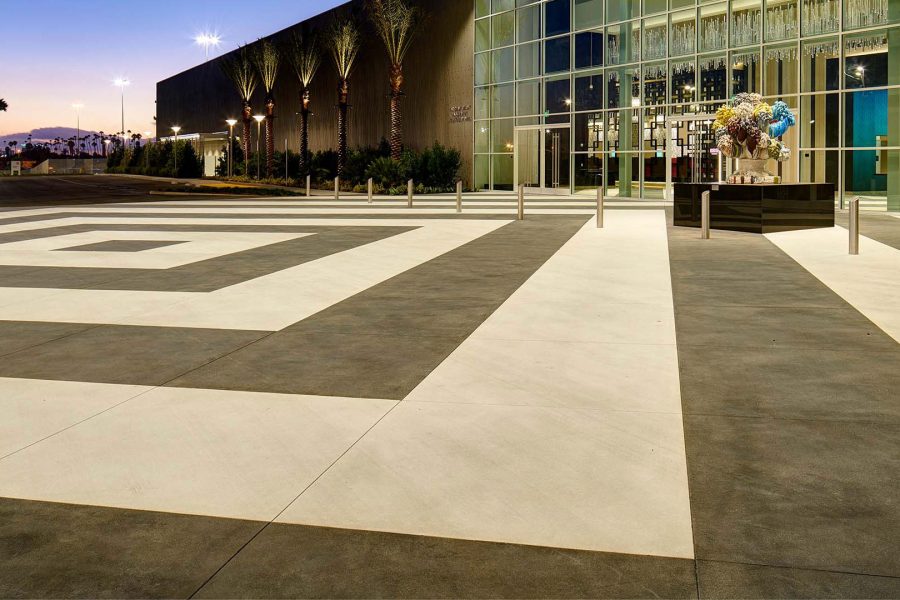
Since 1998 students and sports fans entering The Ohio State University’s Jerome Schottenstein Center arena—home to OSU’s men’s and women’s basketball and men’s ice hockey teams—have been greeted by expansive murals depicting the athletic legacy of the Big 10 school. But the murals don’t hang on the walls; they are underfoot.

Designed by celebrated conceptual artist Alexis Smith and collectively known as Larger Than Life, the six images are cast in stone with long-lasting epoxy terrazzo. They cover more than 71,000 square feet at the arena’s entry points and celebrate OSU athletes in Buckeye scarlet and gray.

“Ohio State wanted to highlight the history of athletics at their school,” says Casey Ball, global market director of Sherwin-Williams High Performance Flooring. “They decided to look to terrazzo to tell the story.”

An Intricate Installation

The project took more than 8,350 gallons of epoxy resin and 115 tons of stone, glass, and shell chips. Each segment of the artwork took six weeks to install, and the Schottenstein Center was ultimately named the 1998 Terrazzo Job of the Year by the National Terrazzo & Mosaic Association. Architecture firm Moody Nolan served as one of the primary architects for the building and supported the specification of terrazzo flooring for its longevity and design capabilities.

Smith, along with several OSU architecture students, drew each image on the poured concrete substrate; installers then placed more than five miles of zinc wire dividers on the lines and hand-poured each color of mixed terrazzo. “Once they have the divider strips in, it’s paint by numbers,” says Mark Merrifield, market segment manager for Sherwin-Williams High Performance Flooring.

Variations in color and shading allow surprising detail. One mural features NBA Hall of Famer John Havlicek, a Buckeye who went on to play with the Boston Celtics. On another, the faces in the crowd behind ’90s women’s basketball star Averill Roberts include the artist, athletic director, architects, and installers who contributed to the center’s construction.

A Surprising Sustainable History

Terrazzo has been a sustainable option since it was invented during the Renaissance. Reusing excess marble, Venetian stoneworkers bound chips with cement and poured terrace floors (hence the name), ground the surfaces with a weighted stone, and sealed them with goat milk. “Terrazzo is the original recycled content,” Merrifield says.

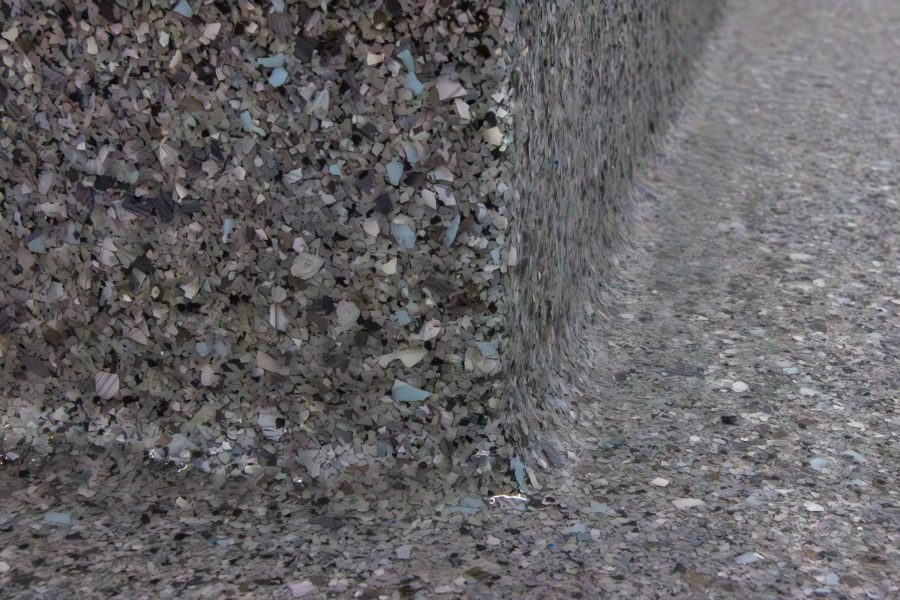
Using epoxy resins as a binder, today’s terrazzo is denser and less fragile than that of the Renaissance. It offers designers a range of colors and can include chips of glass, mirror, and other materials in addition to marble and crushed stone. The Schottenstein Center’s hockey-themed floorscape, for example, includes mother-of-pearl to make the ice shimmer.

Lasting Without Waste

Recent revisions to the product category rule for epoxy terrazzo rates its life cycle to last that of the building that contains it. As a result the material produces less waste than flooring options like VCT or ceramic tile, which wear out and eventually need replacement, according to some experts.

Poured in place, terrazzo essentially becomes part of the building structure. “Other types of floors and floor coverings will eventually end up in a landfill,” says Mike Starner, marketing manager for Sherwin-Williams High Performance Flooring. “Terrazzo bonds directly to the substrate and lasts forever.”

The longevity of terrazzo and its reduced environmental footprint have been recognized in a new product group definition published in the Sustainable Minds Transparency Report. The recently published “Part B: Product group definition | Resinous floor coatings | Part B #25-007,” released February 5, 2026, notes that terrazzo stands out among resinous options because it bypasses the traditional cycle of removing and recoating top system layers, drastically reducing its long-term environmental footprint. The 18-member committee responsible for this recognition of terrazzo as a premier sustainable choice included four representatives from Sherwin-Williams.

Terrazzo is a good choice for any building designed to last a long time and withstand lots of foot traffic—airports, government buildings, schools. And it’s a fraction of the cost of other options like luxury tile, Starner says. “You get great aesthetics and the lowest life cycle cost.”

Easy Maintenance

terrazzo OSU Schottenstein Center

Photo by Kelly Ann Photography, courtesy of Sherwin-Williams

Contractors must limit inconsistencies in the substrate to create a clean canvas for installation. They will also often add a crack suppression membrane before pouring terrazzo to ensure future concrete cracks do not project through the finished floor. The terrazzo is then ground flat and grouted with additional epoxy to make it impervious to dirt and grime.

Maintenance is simple—a dust mop or wet mop is usually all that’s needed on a daily basis; many large installations use floor scrubbing machines. Depending on traffic, terrazzo needs to be polished periodically to return to its original luster.

Most terrazzo floors feature “sacrificial” coatings of sealers and waxes to protect against spills and dirt and provide slip resistance. Similar to waxed floors, facilities should strip the sacrificial coatings and reapply them every one to two years depending on traffic and wear.

Lasting a Lifetime

Nearly three decades and millions of footsteps later, the Schottenstein Center’s murals still pop. Together they are a testament to the durability of terrazzo and a lasting homage to the school’s history in sport. The floor “is kind of a beacon for the university,” Ball says. “They love the fact that it tells a story.”

”Athletics is about human movement, expression of emotion, [and] accomplishment through physical, improvisational, and intellectual effort,” athletics director Andy Geiger told OSU’s The Lantern in 1998. “The artwork is evocative of the spirit of Ohio State [and] of what a university should be about.”

“Terrazzo gives designers an opportunity to leave a signature mark and tell a story that’s going to be around for a long time,” Merrifield says. “People are going to walk across it and experience it for many years.”

A Materials Revolution with Sustainability Built to Last Generations

Story at a glance:

  • USG Corporation is an industry-leading manufacturer of building products and innovative solutions, from the world’s first gypsum panel to the first acoustical ceiling tile and beyond.
  • A leader at USG shares how the 125-year-old company is building on a tradition of design and manufacturing through a sustainable lens.

“I tell people all the time—USG has really helped shape and develop all the transformational products where we live and work,” says Diane Earll, Ceilings Division president at USG, where she’s been overseeing exciting advances for more than 34 years. “It’s interesting to go through our 125-year history and know that we developed wallboard, we developed acoustical ceilings, we developed modern lightweight technology. We even developed a shaftwall system so big skyscrapers can go higher and use elevators.”

Since its founding USG has been leading a materials revolution, one that continues to push the industry forward, including with some solutions never thought possible, like the recent launch of Sheetrock® Brand UltraLight Tough Panels. “It’s even lighter weight than before, and it’s more durable, so you have less damage on the jobsite,” Earll says. That’s a big deal, given how much wallboard is handled from the time it leaves the manufacturing plant and travels from truck to distributor to jobsite. “This product is more durable so there is less damage and less waste. Installers and distributors are really loving it.”

Why Less is More

Photo courtesy of USG

Earll has spent her decades at USG in many roles, including in product development as well as focusing much of her time on sustainability and now leading USG’s ceilings business, the company’s second largest area. Today she and her team continue to build on a passion for innovation and material science, which includes creating lighter than ever before solutions, directly improving sustainability outcomes. “We’ve done a really good job of prioritizing our lightweight product portfolio. In 2010 we launched our first lightweight wallboard where we took almost 30% of the weight out of wallboard.”

Why does that matter, she asks? For one, it means using less resources, like water, to manufacture. Less water use means less energy is required to drive off water during manufacturing. “And then, because it’s lighter weight, you can get more products on a truck, so you’re using less embodied energy to manufacture and less fossil fuel to transport.”

Sixteen years after the first lightweight innovation, USG’s latest lightweight wallboard is even more durable than the heavier wallboard. “It’s not that easy to innovate and make it lightweight but still make it more durable and have all the other qualities people like about wallboard,” Earll says. “It’s all about the way you formulate it. We have more than 100 scientists at our Corporate Innovation Center (CIC) just outside of Chicago, and they look at what type of materials you need to create the best wallboard.”

The CIC puts all of its products under intensive testing to be sure they’re both lightweight but also strong enough to hold up over the lifespan of the space. Experts utilize unique fire, acoustical, structural, and environmental testing capabilities to evaluate all products and systems.

“We are taking this generational look at what is going to be needed in 10 and 20 years, too,” Earll says. “It’s thinking about how you solve the needs of contractors saying, ‘We want lighter weight products because we need to work faster on the schedule. And we need to ensure our skilled labor force can safely work longer into their careers.” Considering all of this and more from the beginning results in improved products that benefit everyone, and architects and building owners are demanding it, Earll says. “They want to be more sustainable in construction.”

Low Carbon, High Quality

Photo courtesy of USG

USG currently has more than 50 manufacturing plants across North America, with a new, incredibly efficient plant set to open later in 2026 in Wheatland County, Alberta, Canada. “It’s our first wallboard manufacturing plant we have opened in decades,” Earll says.

The new plant will focus on producing wallboard with 20% less carbon emissions and 25% less water. The plant will have an onsite solar field for power operations and take a zero waste to landfill approach; 100% of production waste will be recycled. “This is really one of the first times we’ve done this as a manufacturing plant, but we went in with a vision,” Earll says.

USG also has the capability to bring waste from a jobsite back into its manufacturing operations and reuse that in future processes. “It’s really a circular vision.”

Many of USG’s other plants also have solar fields, Earll says, but the Alberta facility is unique in that every single element is built around sustainability and zero waste. The project comes from lessons learned and processes perfected at other USG plants, she says. “Wheatland has allowed us to design what we would say is best in class. We were able to ask: What could best in class look like? And then we can use that as a proving ground and replicate it in all of our operations.”

We were able to ask: What could best in class look like?

It’s also exciting for Western Canada, she says, as access to many building materials, especially wallboard in that area, is challenging.

Reducing carbon emissions is a win-win, too. “We believe this focus is good not only for the economy but for the future of the planet. We also know it makes really good business sense,” Earll says. “We have proven that when we focus on initiatives that work to reduce emissions, it also drives operational efficiency and reduces operational costs. You focus on reducing carbon, but at the end of the day we’re reducing costs across the business.”

But it doesn’t start and end with products; it’s also operational elements. USG uses LED lights across all of its plants and is always looking at alternative energy opportunities, including wind and hydropower in addition to solar, Earll says. “We will for sure reach 100% renewable power by 2030 in all of our 50-plus manufacturing plants.” On the ceilings side of the business, Earll is proud to say that has already been achieved across manufacturing.

Choosing the right vendors is another path toward a more low-carbon future. USG chooses its partners very carefully, Earll says, with particular focus on how raw materials are sourced. “We’re dependent on that, so how do we focus on partnering with vendors who are local and who have eco-friendly logistics? How do we get it to our customers? And then we encourage our suppliers to have the same vision as us and adopt lower carbon options.”

USG also has a number of recycling programs and partners with both architectural firms and influential building owners when possible in an effort to reduce waste to zero on the jobsite. “We partner with key owners—the Googles or the Amazons of the world, for example—to say, ‘If we are partners with you in this space, we will help remove the job waste from the jobsite.’ We’ll bring it back to our plants, and it’s all about reusing the products. We’re also thinking about doing that from the very beginning,” Earll says.

Forward-Thinking Strategies

Photo courtesy of USG

Planning for the future is one of USG’s four key strategies. “We are really focused on putting in practices today to be able to plan for the future. Everything we do is with future generations in mind,” Earll says.

Since she started more than 30 years ago, she’s seen a profound shift in attitude around sustainability. Where some people used to talk the talk, not everyone put actions behind their words until more recently. “Did they really believe in it?” Earll asks. “We’ve seen a transformation, and our customers are asking for this. You can’t walk in a building today without seeing a LEED certification, and that wasn’t like that before. When I think about sustainability I’m thinking about efficiency, sustainability, innovation—all of that. We have to think about it from the time we are manufacturing a product because you’re manufacturing a product for the future. You’re anticipating needs in the marketplace.”

Earll says USG will continue to focus its innovations around meeting those needs, even as they evolve or differ depending on location, as what’s built in the US may differ from what’s built in South America, for instance. “You have to look at those trends, but sustainability considerations will continue to shape how we think about the entire life cycle of our product development, including this concept of waste reduction, whether it’s in our plants or on jobsites, and then understanding material efficiencies.”

They’ll also remain committed to extending the lifespan of products once installed. “We’d like to make sure the spaces we help create are easy to maintain, and that comes down to quality and durability. That will not change. How people install it may change, so how do we then take that into consideration?”

While the industry continues to face challenges like labor shortages, contributing to demands for lighter, faster, more durable products, USG will continue to meet those needs while investing in sustainability. “We will continue to ask our customers what they are looking for,” Earll says. “We have always been driven to solve the challenges of the owners and architects who are out there building new spaces, or even repurposing existing spaces to serve new needs for the community.”

She says the focus will forever be sustainability for future generations. “We will not lose sight of that,” she says. “We will achieve our sustainability goals. And then we will figure out what is next, and we will continue to innovate around the needs of the industry we have served for over a century.”

Everything Architects Need to Know about Modern Firewalls

Story at a glance:

  • A firewall prevents the spread of fire, but it also influences the daily experience of a building, from sounds to smells to energy efficiency.
  • Sound and air quality considerations are especially crucial in townhouses where tenants share walls.
  • Tighter insulation means less air leaking through the wall and increased energy efficiency.

When a firewall fails inspection, gaps in insulation are often to blame. Then the contractor has to return to the building and repair the insulation, tacking on additional time and cost.

Greenfiber’s SANCTUARY Two-Hour Firewall, a UL-certified assembly filled with Greenfiber FRM insulation, eliminates the gaps in insulation that can lead to inspection failure. Isac Torres, owner of Battle Born, is a contractor who installed the Greenfiber SANCTUARY product in a Las Vegas townhome project—a net zero-ready development in Las Vegas. For the past six years Torres says Battle Born has been using the SANCTUARY product because of its sound control, air quality, fire performance, energy efficiency, and ease of inspection. “Gaps and voids were a big factor before,” he says. “With this SANCTUARY product on the exterior walls, we were able to solve that.”

Our inspectors love it, our builders love it, and our homeowners love it.

The SANCTUARY Two-Hour Firewall with Greenfiber FRM also simplifies the inspection process, says Greenfiber Technical Director Aaron Davenport. “From an inspection standpoint you can go into a job that has this product installed, look at it with one eyeball, and say, ‘OK, this product has completely filled the cavity. Check, it works.”

Torres says he’s never failed inspection using Greenfiber insulation in his townhouse projects in Las Vegas. “Our inspectors love it, our builders love it, and our homeowners love it,” he says.

The Evolution of Firewalls

Firewalls slow a fire’s spread from one part of a building to another and are a key requirement in modern building codes. Codes mandate builders use firewalls for dividing walls in multifamily and townhome construction.

The Greenfiber FRM insulation is designed for only the SANCTUARY Two-Hour Firewall, U370 assembly. It must be included in building plans from their inception to guarantee code compliance. This assembly is suited for party walls between units, or any wall where two-hour fire rating is required in townhouses and rowhouses. It’s also recommended for multifamily buildings with three or more stories and mixed-use developments.

In the Las Vegas townhouse development, Battle Born specifies the U370 party wall with SANCTUARY in the exterior walls and spray foam in the room deck. Torres says he chose this hybrid system because “the spray foam hits the most inefficient parts of the home, and the cellulose complements it by giving us Grade 1 every single time on the exterior walls, making it easy for inspection.”

Sharing Walls and Nothing More

WEB-new-greenfiber-LS-WALL-SCRAPED-(1)

Photo courtesy of Greenfiber

When it comes to the options for firewall materials and assemblies, it’s important to consider performance, sound, and air quality, Davenport says. “You don’t want to hear your neighbor, you don’t want to smell your neighbor, and you sure as heck don’t want to be disrupted by a fire from your neighbor,” he says.

Sound and air quality considerations are especially crucial in townhouses where tenants share walls. The SANCTUARY firewall’s ability to seal gaps thoroughly means sounds and odors can’t pass freely between neighboring units, granting homeowners greater control over their indoor air quality.

For today’s architects it’s not enough to address occupant safety—comfort is key. It’s common for landlords of multifamily properties to deal with noise complaints from residents. People who live in townhouses and multifamily homes don’t want to hear music from a party next door or a play-by-play of their neighbors’ TV shows. The SANCTUARY firewall limits sound power by 60%, and Torres says it significantly improved sound abatement in the Las Vegas townhome project. “We not only use the SANCTUARY on exterior walls, but we also use it on interior walls for sound control from room to room,” he says. “The sound control it gives you has been taken very well by our homeowners.”

For acoustic performance, Greenfiber’s SANCTUARY U370 assembly achieves an STC rating of 60—exceeding Gypsum Area Separation Walls with acoustical batts filling all cavities (STC 56–58) and two-hour double wall assemblies with spray foam (STC 57). Since a 3 dB increase is typically considered noticeable, this difference represents a meaningful acoustic improvement, according to Greenfiber.

Choosing a Firewall System

WEB-new-greenfiber-Finished-UL-U370-Wall

Photo courtesy of Greenfiber

Firewalls sustain structural stability, provide fire resistance, and give anyone in a building during a fire more time to escape. Even when there isn’t a fire, firewalls influence the quality of people’s experiences on a daily basis.

The U370 assembly with Greenfiber FRM insulation addresses multiple issues (fire resistance, sound, air quality, and sustainability) in one step with a single material. For decades the typical approach to installing a firewall has been to combine multiple materials like gypsum board (to achieve fire resistance), fiberglass or mineral wool (for thermal insulation), and staggered studs (to address acoustics). Many builders are still installing firewall assemblies originally designed in the 1970s, which offer patchwork instead of holistic solutions. Combining different products adds cost and coordination challenges, all while increasing the chance of quality control failures.

Alternatively, the SANCTUARY Two-Hour Firewall U370 assembly is made of two opposing, offset stud walls. Each wall’s studs are spaced at the standard 16-inch on center. Offset by half, these studs form an 8-inch wall cavity, into which Greenfiber FRM insulation is spray-applied. Torres says the Greenfiber FRM is “very soft and fluffy, but once we apply it to the wall at about a 3.7-pound density per square foot, it becomes very dense.”

When you spray Greenfiber FRM insulation into the wall cavity with a fine mist of water, you activate the dry adhesive. Within 24 hours the insulation material dries out and is bonded to the wall. “Essentially what you’re doing is site-manufacturing paper-mache into a wall cavity,” Davenport says.

Other Types of Firewall Assemblies

Area Separation Walls (ASW) use shaft liner gypsum and fiberglass batt installation, two other common firewall assemblies. The traditional gypsum shaft liner assembly includes a two-inch gypsum core that’s built with two-inch metal H studs in the middle of a framing gap measuring about four inches. The installation takes two to three days (unlike U370’s one-day assembly) and requires firestop detailing.

Some types of insulation can lose structural integrity while producing voids and pathways for heat and smoke. Batt installation involves inserting pre-cut flat pieces of fiber into the wall cavity. This process can lead to gaps and weak points, particularly around electrical boxes and at plumbing penetrations as well as at the top and bottom plate.

Greenfiber experts say that instead of melting when exposed to extreme heat, the treated cellulose fibers undergo the following chemical reaction: At 212 to 400°F the cellulose releases bound water vapor, which subsequently absorbs thermal energy and cools the surrounding area. At 400 to 600°F the borate treatment causes a chemical transformation that prevents combustion, according to Oak Ridge National Laboratory and US Borax. At 600°F and above, the cellulose develops a stable char layer that serves as a vital thermal insulator and looks like a black, dense crust, according to Oak Ridge National Laboratory and US Borax. Under real fire conditions this char layer is crucial because it protects the wall cavity’s density; this helps maintain structural integrity during the fire while starving the fire of the oxygen it needs to spread.

Eco-Benefits of Cellulose

web-Greenfiber-4

Photo courtesy of Greenfiber

Building materials account for 8% of global CO2 emissions (according to the National Institute of Building Sciences), and insulations are responsible for a significant portion of those emissions.

A report by RMI titled “The Hidden Climate Impact of Residential Construction” found that cradle-to-gate embodied carbon emissions are “highly concentrated in just four categories of materials—concrete, insulation, cladding, and interior surfaces.” Builders for Climate Action conducted a study of 501 homes in Toronto in 2021 where researchers found that insulation made up 26% of total cradle-to-gate embodied carbon emissions.

Unlike conventional batt insulation like fiberglass, cellulose is a carbon-negative, ecofriendly material that’s 85% post-consumer recycled newspaper, cardboard, and paper-based products. Davenport says the other 15% is the fire-retardant (like a boron salt) that also inhibits mold away.

Instead of paper heading to a landfill where it would release more CO2, Greenfiber insulation locks in carbon and diverts an estimated 277,000 tons of paper from landfills each year, Davenport says.

With Greenfiber’s SANCTUARY Two-Hour Firewall, the cellulose is sprayed directly into the wall cavity, filling the entire space completely. As a result the firewall blocks sound, smells, and fire all at once with the same material. When contractors use spray foam for firewalls, they have to shave down the material extensively to fit the wall cavity, and this leads to a lot of waste. “We get to avoid wasting material, all that cutting and throwing away,” Torres says. He says the two-hour firewall solution also makes the process faster and more cost-effective.

Unlike alternative methods, contractors are also able to spray in Greenfiber insulation after the roof goes up. This allows multiple trades to work simultaneously and speeds up the pace of construction, saving time and money. “We are able to do [installations] a lot faster than what we were used to,” Torres says.

Energy Efficiency

In the US buildings consume 40% of total energy use and more than one-third of the country’s carbon emissions. An analysis by ICF Consulting in 2022 found that potential energy savings from better insulation in US residential buildings ranged from 10 to 45%.

Firewalls’ benefits for energy efficiency are especially relevant in places with extremely hot or cold weather. A tight firewall serves as top-notch insulation. For example, a tenant in a sweltering city like Las Vegas (where summer temperatures can regularly reach triple digits) might blast the air conditioner more because the cold air isn’t staying inside the home. In contrast, tighter insulation means less air leaking through the wall, which can naturally reduce energy use.

For the Las Vegas townhome project, Battle Born needed a repeatable way to not only meet code but exceed code for energy efficiency. The townhouse development consumes 55 to 60% less energy than a house built to the 2009 code even without solar panels added to the roof, Davenport says.

Torres says he’s noticed more homeowners are choosing cellulose for insulation in Las Vegas in part because of the benefits for extreme heat. “It has really taken off here,” he says. “It’s great for the weather.”

Davenport adds that, in townhomes, the dividing wall (also called the tenant separation wall) is the “leakiest part of the building.” “Consistently making that part of the dwelling tight has the greatest impact on energy efficiency,” he says.

What Specifiers Need to Know about Designing for Durability in a Type IL World

Story at a glance:

  • Moisture management, performance specifications, and material collaboration matter more than ever in low-carbon concrete.
  • Protecting durability begins with managing early-age behavior, not avoiding Type IL cement.

The North American concrete industry is in the midst of a material transition. Type IL cement, permitted in standards for decades but now widely adopted, has become a cornerstone of lower-carbon concrete strategies. With its higher limestone content and reduced clinker factor, Type IL cement offers a meaningful reduction in embodied carbon, typically on the order of 10% compared to traditional Type I/II cement.

For designers and specifiers focused on sustainability, this is welcome progress. At the same time, broader adoption of Type IL cement has highlighted the need for thoughtful coordination between material selection, construction practices, and performance expectations, particularly when long-term durability is a project priority.

Same Standards, Different Early-Age Behavior

From a standards perspective Type IL cement is intended to perform similarly to legacy Portland cement and is permitted as a one-for-one replacement. It is not inherently less durable. However, like any blended cement, Type IL can exhibit different early-age behavior depending on limestone quality, fineness of grinding, clinker chemistry, and interactions with supplementary cementitious materials.

These differences most often manifest during placement and finishing rather than in long-term cement chemistry. When early-age behavior is not properly anticipated and managed, surface quality can be affected, creating conditions that may influence durability later in the structure’s life.

For specifiers the key distinction is important: Durability concerns associated with Type IL are not a fundamental material flaw but a downstream consequence of early-age variability if it is not addressed through appropriate mix design, placement control, and finishing practices.

The Role of Early-Set Behavior in Long-Term Durability

web-chryso-CFM_0341-Edit

Photo iStock, courtesy of Chryso

As Type IL cement becomes more widely used, many of the challenges encountered in the field occur during the early stages of concrete placement and finishing. Higher limestone content and finer grinding can influence water demand, setting characteristics, and finishing sensitivity. When these factors are not accounted for, crews may struggle to place and finish concrete within the optimal window.

If excess water is added to improve workability or finishing occurs outside the appropriate time frame, the resulting surface layer may be weaker or more porous. Over time it is these early-age surface deficiencies—not the cement itself—that can contribute to durability concerns like scaling, flaking, or moisture intrusion.

Understanding this cause-and-effect relationship is critical. Protecting durability begins with managing early-age behavior, not avoiding Type IL cement.

Influence of Early‑Age Hydration on Moisture Movement

Moisture remains one of the most significant contributors to concrete deterioration, particularly in exterior applications exposed to freeze-thaw cycling. When water enters the concrete matrix and freezes it expands, creating internal stresses that can lead to cracking, scaling, and surface deterioration over repeated cycles.

In Type IL concrete these risks are not driven by cement chemistry alone but by how early water demand, finishing timing, and surface consolidation are managed. A surface that is overly porous or poorly consolidated provides pathways for moisture ingress later in the structure’s life, increasing vulnerability to environmental exposure.

In this way durability concerns are often the downstream result of early cement hydration variability rather than an inherent limitation of Type IL cement.

The Limits of Topical Protection

Historically topical sealers have been used to reduce water penetration in exterior concrete. These products form a thin surface barrier designed to slow moisture ingress and provide short-term protection.

While effective initially, topical sealers are inherently temporary. UV exposure, abrasion, and weathering gradually degrade their performance, requiring regular reapplication to remain effective.
When maintenance cycles are missed, concrete becomes vulnerable again to moisture intrusion.

From a sustainability and life cycle perspective this reliance on ongoing maintenance matters. Repeated applications increase material use, labor, and long-term cost, and overall durability becomes dependent on continual intervention rather than the inherent resilience of the concrete itself.

Supporting Durable Performance Through a Flexible Toolkit

Because early-age behavior plays such a critical role in long-term performance, producers increasingly rely on a range of complementary strategies to stabilize Type IL concrete and protect surface quality. No single solution addresses every challenge, and effective approaches must be adapted to local materials, exposure conditions, and construction practices.

Workability and finishability enhancing solutions like Chryso’s V-Mar, help crews place and finish Type IL concrete within the appropriate window, reducing the temptation to add water and supporting proper surface consolidation. Other tools may focus on set control, strength development, or moisture management, depending on project-specific risk factors.

This flexible, problem-first approach allows producers to meet durability objectives defined by the specification without resorting to overly prescriptive mix requirements or compromising sustainability goals.

Managing Moisture as a Performance Outcome

In applications where moisture exposure and freeze-thaw cycling are primary durability concerns, some producers incorporate pore-blocking technologies as part of a broader performance strategy. Polymer-based admixtures like Chryso PoreTite 110 work within the concrete matrix to reduce capillary pore connectivity, limiting water absorption without altering fundamental concrete properties like workability, strength development, or finishability.

This approach is not about prescribing a specific product; it is about achieving a defined performance outcome, reduced moisture movement, and improved long-term surface durability. When used appropriately pore-blocking technologies can help mitigate the downstream consequences of early-age variability rather than relying solely on surface treatments applied after construction.
For specifiers this reinforces the value of defining durability objectives clearly while allowing flexibility in how those objectives are achieved.

Defining the Right Performance Outcomes

For specifiers the critical question is not whether Type IL cement can be used successfully but how performance success is defined.

Depending on climate and application, relevant performance outcomes may include:

● Freeze-thaw resistance

● Reduced water absorption or permeability

● Resistance to surface scaling and efflorescence

● Long-term aesthetic performance

● Durability aligned with sustainability and life-cycle goals

When these outcomes are clearly articulated, producers and material experts can collaborate to design solutions that meet both durability and carbon-reduction objectives.

Collaboration as a Solution

Durability in a Type IL world is achieved through collaboration. Early engagement among specifiers, producers, and material specialists allows teams to align performance expectations with real-world materials and construction practices.

By focusing on outcomes rather than prescriptions, designers can support innovation, reduce risk, and help ensure low-carbon concrete systems deliver the long-term performance owners expect.

Type IL cement does not change the importance of durability; it changes how durability is achieved. The question for specifiers is how to define performance clearly enough to allow the industry to deliver durable, sustainable concrete with confidence.

If you’re evaluating how early-age behavior, durability performance, and sustainability intersect on your next project, are your specifications enabling collaboration, or unintentionally limiting it?
Chryso’s technical and sustainability experts work alongside designers and producers to help translate performance objectives into durable, low-carbon concrete solutions.

12 Sustainable Products We Saw at Design & Construction Week 2026

Story at a glance:

  • More than 110,000 people attended KBIS and IBS as part of the 2026 Design & Construction Week (DCW) in Orlando.
  • DCW is the largest annual gathering of residential construction and design industry professionals.
  • This in-person event spotlights new products, industry experts and numerous networking opportunities.

The largest annual residential construction industry show combined with North America’s largest trade show dedicated to kitchen and bath Feb. 17 to 19, 2026. This year’s expos took place in Orlando as part of the 2026 Design & Construction Week (DCW). The events drew more than 117,000 attendees from all over.

The year 2026 marked the 13th year that the NAHB International Builders’ Show (IBS) and the NKBA Kitchen & Bath Industry Show (KBIS) shared a location as part of the excitement at DCW.

Sustainability was a key talking point across many of the 2,250 exhibitors at this year’s DCW. These are just a few of this year’s standouts from Design & Construction Week 2026.

1. Thermo Pre-Finished Wood by Maximo Wood

Design-&-Construction-Week-2026-Maximo-Pre-Finished-Ebony

Maximo Pre-Finished Wood combines thermal modification with advanced finishing technology to deliver a fully customizable solution for cladding, walls, and ceilings. Photo courtesy of Maximo Wood

Maximo Wood, a GMX Group brand, debuted its Thermo Pre-Finished Wood product at this year’s IBS. Customizable wood innovations can now take architects and designers even further as their factory-applied finishing system offers up greater control over color, texture, and performance while still being real wood.

Maximo Pre-Finished combines thermal modification with advanced finishing technology to deliver a fully customizable solution for cladding, walls, and ceilings. Each board is processed under tightly controlled factory conditions, ensuring consistent color, refined texture, and long-term surface protection—eliminating the variability and limitations of onsite finishing.

The pre-finished wood benefits from automotive-grade polymer technology and refined coating systems that enhance durability while significantly reducing maintenance requirements. Water-based, low-VOC finishes meet California and international environmental standards.

The collection is available in four thermally modified species—Thermo Ayous, Scandinavian Thermo, Thermo Clear Radiata, and Thermo Ash and a number of diverse textures and transparent finishes.

2. CLiC On-Demand Privacy Glass by Cardinal Glass

CLiC On-Demand Privacy Glass continued to wow attendees as it attracted crowds across three days of the show. Excitement around the new CLiC advancements, including larger sizes and increased availability, was evident as attendees reported amazement over what would come next for the innovative, switchable privacy glass.

An increased desire for natural light combined with a continuing need for thermal protection and privacy led to Cardinal’s development of CLiC switchable privacy glass. “One of the more advanced subsystems in the smart home realm is lighting control. With products like CLiC you’re controlling not only the light you’re creating inside your house but also the light coming in from outside,” Pete Whaley, project manager of product integration and stakeholder experience at Cardinal Glass, previously told gb&d.

For years Cardinal researched the advantages of existing products and evaluated many different material sets before ultimately finding a chemistry that allows them to make CLiC switchable privacy glass that is clear at all viewing angles. “We developed our own formulation of a liquid crystal that gets applied directly to the glass with no film in between—just a piece of glass, the liquid crystal, and then another piece of glass,” Whaley told gb&d. “It’s much clearer than any other switchable glass on the market.

3. 10-Foot OSB Panel by Arclin

design-and-construction-week-2026-arclin-DSC00902-1-1

Photo courtesy of Arclin

Arclin unveiled its latest fire-resistant building solutions, including a new 10-foot Firepoint OSB panel. The proprietary fire-resistant sheathing provides up to 90 minutes of protection—exceeding code by 53%—for tall-wall and multifamily construction, according to Arclin. The solution helps to slow fire spread and give people critical time to protect lives and property. New panel sizes, including 4-by-9 feet and 4-by-10 feet, make it ideal for tall-wall and multifamily construction.

“We spend a lot of time listening to what builders are telling us, about taller walls, tighter schedules, and the need for solutions that fit naturally into the way they already build,” Bradley Bolduc, Arclin’s CEO, said in a press release. “What we’re showcasing this year reflects that feedback.”

4. HercuWall by Nudura

design-and-construction-week-2026-hercuwall-341A5042

Photo courtesy of Nudura

Built for long-term comfort and occupant safety, HercuWall has wind ratings up to 235 miles per hour and is three times stronger than traditional building materials.

“HercuWall is an innovative Insulated Concrete Panel system designed to streamline construction by eliminating costly, time-consuming steps. Pre-fabricated offsite and delivered ready to assemble and integrate concrete, HercuWall ensures faster, more efficient builds. With an impressive R31 insulation rating, it delivers up to 40% energy savings while offering exceptional strength, durability, and comfort,” says Gregory Garrison, business development specialist at Tremco CPG.

5. Modern Classic 7500 by Hörmann

Design-&-Construction-Week-2026--hormann-Modern-Classic-7500_black

Photo courtesy of Hörmann

Hörmann showed a representation of its full line of contemporary, traditional, and carriage model doors at this year’s IBS. The Modern Classic 7500 is a perfect fit not just for contemporary design; it offers up almost endless customization, with 30 panel designs, nine modern colors, and 10 glass options to choose from.

The industrial strength, modern aluminum garage door is one of Hörmann’s top models for enclosing outdoor living areas or for a new garage door to complement the architecture of a modern home. With its completely clear panel, this modern and architecturally refined garage door instantly boosts a residential project’s curb appeal.

6. Old Town Traditions by General Shale

design-and-construction-week-2026-TEST_Interior-Thin-Brick-Accent-Wall_Hometown-Master

Rendering courtesy of General Shale

Old Town Traditions are fired clay thin brick designed for modern aesthetic needs. The new colors and textures are at home in any application—commercial or residential, interior or exterior.

“The Old Town Tradition thin brick collection is a new thin brick lineup introduced for the design community, serving up an aged finish with its tumbled texture,” says Nick Forsberg, digital marketing and sustainability manager at General Shale.

Forsberg says the diversity of products that continues to be offered from General Shale builds upon the company’s longstanding commitment as an industry leader for sustainable building materials in design. “We had great conversations on this at the show and look forward to continuing our activation of our solutions in 2026,” he says.

7. AeroBarrier by Aeroseal

design-and-construction-week-2026-ABR-SealingStation

Photo courtesy of Aeroseal

design-and-construction-week-2026-abr-before-after

Image courtesy of Aeroseal

AeroBarrier from Aeroseal works like a pressurized building; air inside a balloon is at higher pressure than outside. If there are leaks in the balloon, the air inside will find the leaks and escape outside. AeroBarrier’s atomized sealant uses the same principle. It follows the pressurized air escaping the building to the outside and seals the leaks.

The proven system offers up automatic air leak sealing solutions for residential new construction single and multifamily homes for building envelopes and Aeroseal duct sealing product for HVAC ductwork.

8. Intelli-Balance Elite+ Series by Panasonic

Design-&-Construction-Week-2026-Intelli-Balance-Elite-Plus-ERV---Front-view

Photo courtesy of Panasonic

The Intelli-Balance Elite and Elite Plus+ efficiently exchange heat in temperatures as low as -22 degrees Fahrenheit, achieving an impressive 90% sensible recovery efficiency (SRE) rating and reduced cubic feet per minute (CFM) loss at static pressure. Built for year-round performance regardless of climate, these advanced ERVs continuously exchange stale indoor air with fresh, filtered air while recovering energy to cut heating and cooling loads.

Each unit is engineered to meet ASHRAE Standard 62.2 and current building standards, supporting code compliance, healthier indoor environments, and long-term energy savings.

9. Rinnai Electric Heat Pump Water Heater (REHP) by Rinnai

design-and-construction-week-2026-REHP_Garage

Photo courtesy of Rinnai

Rinnai now offers one of the most efficient and sustainable residential water heating solutions available. The Rinnai Electric Heat Pump Water Heater (REHP) delivers consistent hot water by extracting heat from the surrounding air and converting it to hot water while producing zero emissions.

Designed for simple, flexible installation, REHP is duct-ready for indoor use, requiring zero clearance for tight indoor spaces and boasts an industry-leading variable speed fan for whisper-quiet operation. REHP is available in 50-, 65-, and 80-gallon models. The eco-friendly solution also qualifies for numerous rebates.

10. 24-Inch Top Control Dishwasher by Midea

Design-&-Construction-Week-2026-Copy-of-9-SCENE-1

Rendering courtesy of Midea

Available in May 2026, this premium dishwasher from Midea is a game-changer, with STRAWash and SENSOR TruDry technology.

The innovative dishwasher is thoughtfully designed to thoroughly clean a reusable bottle, with dedicated jets to clean inside reusable straws and tall tumblers, plus a dedicated zone for lids. It also features a cycle that gets dishes fully clean and dry in just one hour. The SENSOR TruDry intelligent drying system detects moisture and removes it for cabinet-ready dishes with minimal condensation. A three-level washing system includes an adjustable middle rack to ensure full-coverage cleaning across every level.

11. Bonacci Bath Collection by Delta Faucet Company

Design-&-Construction-Week-2026-Delta®-Bonacci™-Widespread-Faucet-Water

Photo courtesy of Delta Faucet

Design-&-Construction-Week-2026-Delta®-Bonacci™-Roman-Tub-ProClean®

Photo courtesy of Delta Faucet

The Bonacci Bath Collection was among several new kitchen and bath collections on display from Delta Faucet Company at KBIS this year.

“At Delta Faucet we don’t just make fixtures; we create the centerpiece of some of the home’s most meaningful moments, from that first cup of coffee to unforgettable entertaining to everything in between,” says Melissa Tate, director of Delta Brand Marketing at Delta Faucet. “Our latest collections merge thoughtful technology with timeless design and intuitive functionality, creating products that inspire and solve problems in daily routines.”

Available in spring 2026, the Bonacci Bath Collection was inspired by nature and retro revival, bringing the tranquility of nature into the built environment with soft lines and elegant curves.

12. Inverter Heat Pump Water Heater by LG

web-LG-ArtCoolMirror_Kitchen-Living_Talent_C_02

Photo courtesy of LG

Now available in a new black stainless color, the LG Inverter Heat Pump Water Heater delivers efficient, electrified domestic hot water using LG inverter heat pump technology as an efficient option for residential water heating. Available in 58- and 80-gallon capacities, it offers quiet operation as low as 42 dBA, LG ThinQ connectivity for remote control and scheduling, and smart features like self-diagnosis, optional demand response capability on select models, and leak detection on select models.

Verifi Unveils Next-Generation Platform, Ecosystem Strategy, and Technology

Verifi, the global leader in digital concrete management, today announced its next-generation platform architecture, new hardware system, strategic partnerships, and refreshed brand identity ahead of CONEXPO-CON/AGG, March 3 through 7, 2026, in Las Vegas.

These announcements mark a major step in Verifi’s strategy to build the open intelligence platform for concrete—connecting data, workflows, and partners across the value chain.

As operational complexity, performance requirements, and sustainability expectations rise, demand is increasing for real-time visibility into concrete properties during delivery. Verifi’s platform enables producers to monitor and manage concrete in transit, helping reduce variability, minimize waste, and improve consistency across every load.

Visitors to Booth #N13015 at CONEXPO-CON/AGG will experience live demonstrations, partner integrations, and customer case studies showcasing how Verifi technology is being deployed at scale across fleets and job sites worldwide.

Platform Vision: Built for the Next Era of Concrete Operations

Verifi’s refreshed brand reflects its strategic evolution from point solution provider to platform company. The new identity reinforces its mission to provide the visibility and control required to modernize concrete operations and support more sustainable construction.

“The concrete industry doesn’t have a data availability problem—it has a data accessibility problem,” says Sid Singh, CEO of Verifi. “We’re removing that barrier by making real-time operational intelligence available across the value chain, enabling smarter decisions, lower waste, and more reliable outcomes.”

Introducing Verifi Pulse: The Intelligence Core for the Connected Fleet

At CONEXPO-CON/AGG Verifi will debut Verifi Pulse, the central intelligence layer of its hardware ecosystem designed to deliver real-time visibility across every concrete load.

Pulse integrates Verifi’s proven digital slump monitoring technology into a rapidly deployable and compact device that streams real-time operational data directly to the cloud. When paired with the Verifi platform, it provides instant access to key metrics including slump consistency, temperature, drum activity, water additions, and centimeter-level truck positioning powered by Xona Space Systems.

Pulse expands Verifi’s platform capabilities, enabling producers and contractors to more easily leverage digital tools for improving project outcomes.

Partnerships Demonstrating Verifi’s Open Platform Strategy

At their booth Verifi will showcase a group of strategic partnerships demonstrating the scale and interoperability of its open ecosystem:

● Xona – delivering advanced satellite positioning capabilities to enable real-time visibility and precision on complex job sites

● SRM Concrete – the largest ready-mix producer in the US, deploying Verifi technology at enterprise scale across its nationwide fleet

● High-Speed 2 – collaboration with Balfour Beatty & Vinci on one of Europe’s largest infrastructure projects, demonstrating digital concrete management at megaproject scale

Experience Verifi Live at CONEXPO-CON/AGG 2026

Attendees can explore the Verifi platform through live demonstrations, partner integrations, and customer case studies at Booth #N13015.

Singh will deliver a press event on March 4 at 3:30pm, outlining Verifi’s vision, new innovations, and real-world deployment results. Additional keynote sessions featuring industry experts will take place throughout the show.

About Verifi

Verifi has been at the forefront of digital transformation in concrete for more than 15 years. The company develops digital systems that address critical operational challenges across concrete production and delivery.

Verifi’s battle-tested system manages slump, water, and admixture during transit, adjusting concrete properties in real time to ensure consistent quality on every load.

Today Verifi technology provides clarity and control to partners around the world, with solutions deployed on more than 6,000 trucks. Verifi empowers the concrete industry to work smarter and more sustainably, enabling customers to build with greater confidence.

The True Cost of Green Building

Story at a glance:

  • High-end finishes, custom design elements, and elaborate landscaping can inflate budgets far more dramatically than energy-efficient systems or green building materials.
  • High-performance glazing, advanced HVAC systems, onsite renewable energy, and water reuse technologies require initial investment, but often pay for themselves and then some over the life of the building.

In the world of commercial real estate, a persistent myth has long haunted developers and investors: the idea that green building strategies, particularly LEED certification, significantly inflate construction costs. But as we dig deeper into the realities of modern sustainable construction, a different picture emerges—one that challenges this outdated notion and reveals a more nuanced truth about the economics of green building.

What Really Drives Building Costs

When we peel back the layers of construction budgets, we find that LEED certification is far from the cost boogeyman it’s often made out to be. In fact, a myriad of factors has far greater influence over a project’s bottom line than the pursuit of LEED.

“Location, location, location” isn’t just a real estate mantra; it’s a major cost driver. Urban projects grapple with limited space and logistical nightmares, while remote sites may lack basic infrastructure. Both scenarios can send budgets soaring before implementing a sustainable design strategy.

Regulatory compliance is another hidden cost center. Local building codes, permitting processes, and inspection requirements vary widely, each adding its own layer of complexity and expense. Climate-specific mandates for insulation, weatherproofing, and ventilation can require pricier materials and more detailed construction techniques.

The ground beneath our feet plays a crucial role, too. Challenging topography or poor soil conditions demand specialized engineering solutions and foundations that can quickly outpace any premium associated with sustainability features.

The Scale and Scope Effect

Size matters in construction, and not always in the ways you might expect. Larger or taller structures require more robust foundations and advanced safety systems, driving costs upward.

But it’s not just about square footage. The intended use and occupancy levels of a building significantly impact material choices, labor requirements, and project timelines.

Aesthetic considerations also pack a powerful financial punch. High-end finishes, custom design elements, and elaborate landscaping can inflate budgets far more dramatically than energy-efficient systems or green building materials.

The LEED Premium: Myth vs. Reality

So where does LEED certification fit into this complex cost equation? While pursuing LEED involves additional documentation and design considerations, the actual impact on overall project costs is often far less than perceived.

Yes, certain sustainable strategies do come with upfront costs. High-performance glazing, advanced HVAC systems, onsite renewable energy, and water reuse technologies require initial investment. But here’s the kicker: These elements often pay for themselves—and then some—over the life of the building.

Energy and water savings translate directly to lower utility bills, creating a tangible return on investment. Moreover, many jurisdictions offer incentives for green building practices, further offsetting initial costs.

The Non-Linear Nature of LEED Levels

Interestingly, the relationship between LEED certification levels and cost isn’t always straightforward. A project might achieve a higher rating with minimal additional investment if sustainable features are thoughtfully integrated from the start. Conversely, aiming for a lower rating doesn’t necessarily translate to significant savings, as baseline certification requirements already ensure a substantial level of sustainability.

Nutrabolt Headquarters: Elevating Sustainability Goals

Cost-of-Green-Building-Nutrabolt-image-5

Photo by Rafael Gamo, courtesy of The Beck Group

The Nutrabolt Headquarters in Austin, Texas, is a standout example of how strategic planning and an integrated approach can elevate a project’s sustainability without significantly impacting the bottom line. Initially targeting LEED Silver, the project team’s innovative thinking and commitment to sustainability propelled them to reach for—and attain—LEED Gold.

Nutrabolt, a sports nutrition company, wanted its new headquarters to reflect its commitment to health and wellness. The 77,000-square-foot office building was designed with sustainability at its core, incorporating a range of green features from the outset. These included energy-efficient HVAC systems, water-saving fixtures, and carefully selected sustainable materials.

As the project progressed the team realized they were within striking distance of LEED Gold. By fine-tuning their approach and making strategic adjustments they accumulated the additional points needed for the higher certification level.

Enhanced efforts in waste hauling, green building material selection, and whole-building life cycle assessment secured the higher certification. This success story demonstrated that with careful planning and a holistic approach to sustainability, it’s possible to exceed initial green building goals without incurring prohibitive costs. It highlights the value of setting ambitious targets and the potential for optimizing sustainability efforts within existing budget constraints.

The Green Building Advantage

While the cost impact of LEED certification may be overstated, its benefits are anything but. Green buildings boast higher occupancy rates and command rental premiums that increase with each level of certification. According to the AIA, LEED-certified buildings enjoy a 4.1% higher occupancy rate. They can also fetch sales prices up to 16% higher than their conventional counterparts.

The appeal goes beyond mere economics. Tenants are increasingly drawn to spaces prioritizing health, wellness, and environmental responsibility. Improved indoor air quality, abundant natural light, and nontoxic materials create environments that boost cognitive function, reduce stress, and decrease absenteeism. Savvy companies recognize these factors as crucial for attracting and retaining top talent.

A New Perspective on Green Building Economics

As we navigate the complexities of construction, it’s clear that the perceived financial burden of LEED certification is largely a myth. With strategic planning and an integrated approach, projects can often achieve impressive sustainability credentials with minimal additional costs.

The real story of green building economics is one of long-term value creation. By focusing on life cycle costs rather than upfront expenses, developers and investors can reap the benefits of increased marketability, higher occupancy rates, and premium rents while contributing to a more sustainable built environment.

Ultimately, the question isn’t whether we can afford to build green, but rather: Can we afford not to?